# Haptikos Exoskeletons
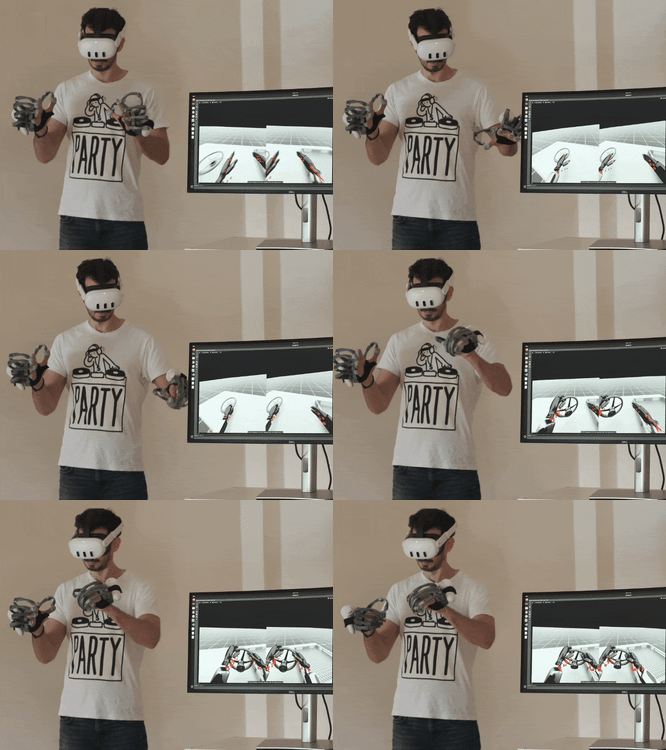
Use the [Haptikos](https://haptikos.tech/) Exoskeletons with the Isaac Capture framework. Currently only Linux is supported. Tested on Meta Quest headsets. Other headsets with controllers may work as well.
> ##### On this page
>
> * [Components](#components)
> * [Prerequisites](#prerequisites)
> * [Quick Start](#quick-start)
> * [Step 1: Get the Haptikos API](#step-1-get-the-haptikos-api)
> * [Step 2: Build the plugin](#step-2-build-the-plugin)
> * [Step 3: Build the entire project](#step-3-build-the-entire-project)
> * [Step 4: Run the plugin](#step-4-run-the-plugin)
> * [Important Information](#important-information)
> * [License](#license)
## Components
- **Haptikos API** (`libHaptikosAPI.so` and `libHaptikosCore.so` from `HaptikosCpp_API_Shared/lib`) — the vendor libraries that read per-joint tracking data from the Haptikos Core App.
- **Plugin executable** (`haptikos_hands_plugin`) — the plugin binary that injects the hand tracking data into the Teleop system via CloudXR and OpenXR.
## Prerequisites
- **Linux** — x86_64 (tested on Ubuntu 22.04 / 24.04).
- **Haptikos API** for Linux.
- **Source-build prerequisites** — the toolchain and system packages in
[Build from Source](../../development/build_from_source/index.md).
## Quick Start
### Step 1: Get the Haptikos API
The Haptikos API must be downloaded separately due to licensing. Check our [website](https://haptikos.tech/).
1. Obtain a Haptikos account.
2. Clone the [repository](https://github.com/Haptikostech/HaptikosAPI).
3. Copy the `HaptikosCpp_API_Shared` folder from our HaptikosAPI repository into the `src/plugins/haptikos` folder. The folder structure should be the following:
```text
src/plugins/haptikos/
├── CMakeLists.txt
├── HaptikosCpp_API_Shared
│ ├── include
│ └── lib
├── haptikos_hands_plugin.cpp
├── haptikos_hands_plugin.hpp
├── main.cpp
├── plugin.yaml
└── README.md
```
### Step 2: Build the plugin
From the repository root:
```bash
cmake -S . -B build
cmake --build build --target haptikos_hands_plugin
```
### Step 3: Build the entire project
```bash
cmake -B build -DENABLE_CLANG_FORMAT_CHECK=OFF #From Project root
cmake --build build --parallel 4
cmake --install build
```
We use the `-DENABLE_CLANG_FORMAT_CHECK=OFF` because the headers in the HaptikosAPI library are not clang-formatted. You can clang format the headers to not include the flag by running:
```bash
clang-format -i src/plugins/haptikos/HaptikosCpp_API_Shared/include/*
```
### Step 4: Run the plugin
The Haptikos plugin connects to the Teleop session through the CloudXR / OpenXR runtime, so the runtime must be running and its environment sourced in the shell that launches the plugin.
Start the CloudXR runtime from the Python environment where `isaaccapture` is installed. It runs as a background service that outlives this shell, until you stop it with `python -m isaaccapture.cloudxr.service stop`:
```bash
python -m isaaccapture.cloudxr.service start --accept-eula
```
In the shell that runs the plugin, source the environment file that the runtime writes on startup. This points the OpenXR loader at CloudXR:
```bash
source ~/.cloudxr/run/cloudxr.env
```
In the same terminal, run the plugin with the following:
```bash
./install/plugins/haptikos/haptikos_hands_plugin
```
## Important Information
1. To use the plugin properly it is necessary to attach the controllers on our exoskeletons using the included mount.
2. The orientation calibration defines the direction the Haptikos gloves define as forward. This needs to be aligned with the Head Mounted Display’s forward direction.
3. To inject the hand tracking data, the controllers, the Haptikos App and the exoskeletons need to be active.
4. The executable will be located in the `build/src/plugins/haptikos`. If you installed the project by running `cmake --install build` the executable will also be found in the `install/plugins/haptikos` folder.
## License
Source files are covered by their stated licenses (Apache-2.0). The Haptikos API is
proprietary to Haptikos and is subject to its own license; it is **not** redistributed
by this project.