Recovering W4A4 NVFP4 Accuracy with Quantization-Aware Distillation#
- Author:
Model Optimizer Team
- Date:
September 16, 2026
- Tags:
quantization, nvfp4, w4a4, qad, distillation, megatron-bridge
Note
Updated October 21, 2026: added output length and calibration results (QAD lengthens SciCode answers and makes the model abstain less on knowledge questions) and links to the ablations.
Weight-only NVFP4 does not make this model faster. On Blackwell, a BF16 activation forces vLLM onto the Marlin dequant-to-BF16 fallback, which never reaches the FP4 tensor cores: W4A16 measured slower than BF16 in 10 of 12 shapes. Quantizing activations as well (W4A4) unlocks those kernels and beats BF16 in 9 of 12 shapes, but costs accuracy that post-training quantization alone does not recover. Quantization-Aware Distillation (QAD) is what closes that gap.
We ran the full flow on Qwen/Qwen3.6-35B-A3B with Megatron-Bridge: W4A4 NVFP4 PTQ, then 500 QAD iterations against the BF16 teacher, evaluated across six benchmarks. The complete reproduction steps, configs and recipe are in the tutorial.
Highlights#
W4A4 is the configuration worth targeting. It beats BF16 in 9 of 12 measured shapes (up to 1.30x) and shrinks the checkpoint from 67 GiB to 22 GiB (3.1x). Weight-only W4A16 is slower than BF16 in 10 of 12.
Only 2 of 6 benchmarks lost measurable accuracy to W4A4, so those are the only two where QAD has anything to recover.
IFBench is fully recovered. PTQ costs 2.6 pp; 500 QAD iterations return the model to statistical parity with BF16.
MMMU-Pro recovers about 40% of its deficit and retains a measurable gap — the blend is text-only, and MMMU-Pro is multimodal.
Repeat counts matter more than expected. At 3 repeats one benchmark showed a 3 pp swing that vanished at 8, and IFBench’s real gain was invisible until 8.
Accuracy is not the whole picture. QAD lengthens SciCode answers, and on knowledge questions the model guesses wrong more often instead of abstaining; see output length and calibration.
Results#
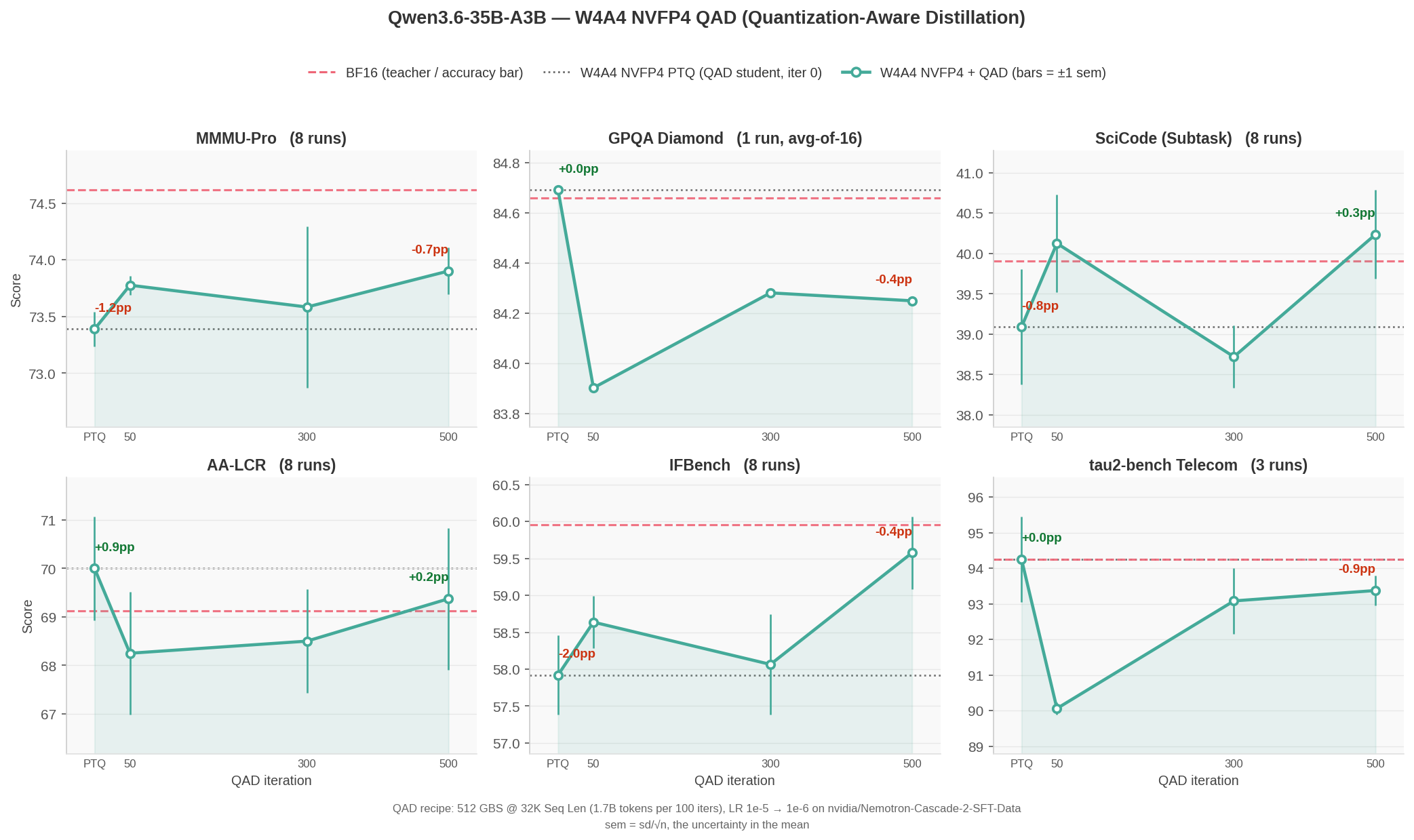
Figure 1. W4A4 NVFP4 accuracy vs. QAD training iteration, Qwen3.6-35B-A3B. Each panel starts at the PTQ student (x=0) and follows it through 500 QAD iterations. The dashed line is the BF16 teacher; the dotted line is the PTQ starting point. Bars are ±1 sem.
Accuracy, mean ± sem across repeats:
Model |
MMMU-Pro |
GPQA-D |
SciCode |
AA-LCR |
IFBench |
tau2-bench |
|---|---|---|---|---|---|---|
BF16 (teacher) |
74.6 ± 0.2 |
84.7 |
39.9 ± 0.6 |
69.1 ± 0.8 |
60.0 ± 0.5 |
94.2 ± 1.0 |
W4A4 NVFP4 PTQ |
73.4 ± 0.2 |
84.7 |
39.1 ± 0.7 |
70.0 ± 1.1 |
57.9 ± 0.5 |
94.2 ± 1.2 |
+ QAD 500 iters |
73.9 ± 0.2 |
84.2 |
40.2 ± 0.6 |
69.4 ± 1.5 |
59.6 ± 0.5 |
93.4 ± 0.4 |
Where QAD Helps#
Only IFBench and MMMU-Pro show a W4A4 deficit larger than run-to-run noise. On the other four, W4A4 is effectively lossless and QAD neither helps nor hurts.
Benchmark |
W4A4 PTQ vs BF16 |
After 500 QAD iters |
Outcome |
|---|---|---|---|
IFBench |
−2.6 pp |
−0.3 pp |
Recovered to BF16 parity |
MMMU-Pro |
−1.2 pp |
−0.7 pp |
~40% recovered, gap remains |
Output Length and Calibration#
SciCode answers get longer. QAD 500 raises SciCode’s mean completion length by 91% over BF16 at an
unchanged score. It is not verbosity: 3.6% of sub-steps never stop thinking and hit the 131K-token
cap (BF16: 0.7%). Qwen’s recommended presence_penalty: 1.5 removes nearly all of them at decode
time (96 to 2 of 2,704) with no accuracy change, but apply it only where outputs run away: on GPQA
Diamond it cuts generation throughput 4.8x (5,109 to 1,067 tokens/s) for no accuracy change.
Knowledge is kept; calibration is not. On AA-Omniscience, where a wrong answer costs as much as a right one earns, every model answers ~21% of questions correctly. What changes is how often it abstains instead of guessing:
Model |
Correct |
Incorrect |
Abstained |
Omniscience index |
Hallucination rate |
|---|---|---|---|---|---|
BF16 (teacher) |
21.0 |
32.3 |
46.0 |
−11.3 |
41% |
W4A4 NVFP4 PTQ |
20.2 |
39.3 |
39.8 |
−19.1 |
49% |
+ QAD 500 iters |
21.0 |
48.5 |
29.8 |
−27.5 |
61% |
QAD does most of this early (index −31.4 at iteration 50), the same shape as SciCode’s runaway sub-steps. None of the six benchmarks above measures it, so evaluate abstention directly if your application needs a model that says “I don’t know”.
Throughput#
Measured with AIPerf against a served vLLM endpoint on 4x GB200, three ISL/OSL shapes at four concurrencies each (output tokens/s):
Shape (ISL/OSL) |
Conc. |
BF16 |
W4A16 NVFP4 |
W4A4 NVFP4 |
W4A4 / BF16 |
|---|---|---|---|---|---|
decode 128/2048 |
128 |
17,636 |
15,222 |
20,076 |
1.14x |
chat 8000/1000 |
32 |
3,649 |
2,373 |
4,079 |
1.12x |
prefill 32000/400 |
128 |
854 |
1,092 |
1,107 |
1.30x |
W4A4 loses to BF16 only at concurrency 1, by a near-constant 0.87–0.88x across all three shapes. That is fixed per-call overhead in the FP4 kernel path, which batch-1 decode has no arithmetic intensity to amortize — not a recipe knob.
What It Costs#
QAD dominates: 500 iterations at 32K sequence length on 32 nodes (128 GB200) took 5.7 hours, about 735 GPU-hours. PTQ is 9 minutes and the HF export a few more. Evaluating one checkpoint across all six benchmarks at the repeat counts above is roughly 100 GPU-hours.
Learn More#
The tutorial has the full reproduction path — data blend, PTQ recipe, QAD command, export, and one NeMo Evaluator config per benchmark — plus the parallelism constraints QAD imposes on this model and what we would try next to close the remaining MMMU-Pro gap. Its ablations cover what did not become the recipe: chat-format data with assistant-only loss, self-distilled data, and the SciCode non-termination diagnosis.