NVIDIA FLARE home

Research with NVIDIA FLARE

Explore ideas.
Build federated experiments.

From multimodal foundation models to efficient training and medical imaging, explore papers and reference implementations built with NVIDIA FLARE.

Based on the main-branch research directory. Follow each project's README for setup, data, and implementation scope.

From the papers

Research highlights

Selected figures connect the research questions to examples you can explore.

Multimodal learning DeCaF 2026

FedCoRe

Learning when a modality is missing

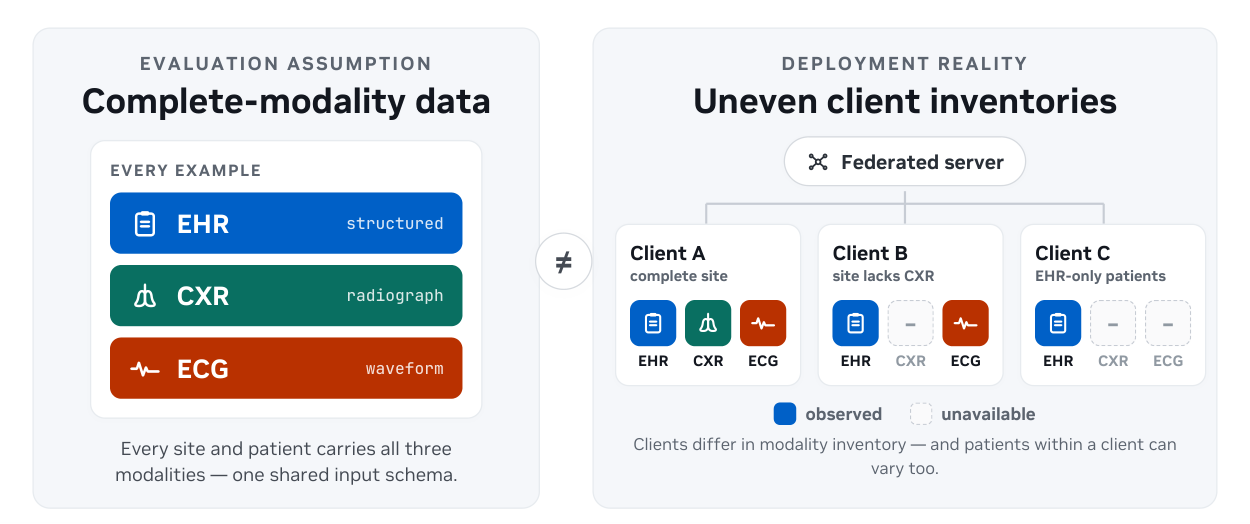
FedCoRe learns representation or logit corrections from clients with paired observations. Validation determines whether to apply completion or keep the original prediction.

Explore the example. The public starter uses frozen Qwen3-VL with MNIST images and simulated OCR reports to demonstrate missing-image completion. It is a tutorial, not a reproduction of the clinical study.

Complete EHR, chest X-ray, and ECG inputs assumed at evaluation, compared with federated clients that have different subsets of those modalities.View full figure
Figure 1. The gap between complete-modality evaluation and uneven modality availability across clients.Source: Roth, Xu, and Cnudde, 2026

Automation arXiv 2026

Auto-FL-Research

An agent-assisted research loop

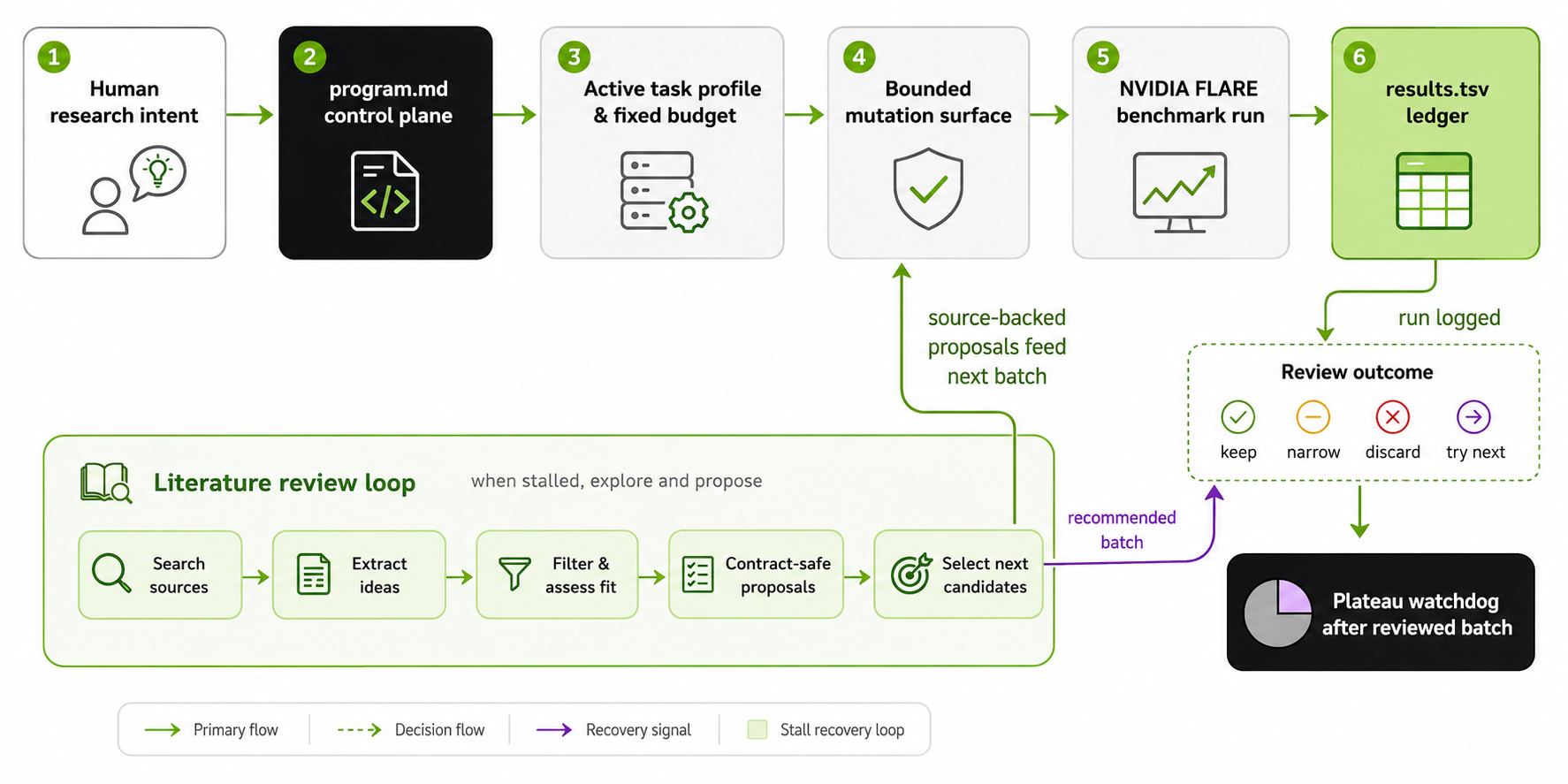
Auto-FL-Research studies coding agents that propose and evaluate FL training recipes within a fixed task profile. The paper examines repeated gains, tuning effects, and failure cases across FLamby and LEAF tasks.

Explore the example. The repository provides task profiles, a simulation harness, candidate review and reporting tools, and a literature-review loop for stalled searches.

Auto-FL loop from research intent through a task profile, bounded code changes, NVFlare experiments, and a results ledger, with a literature-review path when progress stalls.View full figure
Figure 2, left panel. Bounded algorithm search connects each experiment to a recorded review decision.Source: Roth et al., 2026

Financial services arXiv 2026

Federated fraud detection

Collaborative payment fraud detection

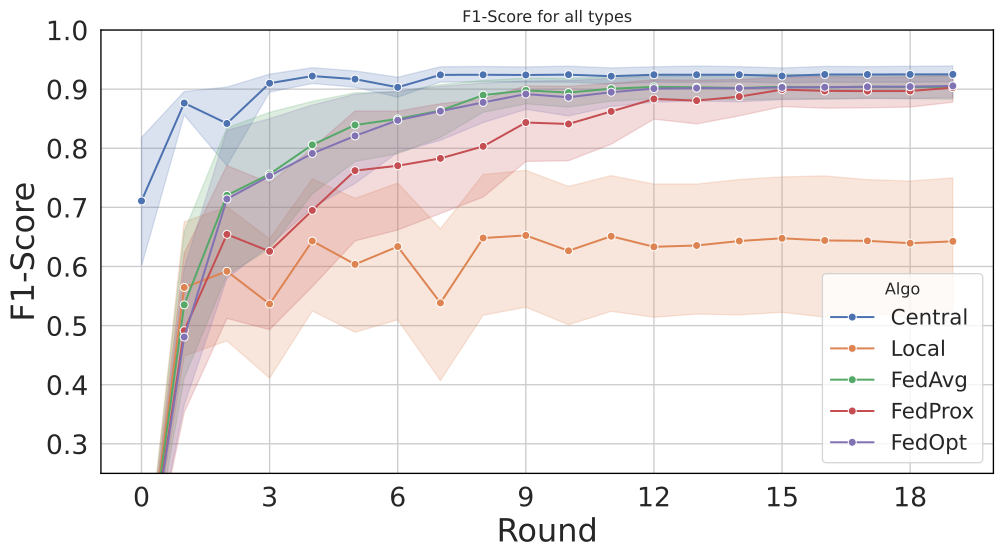
This proof-of-concept study compares local, federated, and centralized training across heterogeneous financial institutions. It also investigates feature attribution and privacy–utility trade-offs with DP-SGD.

Explore the example. Start with configurable synthetic payment data and anomaly injection, then follow the example's federated training and evaluation workflow.

F1-score curves compare local, federated, and centralized payment fraud detection over training rounds, with shaded variability bands.View full figure
Figure 3(a). Fraud-detection performance over training rounds in the paper's experimental setting.Source: Roth et al., 2026

Multimodal learning arXiv 2026

FedUMM

Federating multimodal foundation models

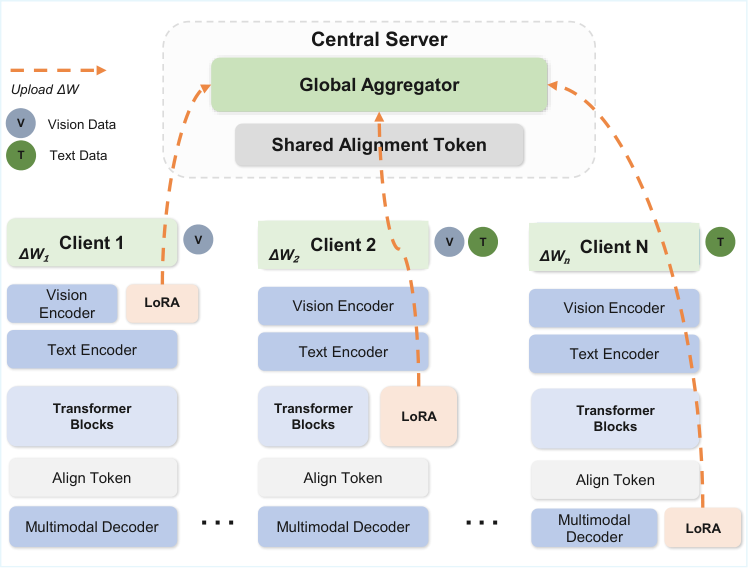
FedUMM trains LoRA adapters while keeping the foundation model frozen. The paper studies BLIP3o on visual question answering and image generation with heterogeneous client data.

Explore the example. The runnable example uses Salesforce/blip-vqa-base as a lightweight stand-in for the paper's BLIP3o backbone and demonstrates federated visual question answering.

Clients with different vision and text inputs train LoRA modules and send adapter updates to a central aggregator while backbone modules stay frozen.View full figure
Figure 3. Adapter aggregation across clients in the FedUMM framework.Source: Su et al., 2026

Efficient training arXiv 2025 · revised 2026

FedRevive

Making stale client updates useful

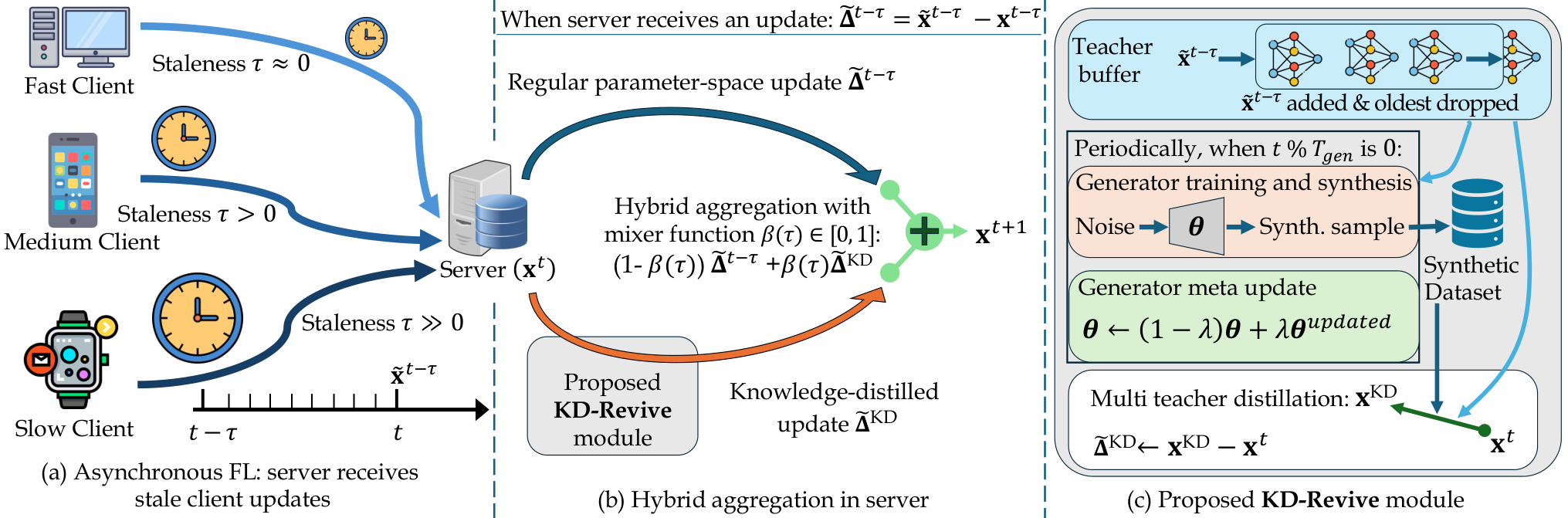
FedRevive combines parameter aggregation with data-free knowledge distillation at the server. A synthetic-data generator and recent client models help transfer knowledge from delayed updates to the current model.

Explore the example. The Collab API implementation compares FedAvg, FedBuff, and FedRevive on CIFAR-10 using reproducible simulated arrival schedules.

Fast and slow clients send updates with different staleness; the server blends parameter updates with knowledge distilled from buffered teachers and generated samples.View full figure
Figure 1. Asynchronous clients, hybrid server aggregation, and the knowledge-distillation module.Source: Askin et al., 2026 revision

Medical imaging MICCAI 2025

FedNCA

Medical imaging on limited resources

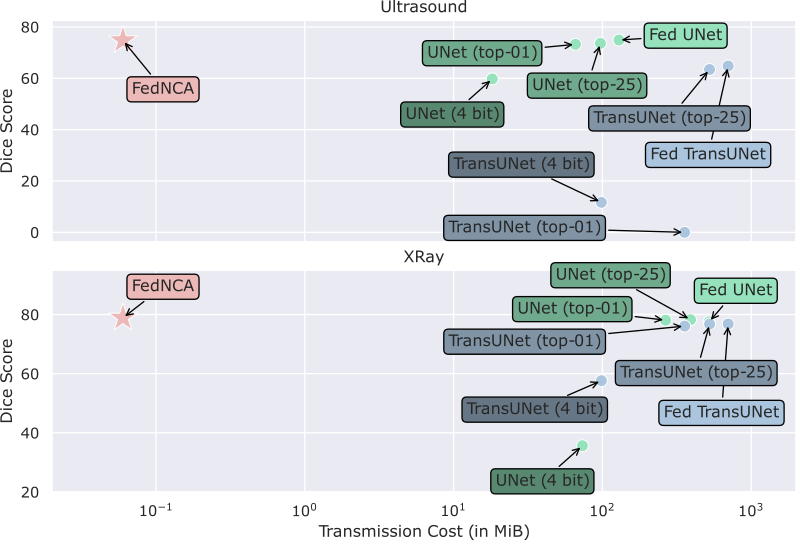
FedNCA uses compact neural cellular automata to study federated segmentation where bandwidth and compute are limited, including heterogeneous devices and encrypted model aggregation.

Explore the example. The research folder introduces the method and links to the authors' external implementation and setup instructions.

Ultrasound and X-ray segmentation Dice scores versus transmission cost on a logarithmic scale, comparing FedNCA with UNet and TransUNet variants.View full figure
Figure 3. Segmentation quality versus model transmission cost on the paper's ultrasound and X-ray tasks.Source: Lemke et al., 2025 · CC BY 4.0

Find your starting point

Explore the research catalog

Browse current and foundational work. Examples range from runnable jobs to links to the authors' reference code.

17 projects

  • FedCoRe

    DeCaF 2026 Multimodal learning

    Learn corrections from paired observations to support clients with missing modalities.

    Paper
  • Auto-FL-Research

    arXiv 2026 Automation

    Explore FL algorithms with coding agents, bounded edits, fixed evaluation, and an experiment ledger.

    Paper
  • Federated fraud detection

    arXiv 2026 Financial services

    Study payment fraud across heterogeneous institutions, including interpretability and DP-SGD.

    Paper
  • FedUMM

    arXiv 2026 Multimodal learning

    Federate lightweight LoRA adapters for multimodal foundation models under non-IID data.

    Paper
  • FedRevive

    arXiv 2025 · revised 2026 Efficient training

    Combine asynchronous model updates with server-side data-free knowledge distillation.

    Paper
  • FedNCA

    MICCAI 2025 Medical imaging

    Use neural cellular automata for medical segmentation with low communication and compute demands.

    Paper
  • FedHCA²

    CVPR 2024 Multitask learning

    Collaborate across clients with different dense prediction tasks and model architectures.

    Paper
  • FedBPT

    ICML 2024 Language models

    Adapt language models with federated black-box prompt tuning; includes an SST-2 example.

    Paper
  • ConDistFL

    DeCaF 2023 Medical imaging

    Learn medical image segmentation from sites with different partial organ annotations.

    Paper
  • FedOBD

    IJCAI 2023 Efficient training

    Explore communication-efficient learning through the contributed ADAQUANT quantization scheme.

    Paper
  • FedCE

    CVPR 2023 Medical imaging

    Estimate client contributions to improve fairness in federated medical image segmentation.

    Paper
  • One-shot vertical FL

    ICCV 2023 Efficient training

    Explore vertical learning with limited overlapping samples and reduced communication on CIFAR-10.

    Paper
  • Quantifying data leakage

    IEEE TMI 2023 Privacy

    Analyze gradient inversion and quantify reconstruction leakage during federated training.

    Paper
  • FedSM

    CVPR 2022 Medical imaging

    Study personalized models and model selection for cross-silo medical image segmentation.

    Paper
  • Auto-FedRL

    ECCV 2022 Automation

    Optimize federated hyperparameters with reinforcement learning; includes CIFAR-10 simulations.

    Paper
  • FedBN

    ICLR 2021 Personalization

    Keep batch normalization local to handle feature shifts across client datasets.

    Paper
  • Federated brain tumor segmentation

    MLMI 2019 Medical imaging

    Compare centralized and federated BraTS18 segmentation and explore privacy-preserving training.

    Paper

From idea to experiment

Research tools

Compose a workflow, simulate a federation, and inspect the results with NVIDIA FLARE.

Simulate and evaluate

Run federated clients on one machine with the Simulator, then use POC mode to exercise server and client processes in a local deployment.

Looking for more? Browse publications and talks and the full research directory.