---
title: System architecture
description: Egress Gate components, boundaries, state, and concurrency.
agent_markdown: true
---
# System architecture
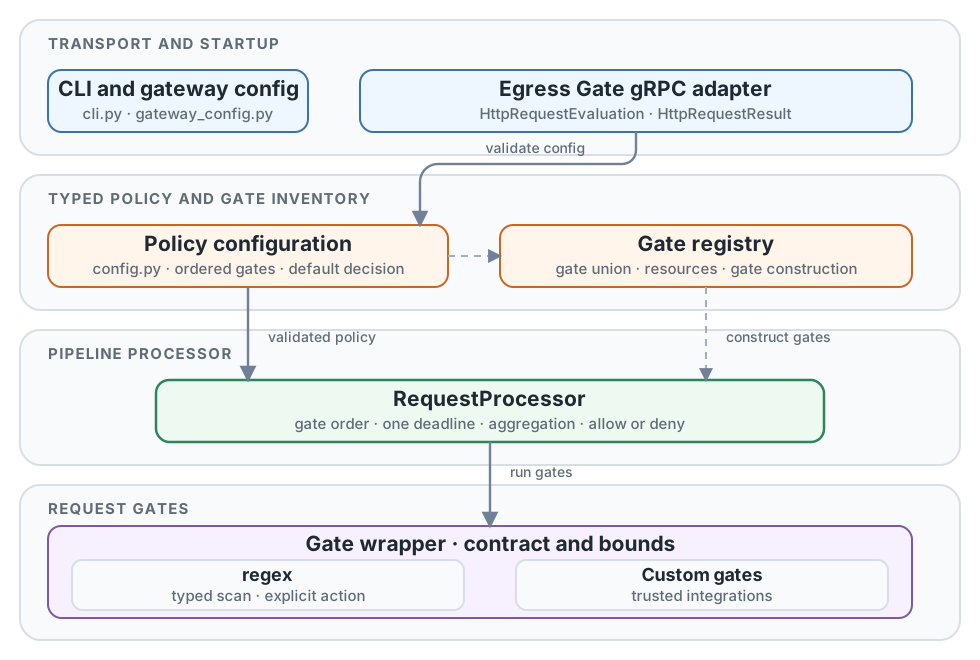
Egress Gate has one transport adapter and one protobuf-free pipeline processor.
The external OpenShell supervisor talks only to the Egress Gate service adapter. The pipeline processor and gates use local domain models.
## Component ownership
| Module | Responsibility |
| --- | --- |
| `request.py` | Immutable request, headers, and `RequestMutations` |
| `request_content/` | Reusable text parsers, strict JSON documents, typed selection, source-preserving edits, and normalized message blocks |
| `result.py` | Gate evaluations, five-field findings, provenance, traces, and result invariants |
| `gates/base.py` | Gate lifecycle, capabilities, output validation, and UTF-8 helper |
| `gates/registry.py` | Trusted registration, exact pipeline schema, resources, discovery, and processor preparation |
| `gates/regex_scans.py` | Typed regex scan and action policy configuration |
| `gates/regex.py` | Content-parser composition, non-body text adaptation, pattern catalogs, bounded matching, finding aggregation, and gate evaluation |
| `config.py` | Strict ordered gates and required default decision |
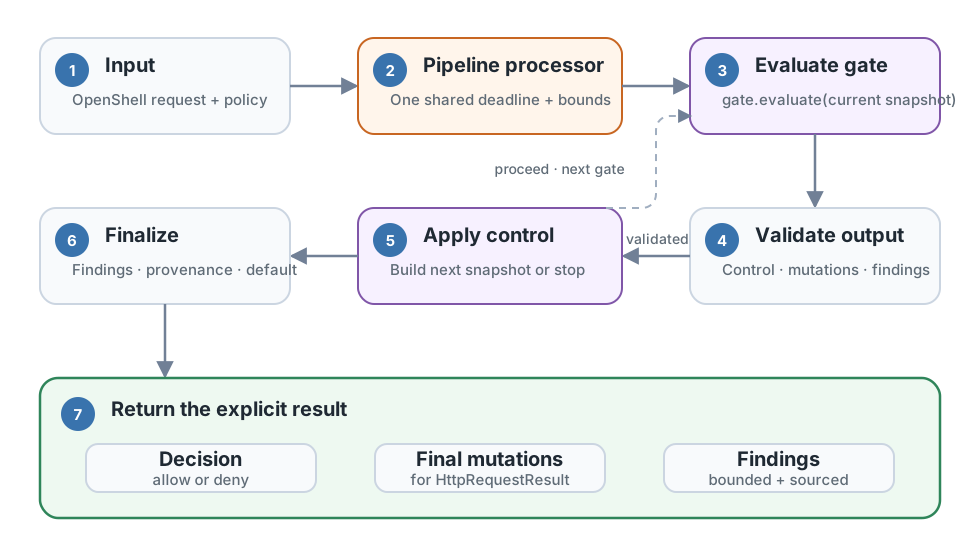
| `request_processor.py` | Shared deadline, immutable snapshot construction, control flow, aggregation, and provenance |
| `service/` | Protobuf validation/conversion, worker slots, lifecycle, and wire serialization |
The CLI's offline evaluator parses bounded YAML. It uses
`GateRegistry.prepare_processor()` and the production `RequestProcessor`. It
does not add a second execution path or import the transport adapter.
Only `service/` imports generated protobuf/gRPC bindings. The pipeline processor
and gates receive domain values and can be tested offline.
The request body remains canonical immutable bytes. A configured gate can
interpret the current body snapshot as strict JSON and select text nodes, then
optionally adapt those nodes to normalized message blocks. These views remain
local to one gate evaluation. The pipeline processor does not parse bodies or
cache request state across reusable gate instances.
Regex scan models remain declarative Pydantic configuration. During gate
preparation, body-based variants compose a reusable `RequestContentParser`:
`Utf8TextParser`, `JsonFieldsParser`, or `MessageBlocksParser`. Each parser owns
text extraction and how immutable `TextReplacement` values become bounded body
bytes. `MessageBlocksParser` composes a `MessageBlockExtractor` to normalize a
parsed JSON document without conflating that semantic step with body parsing.
The regex gate only adapts path, query, and header values itself, then applies
matching and actions uniformly to the text targets it receives.
## Pipeline execution
Each gate proposes changes to its current snapshot. The pipeline processor builds the next snapshot, the service adapter maps the final mutations, and the OpenShell supervisor applies them.
## Trust and state
Registry factories and custom gate modules are trusted deployment code.
Capabilities mechanically constrain outputs but do not sandbox Python reads.
Prepared gates can use application-owned resources that are safe for concurrent
use. Egress Gate does not close these resources.
One validated policy and one prepared pipeline processor (`RequestProcessor`)
are active at a time.
Preparation is serialized and a complete candidate is published only after
the shared deadline checks. A failed candidate leaves the existing policy
unchanged. Gate instances are reused across worker threads, so per-request
state must remain local to `evaluate`.
See [Request lifecycle](request-lifecycle.md) and [Service boundary](service-boundary.md).