

NVIDIA cuEquivariance Documentation#
cuEquivariance is an NVIDIA Python library of GPU-accelerated building blocks for geometric deep learning. It covers two areas: equivariant tensor products for models that respect the symmetries of three-dimensional space, and triangle operations for the pair-representation blocks of biomolecular structure prediction. The tensor products, the triangle multiplicative update and triangle attention have PyTorch and JAX frontends; attention with pair bias is PyTorch only. All of them share one set of prebuilt CUDA kernel wheels.
A descriptor API for segmented polynomials and segmented tensor products, with CUDA kernels that execute them. The operations behind equivariant interatomic potentials such as MACE, NequIP and Allegro.
Irreps, layouts and group representations
Segmented tensor products and polynomials
Linear, channel-wise and fully connected tensor product layers, symmetric contraction, spherical harmonics
Fused kernels for the pair-representation blocks of structure prediction models such as AlphaFold 3.
Triangle multiplicative update
Triangle attention
Attention with pair bias (PyTorch only)
The frontends are open source under the Apache 2.0 license on GitHub. The CUDA kernels ship as prebuilt
cuequivariance-ops-* wheels for CUDA 12 and CUDA 13.
What’s new in 0.14#
Released 2026-11-25. Highlights:
Triangle multiplicative update kernels for ranges of shapes. In 0.13, the optimized PyTorch inference kernels ran only on a fixed list of exact shapes. In 0.14, each pair/hidden width class has a kernel that covers a continuous range of batch sizes and sequence lengths: about 80,000 batch/length combinations per GPU, instead of about 100 fixed shapes. Every shape that was optimized in 0.13 is still optimized. Width classes 128/128, 256/256, 384/256, 384/384 and 512/512, with and without projection bias. The kernels ship prebuilt in the CUDA 13 wheels.
New GPUs for the optimized triangle multiplicative update: B300 SXM, GB300 and Vera Rubin.
Triangle attention on Vera Rubin: new optimized forward kernels for PyTorch and JAX (BF16, head dimension 16, 32, 64 or 128).
Triangle attention on RTX PRO 6000 Blackwell: faster forward kernels for head dimensions 16 to 128.
Fix: triangle attention on inputs with more than 231 elements no longer gives wrong results or fails with an illegal memory access.
From 0.13: optimized triangle multiplicative update training kernels on H100 SXM, H200, GH200 and B200, and
mask=Noneincuex.triangle_attention.
The full list of changes, the exact supported shapes and the known issues are in the Release Notes and the GitHub release notes.
Installation#
Install from PyPI with pip. Pick one frontend and the kernel
wheel that matches your CUDA version. The -cu13 wheels contain kernels that the
-cu12 wheels do not; use -cu13 when your driver allows it.
pip install cuequivariance-torch cuequivariance-ops-torch-cu13 # or -cu12
pip install cuequivariance-jax cuequivariance-ops-jax-cu13 # or -cu12
# Descriptors and NumPy execution, no GPU kernels
pip install cuequivariance
Requirements. Linux x86_64 or aarch64 for the cuequivariance-ops-* wheels.
Python 3.10 to 3.14. PyTorch 2.11 to 2.14 for the cuequivariance-ops-torch-cu13
wheels, and 2.11 to 2.13 for -cu12. JAX 0.9.1 or newer for cuequivariance-jax.
On B300, GB300 and Vera Rubin, use the -cu13 wheels.
Supported operations and hardware#
Every operation has a generic implementation that runs on any supported NVIDIA GPU. The table lists where an operation also has a specialized kernel in 0.14.0. Details per shape and data type are in the Release Notes.
Operation |
Frontends |
Specialized kernels |
Notes |
|---|---|---|---|
Segmented tensor products and polynomials |
PyTorch, JAX |
All supported GPUs: descriptor-driven CUDA kernels, including the fused tensor product and the uniform 1d kernels. |
Kernel methods |
Tensor product layers |
PyTorch, JAX |
Built on the kernels above: linear, channel-wise and fully connected tensor products, symmetric contraction, spherical harmonics, layout transposes. |
PyTorch |
Triangle multiplicative update |
PyTorch, JAX |
PyTorch inference on H100 SXM, H200, GH200 480GB, B200, B300 SXM, GB300 and RTX PRO 6000 Blackwell (Server and Workstation Edition): pair/hidden widths 128/128, 256/256, 384/256, 384/384 and 512/512, for ranges of batch size (up to 32) and sequence length (from 128). Vera Rubin: 128/128, 256/256, 384/256 and 512/512. Training on H100 SXM, H200, GH200 and B200 at listed shapes. |
BF16 pair representation and BF16 parameters. CUDA 13 wheels. Other shapes, other GPUs, the CUDA 12 wheels and JAX use the 0.12 implementation. |
Triangle attention |
PyTorch, JAX |
Native kernels on B200 / B300 (SM100f), RTX PRO 6000 Blackwell (sm120f) and Vera Rubin (forward, BF16, head dimension 16 to 128); generic kernel on H100, H200, A100, L40. |
BF16, FP16; FP32/TF32 for small head dimensions. |
Attention pair bias |
PyTorch |
Inference on H100, H200, B200, B300, RTX PRO 6000 Blackwell, A100; training on H100, H200, B200, B300. |
LayerNorm or RMSNorm. Pair widths 128 and 256 (384 on specific RMSNorm routes); 4 to 16 heads; head dimension 8 to 64. |
Triangle multiplicative update: supported ranges#
In 0.14, the optimized TriMul inference kernels cover continuous ranges of batch size B and sequence length N, not a fixed list of shapes. Each cell gives the range of N that is covered for every B in that column, with and without projection bias, in the incoming and outgoing directions. The largest N is the largest value with B × N² × D below 230; smaller batch sizes inside a column can use slightly longer sequences. Shapes outside the ranges, including B above 32, use the 0.12 implementation.
H100 SXM, H200, GH200 480GB
C / D |
B = 1 |
B = 2 |
B = 3–4 |
B = 5–8 |
B = 9–16 |
B = 17–32 |
|---|---|---|---|---|---|---|
128 / 128 |
128–2896 |
128–2047 |
128–1448 |
128–1023 |
128–724 |
128–511 |
256 / 256 |
128–2047 |
128–1448 |
128–1023 |
128–724 |
128–511 |
128–362 |
384 / 256 |
128–2047 |
128–1448 |
128–1023 |
128–724 |
128–512 |
128–362 |
384 / 384 |
128–1672 |
128–1182 |
128–836 |
128–591 |
128–418 |
128–295 |
512 / 512 |
128–1448 |
128–1023 |
128–724 |
128–511 |
128–362 |
128–255 |
B200
C / D |
B = 1 |
B = 2 |
B = 3–4 |
B = 5–8 |
B = 9–16 |
B = 17–32 |
|---|---|---|---|---|---|---|
128 / 128 |
32–2896 |
32–2047 |
32–1448 |
128–1023 |
128–724 |
128–511 |
256 / 256 |
32–2047 |
32–1448 |
32–1023 |
128–724 |
128–511 |
128–362 |
384 / 256 |
32–2047 |
32–1448 |
32–1024 |
128–724 |
128–512 |
128–362 |
384 / 384 |
128–1672 |
128–1182 |
128–836 |
128–591 |
128–418 |
128–295 |
512 / 512 |
32–1448 |
32–1023 |
32–724 |
128–512 |
128–362 |
128–255 |
B300 SXM, GB300
C / D |
B = 1 |
B = 2 |
B = 3–4 |
B = 5–8 |
B = 9–16 |
B = 17–32 |
|---|---|---|---|---|---|---|
128 / 128 |
128–2896 |
128–2047 |
128–1448 |
128–1023 |
128–724 |
128–511 |
256 / 256 |
128–2047 |
128–1448 |
128–1023 |
128–724 |
128–511 |
128–362 |
384 / 256 |
128–2047 |
128–1448 |
128–1023 |
128–724 |
128–511 |
128–362 |
384 / 384 |
128–1672 |
128–1182 |
128–836 |
128–591 |
128–418 |
128–295 |
512 / 512 |
128–1448 |
128–1023 |
128–724 |
128–511 |
128–362 |
128–255 |
RTX PRO 6000 Blackwell (Server and Workstation Edition)
C / D |
B = 1 |
B = 2 |
B = 3–4 |
B = 5–8 |
B = 9–16 |
B = 17–32 |
|---|---|---|---|---|---|---|
128 / 128 |
128–2896 |
128–2047 |
128–1448 |
128–1023 |
128–724 |
128–511 |
256 / 256 |
128–2047 |
128–1448 |
128–1023 |
128–724 |
128–511 |
128–362 |
384 / 256 |
128–2047 |
128–1448 |
128–1023 |
128–724 |
128–511 |
128–362 |
384 / 384 |
128–1672 |
128–1182 |
128–836 |
128–591 |
128–418 |
128–295 |
512 / 512 |
128–1448 |
128–1023 |
128–724 |
128–511 |
128–362 |
128–255 |
Vera Rubin
C / D |
Sequence lengths N at B = 1 |
|---|---|
128 / 128 |
32–15,231 |
256 / 256 |
32–10,776 |
384 / 256 |
32–9,843 |
512 / 512 |
32–7,624 (7,615 if N is not a multiple of 8) |
384/384 is not optimized on Vera Rubin. There is no fixed upper limit on the sequence length: GPU memory sets the largest N, and the table gives the largest N that ran on a VR200 at B = 1. With larger batch sizes, the largest N decreases approximately as 1/√B.
Getting started#
cuet.SegmentedPolynomial
and the layer modules, with a complete MACE model.
cuex.equivariant_polynomial,
cuex.segmented_polynomial and
the dictionary-based feature interface.
cuet.triangle_multiplicative_update,
cuet.triangle_attention and
cuet.attention_pair_bias.
cuex.triangle_multiplicative_update and
cuex.triangle_attention.
Equivariant tensor products#
Equivariance is the mathematical formalization of “respecting symmetries”. Models that are equivariant to rotations and translations in three-dimensional space are often more data-efficient. An introduction to group representations is on the page Groups and Representations.
cuEquivariance splits this area into three packages. The core package describes the mathematics; the two frontends execute it.
import cuequivariance as cue
# Group representations, descriptors and NumPy execution

import cuequivariance_jax as cuex
# JAX execution and Flax NNX layers

import cuequivariance_torch as cuet
# PyTorch operations and layers
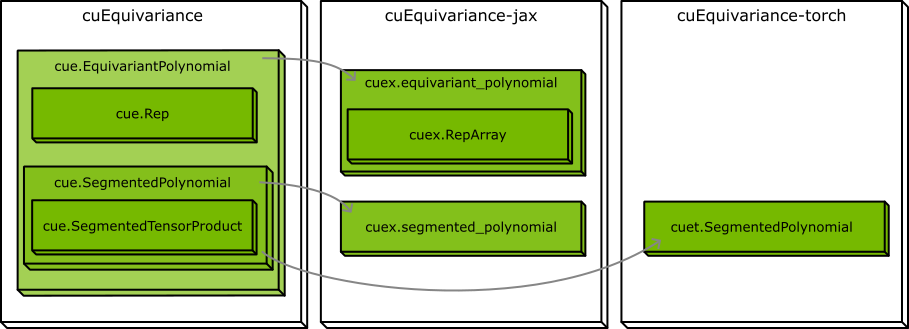
A tensor product is a hierarchy of descriptors:
cue.EquivariantPolynomialholds thecue.Repof each input and of the output.cue.SegmentedPolynomialis the polynomial inside it, made of one or several tensor products.cue.SegmentedTensorProductdefines one tensor product.
The same descriptor is executed with cuet.SegmentedPolynomial in PyTorch, or with
cuex.equivariant_polynomial and
cuex.segmented_polynomial in JAX.
The tutorials Segmented Tensor Product and Segmented Polynomial build descriptors step
by step.
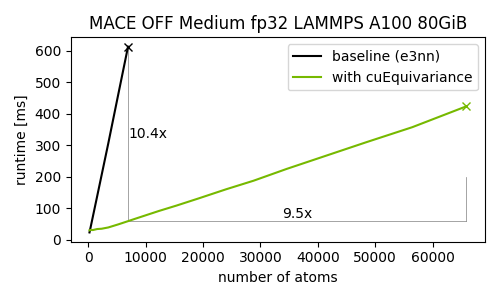
On a MACE model, cuEquivariance trains and runs faster than e3nn and reaches larger systems before running out of memory. Crosses mark the largest number of atoms that fit on one device.
Triangle operations#
Structure prediction models keep a pair representation, a tensor with one row per pair of residues or atoms, and update it with three kinds of blocks. cuEquivariance provides each one as a single fused call with the same inputs and outputs as the reference PyTorch or JAX implementation:
Triangle multiplicative update (
cuet.triangle_multiplicative_update,cuex.triangle_multiplicative_update): input LayerNorm, gated projections, the outgoing or incoming triangle contraction, output LayerNorm and gate.Triangle attention (
cuet.triangle_attention,cuex.triangle_attention): attention along the rows of the pair representation with a per-head bias and a Boolean mask or, in PyTorch, right-paddedkv_lengths.Attention pair bias (
cuet.attention_pair_bias): attention over the single representation biased by a projection of the pair representation, with LayerNorm or RMSNorm, as in the AlphaFold 3 diffusion module.
Forward and backward are supported, so the operations serve inference and
training. The recommended way to run them is torch.compile(model,
mode="reduce-overhead") after a few warm-up iterations; under compile, the
kernel selection costs nothing per call. With varying sequence lengths, one
compiled graph serves a whole range of lengths; with CUDA graphs, pad the lengths to
a small set of sizes. Calls on shapes or GPUs without a specialized kernel run the
generic implementation. The supported shapes, precision
rules, switches and known issues for each release are listed in the
Release Notes.
Agent skills#
The repository ships three agent skills that teach coding assistants how to use
each package: cuequivariance,
cuequivariance-jax
and cuequivariance-torch.
Installed packages expose the same text through python -m cuequivariance skill,
python -m cuequivariance_jax skill and python -m cuequivariance_torch skill.
Tutorials#
API Reference#
Release Notes#
- Release Notes
- Latest Changes
- 0.13.0 (2026-10-15)
- 0.12.0 (2026-09-24)
- 0.11.1 (2026-08-07)
- 0.11.0 (2026-08-04)
- 0.10.0 (2026-04-21)
- 0.9.1 (2026-03-16)
- 0.9.0 (2026-02-17)
- 0.8.1 (2026-01-09)
- 0.8.0 (2025-12-05)
- 0.7.0 (2025-10-13)
- 0.6.1 (2025-09-04)
- 0.6.0 (2025-08-11)
- 0.5.1 (2025-06-18)
- 0.5.0 (2025-06-10)
- 0.4.0 (2025-04-25)
- 0.3.0 (2025-03-05)
- 0.2.0 (2025-01-24)
- 0.1.0 (2024-11-18)
Status#
cuEquivariance is in a Beta state. Beta products may not be fully functional, may contain errors or design flaws, and may be changed at any time without notice. Please report issues and feedback on GitHub.