Coherent circuit primitives
These building blocks compose inside CUDA-Q kernels. The runnable examples compare their complete outputs with independent classical references.
Coherent table lookup with QROM
A classical table can be queried by a quantum address without measuring it. For table entries \(d_a\), QROM implements the XOR lookup
The output word need not start at zero. Addresses beyond the supplied table read zero. A valid zero-valued entry has the same XOR action as padding, although their meanings in the application differ.
from cudaq_algorithms.primitives import QROM

table = QROM([3, 0, 5, 6, 1], address_bits=3, output_bits=3,
             variant="select")
lookup = table.kernel  # callable property, not table.kernel()
Allocate the ladder using table.num_ladder. It must start clean and is
restored by the lookup. The constructor’s validation rules and the exact
Toffoli model are in the API reference,
QROM. The plain callable has this
signature:
lookup(address: qview, ladder: qview, output: qview)
Lookup, use, unlookup
Load the word into a zero output, apply Z to its least-significant bit, then apply the same lookup again. Each address amplitude gains \((-1)^{d_a \bmod 2}\), while output and ladder return to zero. The address can remain entangled with the useful result; cleanup removes the table data, not the selected action. Applying lookup twice without using the word is a useful inverse check, but does not establish the correctness of the lookup.
SELECT and SELECT-SWAP
variant="select" uses a unary-iteration walk. variant="select_swap" loads
blocks and routes a word using controlled swaps. SELECT-SWAP’s ladder view
contains both walk lines and clean block storage. It can require substantially
more qubits, and can lose on small tables or wide output words.
variant="auto" minimizes the implemented coherent Toffoli model and chooses
SELECT on ties. It does not enforce a caller’s qubit budget. Inspect
variant, block_size, num_ladder, and toffoli_count on the returned
object. variant="select_swap" picks the cheapest power-of-two block size
unless block_size is given; the example forces block_size=2.
In the SELECT construction, unary iteration reuses one clean ladder qubit per address bit. Successive lines track progressively longer prefix matches; the final line enables the output gates for that table entry.
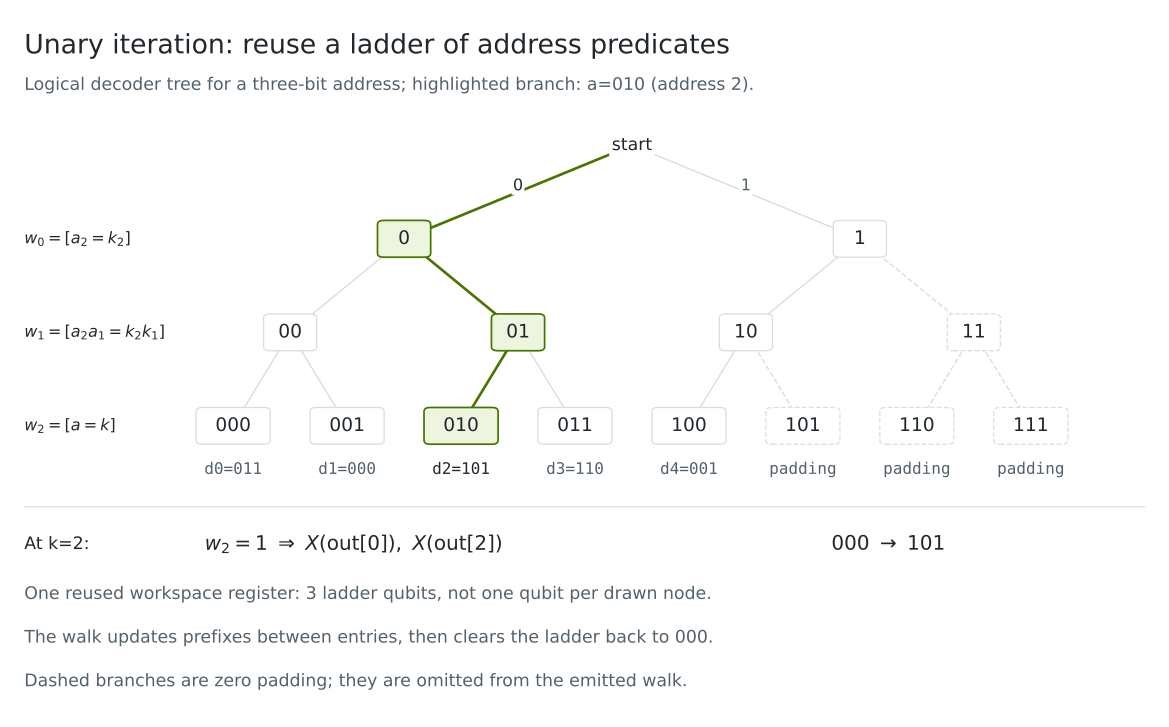
Unary iteration for the five-entry table above. The highlighted basis
component a=010 selects DATA[2]=5 (binary 101), flipping
output bits zero and two. Nodes depict logical checks at different times,
rather than separate physical ancillas: only three ladder qubits are reused and
restored to zero. The valid zero-valued entry at address one remains
distinct from padded addresses five through seven, which the emitted
walk omits. Superposed addresses follow the same lookup coherently.
External control
controlled=True creates a separately priced native-controlled lookup:
controlled_lookup(control: qview, address: qview,
                  ladder: qview, output: qview)
The control is a one-qubit view. On clean ladder input, control zero gives
identity and control one gives the ordinary lookup. Superposed controls must
preserve both branches and their relative phase. Read this object’s own
num_ladder; native control can change the auto-selected geometry.
Wrapping a plain lookup with cudaq.control instead controls every emitted
gate. In particular, a Toffoli can become a three-controlled X. Comparing
only the remaining Toffolis would hide that extra cost. The example counts
two-controlled and higher-controlled X separately and checks the native
price against cudaq.estimate_resources. count_controls("x", 2) is the
Toffoli accessor; count("ccx") is not.
All constructions here use coherent cleanup. These logical gate counts are not synthesized T counts and do not assume measurement-based erasure.
See Circuit primitive examples for executable complex-amplitude and workspace checks, including a resource-only strategy crossover table.
Modular arithmetic and comparison flags
These primitives support two approaches to reversible arithmetic: CDKM ripple-carry arithmetic and QFT arithmetic. Both operate coherently on superpositions, so each integer component undergoes the corresponding arithmetic operation without measurement.
CDKM, named after Cuccaro, Draper, Kutin, and Moulton, follows the familiar idea of binary addition: carries propagate from lower bits to higher bits. The circuit then reverses its temporary carry computations while retaining the sum. It uses X, CNOT, and Toffoli gates, with a gate count that grows linearly with register width. CDKM is a useful choice for arithmetic on binary-encoded registers and for resource estimates organized around Clifford and Toffoli gates. See Cuccaro et al..
QFT arithmetic uses the quantum Fourier transform to represent an integer through quantum phases. Adding a constant becomes a sequence of phase rotations; an inverse QFT converts the result back to binary form. This avoids temporary carry registers. QFT arithmetic is particularly useful when spare qubits are limited, when a register is already in the Fourier basis, or when several additions can share one forward and inverse transform. See Draper.
For the constant-addition implementations provided here, an \(n\)-qubit target requires an additional \(n\)-qubit work register and one carry qubit with CDKM, while the QFT implementation needs no additional qubits. The tradeoff is gate cost: QFT arithmetic introduces controlled phase rotations, including small-angle rotations whose accurate synthesis can be expensive on fault-tolerant hardware. Choose CDKM when its workspace requirements are acceptable and avoiding rotation synthesis is valuable; consider QFT when reducing qubits or reusing the Fourier basis is more valuable. Compare the complete circuit cost, including transforms and rotation synthesis, rather than Toffoli count alone. Both implement the same modular arithmetic in the ideal circuit model.
All integer registers are unsigned and little-endian: bit zero has weight one. Addition wraps modulo \(2^n\). Register views passed to an operation must be pairwise disjoint and have the documented widths; the device kernels do not check aliasing or validate inputs at runtime.
Import these kernels from cudaq_algorithms.primitives. Their signatures
are rendered explicitly here because automatic API documentation does not
render decorated CUDA-Q kernels. See Reversible arithmetic for the
indexed reference, including Fourier transforms and Fourier-basis addition.
Register and constant arithmetic
The ripple-carry CDKM family restores its work and carry registers:
add_register(a: qview, b: qview, carry: qview)
subtract_register(a: qview, b: qview, carry: qview)
add_constant(target: qview, constant_bits: list[int],
             work: qview, carry: qview)
subtract_constant(target: qview, constant_bits: list[int],
                  work: qview, carry: qview)
a and b have width n. Addition preserves a and maps b to
(a+b) mod 2**n; subtraction maps b to (b-a) mod 2**n.
The carry is a one-qubit view initially in zero. Constant arithmetic takes
exactly n little-endian bits for the constant K, an n-qubit clean work
register, and a clean one-qubit carry. For example, adding three to a three-bit seven gives
two, with all workspace restored.
The QFT family takes an integer constant and needs no additional workspace:
add_constant_qft(reg: qview, constant: int)
subtract_constant_qft(reg: qview, constant: int)
Both families implement the same modular permutation. Use the supplied
inverse kernels for round trips: every inverse is hand-written, and
cudaq.adjoint is not supported on the CDKM kernels. The example also tests
each forward action independently: two incorrect operations can cancel in a
round trip.
Comparison flags are XOR outputs
cmp_ge_register(a: qview, b: qview, carry: qview, out: qview)
cmp_gt_register(a: qview, b: qview, carry: qview, out: qview)
cmp_ge_constant(x_reg: qview, complement_bits: list[int],
                k_is_zero: int, work: qview, carry: qview, out: qview)
out is a one-qubit view and obeys out ^= predicate. It is not overwritten
with a classical Boolean. Preloaded-one and coherent flags are valid. The
register comparators preserve both n-bit operands and restore their clean
carry; cmp_gt_register flags the strict a > b at the same price.
For the constant comparator, pass the n low bits of 2**n-K,
least-significant bit first: for n=3 and K=2 the value is 6 and the list is
[0, 1, 1]. The allowed threshold range is 0 <= K <= 2**n. At K=0 pass
all-zero bits and k_is_zero=1, producing an always-true predicate. At
K=2**n pass all-zero bits and k_is_zero=0, producing always false. An
n-qubit work register and one-qubit carry start and finish at zero.
A useful coherent pattern is compute/use/uncompute: start a flag at zero,
compute x >= K into it, apply Z to the flag, and repeat the comparator.
The operand acquires \((-1)^{[x\ge K]}\), while the flag and workspace
return to zero. This is a building block for threshold selection and
boundary masking.
For example, let the operand be (|2> + |5>)/sqrt(2) and use threshold
K=3. Only the branch with x=5 satisfies the comparison. With kets ordered
as operand then flag, the circuit evolves as
The values retain probability one half each, while their relative phase changes. Interference can reveal that change: the final operand state is orthogonal to its initial state. The flag and all work/carry qubits return to zero, so this threshold oracle can compose with subsequent operations. The runnable example prints these four states from separate simulator runs of circuit prefixes and verifies every full state against an independent reference; no measurement is inserted into the oracle.
The QFT comparator temporarily shifts its operand
cmp_ge_constant_qft_shift(x_reg: qview, constant: int,
                         invert: int, out: qview)
cmp_ge_constant_qft_shift_adj(x_reg: qview, constant: int,
                             invert: int, out: qview)
At invert=0 it XORs x >= K into out and leaves x at
(x-K) mod 2**n for positive K. At invert=1 it flags x < K.
The allowed threshold range is again 0 <= K <= 2**n; K=0 leaves x
unshifted. The implementation supports n <= 61.
Use only the flag between compute and its supplied adjoint. The adjoint restores both operand and flag after a phase mark. Treating this compute half as an operand-preserving comparator would consume the wrong integer.
Resources and correctness
In the current implementation, CDKM modular add/subtract uses 2*n-2
Toffolis, while register comparison uses 2*n-1. QFT constant addition
uses controlled and single-qubit rotations instead. Zero Toffolis does not
mean zero fault-tolerant synthesis cost.
The reversible modular arithmetic example uses nonuniform complex superpositions, explicit overflow inputs, logical permutation references, and complete-state cleanup checks. Its resource-only width sweep excludes input-state preparation and reports rotations separately from Toffolis.
Alias preparation and generic LCU composition
AliasSamplingPrepare produces a weighted index marginal with quantum
garbage. It implements coherent alias sampling (Babbush et al.,
Phys. Rev. X 8, 041015 (2018),
arXiv:1805.03662, Sec. III.D): it
combines classical integer alias tables, a
QROM lookup, an
unsigned comparator,
and controlled swaps.
from cudaq_algorithms.primitives import AliasSamplingPrepare

sampler = AliasSamplingPrepare([1.0, 0.0, 2.0**0.5], mu=2)
prepare = sampler.kernel()
unprepare = sampler.adjoint_kernel()
kernel() and adjoint_kernel() are zero-argument methods (QROM.kernel
is a property); the kernels they return both take
(index: qview, garbage: qview). Allocate widths from num_index
and num_garbage; both registers must start at zero for preparation.
What is prepared
Weights are nonnegative with a positive sum. They are padded to
num_bins = 2**num_index bins, with zero probability for zero-weight and
padded bins. The index-register measurement probabilities approximate the
normalized weights. This is not a clean state sum(sqrt(p_k) |k>) with zero
garbage.
The garbage layout is
[alias(num_index) | keep(mu) | reference(mu) | flag
 | QROM ladder(qrom.num_ladder) | carry]
The table and reference data remain entangled with the index. Conditional garbage states need not be orthogonal. Only the QROM ladder and comparator carry are clean between preparation and its inverse. The example reconstructs the complete state from classical branches and reports the index purity.
Integer tables and discretization
For each original bin k and uniformly distributed reference word r in
0 <= r < 2**mu, the selected bin is k if r < keep[k], otherwise
alias[k]. Enumerate these num_bins*2**mu branches to obtain exact
rational probabilities. Self-aliased full bins remain exact even though their
keep threshold is clamped to mu bits.
keep, alias, probabilities, table_probabilities, and
discretization_bound are public inspection properties. Per-bin probability
error is bounded by 1.5/(num_bins*2**mu). Increasing precision tightens
this bound, but individual rounding errors need not decrease strictly at
every step.
Preparation followed by its supplied adjoint restores every register. Discarding garbage, or reflecting only on the index, does not provide that contract.
Compose a non-Pauli LCU
The example next encodes \(H=0.9X_0-0.5CZ_{0,1}\) as a linear combination of unitaries (LCU). Both terms are Hermitian involutions, but CZ is not a single Pauli word.
from cudaq_algorithms import LCUBlockEncoding

encoding = LCUBlockEncoding(
    num_system=2, weights=[0.9, 0.5], mu=2,
    bodies=[
        [("x", 0)],
        [("and_tt", 0, 1, 0), ("z_w", 0),
         ("and_tt", 0, 1, 0), ("sign",)],
    ])
Body programs are host-side data compiled at factory time. Each entry is a tuple: an operation name followed by its operands, which are qubit positions in the system register or in the clean SELECT work register.
("x", t)applies X tosystem[t]only when the index register selects this term.("and_tt", a, b, w)is a Toffoli gate with controlssystem[a]andsystem[b]and targetwork[w]: it XORs the AND of the two system bits intowork[w]. It is not controlled on the index. It runs whichever term the index selects, so the body that uses it must undo it.("z_w", w)applies Z towork[w]only when the index register selects this term.("sign",)multiplies this term’s branch by -1.
Here the first and_tt writes the AND of system bits 0 and 1 into clean
work[0], z_w turns that bit into the CZ phase on the selected branch, the
second and_tt restores work[0], and sign supplies the negative
coefficient. When the index selects the other term, z_w and sign do
nothing and the two and_tt gates cancel. The caller is responsible for
making extended bodies Hermitian involutions with complete workspace
restoration.
Weights remain positive; their signs belong in SELECT. The exact one-norm
alpha is preserved (here 1.4), while discretized_weights specifies the
weights actually encoded by the finite tables. At mu=2 the two bins receive
the table probabilities 5/8 and 3/8, so this fixture realizes
0.875 X_0 - 0.525 CZ_01. The runnable example checks discretized_weights
against these numbers and builds that operator directly from NumPy matrices
rather than calibrating it from circuit output.
To see why the weights can stay positive and the garbage can stay entangled with the index, write the prepared state as
where \(|g_l\rangle\) is the unnormalized garbage state attached to index l and \(p_l\) is the table probability of bin l. SELECT is \(\sum_l |l\rangle\langle l| \otimes U_l\) on the index and the system. It leaves the garbage data unchanged; it only borrows the clean QROM ladder and its own work qubit and returns both to zero. Distinct index states are orthogonal, so only terms with the same l on both sides survive:
Only the norms of the garbage states enter. The garbage may therefore stay
entangled with the index, and the \(|g_l\rangle\) need not be orthogonal:
in this fixture \(\langle g_0|g_1\rangle = 3/8\). The \(p_l\) are
probabilities and cannot be negative, so a minus sign has to come from
\(U_l\); here sign supplies it.
The good block of PREPARE/SELECT/UNPREPARE is therefore the represented
Hamiltonian divided by alpha, here 0.625 X_0 - 0.375 CZ_01. After
nontrivial SELECT, UNPREPARE generally leaves some amplitude outside that
block. SELECT work is nevertheless restored. Project and reflect using the
complete num_ancilla register, including index, preparation garbage, and
SELECT work.
Consumers and costs
The same Walk and QSVT interfaces consume this encoding. Compare their
circuits to the represented operator, and report its discrepancy from the
ideal operator separately. Walk good blocks use T_k(-H_mu/alpha); measured
moments use the positive-H convention.
An extended non-Pauli body does not provide select_observable for odd
Walk.moment orders. Even moments can require an exponentially expanded
reflection observable, so this example validates small statevector blocks.
A standalone sampler can choose QROM variants. LCUBlockEncoding pins its
internal sampler to the select QROM variant to reuse the clean ladder as
the SELECT walk’s ladder. The example
reports each PREPARE direction as its QROM price plus 2*mu-1 Toffolis and
num_index separate Fredkins. These are logical counts, without a rotation
or controlled-swap synthesis assumption.
See Alias sampling and an LCU for the full script and Block encodings for the generic encoding protocol.