Comparing Ising and Chromobius for Color-Code Decoding
This experiment compares Chromobius alone with an Ising neural predecoder followed by Chromobius. It replays the same sampled measurements through both configurations, measuring logical errors and runtime. Running each configuration in process and through a local decoding server also shows how the deployment path affects runtime.
Use this example to evaluate the complete predecoding pipeline and compare it with a conventional decoder on the same workload. See AI Predecoding for how the two decoding stages work together. The experiment runs entirely in software with a GPU; you do not need a QPU or FPGA.
What the Experiment Compares
The script prepares the Ising-Decoder-ColorCode-1-Fast neural network using code from NVIDIA Ising-Decoding. It exports the network and its input and output processing to ONNX, then builds a TensorRT engine. The two decoder configurations are:
chromobius— the Chromobius color-code decoder on its own.trt_decoder— the Ising predecoder, run on TensorRT, with Chromobius as the global decoder for the residual syndrome. This uses the TensorRT decoder plugin, not a separate Ising decoder plugin.
The measurements come from Stim color-code memory experiments (distance
\(d\), \(d\) rounds, Z basis, physical error rate --p) and are
replayed by the Playback Emulator.
For each distance, both decoders process the same sampled shots through two
deployment paths (session):
inproc— the decoder runs inside the emulator process.server— adecoding_serverover UDP on the local machine.
The script uses the superdense color-code memory circuit from Ising-Decoding and allows up to four shots in flight. Measurements are sent as soon as the schedule’s dependencies allow; this is not a simulation of a fixed QPU cycle time. Both sessions exercise the realtime request interface, even though the measurements were sampled beforehand.
Prerequisites
Hardware
CUDA-capable GPU (for the TensorRT engine)
Software
CUDA Toolkit 12.6 or later
TensorRT 10.x libraries (
libnvinfer,libnvonnxparser), plus headers if you build the TensorRT decoder plugin from sourceCUDA-Q SDK pre-installed (
cudaq_qecimports thecudaqPython package)CUDA-Q Realtime libraries (
libcudaq-realtimeand the UDP bridgelibcudaq-realtime-bridge-udp), used bydecoding_serverCUDA-Q QEC with the Python playback interface (
cudaq_qec.playback), thedecoding_serverexecutable, and thechromobiusandtrt_decoderplugins available in the same environmentPython packages: the Ising-Decoding inference requirements at the script’s pinned revision (including
chromobius,matplotlib,onnx,stim, andtorch), andhuggingface_hubfor thehfCLIModel access:
git, plus the gated model’s terms accepted on its page above and thehfCLI authenticated (hf auth login), as for the Realtime Decoding from a Quantum Kernel or FPGA. An existing local weights file can be supplied with--weightsinstead.
Note
The 0.9.0 pip wheels do not include the Python playback interface.
The decoding-server image provides the server and TensorRT plugin, but
does not by itself provide the Python environment needed to run this
experiment. If building an environment from source, follow
Building CUDA-Q QEC from Source with CUDA-Q
realtime support and CUDAQ_QEC_BUILD_TRT_DECODER=ON. Both the Python
process and its local server must be able to load the decoder plugins.
Run the Comparison
Download color_code_demo.py or use the copy under
docs/sphinx/examples/qec/color_code_demo/ in your CUDA-Q QEC checkout.
With the prerequisites above available, run it from a separate scratch
directory. Start with one distance and a small number of shots to check the
setup:
python3 /path/to/color_code_demo.py --distances 5 --shots 100
The script starts and stops the local server itself. If decoding_server
is not on PATH, pass --decoding-server /path/to/decoding_server.
Each distance produces four result lines: one for each decoder and session.
The run fails if any shot does not return a correction successfully; logical
errors are counted as experiment results, not transport failures.
For the full comparison, the defaults are distances 5, 7, 9, 11, and 13, 100,000 shots per distance, and \(p = 0.001\):
python3 /path/to/color_code_demo.py
The script fetches Ising-Decoding at commit
33acb152e403bc189f2effdb07f1a87b34c745f1 and the model weights at revision
c5775431d0ebb06ffecc3836935708b787db51ee into ./deps. Use a fresh
dependency directory, or ensure that an existing deps/Ising-Decoding
checkout matches that commit: the script reuses an existing checkout.
--deps changes the dependency directory; --weights selects an existing
copy of ising_decoder_color_code_1_fast_r13_v1.0.400_fp16.safetensors.
--help lists the remaining options.
For each distance, the script writes the detector error model, exports ONNX,
builds a TensorRT engine, and replays the sampled schedule through all four
configurations. It writes the measurements to schedule.txt, saves results
in results.json, and draws color_code_demo.png. Generated files go to
the current directory; a subsequent run replaces files with the same names.
Reading the Output
For each distance, Stim samples --shots shots (default 100,000) into one
schedule, which every decoder and session replays once. Each run prints and
records:
Runtime per round, in microseconds: the elapsed time to the last correction, divided by
shots * d. This is an amortized runtime, including playback scheduling, transport, and decoding, not isolated TensorRT inference time or the latency of an individual feedback request.Logical errors: the number of shots whose correction differs from Stim’s true observable flip, together with the number of shots sampled.
LER per round: the shot error rate converted using \(1 - (1 - p_{\mathrm{shot}})^{1/d}\), with an approximate binomial uncertainty. For the estimate and uncertainty, the script uses a minimum shot error rate of
0.5 / shots; the recorded error count is unchanged.
The generated figure uses grey for Chromobius and green for the Ising predecoder followed by Chromobius. Points with no logical errors are not drawn, so a short setup check may produce an empty plot. Use larger samples for an accuracy comparison; 100 shots only checks that the workflow runs. The figure below shows example output from an earlier run with 100,000 shots per distance at \(p = 0.001\).
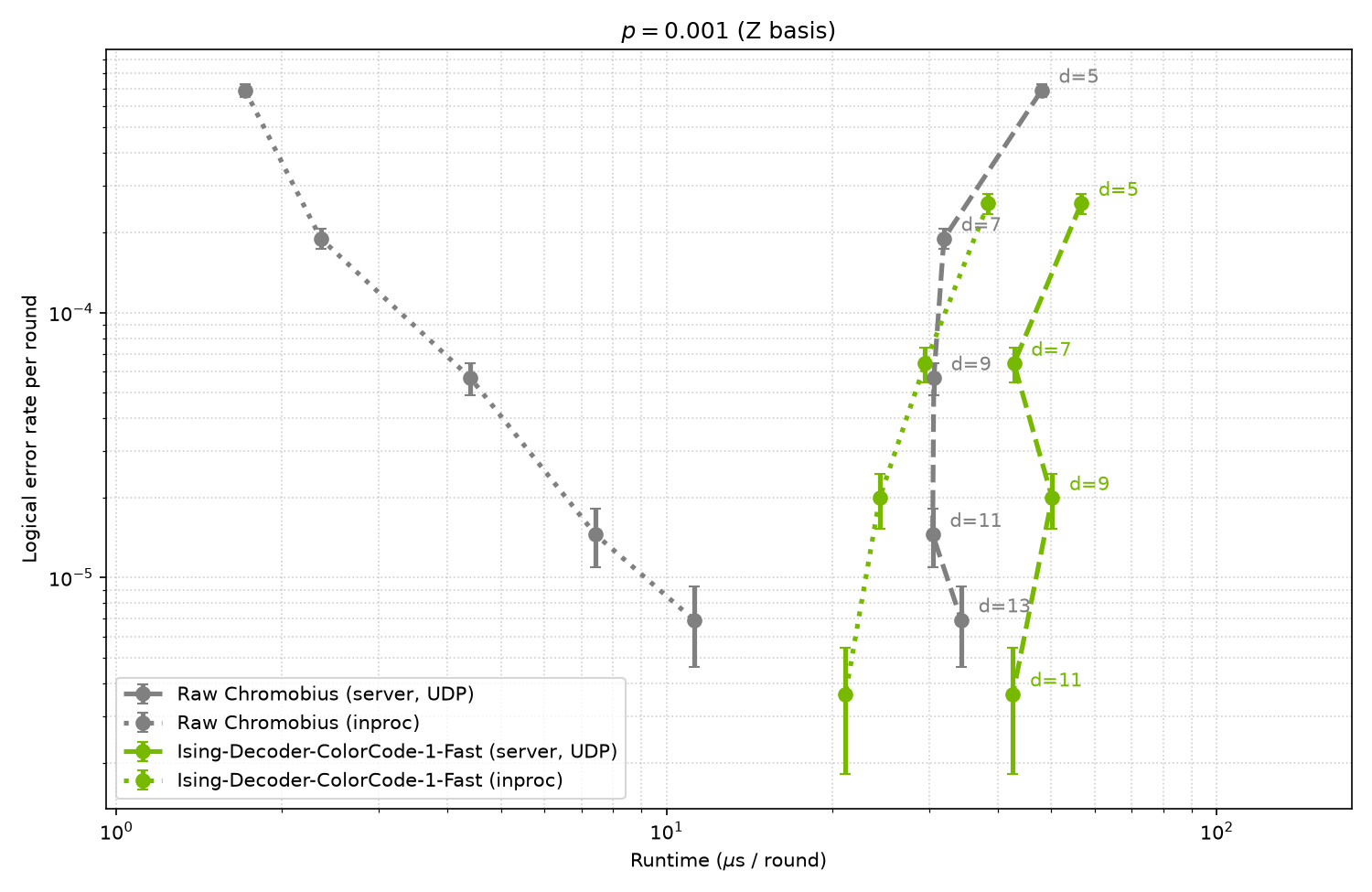
Use the figure generated by your run when comparing configurations. Hardware, software versions, and the selected deployment path affect runtime; the earlier figure is not a performance guarantee for your environment.
The Example Source
"""Ising color-code decoder: LER per round vs. runtime on the playback emulator.

Usage: python3 color_code_demo.py [options]
"""
import argparse, json, os, re, shutil, subprocess, sys, warnings
import numpy as np
import cudaq_qec as qec

pb = qec.playback

parser = argparse.ArgumentParser(description=__doc__.splitlines()[0])
parser.add_argument("--deps",
                    default="deps",
                    help="where to fetch Ising-Decoding and the weights")
parser.add_argument("--weights",
                    help="Ising-Decoder-ColorCode-1-Fast .safetensors file "
                    "(default: downloaded into --deps)")
parser.add_argument("--distances", default="5,7,9,11,13")
parser.add_argument("--p", type=float, default=1e-3, help="physical error rate")
parser.add_argument("--shots",
                    type=int,
                    default=100000,
                    help="shots per distance")
parser.add_argument("--seed", type=int, default=1234)
parser.add_argument("--decoding-server",
                    default=shutil.which("decoding_server"),
                    help="decoding_server binary (default: from PATH)")
parser.add_argument("--server-timeout",
                    type=int,
                    default=7200,
                    help="decoding_server --timeout, in s")
args = parser.parse_args()

distances = [int(d) for d in args.distances.split(",")]
if not args.decoding_server:
    parser.error("decoding_server not found; pass --decoding-server")

# Ising-Decoding source and model weights
ISING_REPOSITORY = "https://github.com/NVIDIA/Ising-Decoding.git"
ISING_COMMIT = "33acb152e403bc189f2effdb07f1a87b34c745f1"
HF_REPOSITORY = "nvidia/Ising-Decoder-ColorCode-1-Fast"
HF_REVISION = "c5775431d0ebb06ffecc3836935708b787db51ee"
HF_FILENAME = "ising_decoder_color_code_1_fast_r13_v1.0.400_fp16.safetensors"

ising = os.path.join(args.deps, "Ising-Decoding")
if not os.path.isdir(ising):
    # Check out into a scratch directory so an interrupted fetch is redone.
    partial = ising + ".partial"
    shutil.rmtree(partial, ignore_errors=True)
    for command in (
        ["git", "init", "-q", partial],
        ["git", "-C", partial, "remote", "add", "origin", ISING_REPOSITORY],
        ["git", "-C", partial, "sparse-checkout", "init", "--cone"],
        ["git", "-C", partial, "sparse-checkout", "set", "code"],
        [
            "git", "-C", partial, "fetch", "-q", "--depth", "1",
            "--filter=blob:none", "origin", ISING_COMMIT
        ],
        ["git", "-C", partial, "checkout", "-q", "--detach", "FETCH_HEAD"],
    ):
        subprocess.run(command, check=True)
    os.rename(partial, ising)
weights = args.weights or os.path.join(args.deps, HF_FILENAME)
if not os.path.exists(weights):
    if not shutil.which("hf"):
        sys.exit("the hf CLI is needed to download the weights; install "
                 "huggingface_hub, or pass --weights")
    subprocess.run([
        "hf", "download", HF_REPOSITORY, HF_FILENAME, "--revision", HF_REVISION,
        "--local-dir", args.deps
    ],
                   check=True)
sys.path.insert(0, os.path.join(ising, "code"))

from qec.color_code.color_code import ColorCode
from qec.color_code.reference_superdense_noise import build_color_memory_circuit

# Shots in flight: shot i starts once shot i - DEPTH has its correction.
DEPTH = 4
# Playback requires a positive tick duration; use one microsecond.
PLAYBACK_TICK_NS = 1000
MEASURE_OPS = {"M", "MZ", "MX", "MY", "MR", "MRX", "MRY", "MRZ"}


def color_circuit(d):
    """Z-basis color-code memory circuit with d rounds, as in the model card."""
    return build_color_memory_circuit(distance=d,
                                      n_rounds=d,
                                      basis="Z",
                                      p_error=args.p,
                                      noise_model_family="legacy",
                                      noise_instruction_semantics="current",
                                      gidney_style_noise=True,
                                      schedule="nearest-neighbor",
                                      add_boundary_detectors=True).stim_circuit


def measurement_maps(circuit, d):
    """Returns (m2d, support): the measurements each detector reads, and the
    data qubits the observable reads. Stim's converter reveals both when
    measurements are flipped one at a time."""
    n = circuit.num_measurements
    flips = np.vstack([np.zeros((1, n), bool), np.eye(n, dtype=bool)])
    dets, obs = circuit.compile_m2d_converter().convert(
        measurements=flips, separate_observables=True)
    dets, obs = dets[1:] ^ dets[0], obs[1:, 0] ^ obs[0, 0]
    data_start = n - ColorCode(d).num_data
    return ([np.flatnonzero(col).tolist() for col in dets.T],
            np.flatnonzero(obs[data_start:]).tolist())


def export_onnx(d, model, support, onnx_path):
    """Exports the Ising predecoder, with the observable's support baked in."""
    import torch
    from qec.color_code import (get_data_to_grid_flat_index,
                                get_parity_matrix_data_only,
                                get_stab_to_grid_flat_index)
    from qec.color_code.detector_input import ColorDetectorInputTransform
    from benchmarks.export_detector_input_trtexec import (
        DetectorInputColorEval, DetectorInputModel)
    from evaluation.logical_error_rate_color import PreDecoderColorEvalModule
    xform = ColorDetectorInputTransform(distance=d, rounds=d, basis="Z")
    # Mirrors Ising's private _build_color_code_parity_maps.
    code = ColorCode(d)
    H = get_parity_matrix_data_only(code)
    K = int(H.sum(1).max())
    H_idx = torch.full((H.shape[0], K), -1, dtype=torch.long)
    for i, row in enumerate(H):
        cols = row.nonzero().flatten()
        H_idx[i, :len(cols)] = cols
    maps = dict(H_idx=H_idx,
                H_mask=H_idx >= 0,
                K=K,
                stab_to_grid=get_stab_to_grid_flat_index(code),
                data_to_grid=get_data_to_grid_flat_index(code),
                num_plaq=H.shape[0],
                num_data=H.shape[1],
                n_rows=code.n_rows,
                n_cols=code.n_cols)
    obs_support = torch.zeros(H.shape[1])
    obs_support[support] = 1.0
    # Module defaults match Ising's config.
    cfg = argparse.Namespace(test=argparse.Namespace())
    pipeline = DetectorInputColorEval(
        DetectorInputModel(xform, model),
        PreDecoderColorEvalModule(model,
                                  cfg,
                                  maps,
                                  basis="Z",
                                  obs_support=obs_support,
                                  num_boundary_dets=int(
                                      xform.num_stabs))).eval()
    with warnings.catch_warnings():
        warnings.simplefilter("ignore", DeprecationWarning)
        warnings.simplefilter("ignore", torch.jit.TracerWarning)
        torch.onnx.export(pipeline,
                          torch.zeros(1, xform.detector_width),
                          onnx_path,
                          opset_version=17,
                          input_names=["dets"],
                          output_names=["L_and_residual_dets"],
                          dynamic_axes={
                              "dets": {
                                  0: "batch"
                              },
                              "L_and_residual_dets": {
                                  0: "batch"
                              }
                          },
                          dynamo=False)


def decoder_config(name, d, m2d, engine_args=None):
    """A one-decoder config. The decoder reads its matrices from the DEM file;
    D_sparse maps the raw measurements to detectors."""
    dc = qec.decoder_config()
    dc.type = name
    dc.D_sparse = qec.d_sparse(m2d)
    dc.stim_dem_path = "dem_d%d.txt" % d
    if name == "trt_decoder":
        # The predecoder returns its observable flips and residual detectors;
        # Chromobius decodes the residual.
        dc.decoder_custom_args = {
            "batch_size": 1,
            "engine_output_format": "observables_and_residual_detectors",
            "global_decoder": "chromobius",
            **(engine_args or {
                "engine_load_path": "engine_d%d.trt" % d
            })
        }
    mdc = qec.multi_decoder_config()
    mdc.decoders = [dc]
    return mdc


def write_schedule(circuit, shots, sched_path, chunk=10000):
    """Samples `circuit` and writes a playback schedule.
    Each shot is a reset, one enqueue per measurement layer, and a
    get_corrections that expects the shot's true observable flips.
    """
    layers, offset = [], 0
    for inst in circuit.flattened():
        if inst.name in MEASURE_OPS:
            width = len(inst.targets_copy())
            layers.append((offset, width))
            offset += width
    sampler = circuit.compile_sampler(seed=args.seed)
    converter = circuit.compile_m2d_converter()
    with open(sched_path, "w") as f:
        for start in range(0, shots, chunk):
            meas = sampler.sample(min(chunk, shots - start))
            obs = converter.convert(measurements=meas,
                                    separate_observables=True)[1]
            text = (meas.astype(np.uint8) + ord("0")).view("S1")
            obs_text = (obs.astype(np.uint8) + ord("0")).view("S1")
            for i, row in enumerate(text):
                s = start + i
                after = " after=s%d" % (s - DEPTH) if s >= DEPTH else ""
                f.write("- reset%s\n" % after)
                for off, w in layers:
                    f.write("- enqueue source=0b%s\n" %
                            row[off:off + w].tobytes().decode())
                f.write("- get_corrections %s signal=s%d\n" %
                        (obs_text[i].tobytes().decode(), s))


def per_round(ler, rounds):
    """Per-round logical error rate from the rate over `rounds` rounds."""
    return float(1 - (1 - np.clip(ler, 1e-12, 1 - 1e-12))**(1 / rounds))


def run_checked(schedule, shots, **session):
    """Runs `schedule`; fails unless every shot returned its correction."""
    result = pb.run(schedule, tick_ns=PLAYBACK_TICK_NS, sources={}, **session)
    records = result.records
    gc = [r for r in records if r["op"] == "get_corrections"]
    bad = [
        str(r["status"]) for r in gc if r["status"] != 0 or
        not r["read_completed"] or not r["correction_bits"]
    ]
    if len(gc) != shots or bad:
        raise RuntimeError("%d/%d corrections returned, failures: %s" %
                           (len(gc), shots, sorted(set(bad))))
    return result, gc


def run_session(name, mdc, schedule, shots):
    """Runs `schedule` with requests routed through session `name`: inproc,
    or a decoding_server for `mdc` over UDP, stopped once the run ends."""
    if name == "inproc":
        return run_checked(schedule, shots, decoders=mdc)
    cfg_path = "server_config.yaml"
    with open(cfg_path, "w") as f:
        f.write(mdc.to_yaml_str())
    proc = subprocess.Popen([
        args.decoding_server, "--config=" + cfg_path, "--transport=udp",
        "--port=0",
        "--timeout=%d" % args.server_timeout
    ],
                            stdout=subprocess.PIPE,
                            stderr=subprocess.STDOUT,
                            text=True)
    try:
        log = []
        for line in proc.stdout:
            log.append(line)
            m = re.search(r"QEC_DECODING_SERVER_READY port=(\d+)", line)
            if m:
                break
        else:
            raise RuntimeError("decoding_server did not start:\n" +
                               "".join(log))
        return run_checked(schedule,
                           shots,
                           udp_endpoints={0: "127.0.0.1:%s" % m.group(1)},
                           udp_timeout_ms=5000)
    finally:
        proc.terminate()
        proc.wait()


# Build and run the experiments
from export.safetensors_utils import load_safetensors

model = load_safetensors(weights, device="cpu")[0].float().eval()
results = {}
for d in distances:
    circuit = color_circuit(d)
    m2d, support = measurement_maps(circuit, d)
    with open("dem_d%d.txt" % d, "w") as f:
        f.write(str(circuit.detector_error_model()))
    export_onnx(d, model, support, "pre_d%d.onnx" % d)
    print("d=%-2d %d detectors" % (d, circuit.num_detectors), flush=True)
    write_schedule(circuit, args.shots, "schedule.txt")
    schedule = open("schedule.txt").read()
    for dec in ("chromobius", "trt_decoder"):
        for sess in ("inproc", "server"):
            # The inproc trt_decoder builds the TensorRT engine that the
            # server then loads.
            engine_args = {
                "onnx_load_path": "pre_d%d.onnx" % d,
                "engine_save_path": "engine_d%d.trt" % d
            } if sess == "inproc" else None
            result, gc = run_session(sess,
                                     decoder_config(dec, d, m2d, engine_args),
                                     schedule, args.shots)
            # Runtime per round: the time until the last reply, divided by
            # the rounds decoded.
            runtime = max(
                r["return_ns"] for r in result.records) / 1e3 / args.shots / d
            errors = sum(r["correction_mismatch"] for r in gc)
            # Per-round rate from the d-round rate, with a binomial error
            # bar.
            total = min(max(errors / args.shots, 0.5 / args.shots), 1 - 1e-12)
            sigma = np.sqrt(total * (1 - total) / args.shots)
            lo, mid, hi = (
                per_round(x, d) for x in (total - sigma, total, total + sigma))
            point = results.setdefault(str(d), {}).setdefault(dec, {})
            point[sess] = dict(runtime=runtime,
                               ler=mid,
                               ler_unc=max(hi - mid, mid - lo),
                               errors=errors)
            print("d=%-2d %-10s %-6s %8.3f us/round  LER/round %.3g +/- "
                  "%.1g (%d/%d)" % (d, dec, sess, runtime, mid,
                                    point[sess]["ler_unc"], errors, args.shots),
                  flush=True)
    json.dump(dict(p=args.p, results=results),
              open("results.json", "w"),
              indent=1)

# Plot the results
import matplotlib

matplotlib.use("Agg")
import matplotlib.pyplot as plt

labels = {
    "chromobius": "Raw Chromobius",
    "trt_decoder": "Ising-Decoder-ColorCode-1-Fast"
}
colors = {"chromobius": "#808080", "trt_decoder": "#76b900"}
styles = {"server": ("--", "o", "server, UDP"), "inproc": (":", "o", "inproc")}
fig, ax = plt.subplots(figsize=(10, 6.5))
for dec in labels:
    for sess, (style, marker, sess_label) in styles.items():
        pts = sorted((int(d), r[dec][sess])
                     for d, r in results.items()
                     if r.get(dec, {}).get(sess, {}).get("errors"))
        if not pts:
            continue
        x = [p["runtime"] for _, p in pts]
        y = [p["ler"] for _, p in pts]
        ax.errorbar(x,
                    y,
                    yerr=[p["ler_unc"] for _, p in pts],
                    color=colors[dec],
                    linestyle=style,
                    marker=marker,
                    markersize=7,
                    linewidth=2.5,
                    capsize=3,
                    label="%s (%s)" % (labels[dec], sess_label))
        if sess == "server":
            for (d, _), xi, yi in zip(pts, x, y):
                ax.annotate("d=%d" % d, (xi, yi),
                            textcoords="offset points",
                            xytext=(9, 4),
                            color=colors[dec])
ax.set_xscale("log")
ax.set_yscale("log")
ax.set_xlabel(r"Runtime ($\mu$s / round)")
ax.set_ylabel("Logical error rate per round")
ax.set_title(r"$p = %g$ (Z basis)" % args.p)
ax.grid(True, which="both", linestyle=":", alpha=0.6)
ax.legend(loc="lower left")
xlo, xhi = ax.get_xlim()
ax.set_xlim(xlo / 1.5, xhi * 2.6)
fig.tight_layout()
fig.savefig("color_code_demo.png", dpi=150)
print("wrote", "color_code_demo.png")
See Also
AI Predecoding – the two-stage pipeline and other evaluation paths
Color-Code AI Predecoding in the Decoding Server – deployment with a prepared model and configuration
Playback Emulator – schedules, sessions, and timing records
Realtime Decoding from a Quantum Kernel or FPGA – a surface-code example with circuit or FPGA input