Decoding Task Graphs
A decoding task graph connects decoding steps into a pipeline. It accepts measurements, routes data between nodes, and combines their results into corrections to logical observables. With a logical-readout mapping and output, it can also return the corrected logical measurements.
Use a task graph when decoding requires more than a single decoder call: for example, to pass a predecoder’s residual to another decoder, divide a long measurement stream into windows, or choose an answer from an ensemble. The graph manages the connections and execution order while each decoder handles the error-correction problem assigned to it.
A detector error model (DEM) and a task graph describe different things. The DEM describes the experiment’s faults, detectors, observables, and measurement mappings. The task graph describes how decoders and other processing steps use that information.
How Data Flows Through a Graph
A graph consists of nodes connected by edges. A node may run a decoder, combine corrections, read logical observables, or organize work into windows. An edge connects a named output port to a compatible input port. Building the graph checks that the connected ports carry compatible types.
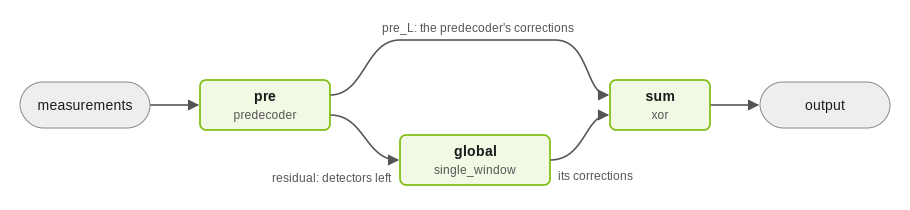
In this pipeline, the predecoder returns corrections and residual detection events. The global decoder processes that residual, and an XOR node combines the two sets of logical corrections. Each stage therefore handles the part of the decoding problem assigned to it.
The DEM’s measurement-to-detector mapping, D, defines how raw measurements
form detection events. Its fault information describes the errors a decoder
must consider; O records which of those faults flip logical observables.
A downstream decoder receiving residual detection events consumes those
events directly.
The graph’s external input is measurements and its correction outputs
are reached through output. Nodes are listed in data-flow order. A node
without its own dem_chunks specification uses the enclosing decoder’s DEM.
The reference describes node kinds, ports, and
result types.
Complete Shots and Streaming
Complete-shot decoding processes a measurement record that is already
available. run() returns the correction from one graph output;
run_batch() processes a collection of shots. For several correction
outputs, run_all() returns one result per output. This path is useful for
offline experiments and testing.
Streaming decoding accepts rounds through enqueue_syndrome() and
processes them as the configured nodes become ready. Window nodes collect the
rounds they need; native streaming decoders process incoming rounds through
their own streaming interface. Tag the last round FINAL to end the shot.
This interface serves realtime decoding and can also be exercised with
synthetic or recorded measurements.
Streaming results include progress information as well as correction bits. Use their status and coverage to determine which rounds have been committed; a zero-valued correction can be a completed result. See Reading Streaming Results.
Corrections and corrected logical measurements are separate outputs.
run() and run_batch() return corrections. To read corrected logical
measurements, provide the DEM’s m2o_sparse mapping and configure a logical
output. See Logical Measurements
for readout, release, and reset rules.
Building a Task Graph
You can declare a graph in a decoder configuration’s task_graph YAML
block, which the decoding server reads, or construct it through the Python
and C++ APIs:
from_specplaces one decoder in a window. Withnum_roundsset, it uses the complete shot; with an unresolved repeating phase, it constructs a sliding window that advances one round at a time.combinejoins two single-node graphs and XORs their correction outputs. Use it when the two corrections are intended to add. To choose between competing answers, use an ensemble.from_topologyaccepts explicit nodes and edges for other arrangements.
The Getting Started with a Decoding Task Graph demonstrates construction, complete-shot and batch decoding, streaming, and XOR composition in Python and C++. Its full source files provide the DEM helper used by the snippets.
For more specialized pipelines, see Parallel Window and Decoder Ensembles. The Reference section below covers configuration and execution details.
Reference
Configuration fields, node behavior, and result semantics for task graphs. For API signatures, see the C++ and Python task-graph references.
Node Kinds
Kind |
What it does |
|---|---|
|
Decodes |
|
Decodes a complete fixed-length shot. |
|
Passes each round to an inner decoder that streams natively. |
|
Decodes streams of any length in windows that decode at the same time. See Parallel Window. |
|
The nodes |
|
XORs its inputs: ports |
|
Reads the raw logical value through the DEM’s |
|
Runs a predecoder and passes its residual detectors on through its
|
|
Runs several member graphs and keeps one answer. See Decoder Ensembles. |
Kinds are a registry, so plugins can add more.
registered_task_graph_node_kinds() lists an installation’s kinds,
decoder_param_schema("task_graph_node.<kind>") describes a kind’s
parameters, and decoder_config_json_schema() returns a JSON Schema for
checking configurations with your own tools.
Guarded Sliding Windows
Overlapping windows see each round more than once. Guard rounds are context only: the window decodes with them but does not correct them, because a neighboring window does.
- id: sw
  type: sliding_window
  window_size: 5
  step_size: 4
  end_guard: 1            # the last round is context only
  inner: {type: single_error_lut}
start_guardandend_guard(orguard_roundsfor both) set the guards.With a guard,
step_sizemust equalwindow_size - start_guard - end_guard, so each round is corrected exactly once.The
FINALround corrects the last window’send_guard.
Asynchronous Streaming Options
By default, enqueue_syndrome returns after the decodes it starts. With
async_streaming, it copies the round and returns, and the graph decodes on
its own worker threads; it waits only when the graph’s queue is full. Reads
(get_obs_corrections, streaming_result) wait for rounds already sent,
and a FINAL round returns once the whole shot is decoded.
task_graph:
  async_streaming: true
  async_num_workers: 4          # worker threads; default: sized to the graph
  async_worker_cpus: [4, 5, 6, 7]
  nodes: [...]
Set these in the task_graph block, or on
TaskGraphOptions in code. The other options apply only
with async_streaming, and each graph gets threads of its own.
Option |
Meaning |
|---|---|
|
|
|
Worker threads that decode. Default: enough for everything that may
decode at once (independent branches and |
|
CPUs to pin the workers to, one worker per CPU (Linux). With fewer CPUs than workers, the pool shrinks to match. Default: none. |
|
CPU to pin the thread that schedules decodes to (Linux). Default
|
|
How long an idle coordinator polls before it sleeps. Default |
|
Records that may be queued or decoding before |
Each
enqueue_syndromecall is queued as a record; a windowed graph may split a long call into several. Records overlap: a later record runs on nodes that have finished earlier ones, up to 16 orasync_queue_capacityat once, whichever is smaller, but each node still sees records in order.A windowed graph that falls behind takes the rounds queued for it together, to catch up. A
FINALround returns only after the queue drains, so a deeper queue helps a graph that falls behind but lengthens its tail.Keep producer threads, workers and the coordinator on separate cores for low latency. Configuring decoders warns when two graphs pin the same CPU or together need more threads than the machine has.
Fire Pools
max_in_flight on a node builds that many copies of it, so several records
can decode on it at once. Results equal one-at-a-time decoding: each record
uses one copy, and corrections fold in record order.
Only kinds that keep no state between decodes take
max_in_flightabove one.sliding_window,single_window,streaming,predecoder,ingestandlogical_readoutdo not.While streaming, a fire pool cannot take raw measurements, so it must be fed by another node, as
decode_windowis fed byingest.Each copy builds its own inner decoder, so the node needs a decoder type, not an already-built decoder.
Copies decode at once only with
async_streaming. Each copy beyond the first adds a worker to the default pool.
Reading Streaming Results
get_obs_corrections() returns the corrections, one byte per observable.
streaming_result() also says whether they are ready and which rounds they
cover. For each graph output it reports:
status:PENDINGbefore the output has published or afterclear_corrections(),AVAILABLEmid-shot,COMPLETEafterFINAL, orFAILED. (In C++, lowercase.)coverage_begin_roundandcoverage_end_round: the rounds the latest update committed, as a half-open range. For a parallel window, this is every round committed since the lastclear_corrections().closure: whether decoded windows were checked against their detectors (see Parallel Window).
The result also reports aggregate status and closure for the graph’s
correction outputs; a logical output does not contribute to these aggregates.
A zero correction with status AVAILABLE is a real result. Synchronously,
enqueue_syndrome also returns whether any node decoded; with
async_streaming, an untagged call returns False, so read status
instead.
Additional result fields describe changes to the output and the shot:
generation: a counter that advances each time an output publishes, once every node that feeds it has updated. Fed only by native streaming nodes, it advances whenever coverage grows. The graph’s generation advances once every output but the logical one has.clear_corrections()keeps it, so usestatus, notgeneration, to decide whether a value can be read.result_revision: advances on any change of value or status.shot_epoch: advances onreset_decoder().error: why the graph failed, whenstatusisfailed. Reset to continue.
With async_streaming, streaming_result() first waits for every
queued round, then returns a snapshot. Without it, the C++ result is a live
reference owned by the graph; copy it to keep it across later calls. Python
always returns a copy.
Staged Outputs
Nodes that feed one output normally decode on the same schedule, and the
output’s coverage follows that schedule. Window nodes such as
decode_window instead finish arbitrary round intervals in any order. An
output fed only by such nodes is staged: the graph holds each result until
every earlier round is done, folds them in round order, and reports coverage
from the frontier at the last clear_corrections() (round 0 in a new shot)
to the current frontier. An output that mixes both kinds of node cannot
stream; wire them to separate outputs. Nodes that commit the same rounds,
such as two parallel_window patterns, cannot share an output either;
building the graph refuses them.
Edge Values
Each port declares the type of value it produces or accepts, and building a
graph rejects an edge whose types do not match. The types you wire most are
measurement_results, detection_events and logical_outcome; others
carry values between built-in nodes, such as the corrections one window sends
another. registered_edge_value_types() (C++) lists an installation’s
types.
A node fed by another node decodes that node’s output, as the global decoder
in Decoding Task Graphs’s first figure decodes the predecoder’s
residual.
Logical Measurements
A graph can return two results:
Corrections, the flips of the logical observables:
get_obs_corrections(),run()and the decoding server’sget_corrections.Logical measurements, the raw logical readout with the corrections applied:
get_logical_measurements()and the server’sget_logical_measurements.
Logical measurements need a detector error model that maps measurements to
the raw logical observables through m2o_sparse (see
Measurements and Logical Readout), and a graph with a logical
output. parallel_window wires one with
output: corrections_and_logical (see Parallel Window);
other graphs wire a logical_readout node (see
Configuring Logical Outputs).
A logical measurement is released once its readout has arrived and every correction that can flip it is committed. A final readout is released at
FINAL. A mid-circuit readout is released mid-shot when the corrections are staged, asparallel_window’s are; otherwise atFINAL.get_logical_measurements(first, count)returnsNone(C++:nullptr) until every measurement in the range is released, and again once the shot is consumed.The logical output is the last of
streaming_result().outputs, with areleasedflag per measurement. It is not inoutput_names(), andget_num_logical_measurements()gives its width.The logical measurements apply every correction of the shot, so the shot can be consumed only after
FINAL:clear_corrections()raises before then.reset_decoder()still abandons a shot.runandrun_batchreturn corrections only.
Configuring Logical Outputs
A logical_readout node uses a detector error model (DEM) with an
m2o_sparse mapping to read the raw logical value. An xor applies the
corrections to it. See Measurements and Logical Readout for the mapping.
The output that the node reaches, whatever its name, is the graph’s logical
output. For a DEM whose rounds all have the same measurement count:
nodes:
  - {id: sw, type: sliding_window, inner: {type: pymatching}}
  - {id: R, type: logical_readout}
  - {id: L, type: xor}
edges:
  - {from: measurements, to: sw}
  - {from: measurements, to: R}
  - {from: sw, to: output.corrections}
  - {from: sw, to: L.a}
  - {from: R, to: L.b}
  - {from: L, to: output.logical}
A graph has at most one logical output, and needs a corrections output beside it.
One
logical_readoutnode reaches the logical output, and it reaches no other output.The node joins any stream, whatever the other nodes’ schedules. Here the corrections publish on the window’s schedule, so the logical measurements are released at
FINAL; see Logical Measurements.
Native Streaming Nodes
A streaming node passes each enqueue_syndrome call to its inner
decoder’s own enqueue_syndrome, for decoders that process rounds
incrementally. Its complete-shot path decodes the whole shot at once.
Rounds may differ in width, such as a narrower readout round, if the inner
decoder implements streaming_correction_provider and so ends its own
shots; a shot may then end at any FINAL round. Coverage is the rounds
the decoder has committed, not the node’s schedule:
Mid-shot, the node publishes whenever
committed_round_count()grows. Coverage starts whereclear_corrections()last consumed the corrections. A decoder without the count publishes nothing beforeFINAL.FINALcovers the roundsfinalized_round_count()reports, or else the committed ones.A shot the decoder ends without
FINALcovers the roundsfinalized_round_count()reports, and the stream continues.Several such nodes may feed one output, which covers the rounds all of them have committed. If one reports no count, or they disagree on where the shot begins, the output follows the nodes’ schedule.
- id: native
  type: streaming
  num_syndromes_per_round: 24
  inner: {type: <streaming-decoder>}
Arbitrary-Length Sliding Windows
arbitrary_length: true on a sliding_window node lets a shot end at any
round, not only on a window boundary. FINAL decodes the actual last
rounds, without padding.
The detector error model uses
dem_chunkswith one measurement count for every round, a prefix, one repeating phase and one or more final phases. The prefix and final phases together must be fewer thanwindow_sizerounds, andwindow_sizeat least 3.The node needs a trailing guard:
step_sizeequal towindow_size - start_guard - end_guard, withend_guardof at least one. Set no guards andend_guarddefaults towindow_size - step_size. Witht > 1final phases,start_guardmust be at leastt, and results lagtrounds behind.The
FINALround must be a complete round, and a shot must have at least the DEM’s minimum number of rounds.The inner decoder is named by type, so the node can build one per window shape; all shapes are built when the graph is.
Nodes combined into one output must all set it.
run() still decodes a fixed-length shot. For streams of any length whose
windows decode at the same time, see Parallel Window.