
An umbrella Helm chart that layers a Kubernetes SRE workflow onto the
Kubernetes Deployer tool. The
deployer runs the official NemoClaw-managed Hermes image behind an OpenShell
gateway; this recipe adds the reviewed kubernetes-sre skill, a bundled
OpenShift client, a policy-bounded HTTPS proxy in front of the cluster API, and
the RBAC that proxy uses. In the default safe mode the assistant can read
common non-secret resources cluster-wide and scale Deployments and
StatefulSets; it can never read Secrets, change RBAC, exec into Pods, or delete
anything. Broader no-delete access and the optional openshift-llm-deploy
model deployment skill are separate, acknowledged opt-ins. The chart consumes
the prebuilt managed image and never runs the NemoClaw CLI or bootstrap, hence
NemoClaw: N/A.
Screenshot
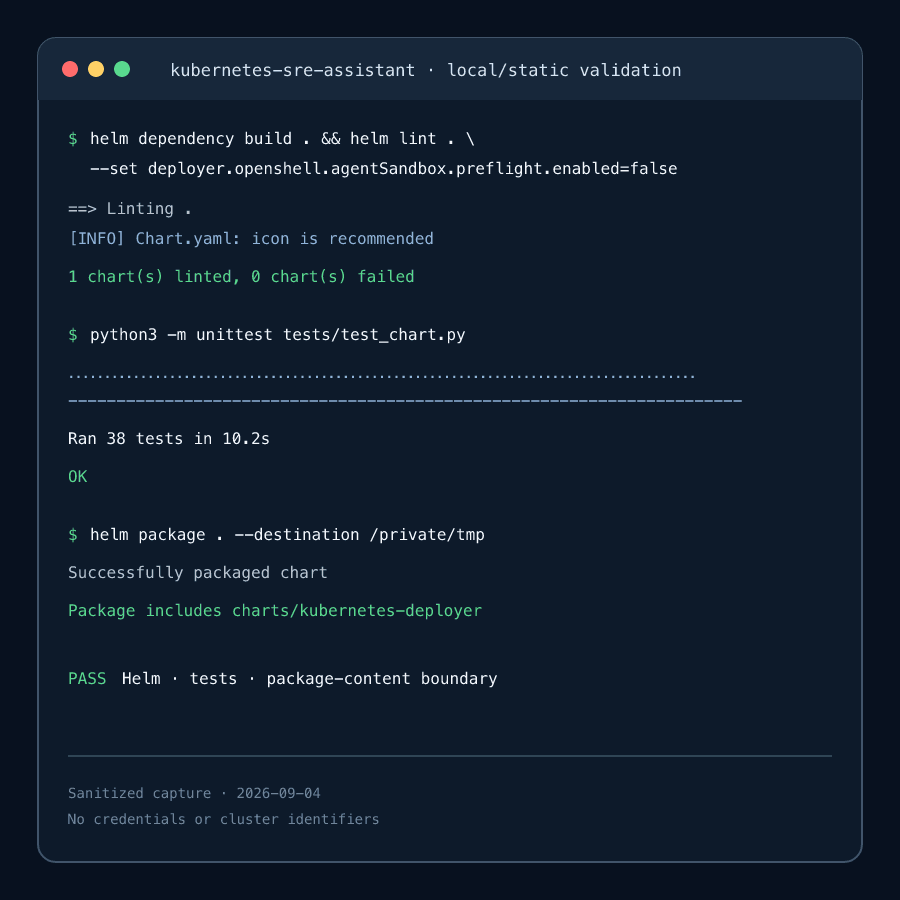
This sanitized terminal capture shows the recipe's reproducible local validation result. The exact commands and searchable expected output are preserved in Verification.
Architecture
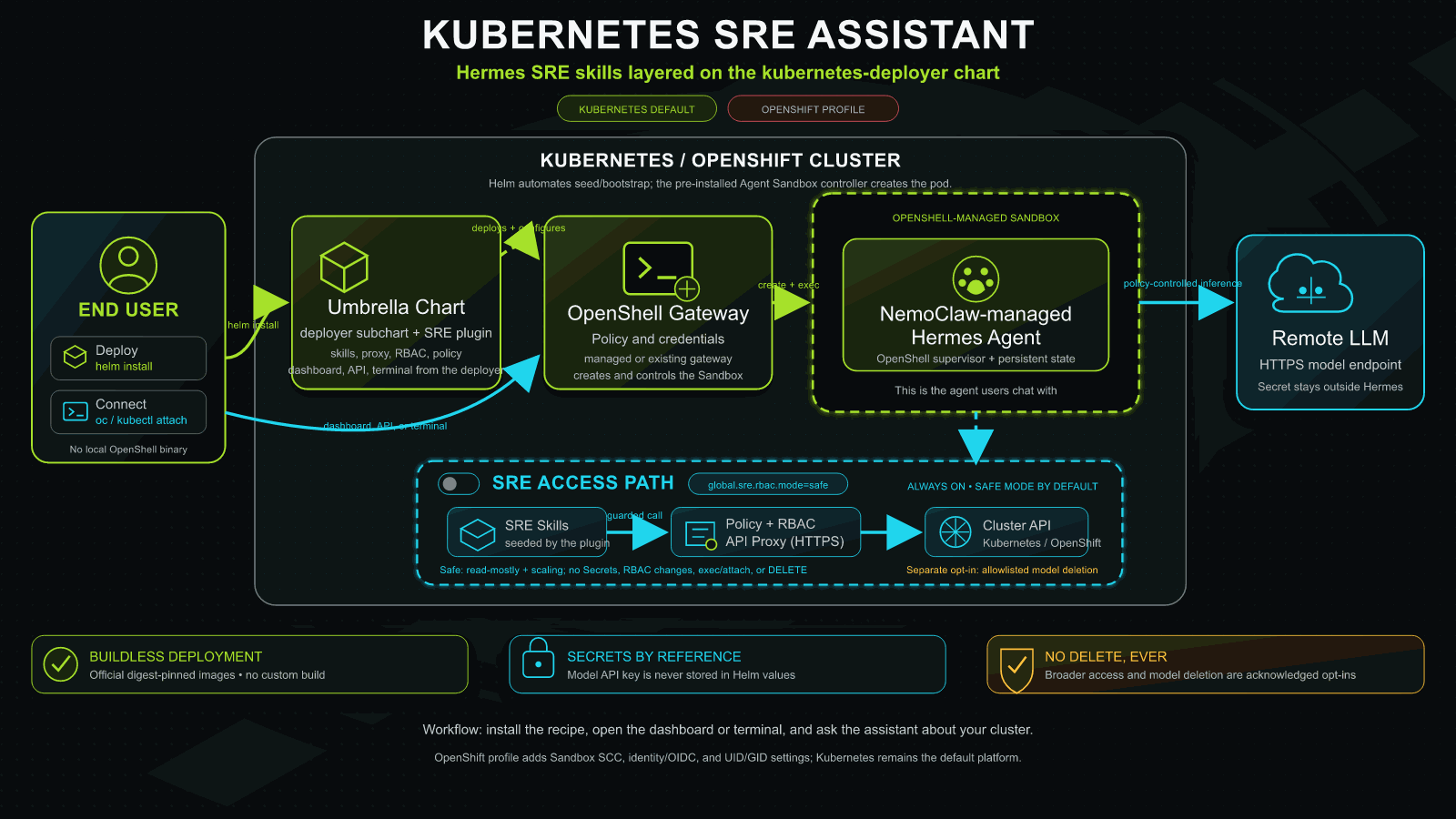
The deployer subchart (alias deployer) installs the OpenShell gateway, seeds
the retained Hermes state volume, creates the Sandbox, and publishes the Hermes
dashboard, OpenAI-compatible API, and terminal. This chart plugs into the
deployer's extension points:
Hermes (sandbox) ── oc/kubectl + SRE_KUBECONFIG ──► HTTPS proxy (bearer token, private CA)
                                                        │ ServiceAccount, ClusterRole (no delete)
                                                        ▼
                                                  Kubernetes / OpenShift API
seed Job ── sre plugin: verify skill bundle, stage oc/kubectl, write kubeconfigs ──► state volume
- A seed plugin (
files/scripts/seed_sre.py) runs inside the deployer's seed Job after the volume is claimed. It reassembles and verifies the skill archive, installs the skill trees read-only, stages the SHA-256-verifiedoc/kubectlbinaries, and writes private kubeconfigs that point at the chart proxies. - Extra state mounts present those files inside the sandbox as read-only
subpaths under
/sandbox/.hermesand/chart-bin. - Policy extensions allow Hermes egress only to the exact proxy Service names, and a NetworkPolicy admits only Agent Sandbox Pods to the proxy ports.
- Environment tells the skill where the proxy and kubeconfig live.
At A Glance
| Question | Answer |
|---|---|
| Category | NVIDIA Recipe |
| Contributor or provenance | NVIDIA |
| Use this when | A platform or SRE team wants a chat assistant that can answer cluster questions and perform bounded operations on Kubernetes or OpenShift without handing an agent a kubeconfig, cluster-admin, or delete rights. |
| You will get | Everything the Kubernetes Deployer provides (gateway, sandboxed Hermes, dashboard, API, terminal), plus the kubernetes-sre skill, a bundled OpenShift client, an authenticated cluster API proxy with safe or broad-no-delete RBAC, optional model deployment, metrics, and exact-resource model deletion, and an opt-in auto-heal controller that detects failure patterns and executes only allow-listed, risk-tiered remediations. |
| Runs on | Kubernetes 1.33+ or OpenShift 4.20+ with an Agent Sandbox controller and a ReadWriteOnce StorageClass. |
| Requires | Helm 3.14+, a clone of this repository (the deployer is a file:// sibling dependency), privileged sandbox admission, a pre-created model API-key Secret, and the deployer's issuer-discovery decision. |
| Verified on | OpenShift 4.22.6 on amd64 with Kubernetes 1.35.5, Agent Sandbox controller v0.4.5, and OpenShell 0.0.116 (recipe 0.1.0 on deployer 0.4.0, safe mode, 2026-09-04). Also on a single-node kubeadm cluster, Kubernetes 1.36.2 on amd64 with Ubuntu 26.04 LTS and containerd 2.3.1, with the auto-heal controller in assisted mode (2026-09-11). |
| Evidence level | Live end-to-end for OpenShift safe mode: seed plugin log, skill and client mounts inside the sandbox, an authenticated read through the proxy, a denied DELETE, and a Hermes answer to a cluster question. Live on standard Kubernetes for install and for the auto-heal loop, including one executed rolling restart that resolved a stale-configuration crash loop and one correct escalation of an unfixable one. Local/static for broad-no-delete, model deployment, metrics, and deletion. |
| Support and maturity | Experimental with best-effort community support. See the repository support policy. |
| External access, data, and actions | Everything the deployer does, plus: downloads the checksum-pinned OpenShift client archive; creates a ClusterRole and ClusterRoleBinding for the proxy identity; sends cluster resource data returned through the proxy to the configured model endpoint. Safe mode can scale Deployments and StatefulSets. Opt-ins can create and patch workloads, read monitoring data, or delete allowlisted model resources. |
| Start here | Quickstart |
| Confirm success | Verification |
Pinned release inputs
- Kubernetes Deployer chart
0.4.0(siblingfile://dependency): NemoClawv0.0.117managed Hermes0.19.0image and OpenShell0.0.116, all as immutable digests; see its README for the full list - OpenShift Client:
4.20.28; official amd64 and arm64 archives are selected by node architecture and verified against pinned SHA-256 checksums - Helper image: immutable multi-architecture Python digest for the proxies and the client stager; the recipe builds no image
- Skill bundle: one deterministic xz/tar archive of the two NVIDIA-authored
skill trees, split into size-bounded ConfigMap chunks; its digest is pinned
in
values.yaml(global.sre.bundle.sha256) and joins the Sandbox configuration identity
For a cluster outside the documented client-version skew, override
global.sre.cli.version plus both architecture URLs and checksums together
with the matching official OpenShift Client release. The chart never accepts an
unverified archive.
Quickstart
The deployer is referenced as file://../../../tools/kubernetes-deployer, so
install from a clone of this repository and materialize the dependency first.
All deployer values live under the deployer key; the recipe's own values live
under global.sre.
git clone https://github.com/NVIDIA/nemoclaw-community.git
cd nemoclaw-community/examples/recipes/nvidia/kubernetes-sre-assistant
helm dependency build .

kubectl create namespace sre-assistant
kubectl -n sre-assistant create secret generic model-api-key \
  --from-literal=api-key='<model-api-key>'

# Standard Kubernetes
helm upgrade --install sre . \
  --namespace sre-assistant \
  -f values-kubernetes.yaml \
  --set deployer.agent.model.name='<model-name>' \
  --set deployer.agent.model.baseUrl='https://model-endpoint.example/v1' \
  --wait --timeout 20m

# OpenShift (pre-create the namespace; Helm reads its SCC UID range)
helm upgrade --install sre . \
  --namespace sre-assistant \
  -f values-openshift.yaml \
  --set deployer.agent.model.name='<model-name>' \
  --set deployer.agent.model.baseUrl='https://model-endpoint.example/v1' \
  --wait --timeout 20m
Keep the release name at 40 characters or fewer and free of api, key,
token, secret, password, and credential segments; the chart derives
every resource name from it and NemoClaw rejects such segments inside the
sandbox environment. values-kubernetes.yaml and values-openshift.yaml are
the deployer profiles nested under deployer; they also carry the acknowledged
anonymous OIDC discovery binding the gateway needs (see the deployer README,
"Issuer discovery").
Helm NOTES prints the sandbox name, the port-forward and gateway-token
commands for the dashboard and API, and the terminal attach command when
deployer.operatorClient.enabled=true. Then ask, for example:
Which Pods in sre-assistant are not Ready, and why?
Scale the deployment demo-api in team-a to 3 replicas.
The assistant inspects first, asks for confirmation before any change, and refuses destructive requests with a human-reviewable command instead.
What the assistant can do
Safe mode (default)
global.sre.rbac.mode=safe grants the proxy identity read access to common
non-secret resources cluster-wide (Namespaces, Nodes, Pods and logs, Services,
Events, ConfigMaps, PVCs, workloads, Jobs, HPAs, Ingresses, Routes, KServe and
NIM resources, metrics) and write access only to the /scale subresource of
Deployments and StatefulSets. The proxy admits only GET and PATCH, and
additionally rejects Secret, ServiceAccount-token, exec, attach, port-forward,
pod-proxy, and node-proxy paths regardless of RBAC.
Hermes authenticates to the proxy with a random chart-managed bearer token
stored in retained state; the proxy's Kubernetes ServiceAccount token is
mounted only in the proxy Pod. Set global.sre.proxy.authSecretRef.name to
use an operator-provided Secret instead.
All sandbox-to-proxy traffic uses CA-verified HTTPS because Kubernetes clients
will not send bearer credentials to plaintext servers. By default Helm creates
and preserves a private CA plus a serving certificate covering the proxy
Service DNS names. Set global.sre.proxy.tlsSecretRef.name to use an
operator-managed kubernetes.io/tls Secret containing the configured
ca.crt, tls.crt, and tls.key keys. NemoClaw routes Hermes egress through
OpenShell's forward proxy; the recipe marks only its exact proxy Service
endpoints with OpenShell tls: skip so the private-CA session stays end to end.
OpenShell still enforces exact host, port, and binary policy, the proxy enforces
methods and paths, and NetworkPolicy limits the proxy ports to Agent Sandbox
Pods.
Broader access
-f values-broad-no-delete.yaml (or global.sre.rbac.mode=broad-no-delete
with I_ACKNOWLEDGE_CLUSTER_WIDE_NO_DELETE) grants create, update, and patch
across API groups and lets the proxy admit POST and PUT. It still excludes
every delete verb and proxy DELETE request, and the proxy path denylist stays
in force. This mode can still cause outages or indirect privilege escalation
without DELETE; it is not recommended for production.
Model deployment skill
global.sre.openshiftLlmDeploy.enabled=true requires broad-no-delete and
adds the openshift-llm-deploy skill, which deploys models with NVIDIA Dynamo
or plain vLLM using only operator-approved, digest-pinned images. The chart
references an existing Hugging Face token Secret by name and key; neither Helm
nor Hermes reads, copies, changes, or deletes that Secret, and the one-time
downloader receives the key only through secretKeyRef with no mounted
ServiceAccount token.
global:
  sre:
    rbac:
      mode: broad-no-delete
      dangerousAcknowledgement: I_ACKNOWLEDGE_CLUSTER_WIDE_NO_DELETE
    openshiftLlmDeploy:
      enabled: true
      targetNamespace: models
      hfTokenSecretRef:
        name: hf-token
        key: HF_TOKEN
On OpenShift, a Dynamo workload may require anyuid. The skill reports the
exact human-run oc adm policy add-scc-to-user command after an admission
failure; the skill and chart never grant that SCC or cluster-admin.
Measured Prometheus/Thanos telemetry is another opt-in
(global.sre.openshiftLlmDeploy.metrics.enabled=true). It creates a separate
proxy identity that can issue only GET to the configured monitoring Service's
query/query_range paths. On OpenShift that identity receives the built-in
read-only cluster-monitoring-view role and trusts the injected service CA.
Standard Kubernetes clusters must point the values at a compatible HTTPS
Prometheus Service and set metrics.caConfigMapRef.name when its certificate is
not anchored in the helper image's system roots.
Namespace-scoped model deletion is a separate opt-in under
global.sre.openshiftLlmDeploy.deletion. It requires the exact namespace,
I_ACKNOWLEDGE_NAMESPACE_MODEL_DELETE, and at least one exact
apiGroup/plural resource/name tuple in allowedResources. Every delete
RBAC rule uses Kubernetes resourceNames; namespace scope is never treated as
ownership. PVCs additionally require deletePVCs=true. Secret deletion is
always rejected and no cluster-scoped delete is granted.
global:
  sre:
    openshiftLlmDeploy:
      deletion:
        enabled: true
        namespace: models
        dangerousAcknowledgement: I_ACKNOWLEDGE_NAMESPACE_MODEL_DELETE
        allowedResources:
          - apiGroup: serving.kserve.io
            resource: inferenceservices
            name: my-model
Autonomous remediation (opt-in)
The assistant above is interactive: a human asks, Hermes answers. The vendored
sre-autoheal-agent subchart adds the other half, a controller that watches
the cluster and acts without being asked. It is off by default; with
autoheal.enabled=false nothing renders.
It detects crash loops, pending pods, stuck terminations, stalled rollouts, pending claims and not-ready nodes, asks an OpenAI-compatible model for a diagnosis, then consults a policy engine before doing anything. Actions are allow-listed and tiered:
| Tier | Actions | Behaviour in assisted mode |
|---|---|---|
| SAFE | restart pod, rollout restart, delete evicted pods, notify only | executed automatically |
| MEDIUM | rollout undo, scale, bump memory limit, force delete pod, cordon, uncordon | only with an approval annotation on that workload |
| NEVER_AUTO | drain, approve CSR, fix image, probe, storage or config, grant RBAC, control-plane work | always escalated to a human |
Namespace scope, an opt-out label, flap detection, a cooldown, and per-cycle
and per-hour budgets apply on top. Policy mode is observe, safe or
assisted, and any mode that can act requires
autoheal.dangerousAcknowledgement=I_ACKNOWLEDGE_CLUSTER_REMEDIATION.
RBAC is a separate read-only, safe or safe+nodes profile, and a
remediating mode on a read-only role is refused at render time.
helm upgrade --install sre . -n nemoclaw-sre-assistant \
  -f values-kubernetes.yaml \
  --set autoheal.enabled=true \
  --set autoheal.llm.baseUrl='https://model-endpoint.example/v1' \
  --set autoheal.llm.model='<model-name>' \
  --set autoheal.agentConfig.policy.mode=assisted \
  --set autoheal.dangerousAcknowledgement=I_ACKNOWLEDGE_CLUSTER_REMEDIATION
Umbrella charts pass static subchart values, so the diagnosis endpoint cannot
be derived from deployer.agent.model; set it explicitly. Start at
mode=observe on a cluster you share. Watch what it decides with:
kubectl -n nemoclaw-sre-assistant logs deploy/<release>-autoheal -f
Every decision is recorded in the release's memory ConfigMap, which also drives the learning that promotes or demotes an action for a recurring fingerprint.
The controller reloads file-backed Kubernetes API tokens before each request, so projected ServiceAccount token rotation does not require a restart. If the file cannot be read or is empty, the request fails without reusing an old token. An explicitly configured token value takes precedence over a token file.
Failed-Pod cleanup is limited to the Pods recorded in the approved finding; it does not clean unrelated workloads in the same namespace. Pods that are no longer in an eligible failed state are left unchanged.
Treat the release namespace as privileged. The agent's Python source is
mounted from a ConfigMap, so anyone who can edit ConfigMaps there can run code
with the agent's cluster-wide rights; the agent's own Role cannot modify that
ConfigMap. Pod log tails shown to the model are always credential-redacted and
are never written to the memory ConfigMap. autoheal.llm.redactLogs=true goes
further and omits them from the prompt entirely. A model-suggested pod name is
honoured only when it belongs to the failing workload, so text inside a
container's logs cannot redirect a restart to another pod.
Skill bundle and seeding
The two skill trees under files/skills/ are packaged by
scripts/build-sre-skills-bundle.py into one deterministic archive with a
manifest, split into ConfigMap chunks, and pinned by digest in values.yaml.
The builder injects the same cluster-safety contract into every packaged
SKILL.md; the source files stay reviewable and unmodified. Rendering fails
when global.sre.bundle disagrees with the committed files, so rebuild after
any skill change:
python3 scripts/build-sre-skills-bundle.py
The seed plugin reassembles the chunks in memory, rejects links, traversal,
unexpected roots, binary or cache artifacts, and digest mismatches, then stages
the trees at mode 0555 on the retained state volume. Changing the bundle
changes the Sandbox configuration identity, so an existing Sandbox must be
retired first (see Teardown) and the upgrade run with
deployer.lifecycle.seed.runOnUpgrade=true and
deployer.lifecycle.seed.dangerousAcknowledgement=I_ACKNOWLEDGE_SANDBOX_STOPPED.
Verification
Evidence level: contributor-reported live runs for OpenShift safe mode and standard Kubernetes, as listed above. Model deployment, metrics, and deletion have local/static coverage only. The token-rotation and cleanup-scope fixes have local regression coverage; they were not re-tested on a live cluster.
The 0.1.0 evaluation on OpenShift 4.22.6 (safe mode, cluster-local model endpoint) confirmed:
helm dependency buildfollowed byhelm upgrade --install ... -f values-openshift.yaml --waitcompletes; the deployer seed Job log shows thesreplugin verifying the bundle, stagingocandkubectl, and writing the proxy kubeconfig.- Inside the sandbox
/sandbox/.hermes/skills/kubernetes-sre/SKILL.md,/chart-bin/oc, and/sandbox/.hermes/sre-kubeconfigare present read-only. oc --kubeconfig "$SRE_KUBECONFIG" get pods -n <release namespace>succeeds through the proxy, whileoc delete podthrough the same kubeconfig is refused by the proxy withMethodNotAllowedandoc get secretsis refused withForbidden.hermes --skills kubernetes-sre chat -qasked which Pods run in the namespace and answered with the live Pod names followed by the requestedSRE_AGENT_OKmarker (two tool calls, four seconds).- The deployer teardown sequence (
deployer.lifecycle.sandbox.desiredState=absent) removed the Sandbox through the gateway, and the followingpresentrevision recreated it.
Run the local/static checks from this recipe directory:
helm dependency build .
helm lint . --set deployer.openshell.agentSandbox.preflight.enabled=false \
  --set deployer.platform.serviceAccountIssuerDiscovery.preexistingAnonymousAccess=true
python3 -m unittest discover -s tests -p 'test_*.py'
python3 scripts/build-sre-skills-bundle.py
python3 ../../../../scripts/check_license_headers.py --check
helm template test . -f values-kubernetes.yaml --api-versions agents.x-k8s.io/v1alpha1 >/tmp/rendered.yaml
Expected result:
Ran 53 tests
OK
This verifies: dependency wiring, the seed plugin contract and its ownership behavior, bundle integrity, the proxy's method and path policy, RBAC guardrails for every mode, acknowledgements for the opt-ins, package contents, file-backed API token rotation, finding-scoped failed-Pod cleanup, and that the deployer alone carries no SRE material.
These local checks do not verify: live token rotation or cleanup,
broad-no-delete mode, model deployment, metrics, or deletion against a live
cluster, production scale, or availability.
Teardown
Use the deployer's helm-driven sequence; only helm and kubectl/oc are
needed. Deleting the Sandbox ends its active Hermes sessions.
helm upgrade sre . --namespace sre-assistant --reuse-values \
  --set deployer.lifecycle.sandbox.desiredState=absent \
  --set deployer.lifecycle.sandbox.dangerousAcknowledgement=I_ACKNOWLEDGE_SANDBOX_DELETE \
  --wait --timeout 10m
kubectl -n sre-assistant get sandbox    # expect NotFound
helm uninstall sre --namespace sre-assistant
The retained Hermes state, gateway, and nemoclawHome PVCs, the proxy
credential Secret, and the private CA Secret stay behind by design; inventory
and delete them separately. The proxy ClusterRole and ClusterRoleBinding are
Helm-owned and removed by helm uninstall.
Known Limitations
- Everything listed for the Kubernetes Deployer.
- The recipe requires the chart-managed OpenShell gateway; existing-gateway mode is rejected because the sandbox must reach namespace-local proxies.
- The
file://dependency needs a repository clone andhelm dependency build; the recipe is not published as a standalone package. - Release names are limited to 40 characters so every derived name fits.
broad-no-deletecan still cause outages or indirect privilege escalation and is not recommended for production.- The model deployment skill, metrics proxy, and model deletion have render and unit coverage but were not exercised live by this contribution.
Provenance and Support
This NVIDIA-authored recipe layers NVIDIA-authored skills onto the NVIDIA-authored Kubernetes Deployer tool and the official NemoClaw, Hermes, and OpenShell release artifacts without building custom images. It is experimental and provided with best-effort community support under the repository support policy.
The charts/sre-autoheal-agent subchart is vendored, not fetched. It is an
NVIDIA-authored chart whose upstream lives in the hermes-nemo-skills
repository under
skills/operations/infrastructure/sre/sre-autoheal-agent. The vendored copy
keeps its own Apache-2.0 SPDX headers. Local source changes reload file-backed
Kubernetes API tokens and limit failed-Pod cleanup to the current finding.
Through this recipe's values, the agent container image is repinned from the subchart's
mutable 3.12-slim tag to the same immutable digest this recipe already uses
elsewhere. The agent is pure Python standard library and installs nothing at
start-up.
Third-Party Dependencies
See this recipe's third-party notices, the deployer's third-party notices, and the repository third-party notices for upstream licenses, versions, immutable artifacts, and local modifications.