
An OpenClaw agent (or, optionally, a Hermes agent) in a NemoClaw sandbox reviews 36 fictional issuers over 166 trading days (2026-01-02 to 2026-08-31): prices, company news and declared peers, plus three real, public-domain SEC rule texts. The agent writes its own short pandas, scikit-learn and NetworkX analyses and runs them with a helper that configures CUDA-X on a GPU sandbox. It asks Kumo for a five-session ranking, retrieves the rule text with Nemotron embed and rerank, and can ask Auto Ontology a business question about the tables. It proposes issuers for human review and never gives investment advice, places trades or approves anything.
The scenario is built around the NVIDIA Agent Knowledge Foundation: components that ground an agent's analysis in governed definitions, relational predictions, retrieved evidence and GPU-accelerated analytics instead of model memory. This recipe is the NemoClaw sandbox version of the market-analysis example in the Agent Knowledge Foundation (AKF) examples repository, which will be published soon. That repository also holds the evaluation kit; this recipe covers the integration only.
Status: under development. The lifecycle scripts, Python environments, egress policy, Kumo call, skill loading and hosted retrieval (Nemotron embed and rerank, with the rule citation) work in real sandboxes on OpenClaw and on Hermes, including a GPU sandbox (see Verification and CUDA-X). Agent answers are not reliable yet. In the latest runs (one per question, per harness) the agents got the Kumo ranking, the PageRank scores and the 20-session returns right, but got daily volatility, the unusual-session list and the full peer-pair list wrong, and kept running analyses outside
accelerate.py(see Known limitations). Auto Ontology answered a count question but not the median question (see Auto Ontology). Do not read any statement below as a measured accuracy or speed-up.
Screenshot
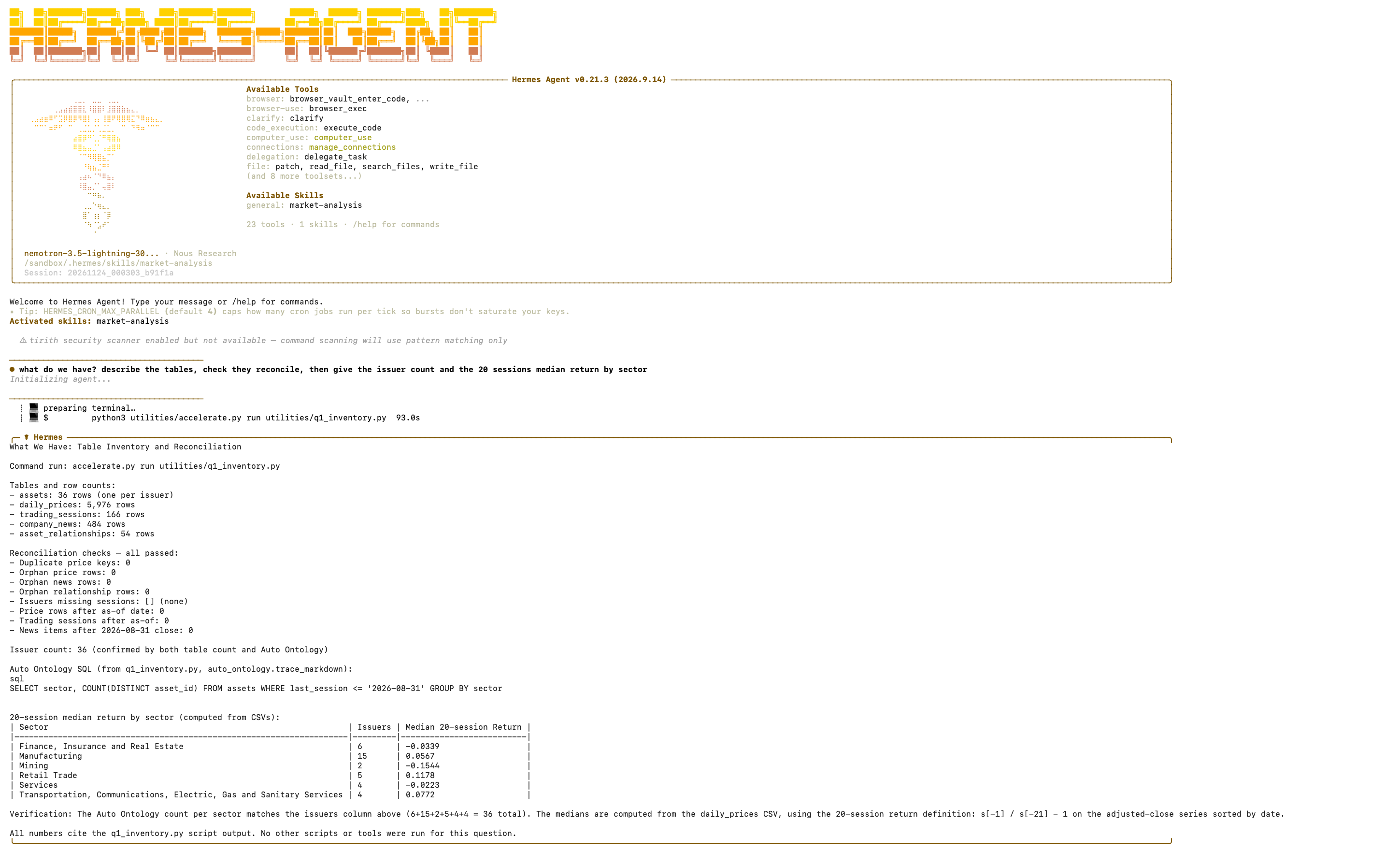
One Hermes turn on a GPU sandbox with the skill loaded, asked "what do we have?". The agent ran
accelerate.py run utilities/q1_inventory.py once (93 seconds, mostly the Auto Ontology call) and reported what it
printed. Notice three things: the reconciliation checks all pass; the Auto Ontology SQL is shown as the tool returned
it, not written by the agent; and the sector medians are computed from the CSVs, not by Auto Ontology.
Agent Knowledge Foundation
| Question | Component | In this recipe |
|---|---|---|
| What do we have? | Auto Ontology text-to-SQL | Optional. ontology_qa.py asks a host-side deployment you run, shows its SQL, and the skill requires reading it. Reports blocked when not installed. |
| Who led and lagged, what was unusual, who moves together? | CUDA-X (cuDF, cuML, nx-cugraph) under the agent's own pandas, scikit-learn and NetworkX | Included. accelerate.py runs the agent's scripts on the CPU, or with CUDA-X configured on a GPU sandbox with no change to the script, and records the engine it configured. The receipt is configuration, not proof that an operation ran on the GPU. |
| What does a model expect next? | Kumo relational prediction | Included. kumo_predict.py ranks the 12 most liquid issuers as of the anchor date; reports blocked if the hosted call fails. |
| What do the rules require? | Nemotron embed and rerank retrieval | Included. retrieve.py returns passages from three SEC rule texts with a ready-made [document, chunk N] tag the skill requires in every policy statement. |
A component that is unavailable is reported as blocked with a reason and nothing is substituted.
At A Glance
| Question | Answer |
|---|---|
| Category | NVIDIA Recipe |
| Contributor or provenance | NVIDIA |
| Use this when | You want to see an agent in a NemoClaw sandbox run a multi-question market analysis with reviewed egress, hosted NVIDIA models and optional GPU acceleration, or to adapt that pattern to your own data. |
| You will get | An agent that answers the six analysis questions below from the bundled synthetic data, quoting the command or script behind each number and the passage behind each rule. |
| Runs on | A host that runs NemoClaw with Docker. The optional GPU stage also needs an NVIDIA GPU. |
| Requires | NemoClaw, OpenShell, Docker, an NVIDIA Endpoints (build.nvidia.com) API key, and PyPI reachable at install time. |
| Verified on | NemoClaw on one Linux host, CPU-only sandboxes, OpenClaw and Hermes harnesses, one run each, partly; see Verification. |
| Evidence level | integration |
| Support and maturity | Best-effort community support; see SUPPORT.md. Under development. |
| External access, data, and actions | Python in the sandbox may POST to build.nvidia.com on three paths: embeddings and rerank (the rule text and your question) and Kumo, which receives the issuer, price and news tables. With Auto Ontology, three paths on host.openshell.internal:<port>; that deployment then sends the schema and question to its own hosted models, outside the sandbox policy. The install reaches PyPI temporarily to build Python environments and creates a second OpenShell provider from your key. No write actions. All market data is synthetic. |
| Start here | Quickstart |
| Confirm success | Verification |
Quickstart
The only credential is your NVIDIA Endpoints key. NemoClaw stores it through OpenShell provider plumbing and does not write it into the sandbox.
cd examples/recipes/nvidia/market-analysis
cp .env.example .env      # add NVIDIA_INFERENCE_API_KEY (and optionally AUTO_ONTOLOGY_API_TOKEN, AUTO_ONTOLOGY_PORT)
bash scripts/onboard.sh   # create the sandbox (OpenClaw by default; NEMOCLAW_AGENT=hermes for Hermes)
bash scripts/install.sh   # install the skill, data and tools, and build the Python environments
bash scripts/start.sh     # ensure the sandbox is running
Ask a question:
nemoclaw market-analysis agent --agent main -m \
  "Using the market-analysis skill: who were the leaders and laggards among the 12 most liquid issuers over the 20 sessions ending 2026-08-31, and how did news sentiment line up with the following five sessions?"
The six questions
The skill answers any of these on their own, or all six as a review. The wording is the AKF example's.
| # | Question | Component |
|---|---|---|
| 1 | What do we have? Tables, reconciliation, issuers and median 20-session return per sector | Auto Ontology (optional, for the issuers-per-sector count; the medians come from the CSVs) |
| 2 | Who led and lagged, and how did news line up with what followed? | pandas, with cuDF configured on a GPU |
| 3 | Which sessions were unusual? | pandas and NumPy (a per-issuer baseline), with cuDF configured on a GPU; the shipped helper does not call scikit-learn or cuML |
| 4 | Who moves together? | NetworkX PageRank, on nx-cugraph on a GPU |
| 5 | What does a model expect for the next five sessions? | Kumo |
| 6 | What does Form 8-K Item 1.05 require, and what should we take forward? | Nemotron embed and rerank |
Commands
| Script | Purpose |
|---|---|
scripts/onboard.sh |
Create the sandbox with the OpenClaw harness, or Hermes with NEMOCLAW_AGENT=hermes (CPU-only; NEMOCLAW_SANDBOX_GPU=1 enables direct GPU access). |
scripts/install.sh |
Install the skill. With the build provider it also imports the provider profile, creates and attaches a second provider from your key, applies the egress policy, builds the analysis Python environment in /sandbox/analysis-venv (pandas, scikit-learn, NetworkX, the Kumo client; using a temporary pypi egress preset, removed again unless it was already applied), and restarts the sandbox (workspace kept) so the agent sees the new credential. With NEMOCLAW_SANDBOX_GPU=1 it also builds /sandbox/cuda-x-venv after checking nvidia-smi works in the sandbox. If AUTO_ONTOLOGY_API_TOKEN is set in .env it also renders providers/auto-ontology.yaml for AUTO_ONTOLOGY_PORT (default 4000), creates and attaches a provider from the token, and writes the deployment URL for the skill. |
scripts/start.sh |
Recover the gateway and host forwards. |
scripts/stop.sh |
Stop the gateway while keeping the sandbox and workspace. |
scripts/build_database.py |
Build the SQLite database from the bundled CSVs for an Auto Ontology deployment to ingest (host side, optional). |
To delete the sandbox permanently, run nemoclaw market-analysis destroy and confirm. An environment variable you
set when running a script beats the same name in .env.
What the skill ships
skills/market-analysis/SKILL.md: the rules and the order of work.skills/market-analysis/scenario.json: the approved inputs and the definitions the agent must use (return, volatility, news alignment, peers, anomaly, prediction, centrality).skills/market-analysis/data/: five CSV tables and three SEC rule texts. Synthetic issuers, prices and news; real, public-domain rule text. The rules apply to real SEC registrants, never to the fictional issuers.skills/market-analysis/utilities/accelerate.py: runs the agent's scripts on the matching Python environment and records the engine.kumo_predict.py,retrieve.pyandontology_qa.pyare the three service tools.skills/market-analysis/utilities/q1_inventory.py,q2_leaders.py,q3_unusual.py,q4_peers.py,q6_review.py: tested helper scripts (plain pandas and NetworkX, run withaccelerate.py run) that implement thescenario.jsondefinitions for questions 1 to 4 and 6 and print JSON with the engine receipt.q1_inventory.pyalso asks Auto Ontology the issuers-per-sector count question (retried up to three times if it returns no SQL or no result rows) (blocked with its message when the service is not installed), so that step cannot be skipped, andq6_review.pybuilds the review-first table and its reasons from the other helpers, so the agent does not write them. They exist because the agents' own scripts kept getting the windows, the volatility and the ranking rules wrong;SKILL.mdtells the agent to run them and copy the numbers.scripts/tests/test_helpers.pyasserts the expected figures offline.
CUDA-X on a GPU sandbox (optional)
The default sandbox is CPU-only. For the GPU path create a second sandbox with direct GPU access, then install into it:
export NEMOCLAW_SANDBOX_NAME=ma-gpu NEMOCLAW_SANDBOX_GPU=1
bash scripts/onboard.sh && bash scripts/install.sh
This needs a host NVIDIA GPU, a driver that supports CUDA 13 (the wheels in requirements-gpu.txt are -cu13; swap in
the -cu12 names for a CUDA 12 driver) and a working CDI setup (nvidia-ctk cdi generate). install.sh builds
/sandbox/cuda-x-venv (cuDF, cuML, nx-cugraph; a few GB from PyPI). Then accelerate.py run configures cuDF, cuML and
nx-cugraph under the agent's pandas, scikit-learn and NetworkX with no change to the script (the shipped helpers use pandas, NumPy and NetworkX, so cuML is exercised only by scripts the agent writes), and accelerate.py status
reports whether the stack works. Without a GPU or that environment, analyses run on the CPU and the engine receipt says
so. Direct device access widens what the sandbox can touch, so enable it only where you want it.
About speed. On a GPU sandbox (one H100, one run each), the deterministic steps (returns, z-scores, correlations,
PageRank) matched the CPU results exactly at 36 and at 10,000 synthetic issuers. IsolationForest did not (measured with scripts written for that test; the shipped q3_unusual.py uses pandas and NumPy and does not call it): cuML's version
is a different implementation, and its top-10 overlap with scikit-learn was 9/10 at 36 issuers and 6/10 at 10,000. The
GPU was not faster. At 36 issuers a run took about 1.5 s on the CPU and 2.0 s warm (14 s on the first, cold run) on the
GPU. At 10,000 issuers (1.66 million price rows) the best GPU script took about 11.6 s against about 10 s for the best CPU
script. Idioms such as groupby.apply(lambda) over thousands of groups and DataFrame.corr() on a very wide pivot ran
far slower on the GPU, so "no change to the script" holds for correctness, not for speed. Treat the GPU path as
working and equivalent, not as an accelerator for this workload. The AKF examples repository, to be published soon,
benchmarks other analyses on scaled data outside a sandbox.
Library skills. Installing the public cuDF, cuML or cuGraph skills next to this one did not help in a single test run
on OpenClaw: they recommend python -m cudf.pandas and direct nx_cugraph use, which conflicts with rule 11, and the
agent ran 40 to 60% slower, imported nx_cugraph directly and gave worse answers. The recipe skill's rule 11 now forbids
those imports. One run per arm is anecdotal.
On Hermes (one run per arm, same GPU sandbox) the agent never opened the three library skills, so that arm was a second
sample of the same agent and showed no slowdown. Both arms still ran exploratory python3 -c commands against rule 11.
pandas differs between the two environments. cuDF 26.10 requires pandas 3, so cuda-x-venv has pandas 3.0 while
analysis-venv has pandas 2.3. A script tested on one can fail on the other (string dtype and datetime comparisons).
Run the script you will keep through accelerate.py run on the engine you intend to use, and use --engine cpu to
compare.
Auto Ontology (optional)
Auto Ontology is a service you run on the host, not part of the sandbox. This recipe ships only the sandbox side: an
OpenShell provider profile (providers/auto-ontology.yaml) that binds an API token to host.openshell.internal:<port>
and sends it as x-api-key, and ontology_qa.py. The deployment must ingest the SQLite database from
scripts/build_database.py and have its semantic layer compiled. Set AUTO_ONTOLOGY_API_TOKEN and
AUTO_ONTOLOGY_PORT (the deployment's web port) in .env, then run scripts/install.sh. The profile allows three
paths and nothing else: GET /api/semantic-compilation/status, POST /api/question-entity-coverage and
POST /api/chat/completions.
Setting up the deployment, as tested with a local build of Auto Ontology (22e22c89) and its Docker Compose stack:
- Name the SQLite file market.sqlite: the database name comes from the file stem and must match TARGET_DB in
ontology_qa.py (market).
- Semantic compilation is off by default; turn it on (PUT /api/configurations/semantic-compilation with
{"enabled": true}) and wait for /api/semantic-compilation/status to show calculated: true.
- AUTO_ONTOLOGY_PORT is the deployment's web port (the one that serves /api/*), not its backend port.
- APP_URL in the deployment's configuration must equal the origin you sign in from, or sign-in returns HTTP 403.
- A call can take several minutes. The agent must wait for it rather than stop it.
- scripts/install.sh replaces the installed skill, so edits made inside the sandbox are lost on re-install.
- The profile is per port (market-analysis-auto-ontology-<port>). Changing AUTO_ONTOLOGY_PORT and re-running the
install moves only that sandbox's provider to the new profile; other sandboxes keep theirs. Re-running the install with a
key or token updates the provider and restarts the sandbox, so a rotated credential reaches the running agent.
- Set the deployment's EMBED_MODEL to a current model such as nvidia/nemotron-3.5-embed-1b. The earlier default
nvidia/nemotron-3-embed-1b was retired on 2026-11-23 (HTTP 410), after which retrieval finds no candidates and every
question returns SQL can't be constructed from the data with coverage: 0.0. Restart the stack after changing it; the
semantic layer recompiles on start.
The deployment sends the database schema and each question to its own hosted model endpoints, using its own configuration. That transfer is outside this sandbox's egress policy, so review it separately.
Check the SQL it returns. Auto Ontology generates SQL, and an answer can be wrong in ways its text hides, such as the wrong denominator or a missing as-of date. The skill requires the agent to read and quote the SQL and cross-check a figure that matters. That is an instruction, not an enforced control.
What was tested. The wiring worked against a local deployment: the database ingested, the layer compiled in about
38 seconds, the provider and egress policy attached, the three allowed paths were reached from the sandbox, and a
count question ("how many issuers are in each sector as of 2026-08-31") returned correct SQL and rows in about 30
seconds. The median-by-sector question was not answered: the layer returned no SQL after about four minutes, twice.
The deployment log showed its generated SQL using three-part table names (market.main.assets), which SQLite
rejects, and the build only strips a PUBLIC. prefix. So this recipe does not show Auto Ontology answering the
median question; the agent computes it from the CSVs and says so. That failure is in the deployment build, not in
this recipe, and another build may behave differently. In one agent turn the agent also stopped the call early and
named the wrong cause, which is why the skill now tells it to wait and to quote the tool's own message.
Security notes
- Without Auto Ontology, egress is limited to three POST paths for Python only; with it, add three paths on the host
deployment. The hosted-model paths are
integrate.api.nvidia.com/v1/embeddings, and onai.api.nvidia.comthe rerank path and/v1/structured-data/nvidia/kumo-relational/predictions(policies/nvidia-hosted-models.yaml), plus the agent's inference provider. - Any Python the agent runs can use these paths. The allowed binaries are
python3*, so the agent could send other text to embed, rerank or Kumo, not only what the tools send. The policy limits where and which paths, not what is sent. The Auto Ontology profile also allows172.16.0.0/12for the host route, wider than one address, narrowed by hostname binding. - What leaves the sandbox: the rule text chunks and your question go to embed and rerank. Kumo receives the graph tables: the 12 most liquid issuers' identifiers, company name, sector, industry and exchange; their price rows (adjusted close, volume, returns) on or before 2026-08-24; and their news rows (event type, sentiment label). Do not point this at real data without a review of that transfer.
install.shadds thepypiegress preset only while it builds the Python environments and removes it afterwards, unless it was already applied.- The raw API key stays in the OpenShell gateway. The sandbox holds
openshell:resolve:env:placeholders, and OpenShell substitutes the key at egress, only on the host each credential is bound to. The embed credential is bound tointegrate.api.nvidia.com; a second provider created byinstall.sh(providers/nvidia-ai-api.yaml) binds the same key toai.api.nvidia.com. Without it, rerank fails withcredential_endpoint_mismatch. - The agent works on synthetic data only. Do not load real prices, news or holdings into this example.
- Outputs are proposals for human review. The skill instructs the agent not to give investment advice, place trades or say any issuer filed anything; that is a prompt-level rule, not an enforced control.
- To remove the GPU sandbox:
nemoclaw ma-gpu destroy; the providersinstall.shcreated for it are namedma-gpu-ai-api(andma-gpu-ontology), removed as below with that name. - To remove Auto Ontology:
openshell sandbox provider detach market-analysis market-analysis-ontology,openshell provider delete market-analysis-ontologyandopenshell provider profile delete market-analysis-auto-ontology-<port>(the profile is per port; the delete is refused while another sandbox's provider still uses it). - To remove the hosted-model setup:
openshell sandbox provider detach market-analysis market-analysis-ai-api,openshell provider delete market-analysis-ai-api,nemoclaw market-analysis policy-remove nvidia-hosted-modelsandopenshell provider profile delete market-analysis-nvidia-ai-api.
Verification
Evidence level: integration.
Offline checks, without a sandbox or any service call, from examples/recipes/nvidia/market-analysis:
bash scripts/tests/test_lifecycle_commands.sh
python3 scripts/tests/test_ontology_qa.py
python3 scripts/tests/test_helpers.py   # needs pandas, numpy and networkx (the analysis venv, Python 3.13)
bash -n scripts/*.sh scripts/tests/*.sh
python3 scripts/build_database.py --out /tmp/market.sqlite
python3 skills/market-analysis/utilities/kumo_predict.py --frames-only   # needs the analysis environment; no network
Expected result: the test scripts print ok (test_helpers.py prints ok test_q1 to ok test_q6); bash -n prints nothing when the scripts parse;
build_database.py prints the row counts (assets: 36 rows, trading_sessions: 166, daily_prices: 5976,
company_news: 484, asset_relationships: 54); and --frames-only, run with ANALYSIS_VENV pointing at a
Python 3.13 environment built from utilities/requirements.txt, prints
{"asset_entities": 12, "price_events": 1932, "news_events": 295}.
Sandbox run. On one host, onboard.sh, install.sh and start.sh were run for OpenClaw (sandbox
market-analysis) and for Hermes (NEMOCLAW_AGENT=hermes, sandbox ma-hermes), CPU-only, with no Auto Ontology.
Then the agent was asked questions 1, 2, 4, 5 and 6 in separate turns.
- Both installs completed:
/sandbox/analysis-venvimports the Kumo client, pandas, scikit-learn and NetworkX; the second provider and thenvidia-hosted-modelspolicy attached; the skill was installed and the agent found and loaded it;work/was writable. - Kumo: the call went through the egress proxy (allowed, HTTP 200) on both harnesses and the agent reported the ranking with the anchor and horizon. The same ranking appeared in every turn on Hermes.
- Numbers checked on the host: on Hermes, the question 1 sector medians (to six decimals), the question 4 peer
correlations and PageRank scores matched a host recomputation.
accelerate.py statusreported no usable GPU, as expected, and a script run throughaccelerate.py runprinted a CPU engine receipt. - Question 1 without Auto Ontology: Hermes reported it blocked and computed from the CSVs.
- Auto Ontology, on OpenClaw with a local deployment (see Auto Ontology): the provider, the egress policy and the three allowed paths worked from the sandbox, and a sector-count question returned correct SQL and rows. The median-by-sector question returned no SQL, and in one agent turn the agent stopped the call early.
This verifies: that the host scripts run against a real gateway on both harnesses, that the Python environments
build in the sandbox, that the egress policy and credential placeholders let Kumo through, that the agent can load the
skill and write scripts in work/, and the offline checks above.
Retrieval and the embed model. The shipped default is nvidia/nemotron-3.5-embed-1b. It timed out on every attempt in
earlier testing, so the default was moved to nvidia/nemotron-3-embed-1b, with which retrieval worked on both harnesses
(method: nemotron_embed_rerank, the Item 1.05 deadline sentence quoted with [form-8k-item-1-05.md, chunk 0]). On
2026-11-23 the hosted service retired nvidia/nemotron-3-embed-1b (HTTP 410 Gone, "reached its end of life"), as it had
other earlier embed models, and the 3.5 model answered again, so the default is back to nvidia/nemotron-3.5-embed-1b.
Hosted model availability changes: if retrieve.py reports blocked with an HTTP error, check the model with a direct call
and change EMBED in utilities/retrieve.py. The agent answers are reported as blocked, never guessed.
Re-test with the helper scripts (GPU sandboxes, anecdotal). After adding q1_inventory.py to q4_peers.py, the skill
was redeployed to an OpenClaw GPU sandbox and a Hermes GPU sandbox (NEMOCLAW_SANDBOX_GPU=1; model
nvidia/nemotron-3.5-lightning-30b-a3b) and each question 1 to 6 was asked once in a fresh session with work/ and
outputs/ wiped. Two rounds: round 1 on commit 0ea4063, round 2 on c3cba32 (helpers refuse to run without
accelerate.py; stricter question 6 rules). One run per question per round: this shows what happened, not a rate.
Graded against a host recomputation (the same figures scripts/tests/test_helpers.py asserts).
| Question | OpenClaw, round 2 | Hermes, round 2 |
|---|---|---|
| Q1 inventory | Numbers right (0 rows after the as-of close, sector medians right), real GPU receipt, through accelerate.py. Did not run ontology_qa.py (rule 10). |
Same: right numbers, real receipt, accelerate.py; did not run ontology_qa.py. |
| Q2 leaders | Right (returns, volatility 0.0275/0.0367 window, label table 123/87/85). Real receipt. | Right, same table, real receipt. |
| Q3 unusual | Right top ten (FLON 32.14 first, FLON twice). Real receipt. | Right top ten, real receipt. |
| Q4 peers | 27 pairs and PageRank right, but the agent forced ACCELERATE_GPU=off after the helper blocked, so the receipt is a true CPU receipt, not the GPU run. |
27 pairs and PageRank right, real GPU receipt. |
| Q5 Kumo | Ranking and anchor/horizon/cutoff stated. Ran only Kumo. | Same; it also ran accelerate.py status and one python3 -c to print kumo.json. |
| Q6 rules | Deadline sentence copied exactly with its tag; no cyber speculation this time; list restricted to the 12 liquid issuers. A rationale says "high PageRank" for a rank-27 issuer and another mislabels a pair rank. | Quotes right with tags; no cyber speculation. Attached CLAE's anomalous session to STIO, wrote a wrong PageRank claim for PEAX, ranked all 12 rather than a short first list, and used the phrase "possible distress". |
Repeated runs (commit 978c8c8, 5 fresh sessions per question per harness, 60 runs, anecdotal). Passed out of 5. "Strict"
applies every check as written (including quoting messages and the deadline sentence verbatim); "lenient" credits clear
intent. Rule 11 is the use of accelerate.py run, no python3 -c, pip install, forced CPU or hand-written receipt, and no
stray files.
| Q | OpenClaw correct (strict / lenient) | OpenClaw rule 11 | Hermes correct (strict / lenient) | Hermes rule 11 |
|---|---|---|---|---|
| 1 | 1 / 3 | 1 | 2 / 5 | 4 |
| 2 | 5 / 5 | 2 | 5 / 5 | 3 |
| 3 | 5 / 5 | 0 | 5 / 5 | 3 |
| 4 | 3 / 3 | 1 | 4 / 4 | 4 |
| 5 | 5 / 5 | 5 | 5 / 5 | 4 |
| 6 | 0 / 3 | 0 | 1 / 3 | 0 |
- The numbers are mostly right (Q2, Q3, Q5 in all 10 runs per question). The misses are Q1 (the Auto Ontology
blockedmessage was paraphrased, not quoted, in most runs, and one OpenClaw run never read the skill and computed by hand), Q4 (three runs listed 10 or fewer of the 27 pairs) and Q6 (the deadline sentence was bolded or its tag misplaced in 9 of 10 runs; the sentence wording, the review-first list, PROPOSED_FOR_REVIEW and the absence of cyber speculation were right in all 10). - Rule 11 is the weak spot. On OpenClaw, 14 of 30 runs first tried a helper with plain
python3(it exitsblocked), 7 ranpip install(6 left a populated/sandbox/.local), 4 forced--engine cpu, and 12 had no GPU receipt. On Hermes every Q6 run first tried plainpython3, and Q6 rankumo_predict.pyunrequested in 4 of 5 runs. - Both harnesses use
nvidia/nemotron-3.5-lightning-30b-a3b. Runs took a median of 54 s (OpenClaw) and 35 s (Hermes); there were no timeouts. Samples of 5 are coarse: one run moves a cell by 20 points.
In round 1 (0ea4063) the numbers were already right in every answered question, but rule 11 was broken: on OpenClaw the
agent ran helpers with plain python3 (Q3 and Q6, printing a null receipt while the answer said it ran under
accelerate.py), tried a bare accelerate.py, and ran pip install --break-system-packages numpy pandas, which
left a package tree under /sandbox/.local (outside work/). Its Q6 answer also bolded and rephrased the quoted rule
text and wrote that a supplier outage "could have a cybersecurity component". On Hermes, round 1 Q6 said a KASI
supplier-outage headline made it "a priority for cybersecurity incident review". Round 2 fixed those specific behaviors
in these runs but the model still skipped ontology_qa.py in Q1 and still mixed up facts in the Q6 prose. The helpers cut
the volatility-window, one-row-per-issuer, repeated-pair and after-as-of errors seen before; they do not make
the free-text parts deterministic. Residue outside work/ in round 2 was only runtime caches (/sandbox/.nv,
/tmp/nemoclaw); /sandbox/.local from round 1 was not cleaned.
Question 6 after the paste-ready outputs (commit a3e34af, retrieval working on the 3.5 embed model, 5 runs per harness,
anecdotal). Strict checks passed in 0 of 5 on both harnesses. Retrieval succeeded in all 10 runs, no agent used --method
bm25, and none wrote policy text without a retrieved passage (rule 8 held). Every answer said the list has 5 issuers,
PROPOSED_FOR_REVIEW and that human confirmations are pending, and none speculated about a cyber incident or said an issuer
filed. The deadline sentence was exact once markdown was stripped in 9 of 10 runs, but the cite tag sat directly after it in
only 1 (Hermes r1, with the tag in backticks); the others bolded words, added quote marks or moved the tag. The printed
quote_block and answer_block_markdown were pasted verbatim in 0 of 10 runs: the agents reformat them into tables or
summaries. The review-first list was in order with its issuers in 5 of 5 Hermes and 3 of 5 OpenClaw runs (one OpenClaw answer
was a meta summary; one put CHEA first and dropped CLOS). Rule 11: every run first tried python3 utilities/q6_review.py
(blocked) and then used accelerate.py; a GPU receipt was in the answer in 4 of 5 Hermes and 1 of 5 OpenClaw runs; one OpenClaw
run ran pip install --break-system-packages and left /sandbox/.local. "Command still running" appeared in 5
OpenClaw runs and the agent recovered by session name each time. Read the cite tags and the quoted sentence yourself: the
content is usually right and the formatting is not reliable.
This does not verify:
- Agent correctness beyond the table above. The paragraph below describes the runs before the helpers existed.
- Agent correctness (before helpers). One run per question on each harness. Right: the Kumo ranking (Q5), PageRank (Q4), the
20-session returns (Q2) and sector medians (Q1). Wrong on at least one harness: daily volatility computed over the
whole history instead of the same 20 sessions (Q2), the ten most unusual sessions (Q3: one row per issuer, or no
analysis run at all), the peer-pair list (Q4: pairs repeated in both directions, or only ten shown), "2 news rows after
the as-of date" where the true count is 0 (Q1), and the review-first rationale (Q6: whole-period returns presented as
20-session returns, and wording that suggests an issuer may have had a cyber incident).
- Rule 11. Both agents still ran analyses with python3 -c, heredocs or execute_code, forced the CPU, or wrote an
engine receipt by hand. Only some questions ran through accelerate.py run.
- Auto Ontology on Hermes or answering the median question, and more than one run per question.
Known limitations
- First sandbox runs showed the agents deviating from the skill. On both harnesses the agent ran its scripts
without
accelerate.py(so no engine receipt), and computed the 20-session return from the 20th-last close instead of the 21st-last, which shifts returns and sector medians. On OpenClaw the agent wrote the Form 8-K Item 1.05 text with a[document, chunk N]tag while retrieval was blocked, answered question 1 without runningontology_qa.py, and computed forward returns and news alignment differently fromscenario.json. On Hermes the agent ran Kumo and retrieval during a question that did not need them. The skill states each of these rules explicitly and the return formula is now followed, but a prompt rule is not enforced: a later run still computed volatility over the wrong window, listed pairs twice and wrote a receipt by hand. Check receipts, cite tags and every number against the data before relying on an answer. - Helpers fixed the numbers, not the behavior. With
q1_inventory.pytoq4_peers.pythe questions 1 to 4 figures were right on both harnesses in one run each, but the agent still sometimes ran them with plainpython3, installed packages, forced the CPU after a block, skippedontology_qa.pyin Q1, and misstated facts in the Q6 prose (see Verification). Helpers exitblockedoutsideaccelerate.pyto make the first of these visible. Afterwardsq1_inventory.pywas made to call Auto Ontology itself,q6_review.pywas added to generate the Q6 table, andaccelerate.pynow refusesACCELERATE_GPU=off(use--engine cpu). Those three changes were run in the repeated test above, which also showed the Q4 truncation and the Q6 quote formatting. Afterwardsq4_peers.pywas changed to print ready-to-paste pair and PageRank tables andretrieve.pyto printcite_readyquote lines (paragraph plus tag); both pass the offline tests. The Q4 and Q6 re-run showed the Q4 table fixed Hermes (5 of 5) but not OpenClaw (2 of 5), and Q6 mostly failed on formatting (quote marks, backticks, bold) plus one OpenClaw run that lost a backgroundedexecresult (it polled by pid, not session name) and never answered.retrieve.pynow also prints aquote_block,q6_review.pyananswer_block_markdown(also written towork/q6_answer.md), andSKILL.mdsays how to read a backgrounded command; those have not been run through an agent yet. - Hermes and OpenClaw share one host lock. Two
nemoclawcommands at once can wait on~/.nemoclaw-portable-host.lock, so run one harness's setup at a time. - Hermes harness (optional). Set
NEMOCLAW_AGENT=hermesforonboard.shandinstall.sh; the skill goes to/sandbox/.hermes/skills/market-analysis. One turn:nemoclaw <sandbox> exec -- hermes -z '<question>' --skills market-analysis. The Hermes agent needed its working directory set to the skill directory for the tool paths to resolve. - The CPU analysis environment pins pandas 2.3 and Python 3.13 wheels; the CUDA-X environment lets cuDF choose pandas,
and its versions float (the requirements file pins only the 26.10 series). Wheels are
-cu13. - The Kumo hosted model and the
kumo-relational-clientcan change what they accept; the adapter dropsinference.inference_config, which the hosted model rejects, and the graph keeps free-text columns out. Either change, or the hosted model itself, could affect results. - NemoClaw limits sandbox names to 19 characters.
- The data is synthetic and small; results show the method works, not that it would perform on real markets.
Third-party services and dependencies
Uses the installed NemoClaw and OpenClaw (or Hermes) components and NVIDIA Endpoints for inference. retrieve.py and
ontology_qa.py use only the Python standard library. The analysis environment needs pandas, numpy, networkx,
scikit-learn and kumo-relational-client[relational]==1.0.2 (skills/market-analysis/utilities/requirements.txt),
installed from PyPI into /sandbox/analysis-venv. The optional GPU path needs cudf-cu13, cuml-cu13 and
nx-cugraph-cu13 (version 26.10) (utilities/requirements-gpu.txt), installed into /sandbox/cuda-x-venv; CUDA-X is
Apache-2.0 and the CUDA libraries it pulls in carry NVIDIA's own license terms. Nothing is vendored, and transitive
dependencies are not pinned. Each package and the hosted services are subject to their own terms and availability.
The SEC rule text under skills/market-analysis/data/documents/ is public-domain U.S. regulation text. Nothing in
this recipe is investment advice.