
mnemo measures what a memory system can answer after ingesting email and chat, and what ingesting and answering cost. It reports quality and cost separately across two synthetic corpora.
Table of Contents
- What A Run Looks Like
- What Is In The Corpora
- What It Asks
- Getting Started
- Reading A Result
- Published Results
- Troubleshooting
- Cleanup
- For Contributors
- Project Structure
- Configuration
- Adding Your System
- How The Runner Treats Your Adapter
- Verification
- Provenance And License
What A Run Looks Like
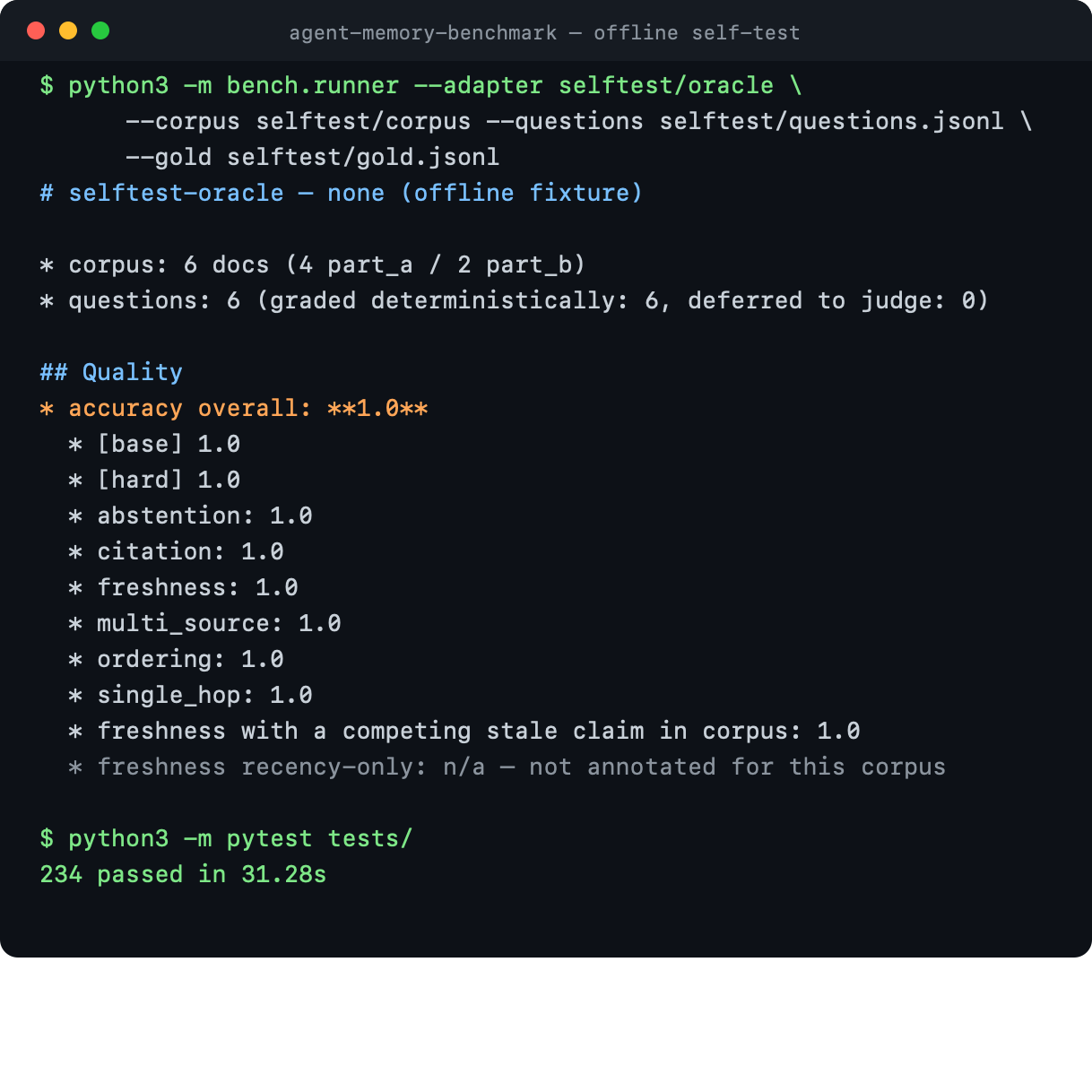
The offline oracle scores 1.0 on a six-document fixture, then the suite
passes. Searchable form of the result: accuracy overall: 1.0, every
question type at 1.0, and deferred to judge: 0. Note that freshness
splits into two lines — a system must not only be current, it must resist a
stale value still sitting in the corpus.
What Is In The Corpora
| Documents | Period | Domain | |
|---|---|---|---|
Corpus A (corpus_a/) — details |
425 — 200 emails, 225 channel-days of chat (559 messages) | 2026-04-16 → 2026-05-27 | a software platform-engineering team |
Corpus B (corpus_b/) — details |
173 — 100 emails, 73 channel-days (383 messages) | 2027-07-20 → 2027-09-24 | a construction program manager running three sites |
Corpus B uses a different domain and generation model so results can be checked across corpora. Both corpora are fully synthetic; see their READMEs for provenance and limitations.
Corpus A ships in two halves, and both are ingested in order:
corpus_a/corpus/part_a/   2026-04-16 .. 2026-05-11
corpus_a/corpus/part_b/   2026-05-12 .. 2026-05-27   # supersedes part_a in places
The runner makes two ingest calls in order, testing whether memory handles
later information that supersedes earlier claims.
What It Asks
Base set (155)
| Type | Count | What it catches |
|---|---|---|
single_hop |
30 | a fact stated in one document |
multi_source |
73 | a fact corroborated across several documents |
disambiguation |
15 | merging two things that only look alike, or splitting one that is not two |
abstention |
13 | answering confidently about something the corpus never says |
freshness |
12 | reporting a superseded value as if it were current |
citation |
12 | recalling a detail only one document carries; cited ids are a diagnostic, not accuracy |
Hard set (31)
Added when the base set stopped separating systems.
| Type | Count | What it catches |
|---|---|---|
set_difference |
6 | which member of a plausible set does not belong |
as_of |
6 | what was true at a date, not what is true now |
constraint |
5 | two or three conditions at once, each matching several candidates alone |
chain_freshness |
5 | a value that moved twice — where it started and where it ended |
attribution |
5 | who proposed something versus who carried it out |
ordering |
4 | placing events relative to each other rather than looking one up |
as_oftests whether a system retained historical values instead of only the latest one.
All 186 questions are graded deterministically; no model runs in the scoring
path. Answers are normalized for case, punctuation, whitespace, date spelling,
and thousands separators before applying each mode's explicit rule set. Reports
still include deferred_to_judge, which is always zero for shipped questions.
Abstention questions have no correct answer. Something merely scheduled has not happened; a merge request that exists only as a reserved URL has not been reviewed. Confidently describing either is scored wrong, and saying "the corpus does not say" is scored right.
Getting Started
Use Python 3.9+ on macOS or Linux, and install pytest and tesseract; the
harness itself imports only the standard library. tesseract is required by two
tests that read the README image and check it shows the run the suite verifies —
without it those two fail rather than skip, because a check a machine might not
run is not a check. A real run also needs an API key for the
configured endpoint. The shipped adapters invoke python3, which a default
Windows installation does not provide.
The entry point is python3 -m bench.runner and the offline check is
python3 -m pytest tests/. Corpus A is the default; corpus_b/ holds the
second corpus, and docs/SUBMITTING.md is the adapter
contract.
1. Check it works — offline, free, no API key
Offline and free. This path sends nothing over the network.
cd examples/tools/agent-memory-benchmark
python3 -m pip install pytest
brew install tesseract        # macOS; on Linux: apt-get install tesseract-ocr
python3 -m pytest tests/      # expected: 234 passed
Then run the whole pipeline against a fixture whose score is known in advance:
python3 -m bench.runner \
    --adapter selftest/oracle \
    --corpus selftest/corpus \
    --questions selftest/questions.jsonl \
    --gold selftest/gold.jsonl
The oracle scores exactly 1.0; its sibling selftest/wrong scores exactly
0.0, wrong in a different way per grading mode. Any drift between the runner
and the report moves a number the tests pin.
2. Score a real system
This spends money and sends data. Corpus text and questions are sent to the endpoint you point
--upstreamat, and you pay for those tokens. The harness itself writes only underresults/— but an adapter you add is not sandboxed and can write anywhere your user can.
export OPENAI_API_KEY=<your key>
python3 -m bench.runner --adapter adapters/naive_rag
The runner ingests both corpus halves in order, feeds
corpus_a/questions/questions.jsonl to your system, grades the answers, and writes
report.json + summary.md under results/runs/.
| Baseline adapter | What it is |
|---|---|
adapters/naive_rag |
embedding index, single retrieval pass |
adapters/agentic_rag |
embedding index; the model writes its own queries over up to three rounds |
adapters/ledger_rag |
drives the Memory-Driven Chief of Staff ledger; SQLite ingest needs no network |
ledger_ragdoes not score the recipe itself. The adapter adds candidate selection and answer generation to a ledger designed for triage and ranking. It does not modify the recipe.
Reading A Result
Compare per-question-type accuracy, not only the overall average. Freshness separates cases with and without a competing stale claim. Evidence recall and citation coverage remain diagnostics rather than accuracy inputs.
Why the two axes are never combined, and what deterministic grading cannot
express: docs/methodology.md.
Two reports are comparable only when their fingerprint blocks match — same
corpus, same questions, same answer key, same normalization, same scorer.
Published Results
The repository includes one self-model run and one agentic retrieval run on corpus A with the same base model and grader. The artifacts show their scores and separate ingest and answer costs, but do not include the self-model's memory or enough accounting evidence for a cost ratio.
Read results/README.md before the table there. Those
runs are corpus A only, on one base model; their answers predate a rename at
publication; and their accounting cannot support a cost comparison. All four
limits are stated where the numbers are.
Troubleshooting
| Symptom | Cause | Fix |
|---|---|---|
No module named pytest |
pytest is a dev dependency and is not vendored. |
python3 -m pip install pytest |
| Two image tests fail with tesseract is required | The README image is verified by reading it, so the tool is required rather than optional. | brew install tesseract, or apt-get install tesseract-ocr |
No module named 'bench' |
python3 -m bench.runner was run from a different directory; -m resolves the package from the current one. |
cd examples/tools/agent-memory-benchmark and re-run. |
| Adapter command not found on Windows | The shipped adapters invoke python3, which a default Windows install does not provide. |
Run on macOS or Linux, or under WSL. |
| Run marked invalid: declared proxy, nothing crossed it | The adapter bypassed the proxy, or it runs a locally-hosted model. | Point the client at OPENAI_BASE_URL, or declare "accounting": "local". |
| Run marked invalid: forwarded request without countable usage | The upstream returned no usage block. | Use a gateway that returns usage; a cost nobody measured must not read as zero. |
| Run marked invalid: declared local but N requests crossed the proxy | The adapter says it runs locally but its client still points at OPENAI_BASE_URL. |
Stop routing through the proxy, or declare "accounting": "proxy". |
| Run marked invalid: N of M questions received no answer | One or more answer rows are missing, blank or non-string. An incomplete submission is not a lower score. | Emit one row per question; to decline, say so in the answer rather than leaving it empty. |
USD is null in the report |
bench/pricing.py has no entry for that model. |
Expected. Token counts are still exact; the harness will not invent a price. |
| Two reports refuse to be compared | Their fingerprint blocks differ — corpus, questions, key, normalization or scorer moved. |
Re-score the stored answers: python3 tools/regrade.py --run results/runs/<dir> |
| A phase hangs, then dies at six hours | The per-phase wall-clock budget. | Raise MNEMO_TIMEOUT_SECONDS, or set 0 to wait indefinitely. |
results/ grew by hundreds of megabytes |
Each run keeps whatever memory the system under test built. | Delete the run directory; see Cleanup. |
Cleanup
Each run writes reports, verdicts, answers, and adapter state under
results/runs/<timestamp>-<adapter>/. Delete that directory to reclaim space.
By default nothing outside that directory is modified by the harness. --out
and --state will write wherever you point them, and an adapter is not
sandboxed, so one you add can write elsewhere; see
How the runner treats your adapter.
A generated run is ignored by Git. Publishing one requires an explicit
.gitignore exception.
For Contributors
Everything below is for someone adding a system, changing the harness, or verifying a claim. A reader who only wants to run the benchmark can stop here.
Project Structure
agent-memory-benchmark/
├── bench/                       the harness — no third-party imports
│   ├── runner.py                orchestrates ingest → answer → grade → report
│   ├── grader.py                deterministic scoring; denial scope, normalization
│   ├── fingerprint.py           hashes corpus+questions+gold+scorer → comparability
│   ├── proxy.py                 local proxy that counts tokens crossing the wire
│   ├── normalize.py             case, punctuation and date-spelling normalization
│   ├── answer_contract.py       what an adapter is told about the answer format
│   ├── report.py                renders report.json into summary.md
│   └── pricing.py               model → USD table; unknown model ⇒ null, never a guess
├── corpus_a/                    corpus A — the default corpus
│   ├── README.md                what it is, and why the split matters
│   ├── corpus/                  425 documents in two dated halves
│   │   ├── part_a/              2026-04-16 .. 2026-05-11
│   │   ├── part_b/              2026-05-12 .. 2026-05-27 — supersedes part_a in places
│   │   ├── manifest.jsonl       per-document provenance
│   │   ├── counts.json          the document/message counts this README quotes
│   │   └── CANARY.txt           a string that must not appear in any model output
│   └── questions/               the questions and the answer key, kept out of corpus/
│       ├── questions.jsonl      the 186 questions asked of every system
│       ├── answers.jsonl        the answer key and its grading rules
│       └── factual_*.json       the drafting record — 103 kept, 17 dropped with a reason, 0 rejected
├── corpus_b/                    corpus B — a second domain, same shape as corpus_a/
├── adapters/                    one directory per system under test
│   ├── naive_rag/               ┐
│   ├── agentic_rag/             ├ shipped baselines, each with an adapter.json
│   ├── ledger_rag/              ┘
│   └── _lib/                    shared helpers adapters may import
├── selftest/                    six documents, six questions, two known-score adapters
│   ├── oracle/                  answers everything correctly — scores exactly 1.0
│   └── wrong/                   wrong in a different way per mode — scores exactly 0.0
├── results/                     published reference runs — see results/README.md
├── tools/regrade.py             re-score stored answers against the current rules
├── docs/                        SUBMITTING.md, methodology.md, provenance.md
└── tests/                       the benchmark's own tests
Dependency files: there are none to install for the harness — bench/
imports only the Python standard library. The offline check needs pytest
(python3 -m pip install pytest) and tesseract (brew install tesseract, or
apt-get install tesseract-ocr), the latter for the two tests that read the
README image. An adapter for a third-party system declares
its own requirements separately, inside its own directory.
Configuration
adapter.json — the contract for a system under test
Every adapter is one JSON file. name, ingest and answer are required —
omitting any of them is an uncaught KeyError, not a default. model is
optional despite naming the id a result is filed under: without it the runner
falls back to the model it observed most.
{
  "name": "my-system",
  "model": "some-model-id",
  "accounting": "proxy",
  "ingest": ["my-cli", "ingest", "--corpus", "{corpus}", "--state", "{state}"],
  "answer": ["my-cli", "answer", "--state", "{state}"],
  "env": { "MY_SYSTEM_PYTHON": "python3" }
}
Field reference — the shape the runner validates:
interface AdapterConfig {
  /** Filed under this name in the report. */
  name: string;
  /** The model id a result is filed under. Not resolved by the harness. */
  model: string;
  /**
   * Argument arrays, never shell strings.
   * ingest receives {corpus} (the part directory), {state} and {part}.
   * answer receives {state} and {questions} — NOT {corpus}. Using {corpus}
   * there fails after both ingest calls have already run.
   */
  ingest: string[];
  answer: string[];
  /**
   * "proxy" (default) — calls go through the local proxy and are counted.
   * "local"           — a locally-hosted model; nothing crosses the wire, and
   *                     the run says so instead of reading as a cost of zero.
   */
  accounting?: "proxy" | "local";
  /** Defaults for adapter-specific variables. Anything already exported wins. */
  env?: Record<string, string>;
}
A declared accounting mode is enforced in both directions. Three things make a run invalid:
- it declares
proxyand nothing crossed the proxy — the adapter either bypassed it or runs a local model and should say so;- it declares
localand requests crossed the proxy anyway — the declaration and the traffic disagree, and the traffic wins;- a forwarded request came back without countable usage, because a cost nobody measured must not read as a cost of zero.
A
localrun that really is local stays valid, and stays out of cost comparisons. Only a fully counted run carriescomparable_on_cost: true.
Environment variables
| Variable | Default | What it does |
|---|---|---|
OPENAI_API_KEY |
(none) | Required to score a real system; MNEMO_API_KEY is accepted instead. Not needed offline. |
MNEMO_UPSTREAM |
https://api.openai.com |
Where the accounting proxy forwards. Also --upstream. |
MNEMO_EMBED_MODEL |
text-embedding-3-small |
Embedding model for the retrieval baselines. |
MNEMO_TIMEOUT_SECONDS |
21600 (six hours) |
Wall-clock budget per phase call. 0 waits indefinitely. Also --timeout-seconds. |
MNEMO_RAG_WORKERS |
6 |
Answer-phase concurrency for all three shipped baselines. |
MNEMO_LEDGER_TOP_K |
12 |
Candidates ledger_rag selects per question. |
MNEMO_LEDGER_SCHEMA |
recipe default path | Where ledger_rag finds the recipe's schema.sql, if the recipe is not at its usual place. |
MNEMO_MODEL |
(unset) | Overrides the model id passed to the adapter. |
MNEMO_PROXY_LOG |
(unset) | Writes a proxy request log. |
MNEMO_DEFAULT_YEAR |
2026 |
Date-normalization year. Part of the fingerprint — changing it makes a run incomparable with published ones. |
MNEMO_ALT_YEARS |
2027 |
The other year normalization accepts. Also part of the fingerprint. |
The shipped baselines default to gpt-4o and text-embedding-3-small, so they
run as printed. Point --upstream at any OpenAI-compatible gateway; model ids
are often namespaced differently there, so set model in the adapter to the id
that gateway expects.
An adapter that needs a host-specific path declares it in its env block, and
anything already exported wins — so nothing machine-specific has to be
committed:
MY_SYSTEM_PYTHON=~/src/my-system/.venv/bin/python \
    python3 -m bench.runner --adapter adapters/my_system
⏱️ The timeout applies to each phase call, and ingest is called twice, so a default run can occupy up to eighteen hours before anything is killed.
Adding Your System
- Write an
adapter.jsonas above. answerreadsquestions.jsonlon stdin and writes one JSON object per line to stdout:
{"id": "example-launch-date", "answer": "<your short answer>", "source_ids": ["E:2027-02-05T10-00-00__bbbb0002"]}
interface AnswerRow {
  /** Must match the question id it answers. */
  id: string;
  /**
   * A short, checkable answer. Blank, whitespace-only, non-string and missing
   * are all "nothing was said" — and one of them invalidates the whole run,
   * because an incomplete submission is not a lower score. A blank answer is
   * not credited as an abstention either.
   */
  answer: string;
  /** Optional. Buys the evidence diagnostics; omitting it costs nothing on accuracy. */
  source_ids?: string[];
}
- Run it. Full instructions, including the path for a system that cannot be
wrapped in a command line:
docs/SUBMITTING.md.
How The Runner Treats Your Adapter
Adapters are not sandboxed. They run with your user, filesystem access, and environment credentials. Review an adapter before running it.
Commands are argument arrays, never shell strings. ["my-cli", "ingest",
"--corpus", "{corpus}"] is executed directly with no shell in between, so a
path containing a space or a quote cannot become a second command.
The guards prevent accidental answer-key access, not a malicious adapter. The
benchmark root remains reachable through PYTHONPATH, as demonstrated by
tests/test_isolation_is_not_a_sandbox.py. Trust the adapter behind any score.
The guards provide:
- Adapters are launched from a scratch directory, not from the benchmark root,
so a relative
open("corpus_a/questions/answers.jsonl")finds nothing. - Before each phase starts, the runner checks the phase was not handed a path it must not have. Ingest never receives the questions or the answer key; answer never receives the answer key. A run that would violate this stops before the adapter launches.
- Each adapter runs in its own process group, so a timeout — or a Ctrl-C —
reaches the workers your adapter started, not just the adapter. A process that
ignores
SIGTERMis killed ten seconds later. Without this, a hung run leaves workers behind that keep the proxy open and keep spending tokens after the run is over.
Verification
Evidence level: local/static. Verified on Python 3.9.6, macOS. Nothing
here exercises a live endpoint.
python3 -m pytest tests/ # expected: 234 passed
Expected result:
234 passed
This verifies the runner, grader, report renderer, ledger ingest, fixtures, and documented corpus counts. It does not test a live endpoint, real model call, or Windows.
Provenance And License
Authored and maintained by NVIDIA, contributed under Apache-2.0.
Both corpora are synthetic and use invented identities, projects, messages, and
reserved .example domains. Nothing came from a live account.
How the corpora were generated, what was screened before publication, and the
content hashes that say whether two scores are comparable:
docs/provenance.md.
License: Apache-2.0 throughout — code, corpus, questions and answer key alike, under the repository's LICENSE.