Pipeline Examples
Copy-paste gst-launch-1.0 recipes for nmossrc / nmossink, with matched
essence across transport=mxl, transport={udp,udp2}, and transport=nvdsudp.
Static scripts and the interactive demo share defaults from
scripts/env.sh (flow IDs, RTP/UDP multicast, caps).
The demo — scripts/gst-nmos-rs-demo.sh —
sources that file and overrides demo-only knobs (domain path, node seeds).
See the configuration guide for property groups and activation semantics.
Prerequisites
Build and load (from the nvnmos rust/ directory):
cargo build here produces nvnmosd and libgstnmos.so only. It does
not build the MXL runtime (libmxl.so) or the gst-mxl-rs plugin
(libgstmxl.so) — those live in the mxl
repo and are required only for transport=mxl.
# libnvnmos.so — build via the nvnmos CMake/Conan flow first (see rust/README.md)
export NVNMOS_LIB_DIR=/path/to/nvnmos/build

cd /path/to/nvnmos/rust
cargo build -p nvnmosd -p gst-nmos-rs
export GST_PLUGIN_PATH=/path/to/nvnmos/rust/target/debug
export LD_LIBRARY_PATH=$NVNMOS_LIB_DIR
For transport=mxl, also build MXL and extend the plugin / library paths
(sibling checkout layout assumed by the demo script):
MXL_REPO=/path/to/mxl
cargo build --manifest-path "$MXL_REPO/rust/Cargo.toml" -p gst-mxl-rs
export GST_PLUGIN_PATH=$GST_PLUGIN_PATH:$MXL_REPO/rust/target/debug
export LD_LIBRARY_PATH=$LD_LIBRARY_PATH:$MXL_REPO/build/Linux-Clang-Debug/lib
transport={udp,udp2} needs only the nvnmos build above plus system
GStreamer plugins (gst-plugins-good; gst-plugins-rs for udp2).
JPEG XS examples (*-udp-jxsv.sh) also need gst-plugins-rs rsrtp
(rtpjxsvpay / rtpjxsvdepay) and a JPEG XS codec
(svtjpegxsenc / svtjpegxsdec from gst-plugins-bad). JPEG XS
is not supported on transport=nvdsudp.
Daemon (terminal 1 — or use the demo script, which starts its own):
/path/to/nvnmos/rust/target/debug/nvnmosd --uds /tmp/nvnmosd.sock
Pipelines below use daemon-uri=$DEMO_DAEMON_URI (default
unix:/tmp/nvnmosd.sock) unless noted.
Tools — example pipeline scripts need ss (from iproute2) to check
that nvnmosd is running. The interactive demo also needs curl and jq
for IS-04 / IS-05 / IS-08 HTTP requests. Missing tools fail fast with an
install hint (require_cmd in env.sh). Exporting pipeline diagrams
additionally needs dot (from graphviz); that is optional and checked
only when you use that action.
MXL domain — example scripts call bootstrap_mxl_domain (from
env.sh), which creates domain_def.json on first use
or reuses the id already stored under DEMO_MXL_DOMAIN_PATH. Override the
path or export DEMO_MXL_DOMAIN_ID before the first run; to start fresh,
remove the domain directory.
export DEMO_MXL_DOMAIN_PATH=/dev/shm/gst-nmos-rs-examples
# optional on first run: export DEMO_MXL_DOMAIN_ID=$(uuidgen)
The example scripts read DEMO_MXL_* flow IDs and DEMO_UDP_* multicast
destinations from the environment (see scripts/env.sh).
Override any DEMO_MXL_{VIDEO,AUDIO}_FLOW_ID{1-4} or
DEMO_UDP_{VIDEO,AUDIO}_MCAST_{IP,PORT}{1-4} before running.
UDP multicast NIC — set the interface that can carry multicast:
export DEMO_NIC_IP=203.0.113.1   # your high-bandwidth network interface
# 203.0.113.1 is from RFC 5737 TEST-NET-3 (reserved for documentation).
High-rate ST 2110-20 video (~1 Gbps at 1080p25 UYVP) needs a large
udpsrc / udpsink socket buffer on transport=udp / udp2.
All UDP video examples below set:
transport-properties="properties,buffer-size=16777216"
(16 MiB — override with DEMO_UDP_VIDEO_BUFFER_SIZE in the example
scripts.) If packets are dropped, raise net.core.rmem_max / wmem_max:
sudo sysctl -w net.core.rmem_max=16777216 net.core.wmem_max=16777216
Pick transport=udp (gst-plugins-good), transport=udp2
(gst-plugins-rs), or transport=nvdsudp (DeepStream Rivermax).
Example UDP scripts use DEMO_UDP_TRANSPORT for the transport property
(default udp).
Environment variables
env.sh exports user-tunable values with the DEMO_
prefix. Example scripts and the interactive demo both source this file.
| Variable | Role |
|---|---|
DEMO_DAEMON_SOCK
|
gRPC UDS path for nvnmosd (default /tmp/nvnmosd.sock) |
DEMO_DAEMON_URI
|
unix: URI derived from DEMO_DAEMON_SOCK (used as daemon-uri) |
DEMO_NMOS_DOMAIN
|
Optional DNS-SD domain (local = mDNS only). Empty omits domain, which selects automatic discovery. |
DEMO_REGISTRATION_URL
|
Optional IS-04 Registration API URL. Empty omits registration-url, which uses DNS-SD. |
DEMO_HOST_NAME
|
Optional IS-04 Node host-name. Empty omits host-name; libnvnmos uses the system hostname (and a domain suffix if the name is not already fully qualified). Must be a DNS name, not an IP address. |
DEMO_NIC_IP
|
Local NIC for UDP IS-05 endpoint props and SDP source-filter |
DEMO_UDP_TRANSPORT
|
transport on example pipelines: udp, udp2, or nvdsudp
|
DEMO_MXL_DOMAIN_ID / DEMO_MXL_DOMAIN_PATH
|
MXL shared-memory domain |
DEMO_MXL_{VIDEO,AUDIO}_FLOW_ID{1-4}
|
MXL flow identity (paired per index) |
DEMO_UDP_{VIDEO,AUDIO}_MCAST_{IP,PORT}{1-4}
|
UDP multicast groups (paired per index) |
DEMO_{MXL,UDP}_{VIDEO,AUDIO}_CAPS
|
Primary essence caps |
DEMO_{MXL,UDP}_{VIDEO,AUDIO}_LABEL
|
Primary essence name for NMOS label (keep in sync with *_CAPS) |
DEMO_{MXL,UDP}_{VIDEO,AUDIO}_CAPS_ALT
|
Alternate essence (demo Node 4) |
DEMO_{MXL,UDP}_{VIDEO,AUDIO}_LABEL_ALT
|
Alternate essence name for NMOS label (keep in sync with *_CAPS_ALT) |
DEMO_UDP_VIDEO_JXSV_{CAPS,RAW_CAPS,BIT_RATE,LABEL}
|
JPEG XS essence caps (image/x-jxsc), encoder input (video/x-raw), format bit rate (kbit/s), and NMOS label
|
DEMO_UDP_AUDIO_TRANSPORT_CAPS_ALT
|
Alt UDP audio transport-caps (a-ptime=0.125 ms; demo Node 4) |
DEMO_UDP_VIDEO_BUFFER_SIZE
|
udpsrc/udpsink socket buffer (udp/udp2 only) |
DEMO_VIDEO_QUEUE_MAX_BUFFERS
|
Queue after video nmossrc on receiver / flipper paths |
DEMO_AUDIO_QUEUE_MAX_TIME_MS
|
Queue after audio nmossrc on receiver / flipper paths |
DEMO_{AUDIO,VIDEO}_SINK
|
Playback sink elements (e.g. fakesink, autovideosink; scripts add videoconvert/audioconvert upstream) |
The interactive demo adds DEMO_TRANSPORT (mxl | udp | udp2 |
nvdsudp) to select the transport family for the whole topology. Example
scripts set transport=mxl explicitly on MXL recipes and use
DEMO_UDP_TRANSPORT on UDP recipes.
Shared Essence
By default, essence formats are aligned across transports at 1920×1080 @ 25 fps 10-bit 4:2:2 video plus 2 ch @ 48 kHz audio.
| Flow | MXL caps | UDP caps |
|---|---|---|
| Video | DEMO_MXL_VIDEO_CAPS — 1080p25 v210
|
DEMO_UDP_VIDEO_CAPS — 1080p25 UYVP
|
| Video (JPEG XS) | — | DEMO_UDP_VIDEO_JXSV_CAPS — 1080p25 image/x-jxsc
|
| Audio | DEMO_MXL_AUDIO_CAPS — 2 ch F32LE
|
DEMO_UDP_AUDIO_CAPS — 2 ch S24BE
|
| Video (alt) | DEMO_MXL_VIDEO_CAPS_ALT — 1080p29.97 v210
|
DEMO_UDP_VIDEO_CAPS_ALT — 1080p29.97 UYVP
|
| Audio (alt) | DEMO_MXL_AUDIO_CAPS_ALT — 8 ch F32LE
|
DEMO_UDP_AUDIO_CAPS_ALT — 8 ch S24BE; DEMO_UDP_AUDIO_TRANSPORT_CAPS_ALT — ptime=0.125 ms |
Primary caps match the table in env.sh.
Alternate caps are used by demo Node 4 for unconstrained-receiver reroute tests
(menu action 4: switch Node 2 between Node 1 and Node 4 senders).
Scenarios
1080p25 Sender
1080p25-sender-mxl.sh ·
1080p25-sender-udp.sh ·
1080p25-sender-udp-jxsv.sh
MXL — caps + mxl-flow-id synthesis, eager activation:
./scripts/example-pipelines/1080p25-sender-mxl.sh
Equivalent one-liner:
gst-launch-1.0 -e \
  videotestsrc pattern=smpte is-live=true ! \
  video/x-raw,format=v210,width=1920,height=1080,framerate=25/1,interlace-mode=progressive ! \
  nmossink transport=mxl daemon-uri=$DEMO_DAEMON_URI \
    node-seed=example sender-name=video1 \
    mxl-domain-id=$DEMO_MXL_DOMAIN_ID \
    mxl-domain-path=$DEMO_MXL_DOMAIN_PATH \
    mxl-flow-id=$DEMO_MXL_VIDEO_FLOW_ID1 \
    caps="video/x-raw,format=v210,width=1920,height=1080,framerate=25/1,interlace-mode=progressive" \
    auto-activate=true
UDP — caps + IS-05 endpoint props synthesise configuring SDP:
export DEMO_NIC_IP=203.0.113.1   # your high-bandwidth network interface
./scripts/example-pipelines/1080p25-sender-udp.sh
# or
./scripts/example-pipelines/1080p25-sender-udp-jxsv.sh
Equivalent one-liner (transport=udp2 also works):
gst-launch-1.0 -e \
  videotestsrc pattern=smpte is-live=true ! \
  video/x-raw,format=UYVP,width=1920,height=1080,framerate=25/1,interlace-mode=progressive ! \
  nmossink transport=udp daemon-uri=$DEMO_DAEMON_URI \
    node-seed=example sender-name=video1 \
    destination-ip=$DEMO_UDP_VIDEO_MCAST_IP1 destination-port=$DEMO_UDP_VIDEO_MCAST_PORT1 source-ip=$DEMO_NIC_IP \
    transport-properties="properties,buffer-size=16777216" \
    caps="video/x-raw,format=UYVP,width=1920,height=1080,framerate=25/1,interlace-mode=progressive" \
    auto-activate=true
1080p25 Receiver
1080p25-receiver-mxl.sh ·
1080p25-receiver-udp.sh ·
1080p25-receiver-udp-jxsv.sh
Start a matching sender first (same flow identity / multicast group).
MXL:
./scripts/example-pipelines/1080p25-receiver-mxl.sh
UDP:
./scripts/example-pipelines/1080p25-receiver-udp.sh
# or
./scripts/example-pipelines/1080p25-receiver-udp-jxsv.sh
Use DEMO_VIDEO_SINK=fakesink on headless hosts (element name only;
scripts add videoconvert upstream). Set DEMO_NIC_IP to your
high-bandwidth network interface.
Flipper (Receive → Process → Re-Transmit)
1080p25-flipper-mxl.sh ·
1080p25-flipper-udp.sh
One node-seed, two resources: nmossrc consumes the inbound flow,
nmossink publishes the processed flow (DEMO_MXL_VIDEO_FLOW_ID3 / outbound
multicast group).
For MXL, start 1080p25-sender-mxl.sh
in another terminal first (inbound flow DEMO_MXL_VIDEO_FLOW_ID1). For UDP, start
1080p25-sender-udp.sh
before the flipper script.
# MXL flipper (after sender is running)
./scripts/example-pipelines/1080p25-flipper-mxl.sh

# UDP flipper (after sender is running)
./scripts/example-pipelines/1080p25-flipper-udp.sh
For Controller-managed IS-05 activation (resources visible on IS-04 before the
data path goes live), omit auto-activate=true and PATCH
/single/{senders,receivers}/{id}/staged — demo Node 3 exercises
this; example scripts use auto-activate=true for simplicity.
Deferred Sender Creation
1080p25-deferred-sender-mxl.sh ·
1080p25-deferred-sender-udp.sh
When neither transport-file* nor caps is set, nmossink derives the
configuring transport file from upstream peer caps and adds the Sender at
READY→PAUSED. Transport-specific identity properties must still be set
(MXL domain + mxl-flow-id, or UDP destination multicast + source-ip).
MXL:
./scripts/example-pipelines/1080p25-deferred-sender-mxl.sh
UDP:
./scripts/example-pipelines/1080p25-deferred-sender-udp.sh
Expected log sequence: no resource added at NULL→READY, then
deferred AddSender complete at READY→PAUSED (MXL synthesises flow_def
JSON; UDP synthesises configuring SDP).
Minimal (controller-driven IS-05)
minimal-prop-sender-mxl.sh ·
minimal-prop-sender-udp.sh ·
minimal-prop-receiver-mxl.sh ·
minimal-prop-receiver-udp.sh
minimal-file-sender-mxl.sh ·
minimal-file-sender-udp.sh ·
minimal-file-receiver-mxl.sh ·
minimal-file-receiver-udp.sh
minimal-prop-sender-udp-jxsv.sh ·
minimal-prop-receiver-udp-jxsv.sh ·
minimal-file-sender-udp-jxsv.sh ·
minimal-file-receiver-udp-jxsv.sh
Smallest NULL→READY Sender and Receiver creation paths with
auto-activate=false. Resources become visible through IS-04 at READY; the
controller PATCHes /single/{senders,receivers}/{id}/staged to bring the data
plane live.
Properties-driven (minimal-prop-*) — sender-name / receiver-name
plus caps (and source-ip / interface-ip for RTP/UDP, or
mxl-domain-* for MXL) synthesise the configuring transport file at NULL→READY.
MXL:
./scripts/example-pipelines/minimal-prop-sender-mxl.sh
./scripts/example-pipelines/minimal-prop-receiver-mxl.sh
UDP:
./scripts/example-pipelines/minimal-prop-sender-udp.sh
./scripts/example-pipelines/minimal-prop-receiver-udp.sh
# or
./scripts/example-pipelines/minimal-prop-sender-udp-jxsv.sh
./scripts/example-pipelines/minimal-prop-receiver-udp-jxsv.sh
Transport-file-driven (minimal-file-*) — configuring SDP / flow_def
from fixtures/minimal-video.sdp.in,
fixtures/minimal-video-jxsv.sdp.in,
and
fixtures/minimal-video.mxl.json.in
via transport-file-path. Resource name comes from the file
(a=x-nvnmos-name or urn:x-nvnmos:tag:name); NMOS label from SDP s=
or flow_def label. render_transport_fixture substitutes
@NIC_IP@, @MXL_DOMAIN_ID@, and @LABEL@. Upstream caps must still
match the file essence. File-driven MXL scripts need only mxl-domain-path
(bootstrap_mxl_domain); they omit mxl-domain-id, caps, and name
properties. UDP fixtures set a=x-nvnmos-iface-ip only — destination
addresses via IS-05 PATCH.
MXL:
./scripts/example-pipelines/minimal-file-sender-mxl.sh
./scripts/example-pipelines/minimal-file-receiver-mxl.sh
UDP:
./scripts/example-pipelines/minimal-file-sender-udp.sh
./scripts/example-pipelines/minimal-file-receiver-udp.sh
# or
./scripts/example-pipelines/minimal-file-sender-udp-jxsv.sh
./scripts/example-pipelines/minimal-file-receiver-udp-jxsv.sh
Multi-Flow (Video + Audio on One Node)
multi-flow-sender-mxl.sh ·
multi-flow-sender-udp.sh
Two nmossink elements sharing node-seed, distinct
sender-name / flow identity:
./scripts/example-pipelines/multi-flow-sender-mxl.sh
# or
./scripts/example-pipelines/multi-flow-sender-udp.sh
DeepStream Rivermax
Set transport=nvdsudp to select the DeepStream Rivermax-based transport
plugin. The NMOS elements then use a bare inner element — no additional
rtp*pay / rtp*depay:
-
nmossink→nvdsudpsink(Mode 3: essence frames in, built-in packetization) -
nmossrc→nvdsudpsrc(Mode 3: built-in ST 2110-20/30/40 depacketization)
The element auto-calculates payload-size, packets-per-line (video), and
payload-multiple (audio) from essence caps. Override inner nvdsudpsink /
nvdsudpsrc properties via transport-properties when needed (any number of
fields in one structure, e.g. properties,gpu-id=0,sync=false).
SDP synthesis from caps emits TP=2110TPN (ST 2110-21 Type N). Use
video/x-raw(memory:NVMM),… in caps for GPU Direct; set gpu-id via
transport-properties.
Prerequisites: Install DeepStream 9.0
and the Rivermax SDK
following their respective installation guides. You also need a ConnectX-5 or
newer NIC for real network traffic, and CAP_NET_RAW on the host binary
(sudo setcap CAP_NET_RAW=ep $(which gst-launch-1.0)).
The DeepStream deb ships nvdsudpsrc / nvdsudpsink as
libnvdsgst_udp.so under
/opt/nvidia/deepstream/deepstream-9.0/lib/gst-plugins. Add that directory
to GST_PLUGIN_PATH and /opt/nvidia/deepstream/deepstream-9.0/lib to
LD_LIBRARY_PATH if plugins fail to load (the DeepStream installation guide
covers the usual setup).
ST 2022-7 (dual-leg): supported on transport=nvdsudp when configuring
SDP has two same-essence m= lines (separate destination addresses).
IS-05 rtp_enabled: false appears as a=inactive in the effective SDP. The
element omits inactive legs when configuring the inner transport elements; if
all legs are inactive, the data plane remains dormant. When both Receiver legs
are active, nvdsudpsrc is supplied with comma-separated st2022-7-streams,
local-iface-ip, and source-address values. Dual-leg transport files on
udp / udp2 are rejected. Caps-only synthesis only emits one leg (m=).
See the
ST 2022-7 design notes.
Not yet supported on nvdsudp: JPEG XS (image/x-jxsc) —
available on udp / udp2 only.
export DEMO_NIC_IP=203.0.113.1
DEMO_UDP_TRANSPORT=nvdsudp ./scripts/example-pipelines/1080p25-sender-udp.sh
Interactive demo:
export DEMO_NIC_IP=203.0.113.1
DEMO_TRANSPORT=nvdsudp ./scripts/gst-nmos-rs-demo.sh
See the DeepStream Rivermax design notes for implementation details.
Interactive Demo
For an end-to-end demo — three NMOS Nodes (producer, consumer,
processor) with an interactive menu for IS-05 enable / disable /
rewire — run
scripts/gst-nmos-rs-demo.sh.
Video essence is matched across transports at 1080p25 10-bit
(v210 on MXL, UYVP on UDP). Pick the transport family with DEMO_TRANSPORT:
# MXL shared-memory (default)
./scripts/gst-nmos-rs-demo.sh

# ST 2110 over RTP/UDP (gst-plugins-good)
DEMO_TRANSPORT=udp ./scripts/gst-nmos-rs-demo.sh

# ST 2110 over RTP/UDP (prefer gst-plugins-rs udpsrc2 / *pay2 / *depay2)
DEMO_TRANSPORT=udp2 ./scripts/gst-nmos-rs-demo.sh
On WSL with WSLg, if autoaudiosink is silent, export the WSLg Pulse
socket before launching: export PULSE_SERVER=unix:/mnt/wslg/PulseServer
On WSL or headless hosts, there is also the option to use fakesink:
DEMO_AUDIO_SINK=fakesink DEMO_VIDEO_SINK=fakesink DEMO_TRANSPORT=udp ./scripts/gst-nmos-rs-demo.sh
The script builds nvnmosd + the plugin, spawns the daemon and several
gst-launch pipelines, then drops into a menu that PATCHes the
IS-05 endpoints so you can exercise activation paths against a
live pipeline.
The demo runs each pipeline with gst-launch-1.0 -m, so its log includes
nmos-activation element messages whenever an nmossink Sender or nmossrc
Receiver is activated, reactivated, or deactivated. The message fields include
the new active value, resource name, and activation reason. Applications can
also query the elements' read-only active property for the current state or
connect to notify::active for property-change notifications.
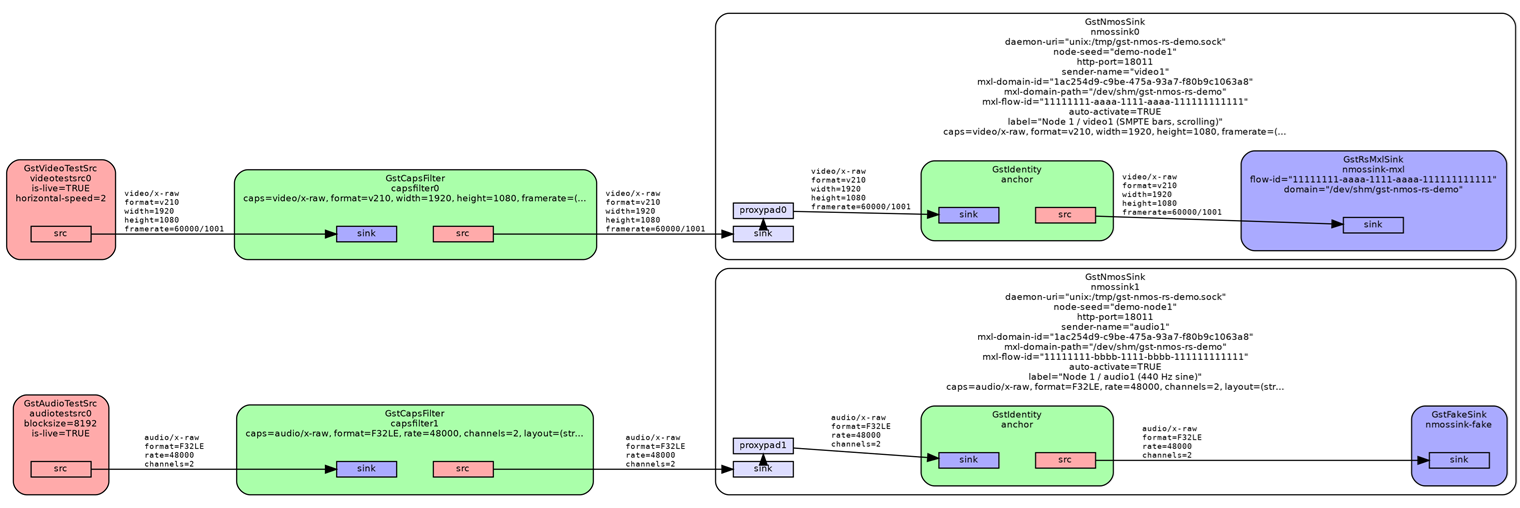
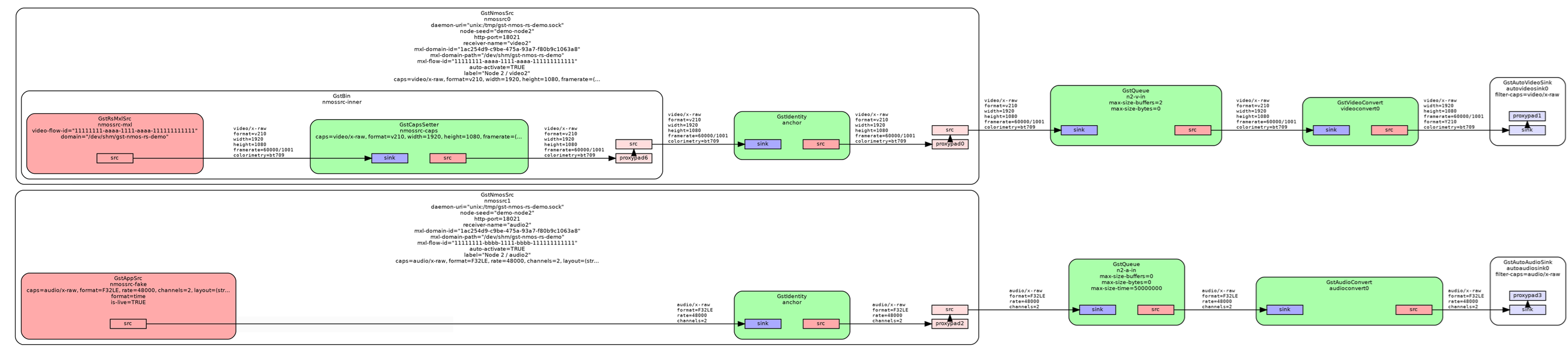
Three-Node Pipeline Diagrams
Each Node runs its own gst-launch-1.0 process (Node 3 uses two:
one for video, one for audio). The diagrams below were exported from
a running demo via the interactive menu.
Node 1 — producer (audiotestsrc + videotestsrc → two nmossink senders):
video sender is enabled, audio sender is disabled
Node 2 — consumer (two nmossrc receivers → queues → sinks):
video receiver is enabled, audio receiver is disabled
Node 3 — processor (receive flows, process, re-transmit):
Video (nmossrc → videoflip → nmossink): receiver and sender enabled

Audio (nmossrc → volume → nmossink): receiver and sender disabled

The results of the search are