
Tenant and operator deployments#
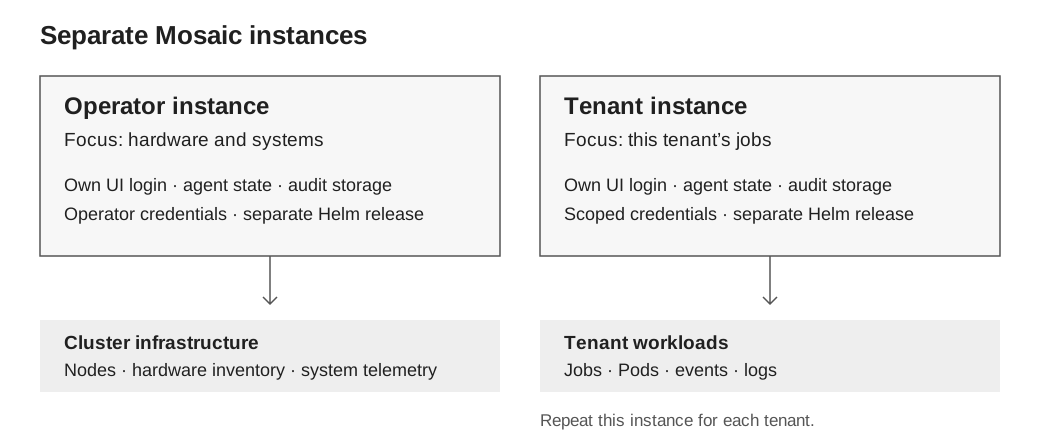
Deploy separate Mosaic instances for operators and tenants. Operators focus on hardware and systems. Tenants focus on their jobs. Each instance is a separate Helm release with its own UI login, agent state, audit storage, and credentials.
Instance |
Focus |
Example question |
|---|---|---|
Operator |
Cluster health, hardware inventory, networking, and system telemetry |
“Which nodes are unhealthy?” |
Tenant |
Its own jobs, Pods, events, and logs |
“Why is my job pending?” |
Repeat the tenant instance for each tenant. In an enterprise, these audiences can be the infrastructure team and an application team. Within a tenant VM, visibility is limited to resources exposed to that VM or its scoped APIs.
Example setup#
These Kubernetes examples are read-only. The provider installs both releases and reuses an existing compatible agent-sandbox controller.
Tenant: tenant-values.yaml disables infrastructure integrations and the default cluster reader. Apply tenant-reader.yaml in workload namespace
tenant-a, provision a kubeconfig for that identity, and store it as Secrettenant-a-kubeconfig(keyconfig) inmosaic-tenant-a.Operator: operator-values.yaml enables cluster monitoring, observability, and Base Command Manager. Configure the monitoring URLs,
mosaic-grafana-authSecret (username,password), andbcm-host-ssh-keySecret (id_ecdsa) for its read-only SSH identity inmosaic-operator.
Complete namespace and registry access setup for each release. In each namespace, create a distinct mosaic-ui-auth Secret (username, password, machineToken) and mosaic-inference Secret (apiKey); replace the example inference URL and model with your approved endpoint.
Install with your approved chart version:
helm upgrade --install mosaic-tenant-a \
  oci://nvcr.io/0948643769302270/afoa-release/mosaic-stack \
  --version "$MOSAIC_CHART_VERSION" --namespace mosaic-tenant-a \
  -f tenant-values.yaml --atomic --wait --timeout 12m

helm upgrade --install mosaic-operator \
  oci://nvcr.io/0948643769302270/afoa-release/mosaic-stack \
  --version "$MOSAIC_CHART_VERSION" --namespace mosaic-operator \
  -f operator-values.yaml --atomic --wait --timeout 12m
Access boundaries#
Backend credentials and Kubernetes RBAC enforce access. The chart’s default Kubernetes reader is cluster-wide, even when installed in a tenant namespace; keep it disabled for tenants. Before handover, verify with the tenant kubeconfig that job and log reads work in tenant-a, while other namespaces, nodes, Secrets, and job mutations are denied.
Give each audience its own UI address and login. Enforce network isolation with authenticated ingress and provider-managed network policies; namespace separation alone is insufficient. Keep storage and credentials separate, including any added MCP or metrics backend. These are separate deployments, not per-user authorization in a shared UI. Cluster administrators and the runtime controller remain trusted; use separately administered clusters or VMs when required for mutually untrusted tenants.