Request lifecycle
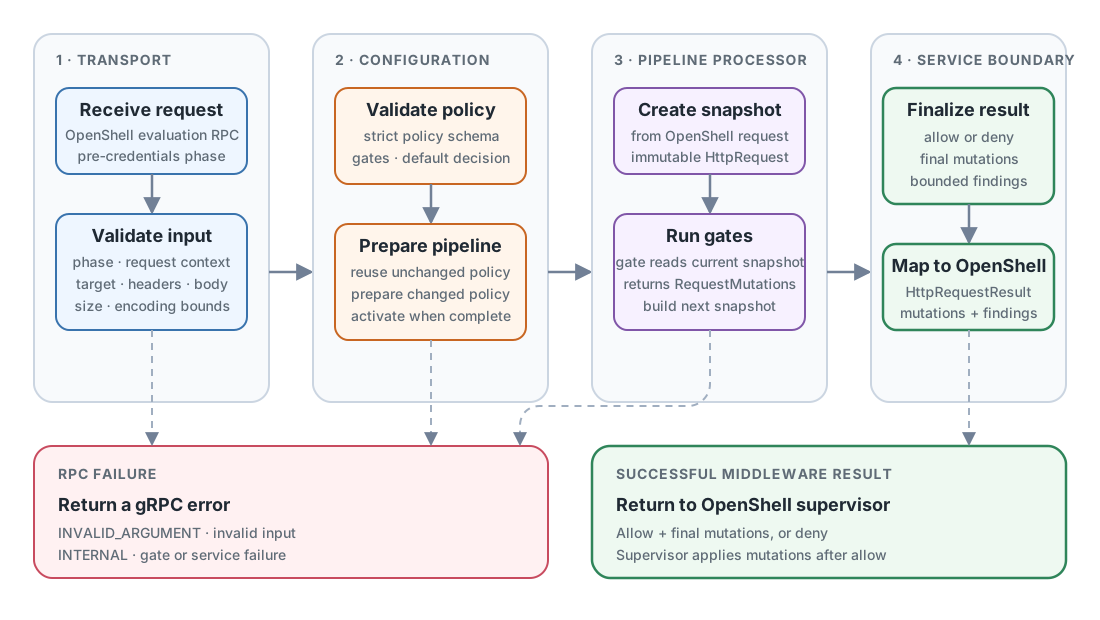
1. Validate the transport
The service checks the pre-credentials phase, exact protobuf configuration, context, target, header, and body bounds. Domain models then enforce bounded scalar and aggregate values. Invalid input produces a cataloged gRPC failure.
2. Validate and prepare the policy
The service converts the protobuf Struct to a mapping. The sealed
GateRegistry validates it as an exact EgressGateConfig. The registry then
prepares each configured gate and creates a RequestProcessor. Preparation
uses one replacement lock and the request Timeout. The service publishes the
candidate only after a final deadline check.
3. Execute the pipeline
For each configured gate, the Egress Gate pipeline processor:
- Check the shared deadline.
- Pass the current read-only
HttpRequestsnapshot to the gate. - Reconstruct and validate the returned
GateEvaluation. - Add a content-safe
GateTraceandSourcedFindingvalues owned by the pipeline processor. - On
proceed, validate the request mutations and construct the next request snapshot. - On terminal
allowordeny, stop without invoking later gates.
The pipeline processor never changes a request object in place. It keeps the
first snapshot private, constructs a new snapshot after each validated mutation
set, and passes that snapshot to the next gate. The final allowed result
combines these mutations in order. A denied result always has an empty mutation
set. Body replacement None and b"" remain distinct. Header mutation variants
use the required kind values write and remove.
If every gate proceeds, default_decision controls the result. Default deny
uses egress_gate_default_deny. Default allow has no reason code.
4. Handle pipeline processor limits
Deadline expiry, worker-slot exhaustion, mutation bounds, finding limits, and
encoded output limits return an atomic deny with source runtime_limit and
egress_gate_limit_exceeded. No partial mutations or findings are returned.
Gate contract and execution failures remain gRPC failures.
The internal processing timeout can return this denial only while the RPC is
still active. The OpenShell gateway owns a separate outer RPC ceiling. If that
outer clock expires first, OpenShell applies the middleware entry's on_error
policy instead of receiving an Egress Gate result. Use on_error: fail_closed
when middleware timeout failures must deny the request.
5. Serialize the result
The Egress Gate service adapter maps the protobuf-free EgressResult to
OpenShell's HttpRequestResult. It serializes the final body and header
mutations, exactly five finding fields, and no internal provenance. An explicit
empty replacement sets has_body=true with an empty body. After an allow, the
OpenShell supervisor applies these mutations to the intercepted request.