
NanoTabICL#
The sdm.nn package provides reusable, GPU-accelerated building blocks for developing foundation models for structured data from scratch.
In this guide, we show how to build a minimal TabICLv2-inspired tabular foundation model (TFM) with it.
Like other in-context learning (ICL) models, it receives labeled context rows together with unlabeled query rows and predicts the query targets in a single forward pass.
TabICL pioneered the “Compress-then-ICL” approach, which has since been adopted by other TFMs such as TabPFN-3, TabFM, and KumoTabular. Its main advantage is its efficient ICL stage that operates on compressed row representations rather than individual cells. It consists of three stages:
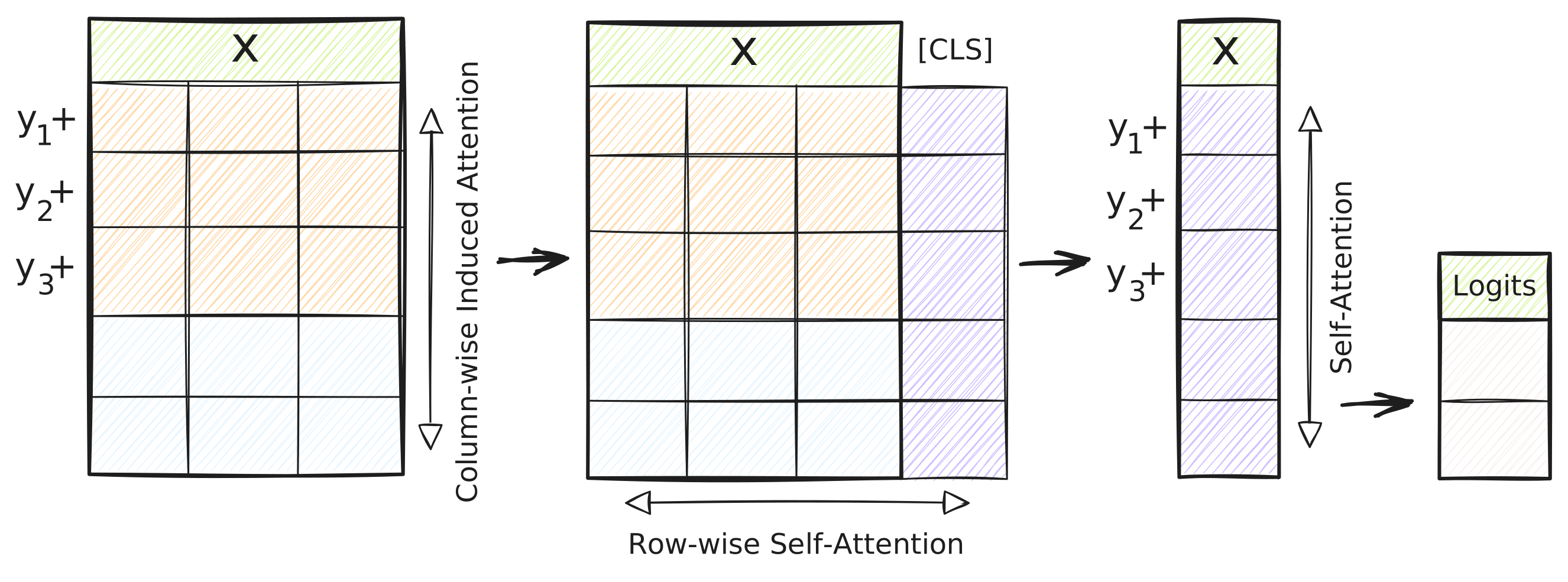
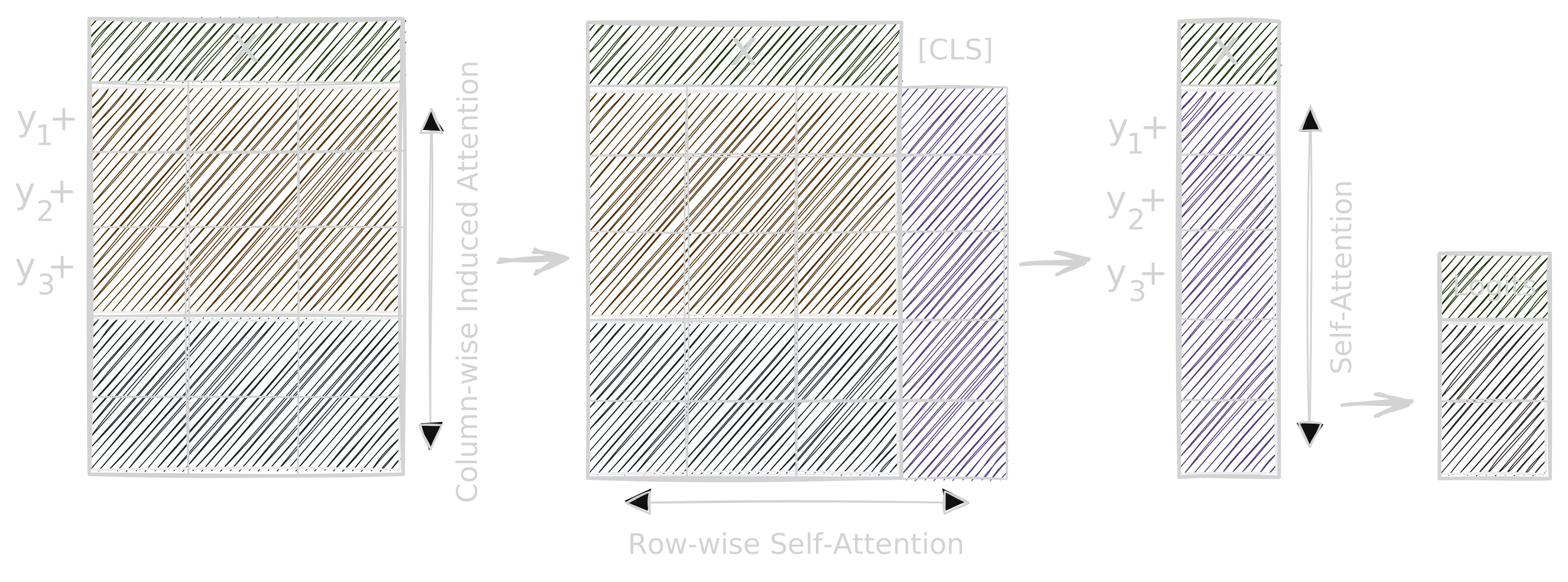
A row-wise compression block that maps each table row to a fixed-size embedding.
An in-context learning block that models interactions among labeled context rows and uses that context to update query representations.
A final prediction head.
Row-wise Compression#
The compression block embeds each table row using column-wise attention followed by row-wise attention. The column-wise attention captures patterns within each column. Afterwards, row-wise attention combines cell information within each row into a single fixed-size embedding.
Column-wise Attention#
Since self-attention grows quadratically with the number of cells, full self-attention across an entire table is not scalable. Thus, the column-wise Transformer uses induced self-attention from the Set Transformer. The key innovation of induced self-attention is to learn a small, fixed number of inducing points. These points first attend to the column entries. Then, column entries attend to the induced representation. This two-stage mechanism thus replaces direct attention between all pairs of elements. The inducing points are learnable parameters. During each forward pass, they attend only to context entries; both context and query entries then attend to the resulting representation. This prevents queries within a batch from influencing each other and allows caching across repeated predictions.
The sdm.nn.InducedTransformerBlock provides a highly reusable and configurable block for induced self-attention, built from two sdm.nn.TransformerBlock modules: (1) the inducing_block that updates the learned inducing points from context entries, and (2) the output_block that updates all column entries from the induced representation.
We start by defining a simple feed-forward multilayer perceptron (MLP):
import torch
from torch import Tensor

def MLP(in_channels: int, out_channels: int) -> torch.nn.Sequential:
    return torch.nn.Sequential(
        torch.nn.LayerNorm(in_channels),
        torch.nn.Linear(in_channels, 2 * in_channels),
        torch.nn.GELU(),
        torch.nn.Linear(2 * in_channels, out_channels),
    )
Next, our ColumnTransformer stacks three layers of column-wise induced attention over 128 inducing points.
Its input is a D-dimensional cell embedding x for each row R and each column C.
The first y.size(0) rows of x are context rows with corresponding labels in y; the remaining rows are query rows.
TabICLv2 uses a pre-norm TransformerBlock, applying LayerNorm before each attention and feed-forward sublayer.
When attending over context rows, TabICLv2 uses sdm.nn.QASSMax to scale queries based on the number of context rows, adapting attention to varying context sizes.
The TransformerBlock supports these attention patterns through configurable normalization, query scaling, and separate query and key/value inputs.
Lastly, to produce task-conditioned compressed representations (e.g., to filter out task-irrelevant columns), TabICLv2 injects target information from context examples before entering the Transformer. This is done by adding a learnable class embedding to each cell in the context rows, supporting up to 10 classes.
Note
We drop the leading batch dimension in all tensor shapes for simplicity. In practice, TFMs are trained in batches.
import sdm

class ColumnTransformer(torch.nn.Module):
    def __init__(
        self,
        channels: int,
        num_heads: int,
    ) -> None:
        super().__init__()

        self.class_emb = torch.nn.Embedding(10, channels)

        self.blocks = torch.nn.ModuleList([
            sdm.nn.InducedTransformerBlock(
                channels=channels,
                num_inducing_points=128,
                inducing_block=sdm.nn.TransformerBlock(
                    channels=channels,
                    num_query_heads=num_heads,
                    query_norm=torch.nn.LayerNorm(channels),
                    key_value_norm=torch.nn.LayerNorm(channels),
                    mlp=MLP(channels, channels),
                    query_scaling=sdm.nn.QASSMax(
                        channels=channels // num_heads,
                        num_heads=num_heads,
                    ),
                ),
                output_block=sdm.nn.TransformerBlock(
                    channels=channels,
                    num_query_heads=num_heads,
                    query_norm=torch.nn.LayerNorm(channels),
                    key_value_norm=torch.nn.LayerNorm(channels),
                    mlp=MLP(channels, channels),
                ),
            ) for _ in range(3)
        ])

    def forward(
        self,
        x: Tensor,  # [R, C, D]
        y: Tensor,  # [R_context]
    ) -> Tensor:  # [R, C, D]

        # Inject task labels into context cell representations:
        x = torch.cat([
            x[:y.size(0)] + self.class_emb(y)[:, None, :],
            x[y.size(0):],
        ], dim=0)

        # Use the row dimension as the sequence axis:
        x = x.transpose(0, 1)  # [C, R, D]
        for block in self.blocks:
            # Inducing points should only attend to context rows:
            x = block(query=x, key_value=x[:, :y.size(0)])
        return x.transpose(0, 1)  # [R, C, D]
Row-wise Attention#
We next perform self-attention across the column vectors of each row.
As the number of columns in a dataset is usually much smaller than the number of rows, we use a full self-attention TransformerBlock.
TabICLv2 prepends four learnable [CLS] tokens to each row and uses their output representations as the row’s final embedding.
This maps rows with varying numbers of columns to fixed-size embeddings.
The [CLS] tokens are initialized from a truncated normal distribution and refined via repeated row-wise attention.
Using multiple [CLS] tokens allows more information to pass through this bottleneck.
Their four output vectors are flattened into a 4*D-dimensional row embedding, which becomes a single token in the ICL stage.
Furthermore, TabICLv2 applies sdm.nn.RotaryEmbedding (RoPE) in row-wise attention to distinguish features by their column positions.
This helps resolve ambiguity between features with similar representations.
class RowTransformer(torch.nn.Module):
    def __init__(
        self,
        channels: int,
        num_heads: int,
    ) -> None:
        super().__init__()

        self.cls_tokens = torch.nn.Parameter(torch.empty(4, channels))
        torch.nn.init.trunc_normal_(self.cls_tokens, std=0.02)

        rope = sdm.nn.RotaryEmbedding(
            channels=channels // num_heads,
            layout="split_half",
        )
        self.blocks = torch.nn.ModuleList([
            sdm.nn.TransformerBlock(
                channels=channels,
                num_query_heads=num_heads,
                query_norm=torch.nn.LayerNorm(channels),
                key_value_norm=torch.nn.LayerNorm(channels),
                query_transform=rope,
                key_transform=rope,
                mlp=MLP(channels, channels),
            ) for _ in range(3)
        ])

    def forward(
        self,
        x: Tensor,  # [R, C, D]
    ) -> Tensor:  # [R, 4*D]

        # Prepend [CLS] tokens:
        cls = self.cls_tokens.expand(x.size(0), -1, -1)  # [R, 4, D]
        x = torch.cat([cls, x], dim=1)  # [R, 4 + C, D]

        for block in self.blocks:
            x = block(x)
        return x[:, :4, :].flatten(1)  # [R, 4*D]
Together, the column-then-row attention blocks form the row-wise compression block of our tabular foundation model.
In-Context Learning#
The ICL stage operates on compressed row representations, modeling interactions among rows through a sequence of TransformerBlock layers:
Query rows attend only to context rows, so each prediction is independent of other queries.
Context rows attend only to context rows, keeping their representations independent of queries.
Unlike ColumnTransformer, TabICLv2’s ICL stage uses full self-attention over context rows.
Before attention, it again adds target embeddings to context row representations.
class ICLTransformer(torch.nn.Module):
    def __init__(
        self,
        channels: int,
        num_heads: int,
    ) -> None:
        super().__init__()

        self.class_emb = torch.nn.Embedding(10, channels)

        self.blocks = torch.nn.ModuleList([
            sdm.nn.TransformerBlock(
                channels=channels,
                num_query_heads=num_heads,
                query_norm=torch.nn.LayerNorm(channels),
                key_value_norm=torch.nn.LayerNorm(channels),
                query_scaling=sdm.nn.QASSMax(
                    channels=channels // num_heads,
                    num_heads=num_heads,
                ),
                mlp=MLP(channels, channels))
            for _ in range(12)
        ])

    def forward(
        self,
        x: Tensor,  # [R, 4*D]
        y: Tensor,  # [R_context]
    ) -> Tensor:  # [R_query, 4*D]

        # Reinject task labels into context row representations:
        x = torch.cat(
              [x[:y.size(0)] + self.class_emb(y),
              x[y.size(0):]],
              dim=0,
          )

        for block in self.blocks:
            x = block(query=x, key_value=x[:y.size(0)])
        return x[y.size(0):]  # [R_query, 4*D]
After the ICL module, an MLP prediction head maps each query row representation to a fixed number of class logits.
Putting It All Together#
We can now compose the blocks into a tabular foundation model for classification, made up of a ColumnTransformer, RowTransformer, and ICLTransformer in sequence:
class NanoTabICL(torch.nn.Module):
    def __init__(self) -> None:
        super().__init__()

        self.cell_emb = torch.nn.Linear(1, 128)
        self.column_transformer = ColumnTransformer(128, num_heads=8)
        self.row_transformer = RowTransformer(128, num_heads=8)
        self.icl_transformer = ICLTransformer(4*128, num_heads=8)
        self.head = MLP(4*128, 10)

    def forward(self,
        x: Tensor,  # [R, C]
        y: Tensor,  # [R_context]
    ) -> Tensor:  # [R_query, 10]

        x = self.cell_emb(x.unsqueeze(-1))  # [R, C, D]
        x = self.column_transformer(x, y)  # [R, C, D]
        x = self.row_transformer(x)  # [R, 4*D]
        x = self.icl_transformer(x, y)  # [R_query, 4*D]
        x = self.head(x)

        return x
The model takes numerical floating-point features x of a table with shape [R, C] and integer labels y for the first y.size(0) context rows.
The remaining rows are treated as query rows whose labels the model predicts.
Categorical encoding, missing-value handling, and feature scaling are typically performed in a preprocessing stage before the model’s forward() call.
device = torch.device("cuda" if torch.cuda.is_available() else "cpu")
x = torch.randn(128, 32, device=device)
y = torch.randint(0, 10, (64, ), device=device)

model = NanoTabICL().to(device)
out = model(x, y)