Matmul (Hopper)
This tutorial shows how to implement a high-performance matrix multiplication kernel (C = A x BT) targeting NVIDIA Hopper GPUs using Tilus.
Starting from a minimal working kernel, each version introduces one new Hopper feature or optimization technique. By the final version, the kernel exceeds vendor-library performance for this shape. The figure below shows the progression: V0 starts at ~305 TFLOPS with a minimal kernel that pushes every operand through the register file, and each optimization closes the gap to cuBLAS, with V6 passing it at ~800 TFLOPS. All kernels and the benchmark script to reproduce the result can be found at examples/hopper_matmul/.
Note
V6 is the one version that does not compute the same thing as the rest: it
accumulates in fp16 inside the WGMMA, while V0–V5 and cuBLAS accumulate in
fp32. That is what buys it the register budget for a 256 x 256 tile, and
it costs about an order of magnitude in accumulated error. V6
quantifies the trade; V5 is the fastest version that is numerically
like-for-like with cuBLAS.
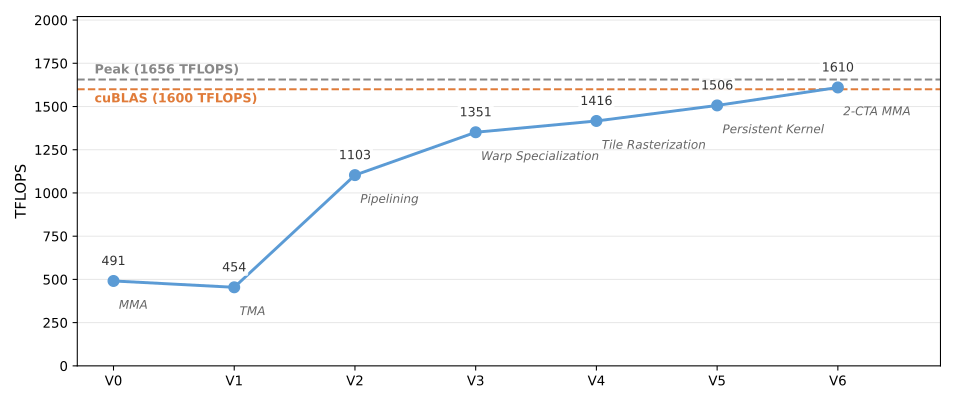
Hopper matmul performance on H100 SXM (M=N=K=8192, fp16). Latency is CUDA-event timed, median of three fresh processes. Peak is the published dense FP16 tensor core throughput of the H100 SXM.
The progression is not perfectly monotonic: V2 introduces multi-stage pipelining but measures slightly slower than V1, because a ring buffer alone does not create overlap when all threads still meet at a block-wide barrier. V3 supplies the missing half and both changes pay off together. The V2 page works through this in detail — it is the most instructive step in the series.
Version |
Optimization |
Accum. |
Latency |
TFLOPS |
Tensor pipe |
|---|---|---|---|---|---|
TMA loads, register-staged |
fp32 |
3.60 ms |
305 |
59% |
|
WGMMA from shared memory |
fp32 |
2.04 ms |
540 |
67% |
|
Multi-stage software pipelining |
fp32 |
2.12 ms |
518 |
71% |
|
Warp specialization |
fp32 |
1.91 ms |
575 |
75% |
|
Two consumers, |
fp32 |
1.71 ms |
642 |
80% |
|
Overlapped WGMMA groups |
fp32 |
1.62 ms |
678 |
88% |
|
Four consumers, fp16 accumulation, TMA epilogue |
fp16 |
1.37 ms |
800 |
93% |
|
cuBLAS |
|
fp32 |
1.48 ms |
742 |
94% |
Tensor pipe utilization is from Nsight Compute
(sm__pipe_tensor_cycles_active.avg.pct_of_peak_sustained_elapsed); the latency and
TFLOPS columns are CUDA-event timings, median of three fresh processes. Reproduce
with:
python examples/hopper_matmul/benchmark.py --size 8192 8192 8192
python examples/hopper_matmul/benchmark.py --ncu --size 8192 8192 8192