1. WGMMA: Hopper’s Asynchronous Tensor Core
V0 drove the tensor cores through dot(), which lowers to the
Ampere-era mma.sync instruction. Every operand fragment had to be copied from
shared memory into registers first, by explicit load_shared calls, before the
tensor core could see it.
This version replaces that with WGMMA (Warp Group Matrix Multiply-Accumulate,
wgmma), Hopper’s native tensor core
instruction. WGMMA is asynchronous and reads its A and B operands
directly from shared memory through a descriptor, so the register round trip
disappears entirely. A single WGMMA instruction, issued cooperatively by a warp
group (4 warps, 128 threads), covers a tile up to 64 x 256 x 16.
The change is small in code — three lines swapped for four — but it is the single most important instruction on Hopper, and every later version builds on its asynchronous protocol.
The Full Kernel
@tilus.autotune(
    "block_m, block_n", [(64, 128), (128, 128), (128, 256), (256, 128), (256, 256)]
)
@tilus.autotune("block_k", [16, 32, 64])
class MatmulWGMMA(tilus.Script):
    def __init__(
        self,
        block_m,
        block_n,
        block_k,
    ):
        super().__init__()
        self.block_m = block_m
        self.block_n = block_n
        self.block_k = block_k

    def __call__(
        self,
        m_size: int32,
        n_size: int,
        k_size: int,
        a_ptr: ~float16,
        b_ptr: ~float16,
        c_ptr: ~float16,
    ):
        self.attrs.blocks = [
            cdiv(m_size, self.block_m),
            cdiv(n_size, self.block_n),
        ]
        self.attrs.warps = 4

        block_m, block_n, block_k = self.block_m, self.block_n, self.block_k
        offset_m: int32 = block_m * self.blockIdx.x
        offset_n: int32 = block_n * self.blockIdx.y

        ga = self.global_view(a_ptr, dtype=float16, shape=[m_size, k_size])
        gb = self.global_view(b_ptr, dtype=float16, shape=[n_size, k_size])
        sa = self.shared_tensor(dtype=float16, shape=[block_m, block_k])
        sb = self.shared_tensor(dtype=float16, shape=[block_n, block_k])
        acc = self.register_tensor(dtype=float32, shape=[block_m, block_n], init=0.0)

        tma_barrier = self.mbarrier.alloc(counts=[1])
        phase: uint32 = 0

        for offset_k in range(0, k_size, block_k):
            # issue asynchronous copy instructions to load tiles of A and B
            with self.single_thread():
                self.mbarrier.arrive_and_expect_tx(
                    tma_barrier, transaction_bytes=sa.nbytes + sb.nbytes
                )
                self.tma.global_to_shared(
                    src=ga, dst=sa, offsets=[offset_m, offset_k], mbarrier=tma_barrier
                )
                self.tma.global_to_shared(
                    src=gb, dst=sb, offsets=[offset_n, offset_k], mbarrier=tma_barrier
                )
                self.mbarrier.wait(tma_barrier, phase=phase)

            # synchronize threads in the block to ensure data is available in shared memory
            self.sync()

            self.wgmma.fence()
            self.wgmma.mma(sa, sb.transpose(), acc)
            self.wgmma.commit_group()
            self.wgmma.wait_group(0)
            self.sync()
            phase ^= 1

        # sa/sb are deliberately not freed. The epilogue allocates no shared
        # memory, so freeing reclaims nothing -- but it would return those slots
        # to the allocator's free list, and the mbarrier allocator (which runs
        # after the whole function is emitted) would then be free to place the
        # barriers inside a buffer the TMA engine writes throughout the loop
        # above, silently corrupting the barrier state.
        casted_acc = self.cast(acc, dtype=float16)
        gc = self.global_view(c_ptr, dtype=float16, shape=[m_size, n_size])
        self.store_global(gc, casted_acc, offsets=[offset_m, offset_n])
What Changed from V0
The kernel structure is unchanged — same block tiling, same TMA loads, same single-stage loop. Only the compute step differs.
V0 |
V1 |
|
|---|---|---|
MMA instruction |
|
|
Operand source |
Registers (staged via |
Shared memory, read directly by the tensor core |
Accumulator |
fp32 registers |
fp32 registers (unchanged) |
Issuing scope |
All threads |
One warp group (4 warps), collectively |
Completion |
Implicit (instruction retires in order) |
|
New instructions |
Why Operands from Shared Memory Matter
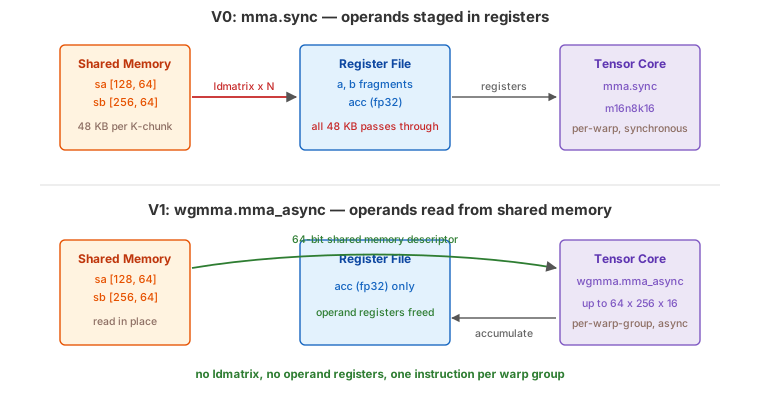
mma.sync (V0) stages both operands through the register file. WGMMA (V1)
hands the tensor core a shared-memory descriptor instead, and only the
accumulator stays in registers.
Consider a 128 x 256 x 64 block tile in fp16. With mma.sync, the A and B
data for one K-chunk is (128 + 256) x 64 x 2 = 48 KB, and all of it must pass
through the register file on its way to the tensor core — every iteration, for
every block. That traffic costs three things:
Instructions: hundreds of
ldmatrix/LDSoperations per K-chunk, all issued by the same warps that are supposed to be feeding the tensor core.Register file bandwidth: shared with the accumulator writes the tensor core is already performing.
Registers: operand fragments need somewhere to live, and on Hopper the fp32 accumulator alone can occupy 256 registers per thread.
WGMMA removes all three at once. The instruction takes a descriptor — a
64-bit value encoding the shared memory base address, the leading/stride byte
offsets, and the swizzle mode — and the tensor core walks shared memory itself.
In Tilus you never construct the descriptor by hand; passing a
SharedTensor to
wgmma.mma() is
enough, and the compiler derives the encoding from the tensor’s layout.
Note
WGMMA can also take its A operand from registers (B must always come
from shared memory). That variant is useful when A is produced on the fly, but
for matmul the shared-memory form is what you want.
The WGMMA Protocol
WGMMA is asynchronous: wgmma.mma()
returns immediately and the tensor core keeps working in the background. It also
reads shared memory and writes registers outside the normal instruction
ordering, so the hardware needs to be told where the boundaries are. Hopper
defines a strict four-step protocol:
self.wgmma.fence()          # 1. prior writes to operands/accumulator are visible
self.wgmma.mma(sa, sb.transpose(), acc)   # 2. issue (may be called many times)
self.wgmma.commit_group()   # 3. bundle all issued MMAs into one commit group
self.wgmma.wait_group(0)    # 4. wait until at most 0 groups remain pending
wgmma.fence()establishes ordering between generic memory accesses and the asynchronous tensor core. It guarantees that the shared memory written by TMA, and the accumulator registers written by any previous non-WGMMA instruction, are visible to the MMA about to be issued.wgmma.mma()computesd = a @ b + d. A[block_m, block_k]by[block_k, block_n]product is decomposed by the compiler into the hardware’s native64 x N x 16shapes and issued as a sequence of instructions.wgmma.commit_group()closes a commit group over every MMA issued since the last commit. Groups complete in order.wgmma.wait_group(n)blocks until at mostncommit groups are still pending.wait_group(0)waits for everything.
V1 uses wait_group(0) immediately after committing, which throws away the
asynchrony — the warp group issues one MMA and stands still until it finishes.
That is deliberate: it keeps V1 a one-line change in behavior from V0. Keeping
groups in flight with wait_group(1) is what V5 does once there is
a pipeline deep enough to feed it.
Note
All four instructions must be executed by a full warp group — 4
consecutive warps, 128 threads, starting at a warp-group-aligned index. In V1
the whole block is one warp group (warps = 4), so the plain block scope
satisfies this. From V3 onward, where the block contains warps
with different jobs, WGMMA is issued inside an explicit
thread_group().
Walkthrough
Setup and epilogue are identical to V0. Only the compute half of the main loop changes.
Main Loop
for offset_k in range(0, k_size, block_k):
    # issue asynchronous copy instructions to load tiles of A and B
    with self.single_thread():
        self.mbarrier.arrive_and_expect_tx(
            tma_barrier, transaction_bytes=sa.nbytes + sb.nbytes
        )
        self.tma.global_to_shared(
            src=ga, dst=sa, offsets=[offset_m, offset_k], mbarrier=tma_barrier
        )
        self.tma.global_to_shared(
            src=gb, dst=sb, offsets=[offset_n, offset_k], mbarrier=tma_barrier
        )
        self.mbarrier.wait(tma_barrier, phase=phase)

    # synchronize threads in the block to ensure data is available in shared memory
    self.sync()

    self.wgmma.fence()
    self.wgmma.mma(sa, sb.transpose(), acc)
    self.wgmma.commit_group()
    self.wgmma.wait_group(0)
    self.sync()
    phase ^= 1
Load phase (unchanged from V0): one thread declares the transaction bytes,
two tma.global_to_shared()
calls fetch the A and B tiles, and the mbarrier.wait plus
sync() make the data visible block-wide.
Compute phase: where V0 had load_shared twice followed by
dot(), V1 has the four-step WGMMA sequence operating on
sa and sb — the shared tensors themselves. sb.transpose() is a view
that swaps the logical axes of the [block_n, block_k] tile into the
[block_k, block_n] shape the MMA expects; no data is moved, and the transpose
is absorbed into the descriptor’s stride encoding.
The trailing sync() still guards the shared buffers against
the next iteration’s TMA. Note that it is only correct because
wait_group(0) has already retired the MMA — with an in-flight WGMMA, a
plain __syncthreads() would say nothing about whether the tensor core is
still reading sa.
Performance
Removing the register round trip is worth 1.8x: 540 TFLOPS (2.04 ms), up from
V0’s 305. Tensor pipe utilization rises from 59% to 67%. Freeing the operand
registers also lets the autotuner move up to a 128 x 128 tile with
block_k=64, twice V0’s tile area, which is itself part of the gain.
Note what did not change: the kernel is still load-then-compute with nothing overlapping, so it remains far from cuBLAS. The complete source is at examples/hopper_matmul/matmul_v1.py.
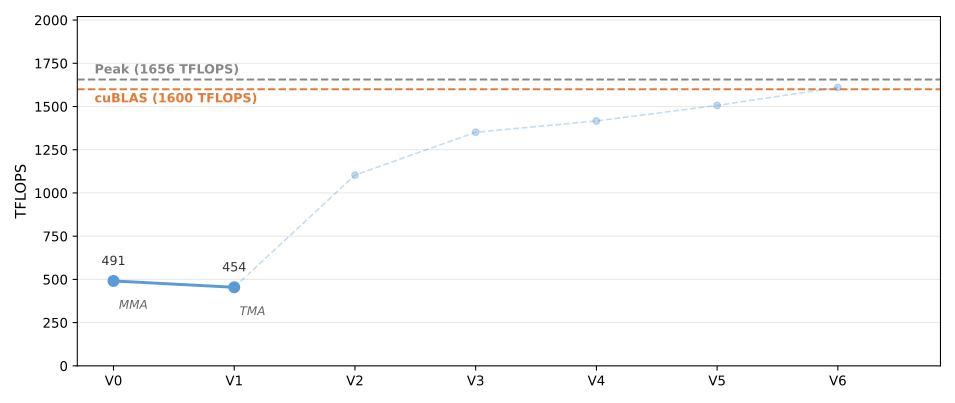
Hopper matmul performance on H100 SXM (M=N=K=8192, fp16). Latency is CUDA-event timed, median of three fresh processes. Peak is the published dense FP16 tensor core throughput of the H100 SXM.
What’s Next
V1 is still single-stage: the loop waits for TMA to complete before issuing the MMA, then waits for the MMA before starting the next TMA. Load and compute are fully serialized, so the TMA engine idles during compute and the tensor cores idle during load. We now have the right instruction, driven in the wrong shape.
In the next version, we introduce multi-stage software pipelining — shared memory becomes a ring buffer with one barrier per stage, and the TMA for iteration i+1 is issued before waiting on iteration i, so loading and computing finally overlap.