

Operation fuser API#
Motivation#
Transformer Engine relies heavily on operation fusion to achieve high performance. A typical training workload involves many memory-bound operations such as activation functions and normalization, so replacing them with fused kernels can deliver a significant performance benefit. This is especially true for low-precision training (e.g. FP8 and FP4) because it involves extra cast operations.
Managing these fusions can be challenging because they differ based on
operation types, communication patterns, data types, and GPU
architectures. The most straightforward solution is to provide
monolithic modules like Linear, LayerNormLinear, or
TransformerLayer. These conform to the interface of a standard
PyTorch module, but can perform arbitrary fusions internally. These
hand-tuned implementations can achieve maximum performance, but they
tend to be complicated and difficult to modify.
As an alternative to this “top-down” design, TE exposes a “bottom-up” operation-based API. The user constructs individual operations and passes them into a fuser, resulting in the same fused kernels as the monolithic modules. This approach is more flexible, making it easier to support new model architectures or to experiment with fusions.
Basic usage#
Sequential operations#
At the most basic level, the operation fuser API involves two classes
in the transformer_engine.pytorch.ops submodule:
FusibleOperation: An abstract base class for tensor operations. Examples includeLinear,LayerNorm, andAllReduce. It is a subclass oftorch.nn.Module, so it can hold trainable parameters and can be called to perform the operation’s forward pass.Sequential: A container of modules in sequential order. Its interface is very similar totorch.nn.Sequential. If it contains anyFusibleOperations, then it may attempt to fuse them in the forward and backward passes.
Thus, using the operation fuser simply involves constructing
FusibleOperation s and passing them into a Sequential.
import torch
import transformer_engine.pytorch as te

# Options
hidden_size = 4096
ffn_size = 28672
batch_size = 16384

# Construct operations and fuse
mlp = te.ops.Sequential(
    te.ops.LayerNorm(hidden_size),
    te.ops.Linear(hidden_size, ffn_size),
    te.ops.SwiGLU(),
    te.ops.Linear(ffn_size // 2, hidden_size),
)

# Forward pass
x = torch.randn(batch_size, hidden_size, device="cuda")
y = mlp(x)
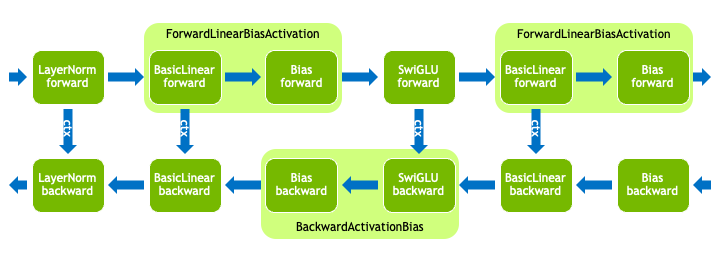
Operations that match LayerNormMLP module. Note that different
fusions have been applied in the forward and backward passes.#
Quantization#
The operation fuser respects TE’s APIs for low-precision (“quantized”)
data formats like FP8 and FP4. Constructing operations within a
quantized_model_init context will enable quantized weights and
performing the forward pass within an autocast context will enable
quantized compute.
import torch
import transformer_engine.pytorch as te

# Construct layer with quantized weights
with te.quantized_model_init():
    fc1 = te.ops.Sequential(
        te.ops.LayerNorm(4096),
        te.ops.Linear(4096, 28672),
    )

# Forward pass within autocast context
x = torch.randn(16384, 4096, device="cuda")
with te.autocast():
    y = fc1(x)

# Backward pass outside of autocast context
y.sum().backward()
Branching operations#
The operation fuser supports very limited branching behavior. While
the operations must be in sequential order, some operations can accept
extra inputs or produce extra outputs. For example, AddExtraInput
will add an extra input tensor to the intermediate tensor and
MakeExtraOutput will return the intermediate tensor as an extra
output. When calling a Sequential that contains any of these
branching operations, the extra inputs should be passed in as
arguments and the extra outputs will be returned.
import torch
import transformer_engine.pytorch as te

# Construct MLP with residual connection
fc1 = te.ops.Sequential(
    te.ops.LayerNorm(4096),
    te.ops.MakeExtraOutput(),  # Output residual
    te.ops.Linear(4096, 28672),
    te.ops.SwiGLU(),
)
fc2 = te.ops.Sequential(
    te.ops.Linear(14336, 4096),
    te.ops.AddExtraInput(),  # Add residual
)

# Forward pass
x = torch.randn(16384, 4096, device="cuda")
y, residual = fc1(x)
y = fc2(y, residual)
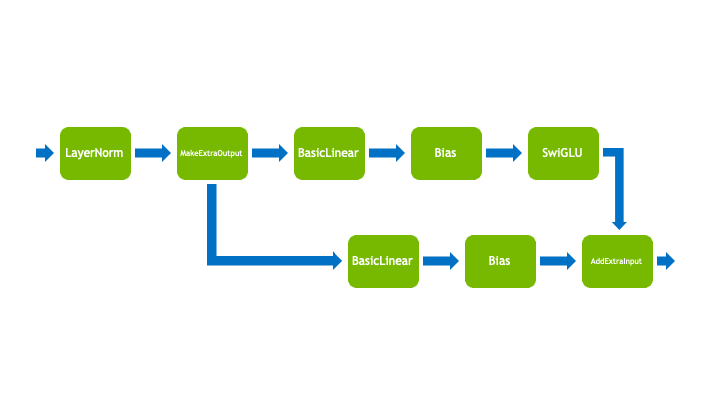
Operations for an MLP block with a residual connection. Note that the block has been split into two sections, each with one branching operation.#
Extra tensor channels#
Branching operations can also route their extra inputs and outputs within
the same Sequential via named channels. Extra output tensors with a
specified channel can be consumed by later operations in the same Sequential
and may optionally be returned to the caller. Extra input tensors with a specified
channel are accessed internally instead of being provided as arguments
to Sequential.
With a channel, the residual block above can be expressed using one
Sequential:
import torch
import transformer_engine.pytorch as te

make_residual = te.ops.MakeExtraOutput()
add_residual = te.ops.AddExtraInput()
make_residual.set_extra_output_channel(
    0, "residual", output_to_caller=False
)
add_residual.set_extra_input_channel(0, "residual")

block = te.ops.Sequential(
    te.ops.LayerNorm(4096),
    make_residual,
    te.ops.Linear(4096, 28672),
    te.ops.SwiGLU(),
    te.ops.Linear(14336, 4096),
    add_residual,
)

# The residual is routed internally and omitted from the public outputs.
x = torch.randn(16384, 4096, device="cuda")
y = block(x)
Channels are also useful for mixture-of-experts blocks. The following
example assumes custom Dispatch and Combine basic operations.
Dispatch has one public extra input containing router probabilities
and three extra outputs: split sizes, token probabilities, and a
routing map. Combine consumes the routing map.
import transformer_engine.pytorch as te
from my_ops import Dispatch, Combine

num_experts = 8
hidden_size = 4096
ffn_size = 14336

dispatch = Dispatch(num_experts)
fc1 = te.ops.GroupedLinear(
    num_experts, hidden_size, 2 * ffn_size, bias=False
)
activation = te.ops.ScaledSwiGLU()
fc2 = te.ops.GroupedLinear(
    num_experts, ffn_size, hidden_size, bias=False
)
combine = Combine(num_experts)

# Dispatch extra outputs:
#   0: split sizes, 1: token probabilities, 2: routing map
dispatch.set_extra_output_channel(
    0, "m_splits", output_to_caller=False
)
dispatch.set_extra_output_channel(
    1, "probs", output_to_caller=False
)
dispatch.set_extra_output_channel(
    2, "routing_map", output_to_caller=False
)

fc1.set_extra_input_channel(0, "m_splits")
activation.set_extra_input_channel(0, "probs")
fc2.set_extra_input_channel(0, "m_splits")
combine.set_extra_input_channel(0, "routing_map")

moe = te.ops.Sequential(dispatch, fc1, activation, fc2, combine)

# Dispatch's extra input has no channel, so the caller passes router_probs.
# Channels supply all later extra inputs internally. The channel outputs
# are not returned because output_to_caller=False.
y = moe(x, router_probs)
Channels cannot connect operations in different OperationFuser
instances. In particular, an ordinary PyTorch module inside a
Sequential splits the fusible operations on either side into
separate fusers. The following channel connection is therefore not
supported:
make_residual = te.ops.MakeExtraOutput()
add_residual = te.ops.AddExtraInput()
make_residual.set_extra_output_channel(0, "residual")
add_residual.set_extra_input_channel(0, "residual")

block = te.ops.Sequential(
    make_residual,
    torch.nn.Identity(),  # Splits the operations into separate fusers.
    add_residual,
)
Use the public extra output and extra input interfaces, as in the
two-Sequential example above, when the producer and consumer cannot
be placed in the same OperationFuser.
The following conditions apply to extra tensor channels:
Every named extra input must have a matching producer earlier in the same fuser. Leave an extra input unnamed when the caller should provide it.
An output channel name has at most one producer, but its output may fan out to multiple consumers.
A named output does not require a consumer. It is returned as a public extra output by default.
A channel is scoped to one
OperationFuser. In aSequential, ordinary PyTorch modules split adjacent fusible operations into separate fusers, and channels cannot cross that boundary.The caller passes unnamed extra inputs. Named, channel-connected extra input slots do not appear in the
Sequentialarguments.set_extra_output_channelacceptsoutput_to_caller(Trueby default). Public extra outputs are returned in their original basic-operation and slot order. Gradients supplied for a returned output are combined with gradients from its internal channel consumers. An unused extra-output gradient may beNoneand is treated as zero.Set
output_to_caller=Falsefor a channel tensor that should remain internal. Removing a channel binding withchannel=Nonerestores that output as public.Channel bindings are captured when an
OperationFuseris constructed, which locks them on every covered basic op. That includes:constructing an
OperationFuserorSequentialexplicitlycalling an op directly (
op(x)), or aFusedOperation, because those paths build a transientOperationFuser([self])
Later
set_extra_input_channel/set_extra_output_channelcalls raise an error, so different routing requires constructing new operations. Bind channels before the first forward call if the op will later participate in a multi-op fuser.
Channel-connected basic operations may still be replaced by registered
FusedOperation implementations. If a fused operation contains both
the producer and consumer of a channel, its fuser_forward and
fuser_backward implementations are responsible for routing the
tensor and its gradient between those basic operations. For a non-public
channel fully owned by one forward fusion, fuser_forward may return
None in the corresponding basic-operation output slot. A tensor is
still required when the output is public or when a consumer is outside
that forward fusion.
Developer guide#
Infrastructure#
In addition to FusibleOperation and Sequential, the fuser
infrastructure relies on the following classes:
BasicOperation: The most basic type ofFusibleOperation. Examples includeBasicLinear,Bias, andReLU. It holds parameters and state, and it implements both a forward and backward pass. Theop_forwardandop_backwardfunctions have an interface reminiscent oftorch.autograd.Function, e.g. they accept a context object that caches state from the forward pass to the backward pass.FusedOperation: AFusibleOperationthat can replace one or moreBasicOperations. Examples includeForwardLinearBiasActivationandBackwardActivationBias. Its forward and backward passes (thefuser_forwardandfuser_backwardfunctions) must produce equivalent results as its correspondingBasicOperations. This also means that theFusedOperationis stateless since it can access parameters and state from theBasicOperations. Note that different fusions may be applied in the forward and backward pass, so aFusedOperationmay be missing its forward and/or backward implementation.OperationFuser: This is the class that manages the operation fusions. It launches the forward and backward passes within atorch.autograd.Function. It can also replace operations with equivalentFusedOperations.
The first time that a Sequential is called, it will group adjacent
FusibleOperation s together into OperationFuser s. The first
time an OperationFuser is called, it will attempt to fuse
operations for the forward pass and backward pass. Subsequent calls
will reuse the same state unless it has been invalidated, e.g. by
changing the quantization recipe.
Quantization#
Each operation that supports quantized compute holds one or more
Quantizer s, which are builder classes for converting
high-precision tensors (e.g. in FP32 or BF16) to quantized tensors. In
order to enable fused quantization kernels, operations can access the
quantizers of neighboring operations and quantize eagerly.
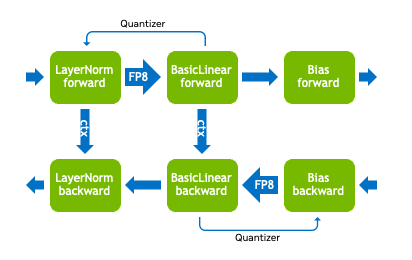
Operations that match LayerNormLinear module with FP8
quantization.#
In some situations, like when operations are split across multiple
Sequential s, it may be helpful to encourage the fuser by manually
adding Quantize operations.
import torch
import transformer_engine.pytorch as te

# Construct layer with quantized weights
with te.quantized_model_init():
    norm = te.ops.Sequential(
        te.ops.LayerNorm(4096),
        te.ops.Quantize(),
    )
    fc1 = te.ops.Sequential(
        te.ops.Linear(4096, 28672),
    )

# Forward pass
x = torch.randn(16384, 4096, device="cuda")
with te.autocast():
    y = norm(x)  # y is a QuantizedTensor
    z = fc1(y)
Warning
This is an expert technique. Quantizer configurations can be quite
complicated, so the Quantize operation’s quantizers may be
suboptimal.
Implementing new operations#
Implementing a basic operation#
Subclasses of BasicOperation must implement op_forward and
op_backward, which are reminiscent of the forward and
backward methods of torch.autograd.Function. They have an
argument for a context object that can be used to cache state from the
forward pass for use in the backward pass.
import torch
import transformer_engine.pytorch as te

class LearnableScale(te.ops.BasicOperation):

    def __init__(self) -> None:
        super().__init__()
        scale = torch.ones((), dtype=torch.float32, device="cuda")
        self.register_parameter("scale", torch.nn.Parameter(scale))

    def op_forward(self, ctx, input_: torch.Tensor, **unused) -> torch.Tensor:
        out = self.scale * input_
        ctx.save_for_backward(self.scale, input_)
        return out

    def op_backward(
        self,
        ctx,
        grad_output: torch.Tensor,
    ) -> tuple[torch.Tensor, Iterable[Optional[torch.Tensor]]]:
        scale, input_ = ctx.saved_tensors
        grad_scale = torch.inner(input_.reshape(-1), grad_output.reshape(-1)).reshape(())
        grad_input = scale * grad_output
        return (
            grad_input,     # Input gradient
            (grad_scale,),  # Param gradients
        )
Implementing a fused operation#
Subclasses of FusedOperation should declare their corresponding
BasicOperation s in the constructor. They should also implement
fuser_forward and fuser_backward, depending on usage. These
functions are similar to op_forward and op_backward from
BasicOperation, but some arguments and returns are lists. For
example, instead of taking a single context object, they take a list
of context objects for all the corresponding BasicOperation s.
import torch
import transformer_engine.pytorch as te
from typing import Optional

class ForwardAxpy(te.ops.FusedOperation):

    def __init__(self, scale: te.ops.ConstantScale, add: te.ops.AddExtraInput) -> None:
        super().__init__((scale, add))  # Equivalent basic ops

    def fuser_forward(
        self,
        basic_op_ctxs: list,
        input_: torch.Tensor,
        basic_op_extra_inputs: list[tuple[torch.Tensor, ...]],
        **unused,
    ) -> tuple[torch.Tensor, list[tuple[torch.Tensor, ...]]]:
        scale_op, add_op = self.basic_ops
        extra_input = basic_op_extra_inputs[1][0]  # Extra input to add op
        out = scale_op.scale * input_ + extra_input
        scale_ctx, add_ctx = basic_op_ctxs  # No state needed for backward
        return (
            out,       # Output
            [(), ()],  # Extra outputs for each basic op
        )
Warning
Forward-only and backward-only fused operations must produce outputs that are interchangeable with the corresponding basic operations, since the opposite pass is fused independently. Joint forward-backward fusions (described below) relax this contract.
In order to make these fused operations useful, they should be
registered with the operation fuser. To do this, first implement a
fusion function that can replace operations with the fused operation,
and then register it with the register_forward_fusion or
register_backward_fusion functions.
def fuse_axpy_ops(
    ops: list[te.ops.FusibleOperation],
    **unused,
) -> list[te.ops.FusibleOperation]:
    """Sliding window scan to perform ForwardAxpy fusion"""
    out = []
    window, ops = ops[:2], ops[2:]
    while len(window) == 2:
        if (
            isinstance(window[0], te.ops.ConstantScale)
            and isinstance(window[1], te.ops.AddExtraInput)
        ):
            window = [ForwardAxpy(window[0], window[1])]
        else:
            out.append(window[0])
            window = window[1:]
        window, ops = window + ops[:1], ops[1:]
    out.extend(window + ops)
    return out

# Register fusion with operation fuser
te.ops.register_forward_fusion(fuse_axpy_ops)
Joint forward-backward fusions#
The fusions above replace operations in either the forward or the backward pass, and they must remain interchangeable with the unfused operations because the opposite pass is fused independently. Some optimizations, however, benefit from co-designing the two passes. For example, a fused operation’s forward pass might skip saving a tensor if it knows that its backward pass can recompute it.
A joint forward-backward fusion expresses this coupling. It is a single
FusedOperation that implements both fuser_forward and
fuser_backward, registered with register_forward_backward_fusion.
Joint fusions are applied before the forward-only and backward-only
fusion passes, so the same fused operation is seen by both passes. Unlike
forward-only or backward-only fusions, the two halves need not be
individually interchangeable with the unfused operations; only the
forward/backward pair must be jointly equivalent.
class LinearSiLU(te.ops.FusedOperation):

    def __init__(self, linear: te.ops.Linear, silu: te.ops.SiLU) -> None:
        super().__init__((linear, silu))  # Equivalent basic ops

    def fuser_forward(self, basic_op_ctxs, input_, **unused):
        weight = self.basic_ops[0].weight
        out = torch.nn.functional.silu(torch.matmul(input_, weight.T))
        # Save reduced state: the backward recomputes the SiLU input
        # rather than saving it.
        basic_op_ctxs[0].save_for_backward(input_, weight)
        return out, [(), ()]

    def fuser_backward(self, basic_op_ctxs, grad_output, **unused):
        x, w = basic_op_ctxs[0].saved_tensors
        y = torch.matmul(x, w.T)  # Recompute SiLU input
        s = torch.sigmoid(y)
        dy = grad_output * s * (1 + y * (1 - s))  # SiLU backward
        return (
            torch.matmul(dy, w),              # Grad input
            [(torch.matmul(dy.T, x),), ()],   # Grad params for each basic op
            [(), ()],                         # Grad extra inputs for each basic op
        )

def fuse_linear_silu(ops, **unused):
    """Sliding window scan to perform LinearSiLU fusion"""
    out = []
    window, ops = ops[:2], ops[2:]
    while len(window) == 2:
        if isinstance(window[0], te.ops.Linear) and isinstance(window[1], te.ops.SiLU):
            window = [LinearSiLU(window[0], window[1])]
        else:
            out.append(window[0])
            window = window[1:]
        window, ops = window + ops[:1], ops[1:]
    out.extend(window + ops)
    return out

# Register joint fusion with operation fuser
te.ops.register_forward_backward_fusion(fuse_linear_silu)