NVIDIA and Jülich researchers successfully simulated magic-state preparation in a 104-qubit protocol using 8,192 GPUs on JUPITER, with development and validation supported by the NVIDIA Accelerated Quantum Research Center (NVAQC).
As quantum computing enters the era of logical qubits, discovering, designing, and optimizing fault-tolerant algorithms that can deliver quantum advantage is becoming increasingly important. These algorithms will be a critical lever for translating quantum computing into meaningful scientific and societal impact.
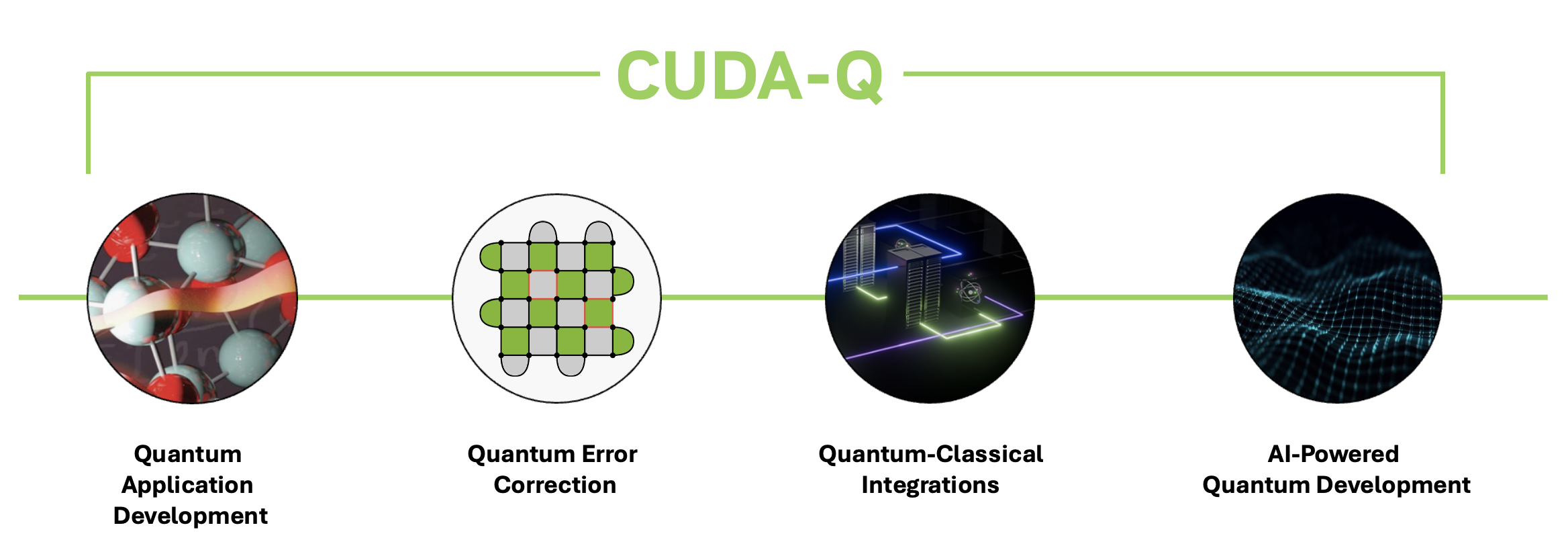
Fault-tolerant quantum algorithms are assembled from recurring components, including state preparation, Hamiltonian encoding, qubitization, polynomial transformations, and time evolution. CUDA-Q provides the programming model, logical architecture, and decoding layers needed for leveraging these components in fault-tolerant quantum-GPU supercomputing. Until now, however, research teams have often had to develop their own circuit-construction, integration, and validation code to turn components into working programs.
There is a fundamental challenge in developing useful quantum computers. The quantum behavior that makes them so desirable to build also makes them difficult to simulate and design.
This becomes especially challenging when trying to model the noise in quantum computing hardware. The exact simulation of \(n\) ideal qubits requires tracking a number of parameters that grows like \( 2^n \), since an increasingly large vector must be tracked for larger quantum systems. But simulating noisy qubits requires not just tracking a Hilbert space vector, but a density matrix, described by \( 2^{2n} \) values - adding yet another quadratic overhead. Including noise is key when simulating new quantum processor designs, but this extra computational cost can be severe.
Thankfully, there is a solution. Quantum trajectory methods approximate noisy systems with an ensemble of stochastically sampled \( 2^n \)-entry statevectors rather than exact density matrices - removing the additional quadratic overhead.
At GTC 2026, NVIDIA introduced cudaq-realtime, a new library built on NVQLink that provides a runtime API for microsecond-latency callbacks between GPUs and quantum controllers. CUDA-Q QEC 0.6 integrates directly with cudaq-realtime to bring GPU-accelerated decoding into the real-time quantum control loop. Now any quantum hardware vendor using NVQLink is able to draw on the power of the CUDA-Q QEC library for real-time decoding.
CUDA-Q QEC 0.6 ships with two new real-time-capable decoder pipelines: the RelayBP belief-propagation decoder for qLDPC codes and an NVIDIA Ising convolutional neural network (CNN) pre-decoder paired with a global decoder (PyMatching) for the surface code. These pipelines enable quantum vendors and QEC researchers to deploy real-time GPU decoding for two popular code families via NVQLink.
This blog describes in detail how CUDA-Q QEC 0.6 interacts with NVQLink, allowing developers to see how they can begin to build highly optimized quantum error correction workflows.
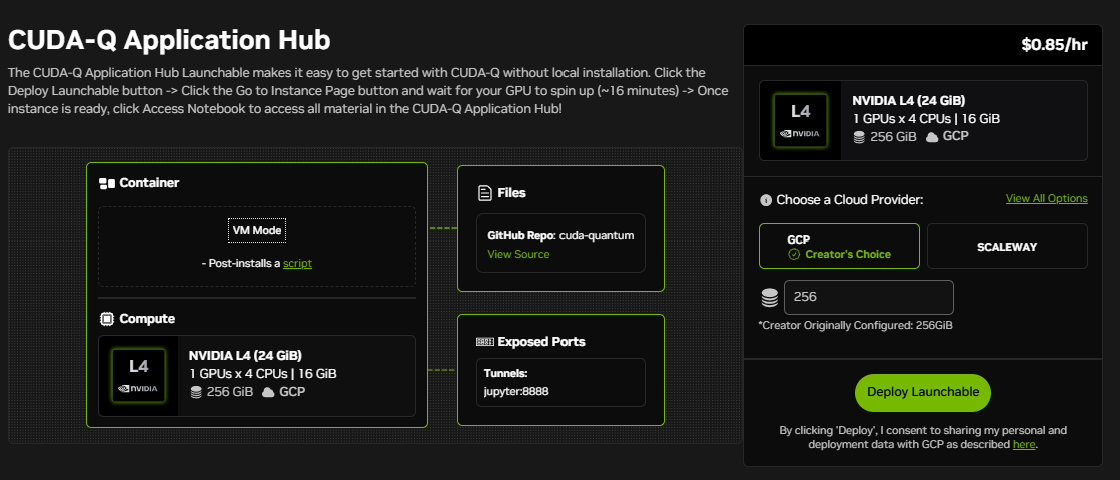
GTC26 sees the release of CUDA-Q 0.14 - delivering several important advancements for developers and researchers. Notably, it introduces the CUDA-Q Application Hub as a Brev Launchable, providing easy access and streamlined experimentation with sample applications across domains like quantum chemistry, AI, and optimization.
In addition, this release adds long-awaited macOS support, enabling efficient local development and prototyping through Python using a local CPU. Furthermore, CUDA-Q provides options to scale experiments by connecting to more supported quantum processing units (QPUs) and cloud simulators, allowing users to seamlessly transition from local testing to more advanced deployments.
Over the past year the quantum computing industry has shifted from qubit demonstrations to the work of building large-scale quantum-classical supercomputers. Central to that transition has been the intersection of quantum computing work with AI supercomputing. At GTC 2026, researchers and developers across the ecosystem are demonstrating how the NVIDIA CUDA-Q platform is bringing accelerated computing to the key workloads set to define quantum computing in 2026 and beyond.
Fault-tolerant quantum computing demands a tight classical–quantum feedback loop in which QEC decoding and autocalibration occur throughout QPU operation.
Our new library, cudaq-realtime, now available in the CUDA-Q 0.14 release, builds on NVQLink by giving developers a runtime API for microsecond-latency callbacks between GPUs and quantum controllers.