Introducing CUDA-Q Pulse: Python-native pulse programming with GPUs in the loop
Gates are the currency of quantum applications. But every quantum gate is a convenient abstraction, representing a shaped microwave or laser pulse executing across a control line with nanosecond precision. Calibration, quantum error correction (QEC), and device bring-up all happen at that deeper layer, and very often crafting and operating with those pulses requires GPU calculations to make fast decisions during quantum runtime.
Today we're releasing CUDA-Q Pulse (cudaq-pulse), an open-source pulse-level programming model and MLIR compiler.
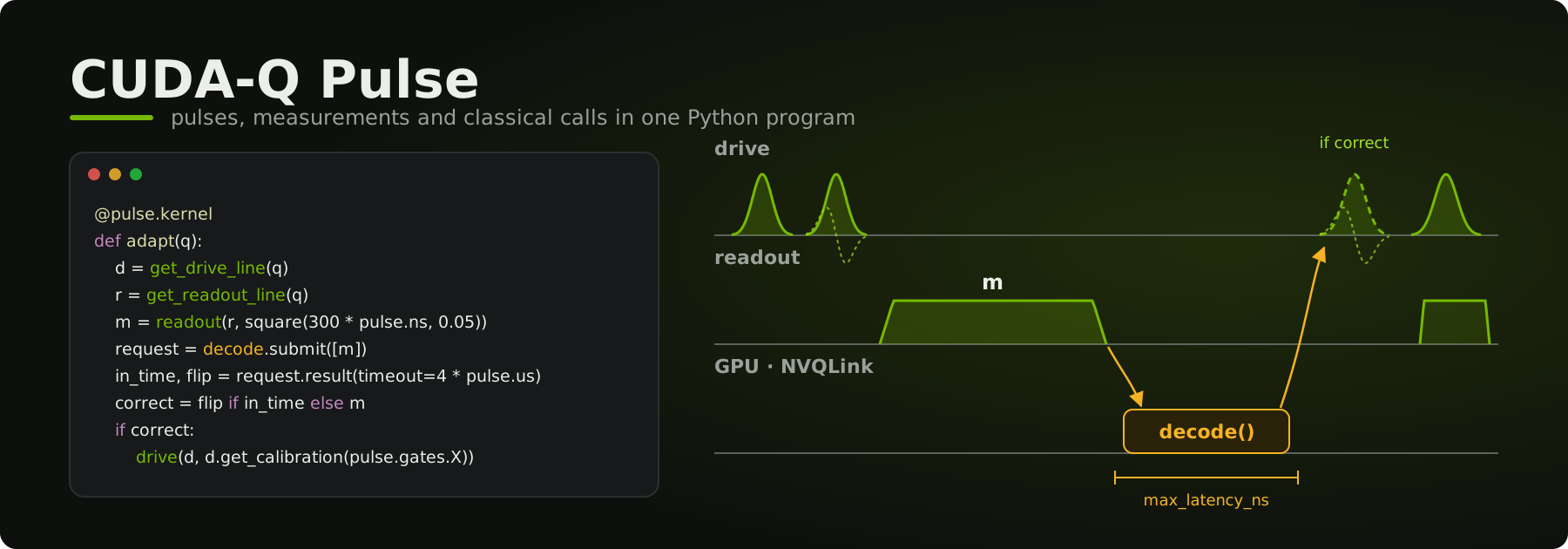
This new addition to the NVIDIA quantum platform allows users to write pulse programs in ordinary Python and call classical functions on a GPU, host, or FPGA in the middle of the experiment. It can work within explicit latency budgets, and simulate the whole loop involved in pulse programming with NVIDIA cuDensityMat before running it on quantum hardware.