

slope_drop (FET003 Physics)#
Property |
Value |
|---|---|
Test name |
slope_drop |
Feature(s) |
|
Engine |
Kit / Isaac Sim (>=2024.2.0) |
Test version |
3.3.6 |
Wall-clock timeout |
600 seconds |
Summary#
Checks proximity to a finite inclined ramp, signed downhill displacement,
box-to-ramp overlap/separation and subsequent floor overlap using PhysX.
The Newton tier owns the separate slope_drop_newton procedure and its setup.
What Pass Guarantees#
The sampled box/displacement proxies met configured limits. This does not prove contact points, collider fidelity or behavior on every ramp. Finite-ramp exit is permitted; the object need not remain on the ramp throughout the clip.
What It Checks#
The box’s signed-distance interval along the ramp normal must reach the proximity allowance before sufficient signed downhill travel. Sideways or uphill motion does not satisfy downhill displacement.
While the complete box footprint is over the ramp, an entire box below the analytic plane beyond its allowance fails. After proximity, sustained excessive minimum separation also fails unless the downhill-exit exemption applies. Ramp separation is exempt only while the leading edge extends past the low end and cumulative displacement still satisfies downhill travel. Crossing the uphill edge or returning uphill does not disable separation checks. After downhill travel, minimum box Z is checked against the floor overlap allowance. These are analytic proxies, not collision contact points. PASS additionally requires the full configured post-travel observation window. If travel occurs too late to fit that window in the hard simulation budget, execution is incomplete (ERROR), not PASS or an asset-response FAIL. An already observed overlap/separation or missing-motion failure retains its verdict. An explicit zero post-travel window completes on the detection observation. Metrics record required/observed post-travel steps and window completion; the test does not add simulation steps or extend the configured cap.
How It Works#
The asset starts near the top of a collision-enabled 45-degree ramp with bounded placement clearance. Defaults configure 240 Hz physics, capture every 16 observed steps, and encode 15 fps video. The existing follow camera stays. Render warmup/stabilization/retries can add ticks excluded from nominal graph time. Encoded playback time is not automatically simulation time.
Default distances are stage units, not automatically metres:
The generated collision floor uses a typed, verified physics-purpose material with static/dynamic friction 0.5/0.4 and restitution 0, shared with the same tier’s flat-floor fixture. Missing/disabled collision, rejected coefficient or binding writes, and mismatching effective readbacks are setup errors. They do not establish an asset defect. These checks qualify USD authoring, not native solver contact behavior; source asset materials remain unchanged.
Setting |
Default |
Meaning |
|---|---|---|
minimum_slope_clearance |
0.1 |
Initial vertical box clearance |
horizontal_movement_threshold |
0.01 |
Signed downhill travel |
slope_contact_tolerance |
0.02 |
Ramp proximity allowance |
slope_penetration_tolerance |
0.02 |
Entire-box distance below ramp allowance |
maximum_slope_separation |
0.05 |
Minimum box-plane separation limit |
floor_margin |
0.1 |
Floor-overlap allowance |
separation_confirmation_seconds |
0.1 |
Nominal separation window |
post_horiz_seconds |
3.0 |
Nominal post-travel window |
simulation_seconds |
10.0 |
Hard nominal step budget |
The existing world-fixed precheck skips the trial. Not applicable requires
positive proof connecting every enabled owned rigid-body component to a fixed
world/static anchor through qualified constraints, resolved endpoints and their
ancestry. Fixed, revolute and spherical connections can supply edges; prismatic
connections need qualified finite travel. Disconnected bodies, unsupported/free
constraints, animated eligibility or breakable essential connections cannot
supply this proof. Both constant breaking thresholds must be positive infinity
or exactly float32 maximum (3.4028234663852886e38), PhysX’s
effectively-unbreakable default. Other finite strengths do not qualify, even
the adjacent lower float32 value. This is an exact sentinel check, not a
tolerance or an asset edit. Incomplete or unresolved endpoint
composition retains the original unmarked skip as Could not assess, supplying
neither measured asset FAIL nor PASS. Cooking, initialization,
capacity and watchdog failures require separate runtime diagnosis.
Configuration is qualified before scene mutation: required numeric settings must be finite real values, not booleans or coercible strings. Physics/capture rates are positive integer-valued numbers, settle frames are nonnegative integer-valued numbers, and load timeout is positive. Lengths, tolerances, confirmation/post-observation durations and friction are nonnegative; floor level and slope angle are signed finite. Derived proximity, movement, penetration and separation gates are also validated before observation steps. Supported zero settings retain their existing comparator policy; invalid configuration is incomplete execution, not an asset-response failure.
Required cleanup preserves the first execution error/cancellation, attempts remaining safe restoration and retires uncertain native context. With no earlier cause, cleanup-only cancellation propagates. Optional notes cannot replace the cause; a later cleanup retry does not qualify worker reuse.
Failure Cases#
Missing proximity, missing downhill travel, whole-box ramp overlap, excessive separation and floor overlap are distinct outcomes. Inspect uphill-motion metrics when downhill travel is absent. None alone establishes the root cause.
How to Fix#
A failed runtime row reports the observed behavior, not ownership of its cause. The message keeps the failed verdict and asks the user to send the result JSON, video, optional motion history, and engine log to the test owner. Users are not expected to enable Newton, build a reduced scene, or tune their collider merely to investigate a failure. The test owner should distinguish generated setup, backend behavior, and a proven asset-authoring violation before recommending a repair. A different collider passing is a diagnostic control, not proof that the original collider is invalid.
Review phases, footage, scale, allowances relative to size, and authored collider settings. Establish a contract violation before repairing an asset. Do not reduce legitimate friction or replace valid geometry merely to force a pass. Preserve engine errors separately, particularly contact-capacity and cooking failures.
Expected Result#
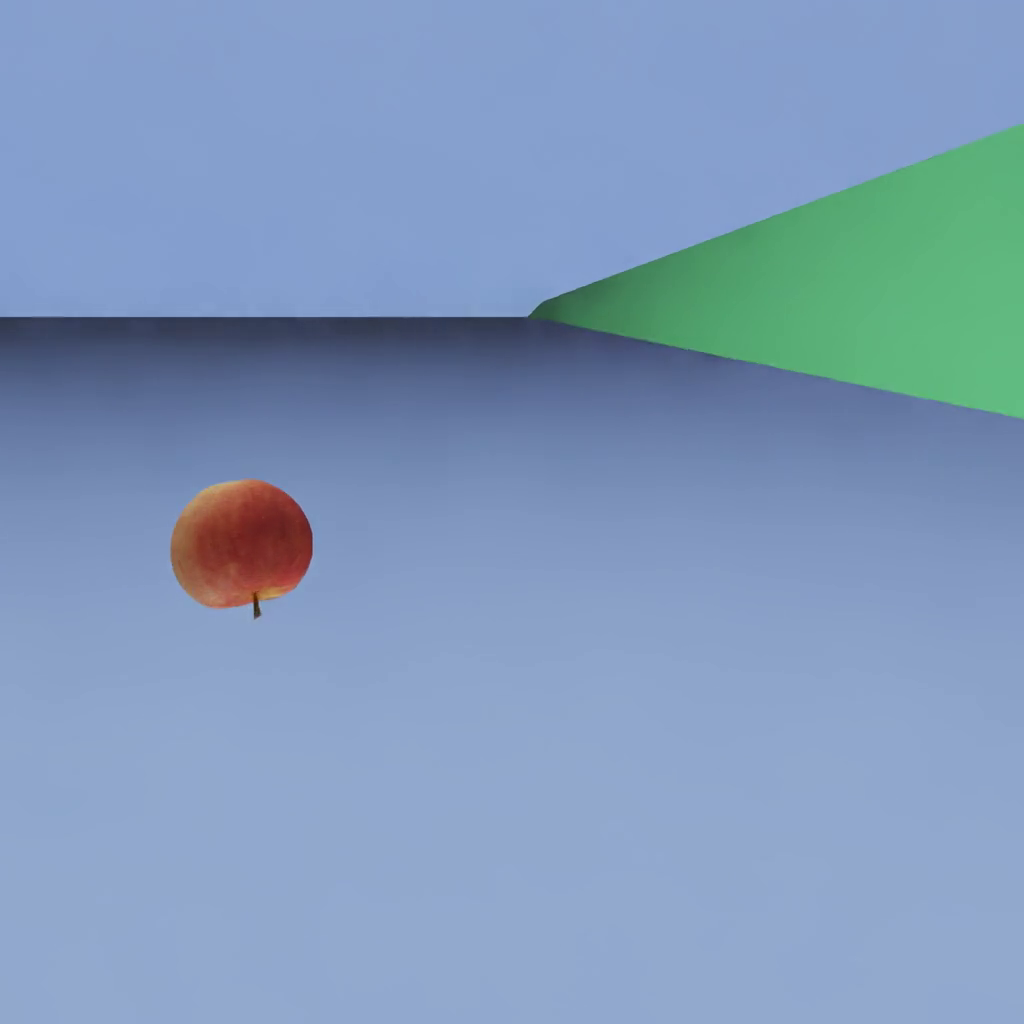
The asset moves downhill, possibly tumbling and leaving the finite ramp. Footage can continue after ramp exit or end at a failure/deadline. Camera following can change apparent framing.
Notes and Caveats#
Version 3.3.1 adds diagnostic context/capture associations and corrects reporting. Version 3.3.2 retains the placement and configured limits, but fixes the ramp-exit separation guard so an uphill launch cannot bypass it. Legitimate downhill exit and the existing transient-separation confirmation window remain permitted. Small box/visible-mesh overlap alone does not prove an SDF collider defect. Version 3.3.3 qualifies finite configuration and required cleanup without changing valid defaults, ramp-exit policy or source assets. Version 3.3.5 requires the complete post-travel window before PASS and uses the qualified typed floor material instead of silently accepting failed fixture authoring. Observation durations, proxy thresholds and asset data are unchanged. Version 3.3.6 requests a near-terminal illustrative render after the measured slope, separation or floor guard fires. Renderer ticks can advance the physics scene, so the image has no exact measurement timestamp. If that optional capture fails, the measured physics result remains and the report records a media warning. Unsafe evidence paths remain execution errors. The box proxies and their limitations are unchanged.
Histories record scale, initial box dimensions, rates, allowances and bounded authored collider settings, not effective cooked geometry. Unmeasured contact points remain unknown. Graph ticks associate successful captures with preceding observations, not exact image timestamps or encoded frame indices. Encoding can omit or repeat images. Tests without optional hooks still run normally.