

ik_target_reach (FET022 Driven Joints)#
Property |
Value |
|---|---|
Test name |
ik_target_reach |
Feature(s) |
|
Engine |
Kit / Isaac Sim (>=2024.2.0) |
Test version |
1.2.9 |
Wall-clock timeout |
1200 seconds |
Nominal Initial Settling#
Before measuring the response, the phase requests complete ctx.step_one()
ticks for the configured initial settling interval, rounded up from
settle_seconds * physics_fps. Zero settling is allowed; FPS must be finite
and positive, and settling seconds finite and nonnegative. Invalid timing
configuration or failed ticks remain execution errors, not asset verdicts.
This is nominal requested tick time, not measured solver or wall-clock time;
render/capture work is separate. The processing-only ctx.physics_steps()
helper is not used to establish this interval.
Summary#
Generates a Fibonacci-sphere distribution of end-effector targets, solves them with the Lula IK solver, commands the articulation to each solution, and verifies the configured sampled success fraction using final live EE position error. Target generation requires a finite robot-base world position and nonempty, finite asset bounds with positive horizontal extent. Missing measurements stop execution without an asset verdict; no synthetic base or reach is used.
Optional Motion Evidence#
Each solved target records bounded per-joint playback histories comparing actual
issued commands with articulation position readbacks and their signed difference.
Only independently commanded solver-subset coordinates have target/error
channels. Passive, mimic-follower, loop and other uncommanded coordinates record
position only.
The target-local nominal step clock covers interpolation and reached-target hold;
solver computation, teleport/reset windows and rendering ticks are explicitly
excluded. Revolute readbacks use radians; unqualified prismatic tensor units
remain unknown_native. Metadata records stage scale and unit basis without
guessing a linear tensor conversion.
These joint-response plots diagnose drive behavior; they are not the
end-effector position-error verdict or proof of orientation accuracy.
Sampling is independent of video enablement. Successful captures associate with the preceding retained observation rather than claiming exact video timing. Optional playback readback or recording failures mark histories partial and retain null measurements. Required joint/kinematics and live end-effector position measurements must be usable; unavailable or invalid state is a setup/runtime error. Runners without the hooks retain ordinary execution.
Required Runtime State#
Missing, non-finite or wrong-shaped runtime state needed by control or the verdict stops the test as a setup/runtime error, not conformance PASS or an evaluated asset-response FAIL. Optional extra motion readbacks remain nullable and can mark diagnostic evidence partial. Response criteria and timing are unchanged. Setup probes now synchronize position and drive targets and zero velocity; failure to establish that configuration is a runtime error. Native solver exceptions, malformed solver status, action construction or hold-command failures, and unavailable end-effector error calculations remain execution errors. They cannot count as correctly rejected out-of-reach targets. An explicit, well-formed solver rejection retains its sampled diagnostic meaning; it is not proof of global unreachability. Precomputation still restores the reference configuration when such an error propagates.
Spatial Safety Observation#
The safety guard compares required finite live articulation geometry with a
frozen setup reach reference derived from owned body geometry, joint-anchor
offsets and bounded prismatic travel, when that topology can be qualified.
The configured volume-margin factor is applied as its cube root to this span;
ordinary bending from a slender initial pose is not judged against that pose’s
small volume. Unsupported topology retains an explicitly unqualified initial
volume proxy. ik_guard_reference records the basis and qualification;
ik_guard_abort retains a detected guard interruption when diagnostics
are available. Raw initial-box metrics remain observations, not the qualified
reach reference.
A guard trip interrupts execution as a runtime/setup error with incomplete response coverage, not an evaluated joint/target failure or an asset-defect diagnosis. Required geometry errors also propagate; optional diagnostic persistence cannot disable the guard or replace its original cause. Inspect completed observations/timing records where supplied, rather than assuming all planned motion ran. No extra physics steps or acceptance tolerances are introduced; native qualification of the reported asset remains separate.
What Pass Guarantees#
A pass meets the configured sampled position-success fraction (default 0.50), not every target. Failed samples remain visible. It does not certify the full workspace, descriptor pairing or final live orientation: Lula orientation tolerance is a solver input, not an observed playback orientation criterion.
What It Checks#
num_reachable_targets (default 5) receive a geometric in-reach sampling label,
not proof of actual workspace reachability. Accepted Lula solutions are played
back and target success uses final live EE position error with
position_tolerance (default 0.02 m). The configured minimum fraction is
min_success_rate (default 0.50). orientation_tolerance (default 0.25 rad)
is supplied to Lula; playback does not independently check live orientation.
Proven standalone grippers skip with standalone_gripper applicability
evidence. A missing compatible Lula descriptor leaves execution incomplete
with NO VERDICT. The
gripper validation receipts alone do not imply a standalone gripper. An arm
with an attached gripper remains applicable when it has independent arm DOFs.
Authored gripper classification or gripper signals plus at most one independent
native DOF establish the standalone case; unknown topology does not establish it.
Before scene setup can infer an unauthored gripper type and pin its base, it
requires positive gripper signals plus qualified one-leader authored topology.
Weak or passive arm joints still count in that conservative setup inspection.
Scene setup records robot_type_authored and robot_type_source in
scene_info and logs the classification source; an inferred type still needs
the native independent-DOF applicability check.
How It Works#
The test uses the Isaac Sim motion_generation extension to instantiate the Lula
IK solver. The Lula solver requires a robot descriptor (a YAML file paired with a
URDF) to be registered for the asset. Missing descriptors, required EE poses
or generated targets are setup/input errors with NO VERDICT.
Robot-name inference uses complete identifier tokens rather than substrings:
UR3/UR3e, UR5/UR5e and UR10/UR10e remain distinct, FR3 is recognized and Panda
aliases Franka. An explicit lula_robot_name still takes precedence. A token
match is a descriptor lookup hint, not proof that the descriptor fits the asset.
Indexed Lula actions are expanded into the full live joint configuration;
the expansion is calculation context, not permission to command every DOF.
The public descriptor subset and each validated action’s joint indices bound
probe, target, velocity and playback writes. Passive, mimic-follower and loop
coordinates are excluded; their controller buffers are left untouched.
The native Lula solver reads its native articulation subset and creates an
action, but does not apply it directly in this phase. The local sparse facade
intercepts only the phase’s later writes; it does not claim to intercept any
external/direct native controller calls. Repeated, noninteger, out-of-range or malformed
indices and nonfinite/wrong-shaped solutions are runtime errors, not failed
reachability measurements. The reference configuration is restored after
precomputation on success, error and cancellation; a cleanup failure retains
the original error rather than replacing it with an asset verdict.
Core requires PhysX and uses public indexed APIs. When required coordinates cannot remain uncommanded, execution stops with a setup limitation rather than an asset failure or a silent full-vector fallback. No-exclusion behavior remains unchanged. Newton’s separately owned provider has its own implementation and backend qualification; this page does not establish its sparse-control support. Native qualification and a matching robot rerun remain necessary for either provider. The target generator, Lula solver and acceptance thresholds are not changed by this control correction.
Fibonacci-sphere sampling distributes targets uniformly over the surface of a sphere with a radius scaled to the robot’s reach estimate. Targets are pre-classified as reachable or out-of-reach geometrically: num_reachable_targets targets are placed at radius fractions within the estimated workspace (default 0.5, 0.7, and 0.9 of the robot’s reach), and a small number of out-of-reach targets are placed beyond it. All targets are then passed to the solver, and the test tracks which targets were geometrically classified as reachable when computing the pass rate.
Playback Timing#
Lula playback retains its own duration policy, separate from the velocity-aware
FRS and coordination ramps. Available speed hints estimate the largest
command-distance/speed ratio, scaled by motion_velocity_scale (default 1.0)
and bounded by motion_min_seconds / motion_max_seconds (both default 1.5).
The configured motion_seconds fallback is 4.0 seconds when no usable estimate
can be constructed. A missing speed array can first use
motion_velocity_fallback (default 2.0 native coordinates/s); this is a configured
estimate, not an observed rating or calibrated prismatic speed. These are
provider timing choices, not proof that a slow joint has enough time to reach
its solution or that interpolation respects a
physical velocity or acceleration cap.
Absent or unusable optional authored speeds can use the existing fallback. Errors querying supported selected authored velocity properties propagate from input gathering; they cannot be replaced by a native ceiling or timing fallback.
Smoothstep playback issues a command on each requested physics tick.
motion_update_hz (default 60 Hz) controls command refresh only in the
reached-target hold loop. settle_seconds_after_apply supplies the post-playback hold
(default 0.25 nominal seconds) only after the reached-target condition is
observed. Captures/render work are separate from the
nominal observation clock; capture_fps (default 8) is the encoded clip rate,
not the simulation frequency. Preserve the actual motion/hold configuration
when interpreting a solver success followed by a live-position miss. This
procedure’s registered whole-test ceiling is 1200 wall seconds; a synchronous
Lula call can still exceed the outer runner deadline or liveness allowance before
the host terminates the session; the local phase cannot interrupt that call.
Failure Cases#
Symptom |
Checks before attributing a cause |
|---|---|
No in-reach targets found |
Target-generation configuration, bounds/reach heuristic, base transform, selected descriptor and live pose source; no workspace defect is established |
Pass rate below configured minimum (default 50 percent) |
Separate solver/playback failures; compare descriptor/TCP, DOF mapping, imported controls/limits, units, coupling, runtime support and playback budget |
Test skipped |
Confirm marked standalone-gripper applicability; a skip supplies no target-tracking evidence |
Setup/input error |
Inspect compatible Lula configuration, required EE pose and generated targets; execution supplies NO VERDICT |
How to Fix#
Separate solver failures, unavailable prerequisites and playback position-error failures. Inspect descriptor/URDF/TCP, selected variant, DOF mapping, imported controls/limits, actual commands/readbacks, coupling, units, base/gravity setup and runtime support before identifying an asset defect. Authored USD revolute limits use degrees and linear limits use stage units; runtime angular coordinates use radians and linear tensor units require qualification.
Preserve the original asset, plan and traces. Do not widen limits, raise ratings, rewrite gains or relax criteria merely to force a pass. Evidence-backed repair or tuning is external to Evaluate.
Expected Result#
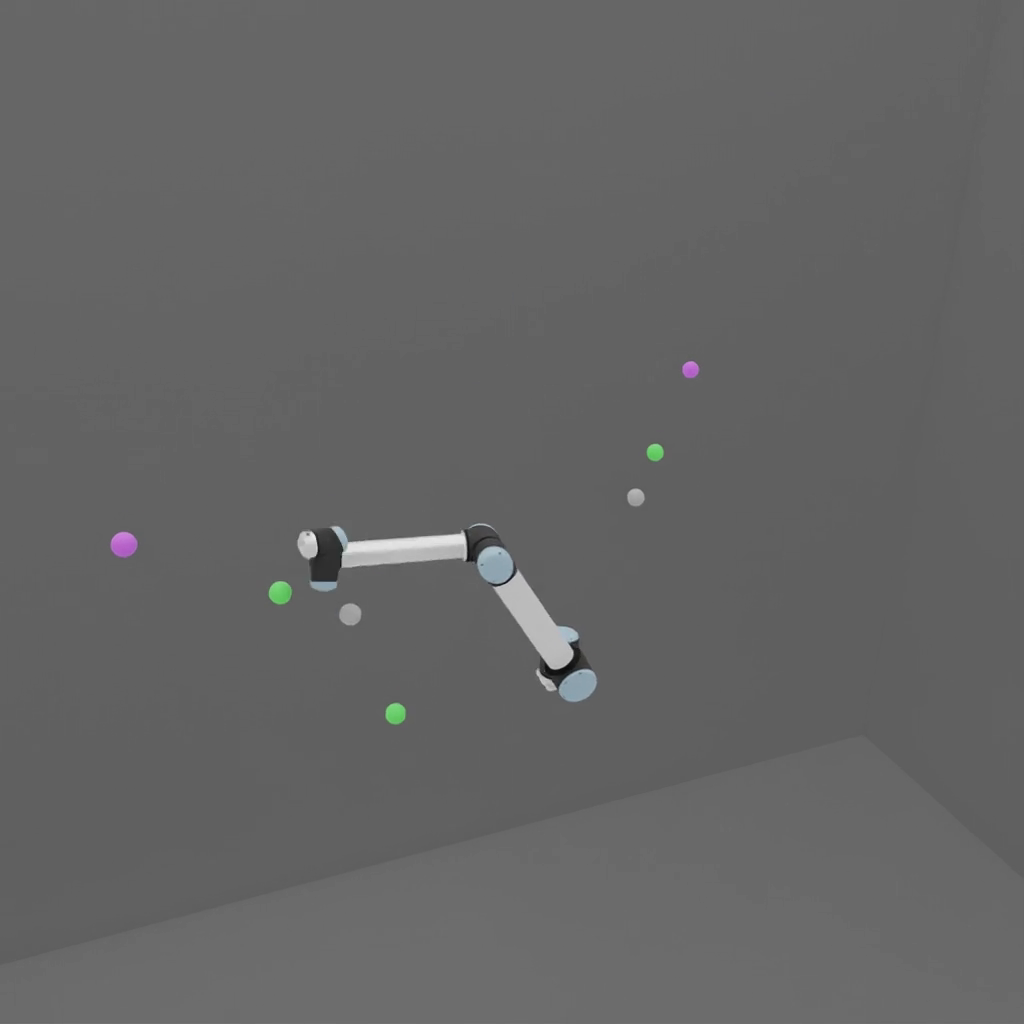
The robot attempts sampled targets and plays back accepted solutions. Inspect per-target status and live position error with video and joint traces. A pass can contain failed targets and does not certify final live orientation.
Notes and Caveats#
This test applies to arm-like Cartesian kinematic chains, not standalone
grippers. It also requires a Lula robot descriptor. Without a descriptor,
execution supplies NO VERDICT. Descriptor resolution uses the installed Lula policy_map and selected
robot name, or explicit lula_yaml_path/lula_urdf_path configuration with
lula_robot_name as needed. Generic SimReady asset metadata alone does not
register a descriptor. Verify that the selected YAML/URDF represents this actual
mechanism, rather than retagging a different robot to force a policy match.
This test is distinct from the jacobian_ik test. The jacobian_ik test uses an in-house damped-least-squares Jacobian solver that does not require a Lula descriptor and samples targets differently. Refer to the jacobian_ik doc for details.