

CCCL Cooperative Groups#
CCCL Cooperative Groups are available through the <cuda/experimental/coop/group> header.
Introduction#
This section describes the fundamental ideas and features of CCCL Cooperative Groups and how they compare to the original cooperative groups (<cooperative_groups.h>, see online docs).
Concerning Groups#
Let’s start with a quick introduction to groups regarding the CUDA programming model. A group could be simply defined as a collection of threads, each identified by a rank in range \([0;N)\), that must be able to synchronize, so they cooperate on solving algorithmic problems. However, such a generic group isn’t too suitable for the CUDA programming model, because the definition doesn’t allow an efficient implementation of synchronization in hardware.
The original cooperative groups solve this issue by adding an upper boundary within which the threads are grouped to the definition. It means that you can’t simply group arbitrary threads, but you can only group threads within a given CUDA hierarchy level. This information is used by the implementation to select the right synchronization mechanism for a given group.
Even though this design solves the synchronization efficiency issue, the design could be improved even further. When writing a collective algorithm, often you can do an operation more efficiently when you know how the threads are actually grouped within the upper boundary. For example, when you have a group of threads within a block and you know that the threads always form a full warp, you could use this information to implement the algorithm more efficiently. However, the original cooperative groups don’t store this information inside the group.
CCCL Cooperative Groups address this problem by changing the group definition again. In this new design, a group is a collection of units within an upper boundary that can synchronize, where the unit can be any CUDA hierarchy level below or the same as the upper boundary. This means that when writing a cooperative algorithm, you know what the biggest building block of the group is and can optimize the algorithm accordingly.
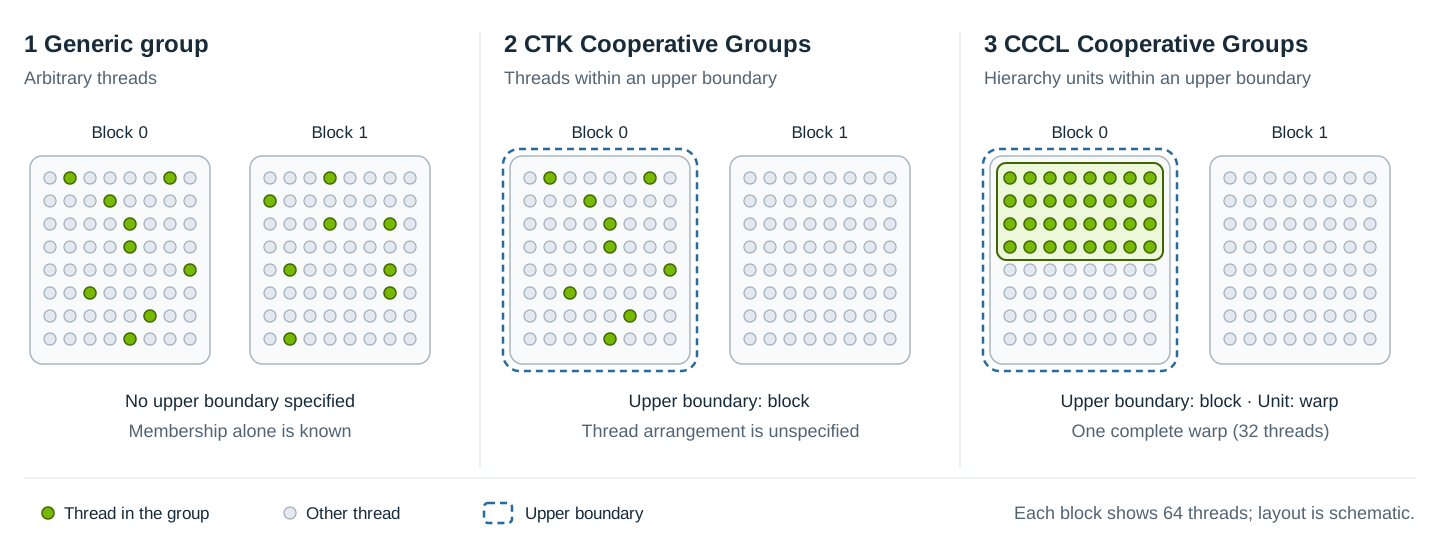
Group definitions illustrated with two CUDA thread blocks. Green dots are participating threads; dashed blue outlines mark the upper boundary. The CCCL example additionally identifies a complete warp as the group’s unit.#
Hierarchy-Aware Groups#
One of the limitations of the original cooperative groups is that they lack static information about the hierarchy of the launched kernel. For instance, with the original cooperative groups, the computation of a 1D thread rank within a block is always done as:
// What cooperative_groups::this_thread_block().thread_rank() would compute.
const auto thread_rank = (threadIdx.z * blockDim.y + threadIdx.y) * blockDim.x + threadIdx.x;
independently of whether the thread block is 1D or 3D. If the thread block is actually 1D, this computation wastes precious registers and introduces unnecessary overhead.
CCCL Cooperative Groups, on the other hand, are hierarchy-aware. They are designed to interoperate with cuda::launch to get as much compile-time information about the launched kernel as possible. If the launched hierarchy really consists of 1D blocks, then CCCL Cooperative Groups would compute only:
// What CCCL Cooperative Groups equivalent computes.
const auto thread_rank = threadIdx.x;
which can make the difference between register spilling to local memory and fitting everything within registers.
Having statically known information about the launched hierarchy has another great benefit. An API taking a group can statically allocate resources such as shared memory precisely for the given group without the need to pass this information separately via a template parameter. This is a property that is very valuable for cooperative algorithms.
Group Queries#
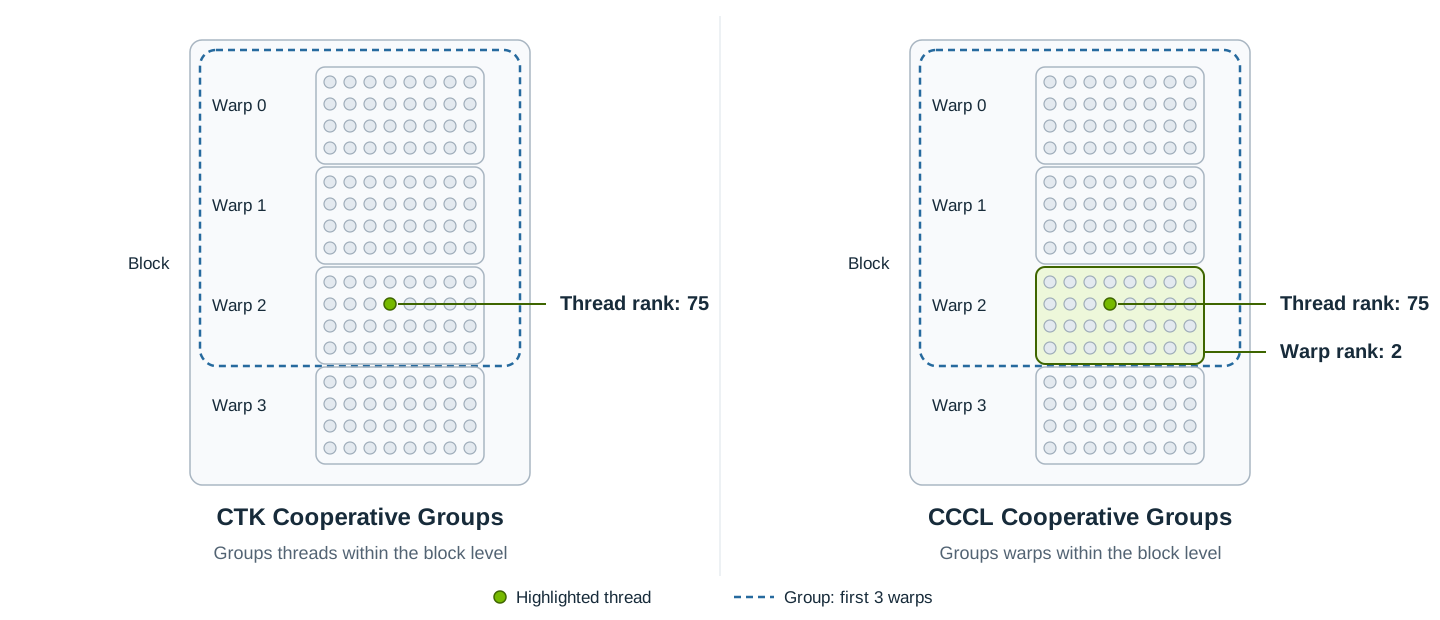
The original cooperative groups provide cg_group.thread_rank() and cg_group.num_threads() methods to query the thread rank/count in a group. CCCL Cooperative Groups could do the same thing; however, these queries would be good enough only for groups with a thread-level unit type. When the unit type of a group is, for example, warp-level, we’d like to query the warp rank/count of the current warp within the group.
For this reason, CCCL Cooperative Groups implement group queries in a similar fashion to hierarchy queries that allow querying information about any level below the group’s unit type. We call them sub-unit queries. Similarly, a group might be queried for its rank/count within the parent group or a hierarchy level, when the group is an implicit group. These are called super-level queries.
See Group Queries the API description.
Requirements on Groups#
The requirements on groups are formally specified by the cuda::experimental::coop::group concept, which is defined as:
namespace cuda::experimental::coop
{

template <typename T>
concept group = requires (T& t, const T& ct)
{
  // Member types.
  requires /*is-hierarchy-level*/<typename T::unit_type>;     // (1)
  requires /*is-hierarchy-level*/<typename T::level_type>;    // (2)
  requires /*is-hierarchy*/<typename T::hierarchy_type>;      // (3)

  // Getters.
  { ct.hierarchy() }
    -> cuda::std::same_as<const typename T::hierarchy_type&>; // (4)

  // Synchronization.
  { t.sync() } -> cuda::std::same_as<void>;                   // (5)
  { t.sync_aligned() } -> cuda::std::same_as<void>;           // (6)

  // Properties.
  { T::is_always_contiguous() } -> cuda::std::same_as<bool>;  // (7), must be constexpr
};

} // namespace cuda::experimental::coop
Where:
The unit level type that defines what units are being grouped.
The upper level bound type that defines the level within which the units are grouped.
The hierarchy type within which the group is operating.
Returns a
const hierarchy_type&to the hierarchy stored by the group.Synchronizes all units that are part of the group.
Same as
sync(), but all of the units are contextually aligned (execute the same statement).A property known at compile time that specifies whether each group occupies a contiguous range of physical units, numbered in ascending physical order from zero.
Group Queries#
Group queries can be used to study group-related information. They are similar to hierarchy queries; however, only a subset of the hierarchy queries is supported. There are 2 types of group queries - the sub-unit and the super-level queries.
Sub-Unit Queries#
Sub-unit queries can be used to query information about levels that are below the group’s unit type. They look like:
qunit.query(group);
Where:
qunitis the query unit, which must be below or the same as the group’s unit type.queryis one of the supported query kinds.groupis the group the query is done for.
The supported query kinds are:
constexpr auto a = qunit.static_count(group); // (1), always constexpr
const auto b     = qunit.count_as<T>(group);  // (2)
const auto c     = qunit.rank_as<T>(group);   // (3)

const auto d     = qunit.count(group);        // (4)
const auto e     = qunit.rank(group);         // (5)
const auto f     = qunit.is_root_rank(group); // (6)
Queries the statically known number of
qunitunits inside thegroupgroup. When equal tocuda::std::dynamic_extent, the value is known only at runtime.Queries the number of
qunitunits inside thegroupgroup, returned as typeT.Queries the current
qunit’s rank within thegroupgroup. Returns a value in the range[0, qunit.count(group))as typeT.Equivalent to
qunit.count_as</*default-T*/>(group).Equivalent to
qunit.rank_as</*default-T*/>(group).Equivalent to
qunit.rank(group) == 0.
Example:
template </*is-this-warp-group*/ Group>
__device__ int sum(const Group& group, int value);

// Returns an array of warp partial sums.
template </*is-warps-within-block-group*/ Group>
__device__ auto parital_sum(const Group& group, int value)
{
  // Make sure that the number of warps in the group is statically-known.
  static_assert(cuda::warp.static_count(group) != cuda::std::dynamic_extent);

  // Allocate shared memory scratch.
  __shared__ int smem_scratch[cuda::warp.static_count(group)];

  // Group consist of several warps within a block, so we can safely use this_warp group for calculating the partials.
  const cuda::experimental::coop::this_warp warp{group.hierarchy()};

  // Calculate partials.
  const auto partial = sum(warp, value);

  // Store partials in shared memory by lane 0 of each warp.
  if (cuda::gpu_thread.is_root_rank(warp))
  {
    smem_scratch[cuda::warp.rank(group)] = partial;
  }

  // Wait until all partials are written.
  group.sync();

  // Return the partials as cuda::std::array object.
  return cuda::std::to_array(smem_scratch);
}
Super-Level Queries#
Super-level queries can be used to query a group’s information within the group’s parent group or a hierarchy level when the group is one of the special group types. When it’s a hierarchy level, it must be the same as or above the group’s level type. See the concrete group’s documentation for more information.
Super-level queries look like:
group.query(/*parent-group-or-qlevel*/);
Where:
groupis the group thequeryis done for.queryis one of the supported query kinds./*parent-group-or-qlevel*/is eithergroup’s parent group or a hierarchy level.
The supported query kinds are:
// Super-level queries.
constexpr auto a = group.static_count(/*parent-group-or-qlevel*/); // (1), always constexpr
const auto b     = group.count_as<T>(/*parent-group-or-qlevel*/);  // (2)
const auto c     = group.rank_as<T>(/*parent-group-or-qlevel*/);   // (3)

const auto d     = group.count(/*parent-group-or-qlevel*/);        // (4)
const auto e     = group.rank(/*parent-group-or-qlevel*/);         // (5)
Queries the statically known number of
groupgroups made fromgroup’s parent group or contained within theqlevellevel. When equal tocuda::std::dynamic_extent, the value is known only at runtime.Queries the number of
groupgroups made fromgroup’s parent group or contained within theqlevellevel, returned as typeT.Queries the current
group’s rank within thegroup’s parent group or theqlevellevel. Returns a value in the range[0, group.count(/*parent-group-or-qlevel*/))as typeT.Equivalent to
group.count_as</*default-T*/>(/*parent-group-or-qlevel*/).Equivalent to
group.rank_as</*default-T*/>(/*parent-group-or-qlevel*/).
Example:
// Inside a kernel receiving the launch configuration:
const cuda::experimental::coop::this_block block{config};

constexpr auto total = block.static_count(cuda::grid); // 4 for grid_dims<4>()
const auto count = block.count(cuda::grid);            // 4
const auto rank  = block.rank(cuda::grid);             // 0, 1, 2, or 3

// Print once per block.
if (cuda::gpu_thread.is_root_rank(block))
{
  printf("Block %d of %d\n", static_cast<int>(rank), static_cast<int>(count));
}
Group Types#
Implicit Groups#
Implicit groups are essential building blocks for other groups. They don’t have a parent group and always use a hierarchy level in super-level queries.
cuda::experimental::coop::this_{level} – abstraction over a whole hierarchy level
cuda::experimental::coop::coalesced_group – a group containing all currently active threads within a warp
Derived Groups#
Derived groups originate by splitting an another parent group.
When creating a group, it is necessary to define how the units are grouped and how the units are synchronized. The original cooperative groups fuse these 2 properties together, providing free functions that partition the group and select a suitable synchronization mechanism for the group.
CCCL Cooperative Groups instead try to give the user control over both properties by separating them. This is implemented by a family of types that implement a well-defined interface. The information about how the units are grouped is passed by Group Mappings and how the units are synchronized is passed by Group Synchronizers. The design can be likened to std::mdspan’s layout mappings and accessors.

This functionality is implemented by the cuda::experimental::coop::generic_group.
Other Group Types#
cuda::experimental::coop::group_view – non-owning view over an another group
cuda::experimental::coop::virtual_group – an abstraction layer over an existing group
Factory Functions and Optional Participation Support#
CCCL Cooperative Groups can be constructed 2 ways – using their constructor or the make_group factory function:
namespace cuda::experimental::coop
{

template <template <typename...> typename GroupTempl, typename... Args>
[[nodiscard]] __device__
auto make_group(Args&&... args)
  -> /*GroupTempl-instantiated-with-args*/;                                          // (1)

template <template <typename...> typename GroupTempl, typename... Args>
[[nodiscard]] __device__
auto make_group(const non_exhaustive_t&, Args&&... args)
  -> cuda::std::optional</*GroupTempl-instantiated-with-args*/>;                     // (2)

template <typename CgGroup, /*hierarchy-like-type*/ HierarchyLike>
[[nodiscard]] __device__
group auto make_group(const CgGroup& cg_group, const HierarchyLike& hierarchy_like); // (3)

} // namespace cuda::experimental::coop
Both overloads take the GroupTempl template template parameter that denotes the group kind that shall be constructed from args arguments.
Equivalent to
GroupTempl{args...}.Instantiates
GroupTemplwithargsand the result the non-exhaustive mapping, returns an emptycuda::std::optional, when the current unit was not assigned to any group. Currently, only cuda::experimental::coop::generic_group is supported.Takes an original cooperative groups group and converts it to a CCCL Cooperative Groups equivalent group.
Note
The group returned by cuda::experimental::coop::make_group(...) doesn’t take ownership of the resources owned by cg_group, so cg_group should outlive the returned group.