

Load#
cuda.coop.cutlass.load() fills each thread’s ThreadData from a contiguous
tile in memory. The algorithm determines which thread reads each value and
whether a shared-memory exchange rearranges it afterward.
Prefer returning Load for a fresh payload. Its source may be global or shared memory; the result remains per-thread values in either case. The shared scratch used by transpose algorithms is distinct from a shared source tile. To write a tile into shared memory, use Store; see the shared-memory staging example.
The explorer shows eight illustrative threads. For the warp-transpose algorithms, it groups them into two four-lane teaching warps. CUDA warps have 32 lanes; executable blocks using these algorithms must contain a multiple of 32 threads. All illustrated loads read a full tile.
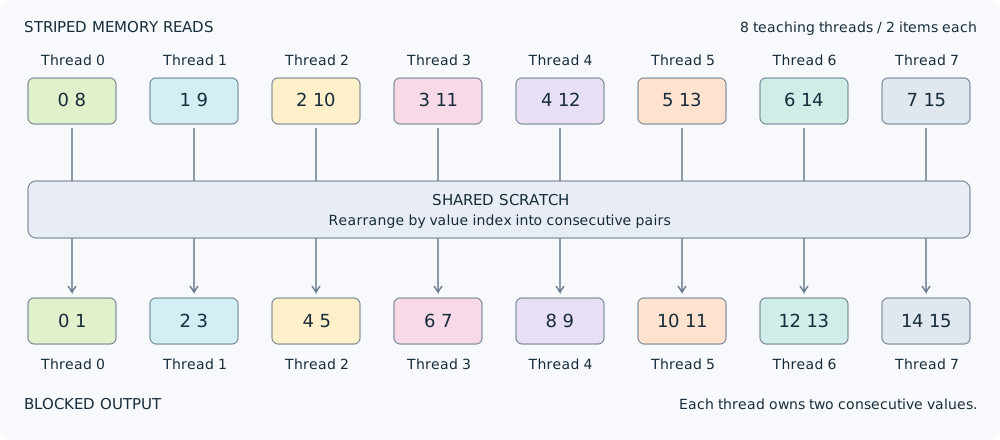
Transpose load with eight illustrative threads and two items per thread.#
Each column below belongs to one thread. Transpose first reads in striped order, then exchanges values to give each thread a consecutive pair.
Thread          0     1     2     3     4     5     6     7
Memory reads   0,8   1,9  2,10  3,11  4,12  5,13  6,14  7,15
After exchange 0,1   2,3   4,5   6,7   8,9  10,11 12,13 14,15
Reading the stages#
See blocked versus striped for a compact ownership table and the index formulas used here.
The memory row numbers values by their position in the tile. The next row shows the threads that read them. For algorithms with an exchange, shared scratch connects those readers to the final owners. Select a value to inspect its source index and destination thread slot.
direct and vectorize produce blocked ownership: thread t receives
K consecutive values starting at t * K, where K is the number of
items per thread. Vectorization can combine a thread’s adjacent values into
a wider access when the pointer, alignment, type, and item count permit it.
The diagram does not guarantee a vector instruction.
striped gives thread t the values at t + j * T for item slot
j and group size T. Neighboring threads read neighboring addresses
at each slot, and the output stays striped. transpose starts with those
same reads and exchanges the values into blocked ownership.
warp_transpose reads a separate striped tile within each physical warp
and exchanges it into blocked ownership. warp_transpose_timesliced uses
the same memory reads, then lets warps take turns through a shared scratch
region sized for one warp. The animation separates those exchange rounds;
it does not serialize the global-memory loads.
Using Load in a kernel#
This CuTe fragment uses the kernel-fragment
setup. Launch with 128 threads and provide at
least 128 * items_per_thread source elements for each block.
block = coop.this_block()
offset = block_index * 128 * items_per_thread
items = coop.load(
    block, source, items_per_thread=items_per_thread,
    algorithm="transpose", offset=offset,
)
# Each thread owns items_per_thread consecutive values in the result.
For a partial final tile, supply valid_items and, when needed,
oob_default. See cuda.coop.cutlass.load() for the full parameter contract
Programming Guide for complete examples.