

TopK#
cuda.coop.cutlass.topk_min_keys() selects the smallest keys in a block;
cuda.coop.cutlass.topk_max_keys() selects the largest. The corresponding
topk_min_pairs() and topk_max_pairs()
operations carry a value with each selected key. All four return new
payloads and preserve the inputs.
The explorer uses one complete one-dimensional block of eight teaching
threads. Change k and valid_items to see how the defined output
prefix changes. Repeated keys expose the selection boundary: when several
keys tie there, TopK may choose any subset needed to fill the result.
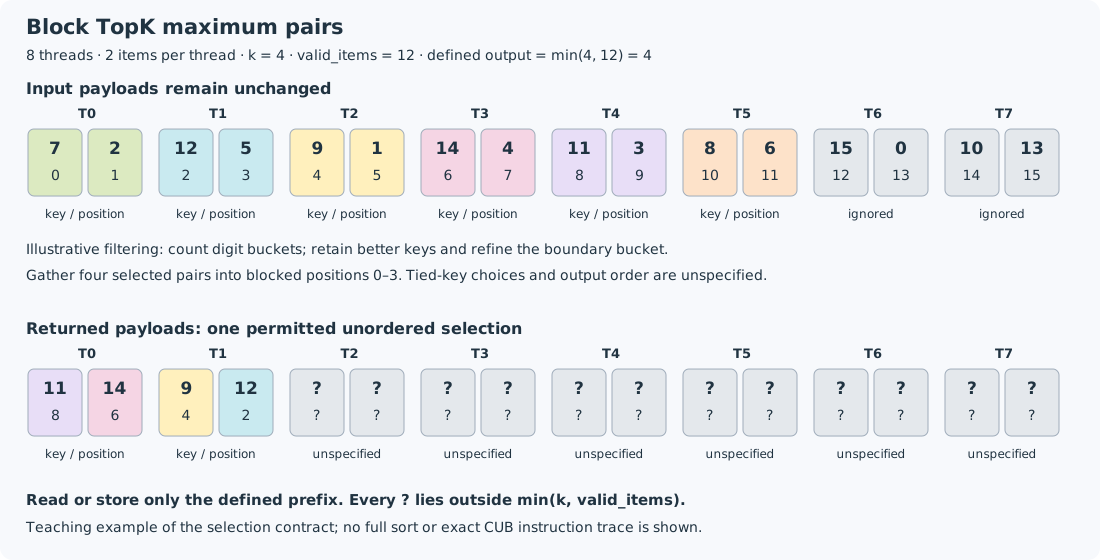
Maximum pairs, two items per thread, k=4, valid_items=12.#
Only the first min(k, valid_items) blocked output positions are
defined. This is one permitted output order. ? marks an unspecified
output that the program must not read or store; parentheses mark inputs
outside the valid prefix.
Thread             T0    T1    T2    T3    T4    T5     T6      T7
Input keys         7,2  12,5   9,1  14,4  11,3   8,6  (15,0) (10,13)
Input positions    0,1   2,3   4,5   6,7   8,9  10,11 (12,13)(14,15)
Selected keys     11,14  9,12  ?,?   ?,?   ?,?   ?,?    ?,?     ?,?
Selected positions 8,6   4,2   ?,?   ?,?   ?,?   ?,?    ?,?     ?,?
Reading the stages#
The input rows stay visible throughout playback. In blocked order,
position thread_rank * items_per_thread + item belongs to that
thread’s local item slot. valid_items counts the input prefix in
this order, across the whole block. Every thread participates even when
none of its items is valid.
The teaching model uses small nonnegative integer keys and two-bit digits. It counts candidates by the high digit first, then refines the bucket containing the selection boundary using the low digit. Digits on the preferred side are guaranteed selections; digits on the other side are excluded. Inspect a key to distinguish these from the remaining boundary candidates. The candidate row annotates source positions. It does not represent input data moving during filtering.
This follows the candidate-filtering idea in CUB’s internal block TopK implementation. CUB determines a boundary with radix histograms, then partitions selected items through shared memory into a blocked output prefix. The explorer’s digit width, tie choices, and output order are illustrative. It does not show the exact compiled instructions or imply a full sort. When all valid items are selected, filtering is unnecessary.
The defined output length is min(k, valid_items). Setting either count
to zero leaves no defined output items. If k exceeds valid_items,
all valid inputs are selected. Both counts must be uniform across the
block and lie in [0, block_threads * items_per_thread]. Uniformity is a
caller precondition. The backend validates count ranges, but does not
check agreement among threads.
TopK does not promise sorted output, stable ordering among equal keys, or a particular choice of tied items at the boundary. For pairs, the chosen values still belong to their original keys. Use a sorting primitive when you need an ordered result. See the TopK ordering FAQ.
Using TopK in a kernel#
This example selects the smallest keys and largest pairs from a partial tile. It verifies selected multisets and pair identities without relying on output order or stable ties, and demonstrates register-payload conversions.
@cute.kernel
def select_tile(
    source: cute.Pointer,
    smallest: cute.Pointer,
    largest: cute.Pointer,
    selected_positions: cute.Pointer,
    original_keys: cute.Pointer,
    original_positions: cute.Pointer,
    items_per_thread: cutlass.Constexpr,
):
    tile_size = _THREADS * items_per_thread
    valid_items = tile_size - 35
    selected_items = min(_K, valid_items)
    block = coop.this_block()
    positions = coop.ThreadData(items_per_thread)
    keys = coop.load(block, source, items_per_thread=items_per_thread)
    for item in cutlass.range_constexpr(items_per_thread):
        positions[item] = (
            cutlass.Int32(block.rank()) * items_per_thread + item
        )
    input_keys = keys.to_register_tensor()
    input_positions = positions.to_tensor_ssa(dtype=cutlass.Int32)
    scratch = coop.TempStorage(alignment=16, auto_sync=True)
    min_keys = coop.topk_min_keys(
        block,
        input_keys,
        k=_K,
        valid_items=valid_items,
        temp_storage=scratch,
    )
    max_keys, max_positions = coop.topk_max_pairs(
        block,
        input_keys,
        input_positions,
        k=_K,
        valid_items=valid_items,
        temp_storage=scratch,
    )
    # Only min(k, valid_items) output positions are defined, in any order.
    coop.store(
        block,
        smallest,
        min_keys,
        valid_items=selected_items,
    )
    coop.store(
        block,
        largest,
        max_keys,
        valid_items=selected_items,
    )
    coop.store(
        block,
        selected_positions,
        max_positions,
        valid_items=selected_items,
    )
    coop.store(block, original_keys, keys)
    coop.store(block, original_positions, positions)

@cute.jit
def launch(
    source: cute.Pointer,
    smallest: cute.Pointer,
    largest: cute.Pointer,
    selected_positions: cute.Pointer,
    original_keys: cute.Pointer,
    original_positions: cute.Pointer,
    items_per_thread: cutlass.Constexpr,
):
    select_tile(
        source,
        smallest,
        largest,
        selected_positions,
        original_keys,
        original_positions,
        items_per_thread,
    ).launch(grid=1, block=_THREADS)
TopK calls accept numeric ThreadData payloads in blocked order.
All four variants accept ThreadData and CuTe register payloads. They
preserve inputs and return fresh payloads. See the Programming Guide and cuda.coop.cutlass API Reference for counts, dtypes, and scratch rules.