

Discontinuity#
cuda.coop.cutlass.discontinuity() flags changes between adjacent values in a
full block tile. A head marks the start of a run; a tail marks its end.
The default predicate compares neighboring values for inequality.
mode="heads_and_tails" returns both int32 payloads as
(heads, tails). Each flag stays in its input item’s blocked slot, and
the input remains unchanged.
Runs can cross thread boundaries. The explorer shows eight teaching threads, with separate rows for the neighbor values and returned flags. Supply a tile predecessor or successor to see whether a run continues outside the tile.
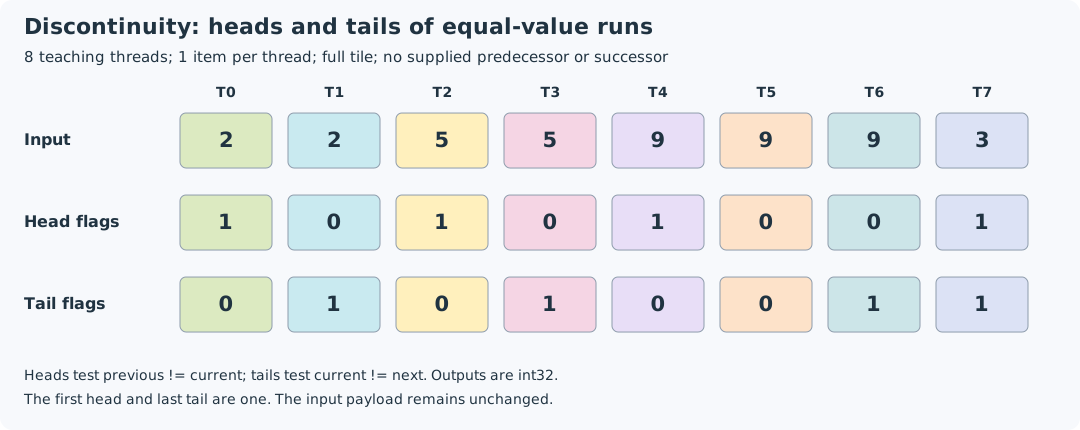
Head and tail flags for a full tile with no supplied boundary values. The run of three nines spans three threads here.#
With no tile predecessor or successor:
Input        2  2  5  5  9  9  9  3
Heads        1  0  1  0  1  0  0  1
Tails        0  1  0  1  0  0  1  1
Input after  2  2  5  5  9  9  9  3
Reading the stages#
Input positions follow blocked order:
all of thread zero’s items, then thread one’s, and so on. Head flags test
previous != current. Tail flags test current != next. A boundary
between threads is an ordinary adjacent pair.
When no predecessor is supplied, the first head is one. When no successor
is supplied, the last tail is one. Supplying the appropriate tile boundary
value replaces that forced flag with the predicate result. For example,
tile_predecessor_item=2 changes the first head in the fallback table
from one to zero. It does not change any other flag. Scalar boundary values
must match the input dtype and agree across the block.
Every thread in the complete block must call the operation; warp groups
are unsupported. The function infers dtype and per-thread extent from
ThreadData. It accepts automatic scratch or an explicit
TempStorage.
The operation requires a full tile. There is no valid_items argument.
Padding becomes input: a padding value equal to the final valid value can
make its tail zero, while a different padding value can make it one.
Masking stores afterward does not repair that comparison. Use this API
only when the entire tile and its boundary values have the intended
meaning.
A complete neighbor example#
This CuTe example computes differences and head/tail flags while preserving the input. It reuses scratch with explicit synchronization policy.
@cute.kernel
def compare_neighbors(
    source: cute.Pointer,
    deltas: cute.Pointer,
    head_flags: cute.Pointer,
    tail_flags: cute.Pointer,
    items_per_thread: cutlass.Constexpr,
):
    block = coop.this_block()
    values = coop.load(block, source, items_per_thread=items_per_thread)
    scratch = coop.TempStorage(alignment=16, auto_sync=True)
    differences = coop.adjacent_difference(
        block, values, temp_storage=scratch
    )
    heads, tails = coop.discontinuity(
        block, values, mode="heads_and_tails", temp_storage=scratch
    )
    coop.store(block, deltas, differences)
    coop.store(block, head_flags, heads)
    coop.store(block, tail_flags, tails)

@cute.jit
def launch(
    source: cute.Pointer,
    deltas: cute.Pointer,
    head_flags: cute.Pointer,
    tail_flags: cute.Pointer,
    items_per_thread: cutlass.Constexpr,
):
    compare_neighbors(
        source, deltas, head_flags, tail_flags, items_per_thread
    ).launch(grid=1, block=128)
An inclusive sum of head flags counts started runs; subtract one for zero-based IDs. Those IDs restart in each block. Global run IDs need another step to account for preceding tiles and runs spanning tile boundaries.