

rustc_public – Stable MIR#
cuda-oxide does not invent its own Rust parser or type system. It piggybacks on
the real Rust compiler, intercepts the internal representation that rustc
produces after type-checking and monomorphization, and compiles that to PTX.
This chapter explains the intermediate representation cuda-oxide reads (MIR),
the stability layer it reads it through (rustc_public), and the bridge
pattern that connects the two worlds.
What is MIR?#
After rustc parses your source code, resolves names, checks types, and
desugars all the syntactic conveniences (closures, for loops, ? operator),
it produces MIR – the Mid-level Intermediate Representation. MIR is a
simplified, control-flow-oriented form of your program that looks much closer
to what a machine would execute than the abstract syntax tree you wrote.
MIR is where the heavy lifting happens:
Borrow checking – Rust’s ownership rules are verified against MIR, not against your source code.
Optimizations – constant propagation, copy propagation, dead store elimination, and inlining all operate on MIR.
Monomorphization – generic functions are stamped out into concrete versions for each set of type parameters.
In a normal Rust compilation, MIR is lowered to LLVM IR (or Cranelift IR if
you are using the cranelift backend), and from there to machine code. But
what if you could intercept MIR before it reaches LLVM and do something else
with it – like compile it to PTX for GPUs?
That is exactly what cuda-oxide does.
The stability problem#
There is a catch. MIR is rustc’s internal intermediate representation.
It was never designed as a public API. Types get renamed, enum variants get
reordered, fields appear and disappear – all between consecutive nightly
releases, sometimes between consecutive commits. The compiler team is under
no obligation to keep any of it stable, and they don’t.
If cuda-oxide consumed rustc_middle types directly, every nightly update
would be a game of whack-a-mole: something moves, something breaks, someone
spends a weekend patching compilation errors instead of writing GPU code.
This is where rustc_public comes in.
What is rustc_public?#
rustc_public (formerly known as stable_mir) is a stable interface to
the Rust compiler’s internals. It lets tool developers – verifiers, linters,
codegen backends like cuda-oxide – perform analyses and code generation
without breaking every time the compiler’s plumbing shifts.
The implementation lives in two crates inside the rustc repository:
Crate |
Role |
|---|---|
|
The user-facing public API. Defines stable types for |
|
The translation layer. Converts between |
The stable API covers the types cuda-oxide cares about most:
Body– the MIR of a single function (basic blocks, locals, types).BasicBlock– a straight-line sequence of statements followed by a terminator.LocalandPlace– variables and memory locations.Ty– the full Rust type system: primitives, references, tuples, ADTs, function pointers, closures.StatementKind– assignments, storage annotations, discriminant reads.TerminatorKind– branches, calls, returns, asserts, drops.Instance– a monomorphized function (concrete types filled in).
Note
The rustc_public effort is driven by the Kani
team at AWS (formal verification for Rust) and other projects that need stable
compiler access. cuda-oxide benefits from their work without having to
maintain the bridge itself.
How cuda-oxide hooks in#
The CodegenBackend trait#
Deep inside rustc, compilation is organized around a trait called
CodegenBackend. Its key method is codegen_crate, which receives a
TyCtxt – the compiler’s god-object containing all type information,
MIR bodies, and metadata for the current compilation – and must produce
compiled output.
Normally, rustc_codegen_llvm implements this trait and turns MIR into
machine code via LLVM. cuda-oxide provides CudaCodegenBackend, which
wraps the LLVM backend rather than replacing it. This is a deliberate
design choice: cuda-oxide is not a full replacement for LLVM, it is a
specialist that handles the GPU side while letting LLVM do what LLVM does
best.
The wrapping flow looks like this:
rustccallsCudaCodegenBackend::codegen_crate(tcx).cuda-oxide intercepts, runs its collector to identify all device functions (kernels and their transitive callees), and enters the stable MIR context to compile them to PTX via
mir-importer.The PTX output is written to disk alongside the build artifacts.
cuda-oxide delegates the host code to the wrapped LLVM backend, which compiles it into a native binary as normal.
The result is a single cargo invocation that produces both a native host
binary and a PTX module, without requiring two separate toolchains or a
split build system.
Entering the stable MIR context#
Inside codegen_crate, cuda-oxide receives rustc_middle types – the
internal, unstable kind. The mir-importer crate, which does the actual
MIR-to-Pliron-IR translation, uses rustc_public as its main MIR interface. To
cross the boundary, cuda-oxide uses the bridge:
// Inside codegen_crate():
let result = rustc_internal::run(tcx, || {
    // Now in stable MIR context
    let stable_instance = rustc_internal::stable(func.instance);
    let body = stable_instance.body().unwrap();
    // Feed to cuda-oxide pipeline
    mir_importer::run_pipeline(&functions, &config)
});
rustc_internal::run(tcx, || { ... }) sets up a scoped context where stable
MIR queries are available. Inside the closure, rustc_internal::stable()
converts an internal rustc_middle::ty::Instance<'tcx> into its stable
counterpart rustc_public::mir::mono::Instance. From there, calling
Instance::body() retrieves the MIR through the stable API – no direct
contact with rustc_middle needed.
Thread-local context management#
You might wonder why the bridge needs a special run() scope instead of just
passing a context object around. The answer is lifetime entanglement.
TyCtxt<'tcx> borrows data from the compiler’s arena allocator. It can be
stored in a struct or passed between functions, but its 'tcx lifetime must
remain within the compiler session. rustc_public uses scoped thread-local
storage so its public query methods can find the current context without
requiring a TyCtxt argument on every call.
The bridge sets up a thread-local variable (TLV):
TLV |
Stored value |
Purpose |
|---|---|---|
|
|
Scoped access to the current |
The pointer is erased internally; compiler_interface::with() recovers the
CompilerInterface reference for queries such as local_crate() and
all_local_items(). Conversions such as rustc_internal::stable(instance)
use with_bridge(), which accesses the same interface through with() and
borrows its translation tables. There is no second thread-local context.
For example, converting an instance and then asking for its MIR body uses one context throughout:
rustc_internal::run(tcx, || {
    stable_instance = stable(instance) -> with_bridge() -> with() -> tables
    stable_instance.body() -----------------------------> with() -> query
})
Queries outside an active scope panic; starting a nested run() returns an
error. The current design replaced the old Container and two-context
implementation in rust-lang/rust#147923.
The bridge pattern#
The CompilerInterface owns a Tables struct – a bidirectional mapping
between rustc’s internal IDs and the stable API’s types. When you
call rustc_internal::stable(instance), the bridge looks up (or creates) the
corresponding stable ID in the tables. When the stable API needs to query the
compiler on your behalf – say, to fetch a function’s MIR body – it goes
through the tables in the opposite direction to recover the internal type.
    rustc_middle::ty::Instance<'tcx>
              │
              ▼
         ┌─────────┐
         │  Tables │  (bidirectional: internal ↔ stable)
         └─────────┘
              │
              ▼
    rustc_public::mir::mono::Instance
A few implementation details worth knowing:
Interior mutability –
CompilerInterfaceholds the tables and compiler context inRefCells. Each query borrows them on the current thread; overlapping mutable borrows are rejected at runtime.Caching – once a type or instance is translated, the result is stored in the tables. Repeated lookups hit the cache instead of recomputing.
Automatic cleanup – when
rustc_internal::run()returns, the scoped thread-local value is unset and the interface and its tables are dropped. Stable IDs refer to these tables; do not reuse them in a later context.
The driver in rustc-codegen-cuda opens the scope with
rustc_public::rustc_internal::run() and converts instances with stable().
The mir-importer translator primarily consumes rustc_public types, but
some checks still consult rustc_middle through the bridge. For example,
grid-constant validation reads declared reference lifetimes and inlining
ownership from the compiler’s internal representation. The importer does
not manage the bridge tables itself.
What MIR looks like#
Before cuda-oxide can translate MIR, it helps to know what MIR actually is. Here is a simple function and its MIR:
fn add(x: i32, y: i32) -> i32 {
    x + y
}
// MIR for `add`:
// _0: i32              (return place)
// _1: i32              (argument `x`)
// _2: i32              (argument `y`)
// _3: (i32, bool)      (temporary for checked arithmetic)
//
// bb0: {
//     _3 = CheckedAdd(_1, _2);
//     assert(!(_3.1), "attempt to compute `{} + {}`, which would overflow") -> bb1;
// }
// bb1: {
//     _0 = (_3.0);
//     return;
// }
A few things to notice:
Locals are numbered.
_0is always the return place (where the result goes)._1,_2, … are function arguments. Higher-numbered locals are temporaries the compiler introduces.Basic blocks (
bb0,bb1, …) are straight-line sequences of statements. Every block ends with exactly one terminator that transfers control – a branch, a call, a return, or an assert.CheckedAddreturns a tuple(i32, bool). Theboolis an overflow flag. Theassertterminator checks it and either continues tobb1or panics. In debug builds this catches integer overflow; in release builds the check is optimized away.No expressions are nested.
x + yin the source becomes two separate operations in MIR: compute the checked add, then extract the result. Every intermediate value gets its own local. This flat structure is what makes MIR easy for tools like cuda-oxide to consume – no recursive expression trees, just a flat list of operations per block.
Note
You can see the MIR for any function by passing --emit=mir to rustc, or
by visiting the Rust Playground and selecting
MIR output. It is a surprisingly readable format once you get used to the
local numbering.
Why this matters for cuda-oxide#
MIR’s flat, explicit structure is what makes it feasible to build a GPU
compiler on top of it. Consider the alternative: if cuda-oxide operated on
Rust’s AST or HIR (the high-level IR), it would have to handle closures,
method resolution, trait dispatch, type inference, and a hundred other
language features that are already resolved by the time MIR is produced.
By reading MIR, cuda-oxide gets a representation where generics are already
monomorphized, closures are already lowered to structs, and control flow is
already explicit. The mir-importer crate translates this into Pliron IR
(an MLIR-like framework), and from there the
lowering pipeline takes it the rest of the way to PTX.
Stabilizing the toolchain pin#
Even with rustc_public providing a stable API, the bridge layer
(rustc_public_bridge) is compiled against librustc_driver.so and is tied to
an exact compiler build. Instead of chasing daily nightly snapshots,
cuda-oxide pins an official stable Rust release via
rust-toolchain.toml:
[toolchain]
channel = "1.99.1"
components = ["rust-src", "rustc-dev", "rust-analyzer", "clippy", "rustfmt", "llvm-tools"]
When bumping this pin, run cuda-oxide/scripts/check-toolchain-parity.sh to
verify that scaffold.rs, .devcontainer/devcontainer.json, the book, and the
READMEs agree, and run nix flake update rust-overlay in cuda-oxide/ so
cuda-oxide/flake.lock carries the new release manifest.
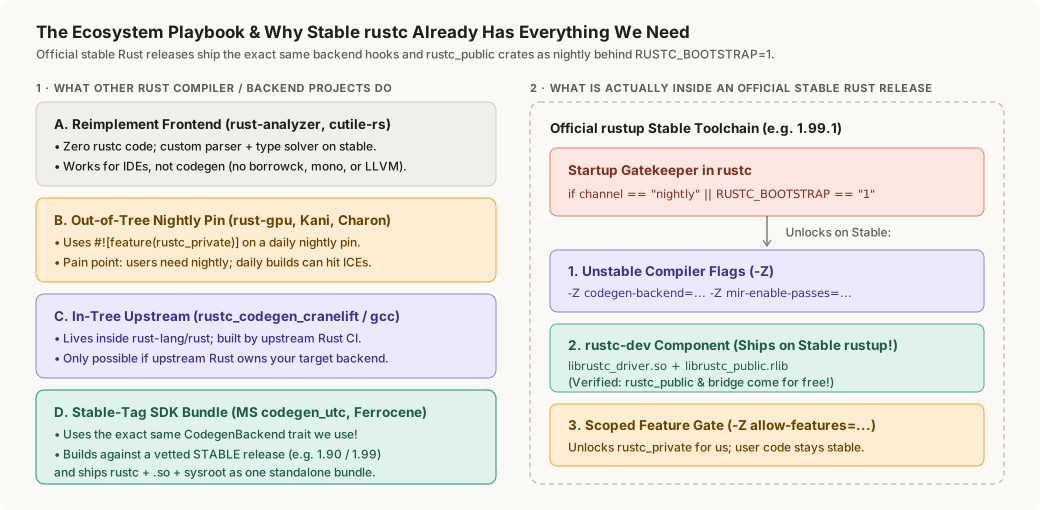
How custom Rust compiler backends ship in production, and what lives inside an official stable rustup release.#
Why stable rustc already has rustc_private and rustc_public#
Official stable rustc binaries are compiled from the same source tree as
nightly; nothing is stripped out of the binary. In addition, rustup publishes
the rustc-dev component (librustc_driver.so, librustc_public.rlib,
librustc_public_bridge.rlib, and librustc_middle.rlib) for every stable
release.
When cargo-oxide invokes Cargo (and inside the workspace via
cuda-oxide/.cargo/config.toml), it sets RUSTC_BOOTSTRAP=1 in the process
environment. That unlocks #![feature(rustc_private)] and -Z flags
(-Z codegen-backend=..., -Z mir-enable-passes=-JumpThreading,
-Z always-encode-mir) on the pinned stable compiler while giving developers
and users a compiler that has already completed Rust’s 12-week nightly and beta
stabilization cycle.
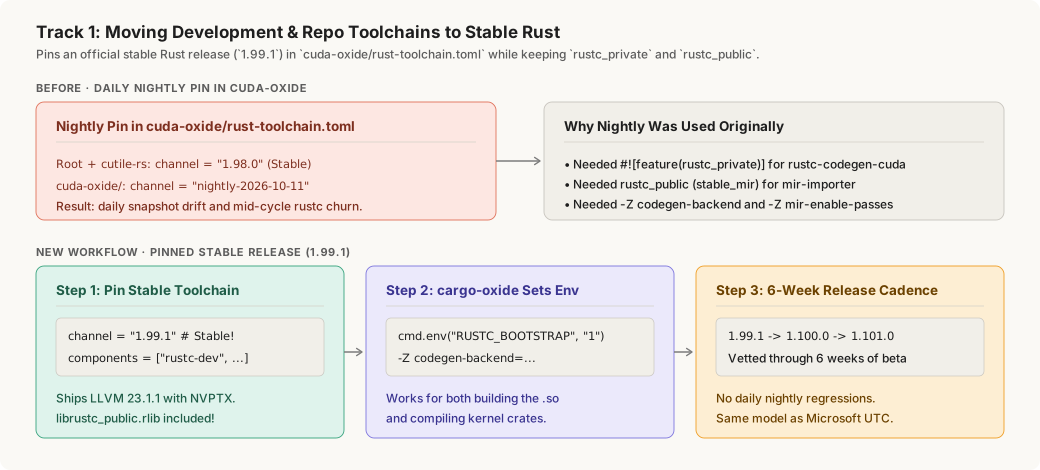
Pinning an official stable release (1.99.1) in cuda-oxide/rust-toolchain.toml with RUSTC_BOOTSTRAP=1 managed by cargo-oxide.#
Upstreaming to rustc_public without emergency toolchain bumps#
When a feature requires a new rustc_public query that we upstream to
rust-lang/rust (such as ArgAttributes getters in
rust-lang/rust#163242), it takes 6 to 12 weeks for that commit to reach the
next stable Rust release.
Because rustc_public only wraps data that already exists inside
rustc_middle and rustc_abi, crates/mir-importer/src/translator/facts.rs
acts as our quarantine boundary:
Day 1 (on the current stable pin): Land the feature immediately by reading the underlying
rustc_middle/rustc_targetfield insidefacts.rsviarustc_internal::internal(tcx, ...), while upstreaming therustc_publicgetter in parallel.Next scheduled stable upgrade: Once the new stable Rust release ships with the upstreamed
rustc_publicAPI, replace the temporary internal read infacts.rswith therustc_publicmethod call.
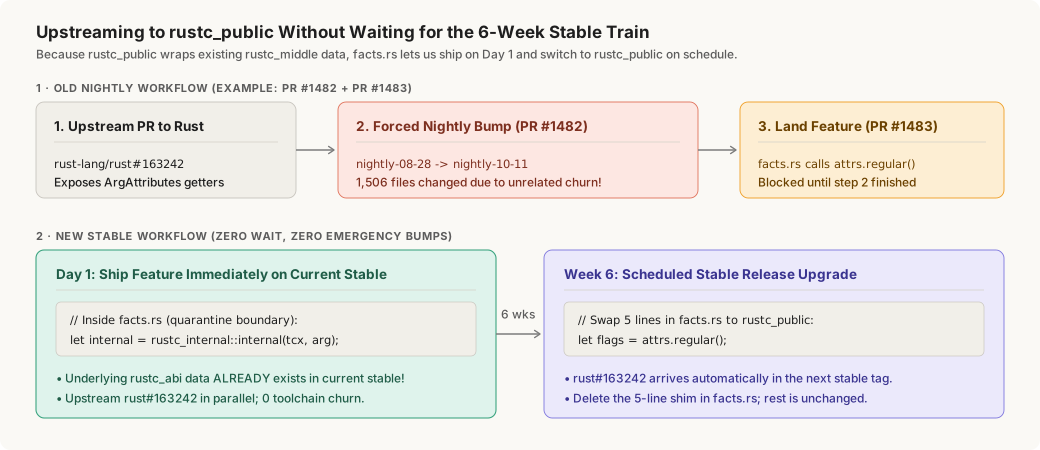
Decoupling feature delivery from toolchain bumps using facts.rs and scheduled stable upgrades.#
Self-contained bundling for standalone and CUDA Toolkit distribution#
For standalone or CUDA Toolkit packaging (following the same model as
Microsoft’s rustc_codegen_utc and Ferrocene), users do not need rustc-dev
(~930 MB of compiler-internal .rlibs used only when building the backend
itself). A stripped runtime bundle containing rustc, cargo, cargo-oxide,
librustc_codegen_cuda.so (34 MB stripped, 8.6 MB compressed),
librustc_driver.so, libLLVM.so, and a pre-encoded core/alloc/std
sysroot totals roughly 453 MB on disk (~120 MB compressed).
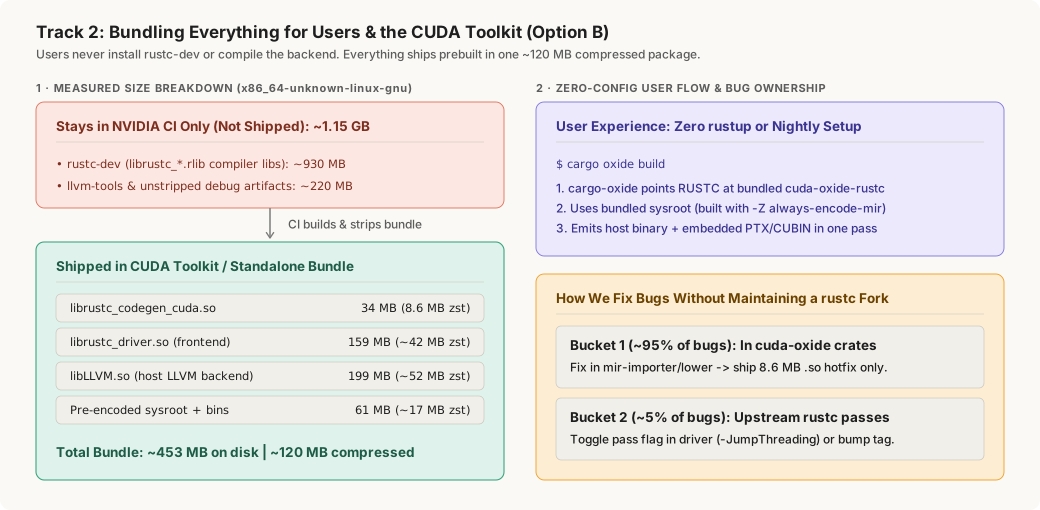
Measured bundle footprint on x86_64-unknown-linux-gnu and the two-bucket maintenance workflow.#
Now that you understand how cuda-oxide talks to the Rust compiler, the next chapter covers what happens when that conversation reaches the codegen backend: The Code Generator.