

Overview: cute-rs and cutlass-primitives (preview)#
Preview
cute-rs compiles for four targets (sm_100a, sm_103a, sm_107a, and sm_120a) through the pinned CUTLASS 4.8.1 compiler, and covers a validated subset of CuTeDSL 4.8 on them. The support matrix lists what is supported, what is partial, and what is missing. Expect API changes between releases.
cute-rs brings CUTLASS CuTe’s layout algebra, partitions, TMA transfers, pipelines, and tensor-core MMA operations into Rust’s type system across Blackwell and Vera Rubin GPUs, without a Python interpreter or runtime JIT tracer.
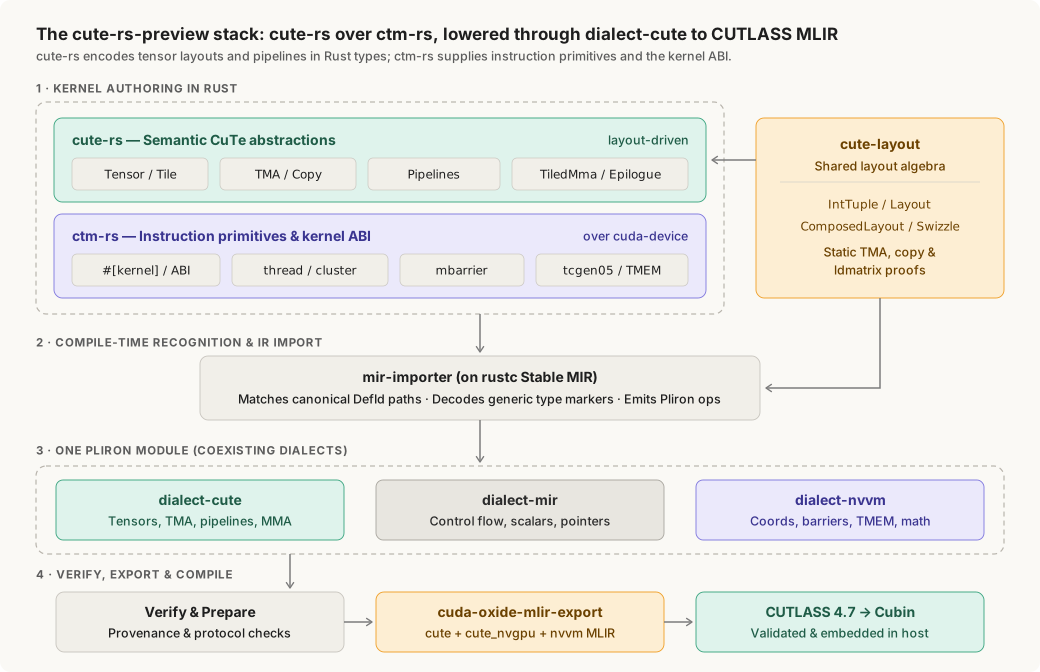
The cute-rs-preview stack: kernels author tensor computation in cute-rs over cutlass-primitives instruction primitives, import into one Pliron module (dialect-cute, dialect-mir, and dialect-nvvm), pass whole-module verification, and compile through CUTLASS 4.8.1 MLIR into an embedded cubin.#
The Two-Layer Kernel Stack#
Every CuTe kernel in cuda-oxide is built on two complementary device crates plus a shared layout algebra crate:
Crate |
Layer |
What it owns |
|---|---|---|
cute-rs |
1-to-1 CuTeDSL layer |
|
cutlass-primitives |
Entry ABI & PTX layer |
|
cute-layout |
Shared layout algebra |
|
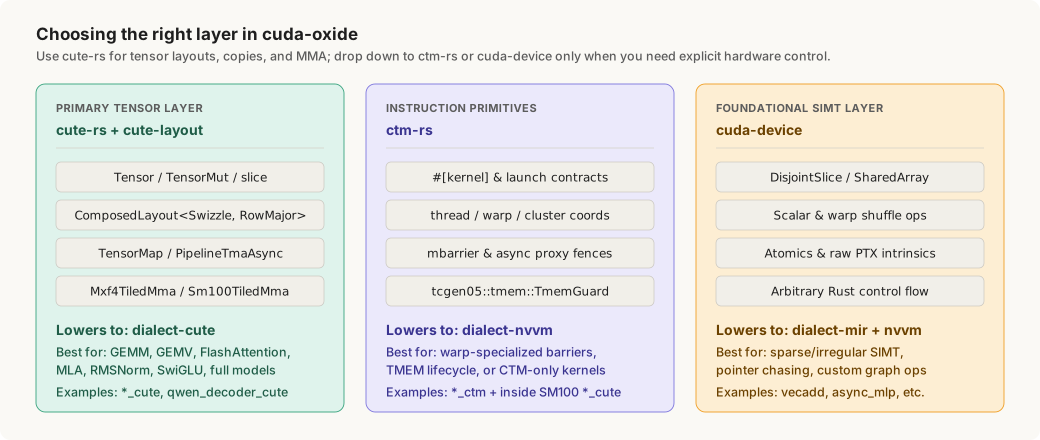
When to use cute-rs, cutlass-primitives, and cuda-device.#
Your First cute-rs Kernel#
In cute-rs, a Tensor pairs storage with a logical coordinate layout. Splitting a vector into 4-element (16-byte) tiles and slicing the tile owned by tid takes three lines:
use cutlass_primitives as prims;
use prims::memory::DisjointSlice;
use prims::{cuda_module, kernel, thread};

#[cuda_module]
mod kernels {
    use super::*;

    #[kernel]
    pub fn add_f32(a: &[f32], b: &[f32], mut c: DisjointSlice<f32>) {
        let tid = thread::index_1d().get();
        let t_a = cute_rs::Tensor::from_slice(a).zipped_divide::<4>().slice(tid);
        let t_b = cute_rs::Tensor::from_slice(b).zipped_divide::<4>().slice(tid);
        let mut t_c = cute_rs::TensorMut::from_disjoint_slice(&mut c).zipped_divide::<4>().slice(tid);

        if t_a.is_full() {
            // Complete 16-byte tile -> lowers to a vectorized cute.copy
            unsafe { t_c.store(t_a.load() + t_b.load()) };
        } else {
            // Ragged boundary tile -> safe scalar tail loop
            let mut k = t_a.base();
            while k < a.len() {
                unsafe { t_c.store_at(k, a[k] + b[k]) };
                k += 1;
            }
        }
    }
}
Run and Inspect the Emitted CuTe MLIR#
Install the pinned CUTLASS 4.8.1 compiler once, then run any *_cute example from cuda-oxide/:
# Install the managed CUTLASS 4.8.1 compiler (x86_64 or aarch64 Linux)
cargo oxide toolchain install cutlass

# Run the f32 + f16 elementwise example through the CUTLASS MLIR backend
CUDA_OXIDE_DEVICE_BACKEND=cutlass-mlir \
  cargo oxide run elementwise_cute --arch sm_120a

# Dump the prepared CUTLASS MLIR module to inspect the generated cute ops
CUDA_OXIDE_DEVICE_BACKEND=cutlass-mlir \
CUDA_OXIDE_MLIR_OUTPUT="$PWD/module.mlir" \
  cargo oxide build elementwise_cute --arch sm_120a
Note
dialect-cute, dialect-mir, and dialect-nvvm coexist inside a single Pliron module rather than acting as separate sequential passes. Before exporting MLIR, dialect-cute’s whole-module verifier checks tensor origins, pipeline state transitions, and TMA/MMA layout and collector contracts.