

From Python CuTeDSL to cute-rs#

If you have used NVIDIA’s Python CuTeDSL, the concepts in cute-rs will feel immediately familiar: layouts, composed swizzles, zipped_divide, TMA copy atoms, and tiled MMA. Both compile down to the exact same CUTLASS cute and cute_nvgpu MLIR operations.

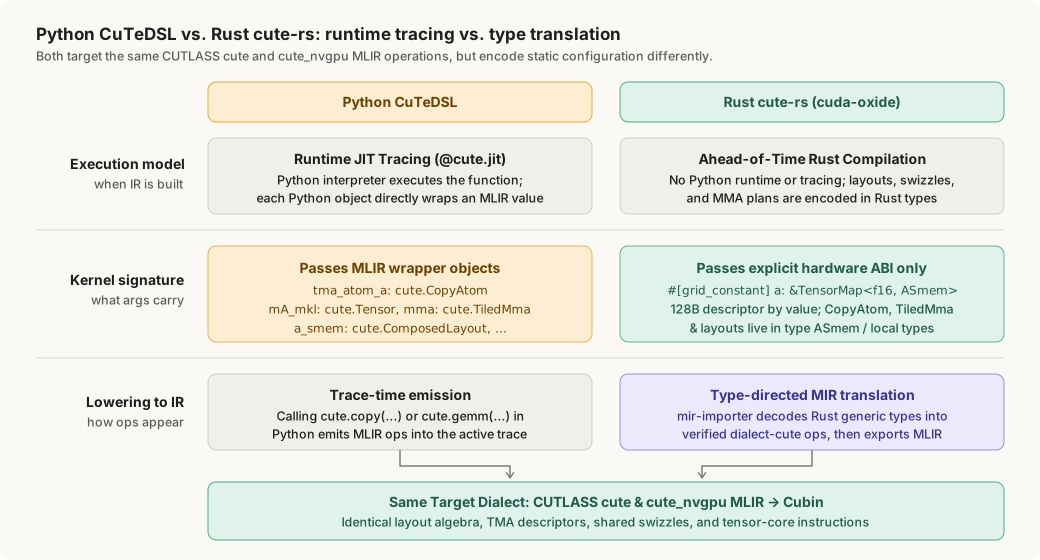
The key difference is where the static configuration lives and when the IR is constructed:
../_images/cute-rs-vs-cutedsl.svg

Python CuTeDSL traces Python objects wrapping live MLIR values at runtime; Rust cute-rs encodes layouts, swizzles, and MMA plans in Rust types and translates them ahead of time.#


Why the Kernel Signatures Look Different#

In Python CuTeDSL, @cute.jit traces a Python function at runtime to build an MLIR module. Because Python objects like cute.Tensor, cute.CopyAtom, cute.TiledMma, and cute.ComposedLayout directly wrap MLIR values, the host script constructs all of them and passes them as parameters into @cute.kernel:

# Python CuTeDSL: 18 parameters wrapping MLIR types during @cute.jit tracing
@cute.kernel
def kernel(
    self,
    tma_atom_a: cute.CopyAtom,              mA_mkl: cute.Tensor,
    tma_atom_b: cute.CopyAtom,              mB_nkl: cute.Tensor,
    tma_atom_sfa: cute.CopyAtom,            mSFA_mkl: cute.Tensor,
    tma_atom_sfb: cute.CopyAtom,            mSFB_nkl: cute.Tensor,
    tma_atom_c: cute.CopyAtom,              mC_mnl: cute.Tensor,
    tiled_mma: cute.TiledMma,               cta_layout_mnk: cute.Layout,
    a_smem_layout: cute.ComposedLayout,     b_smem_layout: cute.ComposedLayout,
    sfa_smem_layout: cute.Layout,           sfb_smem_layout: cute.Layout,
    epi_smem_layout: cute.ComposedLayout,   tile_sched_params: PersistentTileSchedulerParams,
): ...

In Rust cute-rs, there is no runtime tracer: rustc compiles the kernel ahead of time. Nothing is hidden:

  1. Kernel parameters carry only the hardware launch ABI (for example, 128-byte hardware TMA descriptors passed by value via #[grid_constant], device pointers, and scalar dimensions).

  2. Layouts, swizzles, operand roles, and MMA configurations live in Rust types (ASmem, Sm100TiledMma<...>, MainloopPipeline) with zero runtime byte overhead.

// Rust cute-rs: static configuration lives in types; arguments carry only runtime TMA descriptors
type ASmem = ComposedLayout<Swizzle<3, 3, 3>, 0, RowMajor<128, 64>>;
type B0Smem = ComposedLayout<Swizzle<3, 3, 3>, 0, RowMajor<96, 64>>;
type B1Smem = ComposedLayout<Swizzle<3, 3, 3>, 0, RowMajor<80, 64>>;
type CSmem = ComposedLayout<Swizzle<2, 3, 3>, 0, RowMajor<128, 32>>;
type TiledMma = Sm100TiledMma<ASmem, B0Smem, B1Smem, 192, 160>;
type MainloopPipeline = PipelineTmaUmma<5, 77_824>;

#[kernel]
pub fn fp16_gemm_256x352(
    #[grid_constant] a: &TensorMap<f16, ASmem>,
    #[grid_constant] b0: &TensorMap<f16, B0Smem>,
    #[grid_constant] b1: &TensorMap<f16, B1Smem>,
    #[grid_constant] c: &TensorMap<f16, CSmem>,
    bias: *const f16, m: u64, n: u64, k: u64, has_bias: u64,
) { ... }

How mir-importer Translates Rust Types to CuTe IR#

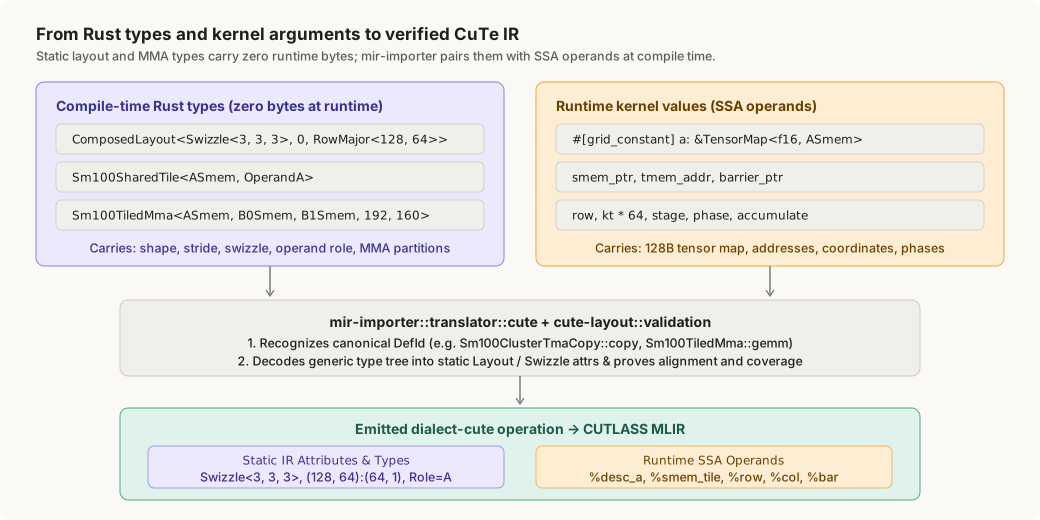
When mir-importer translates a cute-rs call, it matches the callee’s canonical rustc DefId, structurally walks its monomorphized generic type arguments (static_config.rs), runs cute-layout static validation proofs, and emits a dialect-cute operation combining those static attributes with the call’s runtime SSA operands:
../_images/rust-types-to-cute-ir.svg

Compile-time Rust types supply the static IR attributes (shape, stride, swizzle, operand role, MMA partitions), while kernel values supply the runtime SSA operands.#


Side-by-Side Concept Map#

Concept

Python CuTeDSL

Rust cute-rs

Layout definition

cute.make_layout((128, 64), stride=(64, 1))

RowMajor<128, 64> or Layout<(C<128>, C<64>), (C<64>, C<1>)>

Swizzled SMEM layout

cute.make_composed_layout(Swizzle(3, 3, 3), 0, layout)

ComposedLayout<Swizzle<3, 3, 3>, 0, RowMajor<128, 64>>

Tensor view

cute.make_tensor(ptr, layout)

Tensor::from_slice(a), TensorMut::from_disjoint_slice(&mut c), Tensor::from_storage(storage, layout): constructors are from_*, the Rust form of make_*

Tiling

cute.local_tile(mA, tiler, coord)

Tensor::local_tile::<TILE>(tile), equal to zipped_divide::<TILE>().slice(tile): a one-dimensional tiler and one tile coordinate, no projection

Register fragment

cute.make_fragment_like(tensor, dtype)

no function: the tile or MMA atom type fixes the fragment. RegisterTile<T, TILE> comes from Tensor::load() or RegisterTile::from_array(..); FragmentA, FragmentB and FragmentC::ZERO serve the MMA atoms

TMA descriptor

(tma_atom, tma_tensor) pair passed into @cute.kernel

#[grid_constant] a: &TensorMap<f16, ASmem> (128B by value)

TMA encoding (host)

cpasync.make_tiled_tma_atom(op, mA, smem_layout, cta_tiler)

create_tensor_map_tiled::<T, SmemL>(ptr, rows, cols, ld) in cute_rs::copy::tma, the rank-three SM100 form in cute_rs::attention::sm100; size_in_bytes::<T, SmemL>() gives the expected bytes

TMA copy

cute.copy(tma_atom, src, dst, tma_bar_ptr=bar) in both directions

copy_tma_2d and copy_tma_s2g_2d; Sm100ClusterTmaCopy::copy; TmaCopy::load(desc, &mut dst, row, col, barrier, rank) and TmaCopy::store(desc, &src, row, col) in cute_rs::attention::sm100

Shared tensor view

storage.sA.get_tensor(a_smem_layout)

SharedTensor<Mxf4E2M1, f16, SmemP, Mkl> or Sm100SharedTile<ASmem, OperandA>

TMA pipeline

pipeline.PipelineTmaAsync.create(...), pipeline.PipelineTmaUmma.create(...), pipeline.PipelineUmmaAsync.create(...), pipeline.PipelineAsyncUmma.create(...), pipeline.PipelineAsync.create(...)

PipelineTmaAsync<STAGES, CONSUMER_WARPS, TX_BYTES>, PipelineTmaUmma<5, 77_824> (in cute_rs::sm100), or PipelineTmaUmma<STAGES>, PipelineUmmaAsync<STAGES>, PipelineAsyncUmma<STAGES>, PipelineAsync<STAGES> and TwoCtaRing (in cute_rs::attention::sm100::pipeline)

TMEM allocator

utils.TmemAllocator with allocate(cols), relinquish_alloc_permit(), retrieve_ptr(), free(ptr, cols)

Sm100Tmem<512> and Sm100DeallocBarrier (2-CTA GEMM dialect-cute), or TmemAllocator<COLUMNS, GROUP> with allocate, relinquish_alloc_permit, retrieve_ptr, free and tmem_row_address (SM100 attention)

Pipeline state

make_pipeline_state(PipelineUserType.Producer, stages), state.index, state.phase, state.advance()

PipelineState::<Producer, STAGES>::new(), index() -> usize, phase(), advance(); the SM100 attention ring’s RingCursor::index() -> u32

Pipeline producer step

producer_acquire(state) waits on the empty barrier and arrives with the expected bytes, under is_leader_cta in PipelineTmaUmma

producer_acquire waits only; the elected lane then calls producer_expect_tx on PipelineTmaAsync, PipelineTmaUmma and TwoCtaRing (producer_expect_tx_cursor with a cursor)

Persistent scheduler

StaticPersistentTileScheduler.create(params, block_idx, grid_dim), get_grid_shape(params, max_active_clusters), work = get_current_work(), work.is_valid_tile, work.tile_idx, advance_to_next_work(advance_count=1)

StaticPersistentTileScheduler::<M_TILES, N_TILES, BATCHES>::new_1d(), get_grid_shape(sm_count, active_ctas_per_sm) -> Option<u32>, has_work(), get_current_work(), tile_idx() -> (m, n, l) with linear_idx(), advance_to_next_work()

Tiled MMA

cute.make_tiled_mma(mma_op, atom_layout, ...)

Mxf4TiledMma::<SmemP>::get_slice(lane), Nvfp4TiledMma::<SmemP>::get_slice(lane), Bf16Mma16x8x16::get_slice(lane), or Sm100TiledMma<ASmem, B0Smem, B1Smem, 192, 160>

Tiled copy

thr_copy = tiled_copy.get_slice(tidx); cute.copy(tiled_copy, thr_copy.partition_S(gA), thr_copy.partition_D(sA))

tiled_copy.get_slice(thread_idx).copy_g2s(&g_a, tile_coord, &mut s_a) (plus copy_s2g and copy_r2s): both partitions come from the plan’s layouts

Register vectors

TensorSSA with a + b, a - b, a * b, a / b, a // b, -a, where, conversions and reductions

RegisterTile<T, N> with +, -, *, / and unary -; map, zip_map, fold and gather for the rest

Architecture primitives

cute.arch.thread_idx(), warp_idx(), elect_one(), cluster_arrive(), cluster_dim(), fence_view_async_shared(), fence_view_async_tmem_load(), fence_view_async_tmem_store(), {add,mul,fma}_packed_f32x2(), cvt_f16x2_f32(), warp_reduction_{max,sum}(), fence_sync_restrict(MemOrder.ACQUIRE), …

cute_rs::arch::thread_idx(), warp_idx(), elect_one_sync(), cluster_arrive(), cluster_dim(), fence_view_async_shared(), fence_view_async_tmem_load(), fence_view_async_tmem_store(), {add,mul,fma}_packed_f32x2(), cvt_f16x2_f32(), warp_reduction_{max,sum}_f32(), fence_sync_restrict::<Acquire>(), …: forwarders over the PTX-named ctm-rs layer


Where cute-rs Deviates, and Why#

The names follow CuTeDSL 4.7. Where the Rust form differs on purpose, the difference and its reason are listed here, so a CuTeDSL author is not surprised.

Concept

CuTeDSL 4.7

Rust cute-rs

Why

Constructors and plans

make_layout, make_tensor, make_tiled_mma and make_tiled_copy build objects while tracing

new and from_* constructors; a compile-time plan is a type or a const generic (RowMajor<128, 64>, TiledCopy<Atom, ThreadLayout, ValueLayout, TileLayout>, zipped_divide::<8>())

the compiler reads the plan from the generic arguments, so there is nothing for a make_* call to build

Pipeline producer step

producer_acquire folds the arrive-expect into the wait, under is_leader_cta in PipelineTmaUmma

producer_acquire waits; the elected lane calls producer_expect_tx, or producer_expect_tx_cursor on TwoCtaRing

electing the lane is a convergence obligation the compiler does not prove, so it stays visible in kernel code; the pipeline value stores pointers only

Scheduler

WorkTileInfo.is_valid_tile; get_grid_shape(params, max_active_clusters) returns (m, n, persistent_clusters); advance_to_next_work(advance_count=1); tile_idx is a Coord

has_work() on the scheduler; get_grid_shape(sm_count, active_ctas_per_sm) -> Option<u32>; advance_to_next_work(); tile_idx() -> (m, n, l) with linear_idx() beside it

the grid is one dimensional and has no params object; the bounds check stays outside the coordinate arithmetic; the step is always one grid of blocks; the coordinate is a Rust tuple

Pipeline state

PipelineState.index is an Int32

PipelineState::index() -> usize; RingCursor::index() -> u32

a usize scales a shared-buffer offset directly; the SM100 attention ring keeps the u32 its barriers take

TMA names

make_tiled_tma_atom returns the atom and a TMA tensor; one cute.copy loads and stores

TensorMap is the one descriptor type; create_tensor_map_tiled is the one host encoder, with the rank-three SM100 form in cute_rs::attention::sm100; TmaCopy::load and TmaCopy::store stay two methods; size_in_bytes::<T, SmemL>() is cute.size_in_bytes, a cosize, so a padded row stride counts and a swizzle does not

the descriptor is CUDA’s CUtensorMap typed by element and shared layout; load takes a barrier and a CTA rank and store takes neither, so one signature cannot serve both

Clusters

cute.arch.cluster_dim() is the number of clusters in the grid; cute.arch.block_in_cluster_dim() is CTAs per cluster

the same two names with the same meanings

the compiler’s own cluster_dim vocabulary (the #[cluster_launch] attribute, the cluster_dim field of cuda_launch! and the cluster_dim_x/y/z NVVM annotations) means CTAs per cluster; in a kernel, cluster_dim() reads as the DSL does and block_in_cluster_dim() is the launch value

Named barriers

pipeline.NamedBarrier(barrier_id, num_threads) with arrive_and_wait(), its alias sync(), arrive(), wait() and the unaligned forms

NamedBarrier::<ID, THREADS>::sync() only; cute_rs::arch::barrier(id, n) and barrier_arrive(id, n) are the cute.arch free functions

both values are const generics, so the id and the thread count (a multiple of 32, at most 1024) are checked at compile time; the split arrive and wait methods are not bound on the type

Sync-restricted fence

fence_sync_restrict(order) in the experimental primitives layer, order a MemOrder string enum

cute_rs::arch::fence_sync_restrict::<Acquire>(), the order a sealed marker type; acquire only

the instruction is chosen when the kernel compiles; the release form waits for its intrinsic to be bound

Tiled copy

make_tiled_copy, get_slice, partition_S, partition_D, cute.copy

TiledCopy::new().get_slice(tid) with ThrCopy::{copy_g2s, copy_s2g, copy_r2s}

the thread and value layouts live in TiledCopy<Atom, ThreadLayout, ValueLayout, TileLayout>, so copy_g2s, copy_s2g, and copy_r2s partition both source and destination from the plan

Register vectors

/ on integer vectors converts both sides to f32 and divides; // floors; -a is 0 - a

/ on integer lanes truncates toward zero; unary - negates each lane, so a +0.0 lane becomes -0.0

the operators are Rust’s own: floating-point division matches the DSL, integer division and the sign of a negated zero differ

ctm-rs keeps PTX instruction names (cp_async_bulk_tensor_shared_cta_global, mbarrier_arrive_expect_tx, fence_sync_restrict_acquire); the cute.arch concept names live in cute_rs::arch as forwarders over them. Dialect op, type and attribute names are compiler-internal and are not part of this surface.