Single Variable Perturbation Method
Intermediate ensemble inference using a custom perturbation method.
This example will demonstrate how to run a an ensemble inference workflow with a custom perturbation method that only applies noise to a specific variable.
In this example you will learn:
- How to extend an existing pertubration method
- How to instantiate a built in prognostic model
- Creating a data source and IO object
- Running a simple built in workflow
- Extend a built-in method using custom code.
- Post-processing results
Set Up
All workflows inside Earth2Studio require constructed components to be
handed to them. In this example, we will use the built in ensemble workflow
earth2studio.run.ensemble.
# SPDX-FileCopyrightText: Copyright (c) 2024-2026 NVIDIA CORPORATION & AFFILIATES.
# SPDX-FileCopyrightText: All rights reserved.
# SPDX-License-Identifier: Apache-2.0
#
# Licensed under the Apache License, Version 2.0 (the "License");
# you may not use this file except in compliance with the License.
# You may obtain a copy of the License at
#
# http://www.apache.org/licenses/LICENSE-2.0
#
# Unless required by applicable law or agreed to in writing, software
# distributed under the License is distributed on an "AS IS" BASIS,
# WITHOUT WARRANTIES OR CONDITIONS OF ANY KIND, either express or implied.
# See the License for the specific language governing permissions and
# limitations under the License.

from collections import OrderedDict
from datetime import datetime
from math import ceil

import numpy as np
import torch
from loguru import logger
from tqdm import tqdm

from earth2studio.data import DataSource, ForecastSource, fetch_data
from earth2studio.io import IOBackend
from earth2studio.models.dx import DiagnosticModel
from earth2studio.models.px import PrognosticModel
from earth2studio.perturbation import Perturbation
from earth2studio.utils.checkpoint import (
    Checkpoint,
    CheckpointSession,
    NullCheckpoint,
)
from earth2studio.utils.coords import CoordSystem, map_coords, split_coords
from earth2studio.utils.time import to_time_array

logger.remove()
logger.add(lambda msg: tqdm.write(msg, end=""), colorize=True)


def deterministic(
    time: list[str] | list[datetime] | list[np.datetime64],
    nsteps: int,
    prognostic: PrognosticModel,
    data: DataSource,
    io: IOBackend,
    output_coords: CoordSystem = OrderedDict({}),
    device: torch.device | None = None,
    verbose: bool = True,
    checkpoint: Checkpoint | CheckpointSession | NullCheckpoint = NullCheckpoint(),
) -> IOBackend:
    """Built in deterministic workflow.
    This workflow creates a determinstic inference pipeline to produce a forecast
    prediction using a prognostic model.

    Parameters
    ----------
    time : list[str] | list[datetime] | list[np.datetime64]
        List of string, datetimes or np.datetime64
    nsteps : int
        Number of forecast steps
    prognostic : PrognosticModel
        Prognostic model
    data : DataSource
        Data source
    io : IOBackend
        IO object
    output_coords: CoordSystem, optional
        IO output coordinate system override, by default OrderedDict({})
    device : torch.device, optional
        Device to run inference on, by default None
    verbose : bool, optional
        Print inference progress, by default True
    checkpoint : Checkpoint, optional
        Checkpoint manager or checkpoint session used to record and resume workflow
        progress, by default no checkpoint

    Returns
    -------
    IOBackend
        Output IO object
    """
    logger.info("Running simple workflow!")
    # Load model onto the device
    device = (
        device
        if device is not None
        else torch.device("cuda" if torch.cuda.is_available() else "cpu")
    )
    logger.info(f"Inference device: {device}")
    prognostic = prognostic.to(device)
    prognostic_ic = prognostic.input_coords()
    time = to_time_array(time)

    # Set up IO backend
    total_coords = prognostic.output_coords(prognostic.input_coords()).copy()
    for key, value in prognostic.output_coords(
        prognostic.input_coords()
    ).items():  # Scrub batch dims
        if value.shape == (0,):
            del total_coords[key]
    total_coords["time"] = time
    total_coords["lead_time"] = np.asarray(
        [
            prognostic.output_coords(prognostic.input_coords())["lead_time"] * i
            for i in range(nsteps + 1)
        ]
    ).flatten()
    total_coords.move_to_end("lead_time", last=False)
    total_coords.move_to_end("time", last=False)

    for key, value in total_coords.items():
        total_coords[key] = output_coords.get(key, value)
    var_names = total_coords.pop("variable")
    io.add_array(total_coords, var_names)

    with checkpoint as ckpt:
        restart_step = None
        if ckpt.exists and ckpt.write_count > 0:
            if ckpt.catalog.level < 2:
                logger.warning(
                    "deterministic received checkpoint level "
                    f"{ckpt.catalog.level}; component state may not be "
                    "complete enough to resume a rollout. Re-running from "
                    "lead time zero."
                )
            else:
                restart_step = ckpt.write_count - 1
                if restart_step >= nsteps:
                    logger.success("\nInference complete")
                    return io

        # Fetch data from data source and load onto device
        if hasattr(prognostic, "interp_method"):
            interp_to = prognostic_ic
            interp_method = prognostic.interp_method
        else:
            interp_to = None
            interp_method = "nearest"

        x, coords = fetch_data(
            source=data,
            time=time,
            variable=prognostic_ic["variable"],
            lead_time=prognostic_ic["lead_time"],
            device=device,
            interp_to=interp_to,
            interp_method=interp_method,
        )

        logger.success(f"Fetched data from {data.__class__.__name__}")

        # Map lat and lon if needed
        x, coords = map_coords(x, coords, prognostic.input_coords())
        # Create prognostic iterator
        model = prognostic.create_iterator(x, coords)

        logger.info("Inference starting!")
        initial_progress = 0 if restart_step is None else restart_step + 1
        with tqdm(
            total=nsteps + 1,
            initial=initial_progress,
            desc="Running inference",
            position=1,
            disable=(not verbose),
        ) as pbar:
            for local_step, (x, coords) in enumerate(model):
                step = (
                    local_step
                    if restart_step is None
                    else restart_step + local_step + 1
                )

                current_lead_time = coords["lead_time"][-1]
                # Subselect domain/variables as indicated in output_coords
                x, coords = map_coords(x, coords, output_coords)
                io.write(*split_coords(x, coords))
                ckpt.write(lead_time=current_lead_time)
                pbar.update(1)
                if step == nsteps:
                    break

        ckpt.flush()

    logger.success("\nInference complete")
    return io


def diagnostic(
    time: list[str] | list[datetime] | list[np.datetime64],
    nsteps: int,
    prognostic: PrognosticModel,
    diagnostic: DiagnosticModel,
    data: DataSource | ForecastSource,
    io: IOBackend,
    output_coords: CoordSystem = OrderedDict({}),
    device: torch.device | None = None,
    verbose: bool = True,
    checkpoint: Checkpoint | CheckpointSession | NullCheckpoint = NullCheckpoint(),
) -> IOBackend:
    """Built in diagnostic workflow.
    This workflow creates a determinstic inference pipeline that couples a prognostic
    model with a diagnostic model.

    Parameters
    ----------
    time : list[str] | list[datetime] | list[np.datetime64]
        List of string, datetimes or np.datetime64
    nsteps : int
        Number of forecast steps
    prognostic : PrognosticModel
        Prognostic model
    diagnostic: DiagnosticModel
        Diagnostic model, must be on same coordinate axis as prognostic
    data : DataSource | ForecastSource
        Data source
    io : IOBackend
        IO object
    output_coords: CoordSystem, optional
        IO output coordinate system override, by default OrderedDict({})
    device : torch.device, optional
        Device to run inference on, by default None
    verbose : bool, optional
        Print inference progress, by default True
    checkpoint : Checkpoint, optional
        Checkpoint manager or checkpoint session used to record and resume workflow
        progress, by default no checkpoint

    Returns
    -------
    IOBackend
        Output IO object
    """
    logger.info("Running diagnostic workflow!")
    device = (
        device
        if device is not None
        else torch.device("cuda" if torch.cuda.is_available() else "cpu")
    )
    logger.info(f"Inference device: {device}")
    prognostic = prognostic.to(device)
    diagnostic = diagnostic.to(device)

    prognostic_ic = prognostic.input_coords()
    diagnostic_ic = diagnostic.input_coords()
    time = to_time_array(time)

    total_coords = prognostic.output_coords(prognostic.input_coords())
    for key, value in prognostic.output_coords(
        prognostic.input_coords()
    ).items():  # Scrub batch dims
        if key in diagnostic.output_coords(diagnostic_ic):
            total_coords[key] = diagnostic.output_coords(diagnostic_ic)[key]
        if value.shape == (0,):
            del total_coords[key]
    total_coords["time"] = time
    total_coords["lead_time"] = np.asarray(
        [
            prognostic.output_coords(prognostic.input_coords())["lead_time"] * i
            for i in range(nsteps + 1)
        ]
    ).flatten()
    total_coords.move_to_end("lead_time", last=False)
    total_coords.move_to_end("time", last=False)

    for key, value in total_coords.items():
        total_coords[key] = output_coords.get(key, value)
    var_names = total_coords.pop("variable")
    io.add_array(total_coords, var_names)

    with checkpoint as ckpt:
        restart_step = None
        if ckpt.exists and ckpt.write_count > 0:
            if ckpt.catalog.level < 2:
                logger.warning(
                    "diagnostic received checkpoint level "
                    f"{ckpt.catalog.level}; component state may not be "
                    "complete enough to resume a rollout. Re-running from "
                    "lead time zero."
                )
            else:
                restart_step = ckpt.write_count - 1
                if restart_step >= nsteps:
                    logger.success("\nInference complete")
                    return io

        if hasattr(prognostic, "interp_method"):
            interp_to = prognostic_ic
            interp_method = prognostic.interp_method
        else:
            interp_to = None
            interp_method = "nearest"

        x, coords = fetch_data(
            source=data,
            time=time,
            variable=prognostic_ic["variable"],
            lead_time=prognostic_ic["lead_time"],
            device=device,
            interp_to=interp_to,
            interp_method=interp_method,
        )
        logger.success(f"Fetched data from {data.__class__.__name__}")

        x, coords = map_coords(x, coords, prognostic_ic)
        model = prognostic.create_iterator(x, coords)

        logger.info("Inference starting!")
        initial_progress = 0 if restart_step is None else restart_step + 1
        with tqdm(
            total=nsteps + 1,
            initial=initial_progress,
            desc="Running inference",
            position=1,
            disable=(not verbose),
        ) as pbar:
            for local_step, (x, coords) in enumerate(model):
                step = (
                    local_step
                    if restart_step is None
                    else restart_step + local_step + 1
                )

                current_lead_time = coords["lead_time"][-1]
                x, coords = map_coords(x, coords, diagnostic_ic)
                x, coords = diagnostic(x, coords)
                x, coords = map_coords(x, coords, output_coords)
                io.write(*split_coords(x, coords))
                ckpt.write(lead_time=current_lead_time)
                pbar.update(1)
                if step == nsteps:
                    break

        ckpt.flush()

    logger.success("\nInference complete")
    return io


def ensemble(
    time: list[str] | list[datetime] | list[np.datetime64],
    nsteps: int,
    nensemble: int,
    prognostic: PrognosticModel,
    data: DataSource,
    io: IOBackend,
    perturbation: Perturbation,
    batch_size: int | None = None,
    output_coords: CoordSystem = OrderedDict({}),
    device: torch.device | None = None,
    verbose: bool = True,
    checkpoint: Checkpoint | CheckpointSession | NullCheckpoint = NullCheckpoint(),
) -> IOBackend:
    """Built in ensemble workflow.

    Parameters
    ----------
    time : list[str] | list[datetime] | list[np.datetime64]
        List of string, datetimes or np.datetime64
    nsteps : int
        Number of forecast steps
    nensemble : int
        Number of ensemble members to run inference for.
    prognostic : PrognosticModel
        Prognostic models
    data : DataSource
        Data source
    io : IOBackend
        IO object
    perturbation : Perturbation
        Method to perturb the initial condition to create an ensemble.
    batch_size: int, optional
        Number of ensemble members to run in a single batch,
        by default None.
    output_coords: CoordSystem, optional
        IO output coordinate system override, by default OrderedDict({})
    device : torch.device, optional
        Device to run inference on, by default None
    verbose : bool, optional
        Print inference progress, by default True
    checkpoint : Checkpoint, optional
        Checkpoint manager or checkpoint session used to record and resume workflow
        progress, by default no checkpoint

    Returns
    -------
    IOBackend
        Output IO object
    """
    logger.info("Running ensemble inference!")

    device = (
        device
        if device is not None
        else torch.device("cuda" if torch.cuda.is_available() else "cpu")
    )
    logger.info(f"Inference device: {device}")
    prognostic = prognostic.to(device)

    prognostic_ic = prognostic.input_coords()
    time = to_time_array(time)
    if hasattr(prognostic, "interp_method"):
        interp_to = prognostic_ic
        interp_method = prognostic.interp_method
    else:
        interp_to = None
        interp_method = "nearest"

    x0, coords0 = fetch_data(
        source=data,
        time=time,
        variable=prognostic_ic["variable"],
        lead_time=prognostic_ic["lead_time"],
        device=device,
        interp_to=interp_to,
        interp_method=interp_method,
    )
    logger.success(f"Fetched data from {data.__class__.__name__}")

    total_coords = prognostic.output_coords(prognostic.input_coords()).copy()
    if "batch" in total_coords:
        del total_coords["batch"]
    total_coords["time"] = time
    total_coords["lead_time"] = np.asarray(
        [
            prognostic.output_coords(prognostic.input_coords())["lead_time"] * i
            for i in range(nsteps + 1)
        ]
    ).flatten()
    total_coords.move_to_end("lead_time", last=False)
    total_coords.move_to_end("time", last=False)
    total_coords = {"ensemble": np.arange(nensemble)} | total_coords

    for key, value in total_coords.items():
        total_coords[key] = output_coords.get(key, value)
    variables_to_save = total_coords.pop("variable")
    io.add_array(total_coords, variables_to_save)

    if batch_size is None:
        batch_size = nensemble
    batch_size = min(nensemble, batch_size)
    with checkpoint as ckpt:
        completed_ensembles = []
        if ckpt.exists and not isinstance(ckpt, NullCheckpoint):
            completed_ensembles = [
                int(value) for value in ckpt.metadata.get("completed_ensembles", [])
            ]

        completed = set(completed_ensembles)
        start_batch_id = next(
            (index for index in range(nensemble) if index not in completed),
            nensemble,
        )
        number_of_batches = ceil((nensemble - start_batch_id) / batch_size)
        restart_first_batch = (
            ckpt.exists
            and ckpt.write_count > 0
            and start_batch_id < nensemble
            and ckpt.lead_time != total_coords["lead_time"][-1]
        )

        logger.info(f"Starting {nensemble} Member Ensemble Inference with \
            {number_of_batches} number of batches.")
        for batch_index, batch_id in enumerate(
            tqdm(
                range(start_batch_id, nensemble, batch_size),
                total=number_of_batches,
                desc="Total Ensemble Batches",
                position=2,
                disable=(not verbose),
            )
        ):
            mini_batch_size = min(batch_size, nensemble - batch_id)
            ensemble_coords = np.arange(batch_id, batch_id + mini_batch_size)
            ensemble_members = [int(value) for value in ensemble_coords]
            restart_step = None
            if batch_index == 0 and restart_first_batch:
                if ckpt.catalog.level < 2:
                    logger.warning(
                        "ensemble received checkpoint level "
                        f"{ckpt.catalog.level}; component state may not be "
                        "complete enough to resume a rollout. Re-running from "
                        "lead time zero."
                    )
                    ckpt.write_count = 0
                else:
                    restart_step = ckpt.write_count - 1
                    if restart_step >= nsteps:
                        continue
            elif not isinstance(ckpt, NullCheckpoint):
                ckpt.write_count = 0

            x = x0.to(device)
            coords = OrderedDict({"ensemble": ensemble_coords}) | coords0.copy()
            x = x.unsqueeze(0).repeat(mini_batch_size, *([1] * x.ndim))
            x, coords = map_coords(x, coords, prognostic_ic)
            x, coords = perturbation(x, coords)

            model = prognostic.create_iterator(x, coords)
            initial_progress = 0 if restart_step is None else restart_step + 1
            with tqdm(
                total=nsteps + 1,
                initial=initial_progress,
                desc=f"Running batch {batch_id} inference",
                position=1,
                leave=False,
                disable=(not verbose),
            ) as pbar:
                for local_step, (x, coords) in enumerate(model):
                    step = (
                        local_step
                        if restart_step is None
                        else restart_step + local_step + 1
                    )

                    current_lead_time = coords["lead_time"][-1]
                    x, coords = map_coords(x, coords, output_coords)
                    io.write(*split_coords(x, coords))
                    if step == nsteps:
                        completed.update(ensemble_members)
                        completed_ensembles = sorted(completed)
                    ckpt.write(
                        lead_time=current_lead_time,
                        completed_ensembles=completed_ensembles,
                    )
                    pbar.update(1)
                    if step == nsteps:
                        break

            ckpt.flush()

    logger.success("\nInference complete")
    return io
We need the following:
- Prognostic Model: Use the built in DLWP model
earth2studio.models.px.DLWP. - perturbation_method: Extend the Spherical Gaussian Method
earth2studio.perturbation.SphericalGaussian. - Datasource: Pull data from the GFS data api
earth2studio.data.GFS. - IO Backend: Save the outputs into a Zarr store
earth2studio.io.ZarrBackend.
import os

os.makedirs("outputs", exist_ok=True)
from dotenv import load_dotenv

load_dotenv()  # TODO: make common example prep function

import numpy as np
import torch

from earth2studio.data import GFS
from earth2studio.io import ZarrBackend
from earth2studio.models.px import DLWP
from earth2studio.perturbation import Perturbation, SphericalGaussian
from earth2studio.run import ensemble
from earth2studio.utils.type import CoordSystem

# Load the default model package which downloads the check point from NGC
package = DLWP.load_default_package()
model = DLWP.load_model(package)

# Create the data source
data = GFS()
Console output4 lines
Downloading dlwp_cubesphere.zip: 0%|          | 0.00/67.2M [00:00<?, ?B/s]
Downloading dlwp_cubesphere.zip: 34%|███▍      | 22.9M/67.2M [00:00<00:00, 238MB/s]
Downloading dlwp_cubesphere.zip: 77%|███████▋  | 51.6M/67.2M [00:00<00:00, 275MB/s]
Downloading dlwp_cubesphere.zip: 100%|██████████| 67.2M/67.2M [00:00<00:00, 269MB/s]
The perturbation method in 03 ensemble workflow is naive because it applies the same noise amplitude to every variable. We can create a custom wrapper that only applies the perturbation method to a particular variable instead.
class ApplyToVariable:
    """Apply a perturbation to only a particular variable."""

    def __init__(self, pm: Perturbation, variable: str | list[str]):
        self.pm = pm
        if isinstance(variable, str):
            variable = [variable]
        self.variable = variable

    @torch.inference_mode()
    def __call__(
        self,
        x: torch.Tensor,
        coords: CoordSystem,
    ) -> tuple[torch.Tensor, CoordSystem]:
        # Apply perturbation
        xp, _ = self.pm(x, coords)
        # Add perturbed slice back into original tensor
        ind = np.isin(coords["variable"], self.variable)
        x[..., ind, :, :] = xp[..., ind, :, :]
        return x, coords


# Generate a new noise amplitude that specifically targets 't2m' with a 1 K noise amplitude
avsg = ApplyToVariable(SphericalGaussian(noise_amplitude=1.0), "t2m")

# Create the IO handler, store in memory
chunks = {"ensemble": 1, "time": 1, "lead_time": 1}
io = ZarrBackend(
    file_name="outputs/05_ensemble_avsg.zarr",
    chunks=chunks,
    backend_kwargs={"overwrite": True},
)
Execute the Workflow
With all components initialized, running the workflow is a single line of Python code. Workflow will return the provided IO object back to the user, which can be used to then post process. Some have additional APIs that can be handy for post-processing or saving to file. Check the API docs for more information.
For the forecast we will predict for 10 steps (for FCN, this is 60 hours) with 8 ensemble members which will be ran in 2 batches with batch size 4.
nsteps = 10
nensemble = 8
batch_size = 4
io = ensemble(
    ["2024-01-01"],
    nsteps,
    nensemble,
    model,
    data,
    io,
    avsg,
    batch_size=batch_size,
    output_coords={"variable": np.array(["t2m", "tcwv"])},
)
Console output58 lines
2026-08-25 09:12:40.840 | INFO     | earth2studio.run:ensemble:394 - Running ensemble inference!
2026-08-25 09:12:40.840 | INFO     | earth2studio.run:ensemble:401 - Inference device: cuda

Fetching GFS data:   0%|          | 0/7 [00:00<?, ?it/s]
Fetching GFS data:  14%|█▍        | 1/7 [00:00<00:02,  2.35it/s]
Fetching GFS data:  29%|██▊       | 2/7 [00:00<00:01,  3.15it/s]
Fetching GFS data:  57%|█████▋    | 4/7 [00:00<00:00,  6.30it/s]
Fetching GFS data: 100%|██████████| 7/7 [00:00<00:00,  8.74it/s]

Fetching GFS data:   0%|          | 0/7 [00:00<?, ?it/s]
Fetching GFS data:  14%|█▍        | 1/7 [00:00<00:01,  4.63it/s]
Fetching GFS data:  71%|███████▏  | 5/7 [00:00<00:00, 17.56it/s]
Fetching GFS data: 100%|██████████| 7/7 [00:00<00:00, 21.03it/s]
2026-08-25 09:12:42.833 | SUCCESS  | earth2studio.run:ensemble:422 - Fetched data from GFS
2026-08-25 09:12:42.877 | INFO     | earth2studio.run:ensemble:466 - Starting 8 Member Ensemble Inference with             2 number of batches.


Total Ensemble Batches:   0%|          | 0/2 [00:00<?, ?it/s]

Running batch 0 inference:   0%|          | 0/11 [00:00<?, ?it/s]

Running batch 0 inference:   9%|▉         | 1/11 [00:00<00:01,  7.36it/s]

Running batch 0 inference:  18%|█▊        | 2/11 [00:00<00:01,  4.84it/s]

Running batch 0 inference:  36%|███▋      | 4/11 [00:00<00:00,  8.08it/s]

Running batch 0 inference:  55%|█████▍    | 6/11 [00:00<00:00,  9.91it/s]

Running batch 0 inference:  73%|███████▎  | 8/11 [00:00<00:00, 11.13it/s]

Running batch 0 inference:  91%|█████████ | 10/11 [00:00<00:00, 11.82it/s]


Total Ensemble Batches:  50%|█████     | 1/2 [00:02<00:02,  2.62s/it]

Running batch 4 inference:   0%|          | 0/11 [00:00<?, ?it/s]

Running batch 4 inference:  18%|█▊        | 2/11 [00:00<00:00, 13.96it/s]

Running batch 4 inference:  36%|███▋      | 4/11 [00:00<00:00, 12.80it/s]

Running batch 4 inference:  55%|█████▍    | 6/11 [00:00<00:00, 14.16it/s]

Running batch 4 inference:  73%|███████▎  | 8/11 [00:00<00:00, 14.10it/s]

Running batch 4 inference:  91%|█████████ | 10/11 [00:00<00:00, 14.50it/s]


Total Ensemble Batches: 100%|██████████| 2/2 [00:04<00:00,  2.22s/it]
Total Ensemble Batches: 100%|██████████| 2/2 [00:04<00:00,  2.28s/it]
2026-08-25 09:12:47.432 | SUCCESS  | earth2studio.run:ensemble:536 -
Inference complete
Post Processing
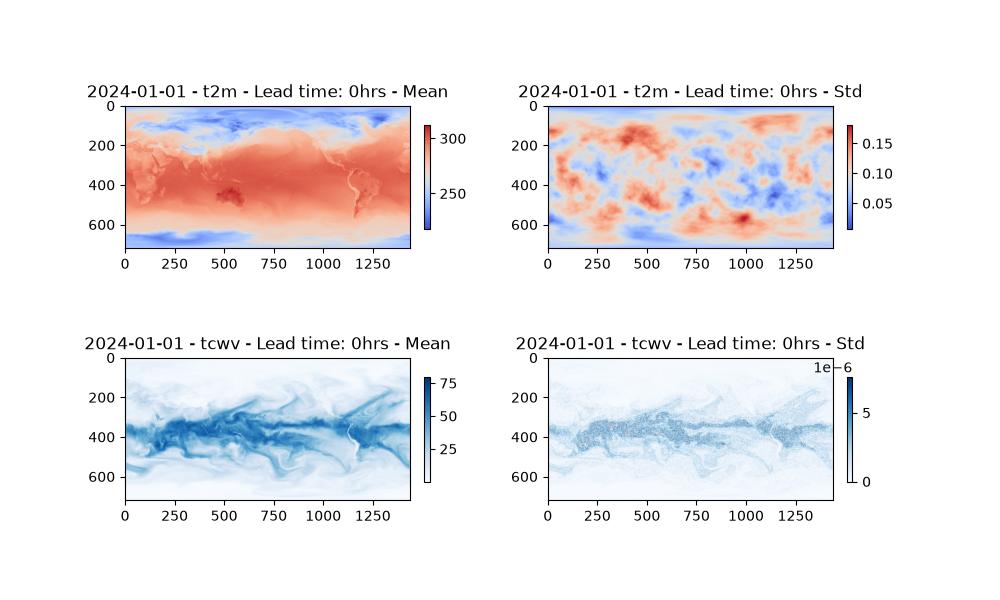
The last step is to post process our results. Lets plot both the perturbed t2m field and also the unperturbed tcwv field. First to confirm the perturbation method works as expect, the initial state is plotted.
Notice that the Zarr IO function has additional APIs to interact with the stored data.
import matplotlib.pyplot as plt

forecast = "2024-01-01"


def plot_(axi, data, title, cmap):
    """Simple plot util function"""
    im = axi.imshow(data, cmap=cmap)
    plt.colorbar(im, ax=axi, shrink=0.5, pad=0.04)
    axi.set_title(title)


step = 0  # lead time = 24 hrs
plt.close("all")

# Create a figure and axes with the specified projection
fig, ax = plt.subplots(nrows=2, ncols=2, figsize=(10, 6))
plot_(
    ax[0, 0],
    np.mean(io["t2m"][:, 0, step], axis=0),
    f"{forecast} - t2m - Lead time: {6*step}hrs - Mean",
    "coolwarm",
)
plot_(
    ax[0, 1],
    np.std(io["t2m"][:, 0, step], axis=0),
    f"{forecast} - t2m - Lead time: {6*step}hrs - Std",
    "coolwarm",
)
plot_(
    ax[1, 0],
    np.mean(io["tcwv"][:, 0, step], axis=0),
    f"{forecast} - tcwv - Lead time: {6*step}hrs - Mean",
    "Blues",
)
plot_(
    ax[1, 1],
    np.std(io["tcwv"][:, 0, step], axis=0),
    f"{forecast} - tcwv - Lead time: {6*step}hrs - Std",
    "Blues",
)

plt.savefig(f"outputs/05_{forecast}_{step}_ensemble.jpg")
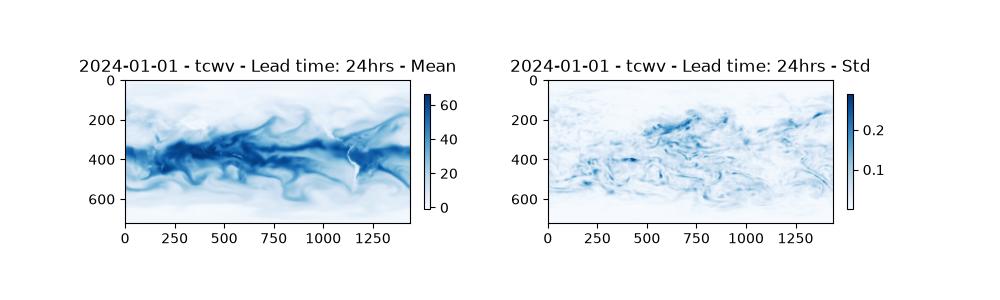
Due to the intrinsic coupling between all fields, we should expect all variables to have some uncertainty for later lead times. Here the total column water vapor is plotted at a lead time of 24 hours, note the variance in the members despite just perturbing the temperature field.
step = 4  # lead time = 24 hrs
plt.close("all")

# Create a figure and axes with the specified projection
fig, ax = plt.subplots(nrows=1, ncols=2, figsize=(10, 3))
plot_(
    ax[0],
    np.mean(io["tcwv"][:, 0, step], axis=0),
    f"{forecast} - tcwv - Lead time: {6*step}hrs - Mean",
    "Blues",
)
plot_(
    ax[1],
    np.std(io["tcwv"][:, 0, step], axis=0),
    f"{forecast} - tcwv - Lead time: {6*step}hrs - Std",
    "Blues",
)

plt.savefig(f"outputs/05_{forecast}_{step}_ensemble.jpg")