AIDAWeatherMesh5C
GlobalMRFWindbornePyTorch40 GB
Import path: earth2studio.models.da.AIDAWeatherMesh5C
View source on GitHub View install commands
Documentation
Bases: Module, AutoModelMixin, PrognosticMixin
Global WeatherMesh-5c forecasts initialized by AIDA.
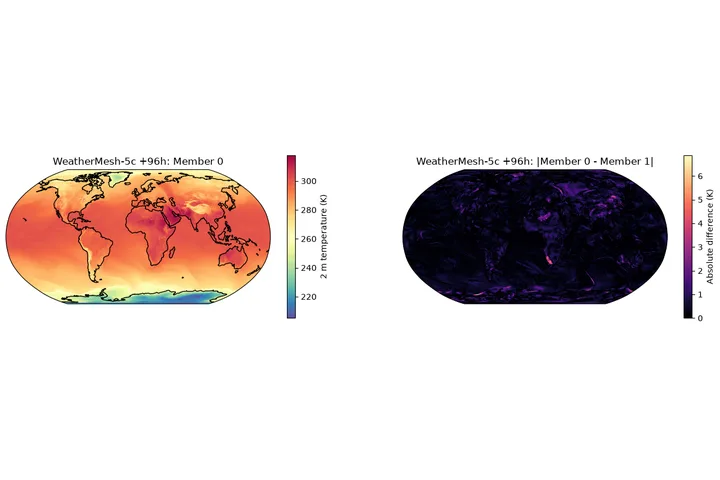
AIDA uses an ECMWF IFS ensemble background, NOAA OISST, and satellite and conventional observations to initialize the forecast. The input time is the analysis valid time, nine hours after the background by default. Forecasts begin at +3h and provide surface and pressure-level fields every three hours on a global 0.25° latitude-longitude grid (720 × 1440). At +72h by default, a learned perturbation lets members that share a background diverge.
Parameters:
-
core_model(Module) –WeatherMesh-5c network with AIDA.
-
assimilation_steps(int, default:3) –Initial AIDA updates, by default 3
-
max_observations(int | None, default:None) –Maximum reports per source per update, by default None
-
fork_hour(int | None, default:72) –Learned branch time; None disables it, by default 72
-
variables(tuple[str, ...] | None, default:None) –Forecast fields, by default all fields
Note
Use [CoupledRunner][earth2studio.coupling.CoupledRunner] with source_member
to assign several output members to the same IFS background. Batch those
members together: use member_batch at least as large as the number of fork
branches per IFS member to reuse observation preparation. With
member_batch=1, preparation repeats for every member. Each branch still
repeats AIDA and the pre-fork forecast. Decoded fields are converted to physical units on the CPU
at every output step. See the WeatherMesh-5c
release notes,
the model card, and the
runtime.
__call__ 
__call__(
    background: DataArray,
    sst: DataArray,
    mhs: ObservationInput = None,
    amsua: ObservationInput = None,
    atms: ObservationInput = None,
    iasi: ObservationInput = None,
    gpsro: ObservationInput = None,
    radiosonde: ObservationInput = None,
    windborne: ObservationInput = None,
    satwnd: ObservationInput = None,
    surface: ObservationInput = None,
) -> DataArray
Return the first forecast without retaining the state.
See Also
AIDA.call : Shared physical and raw-observation inputs.
Returns:
-
DataArray–Complete physical forecast at analysis lead +3h.
set_rng 
Seed new trajectories without changing existing continuation states.
initialize 
initialize(
    background: DataArray,
    sst: DataArray,
    mhs: ObservationInput = None,
    amsua: ObservationInput = None,
    atms: ObservationInput = None,
    iasi: ObservationInput = None,
    gpsro: ObservationInput = None,
    radiosonde: ObservationInput = None,
    windborne: ObservationInput = None,
    satwnd: ObservationInput = None,
    surface: ObservationInput = None,
) -> tuple[DataArray, _State]
step 
create_iterator 
create_iterator(
    background: DataArray,
    sst: DataArray,
    mhs: ObservationInput = None,
    amsua: ObservationInput = None,
    atms: ObservationInput = None,
    iasi: ObservationInput = None,
    gpsro: ObservationInput = None,
    radiosonde: ObservationInput = None,
    windborne: ObservationInput = None,
    satwnd: ObservationInput = None,
    surface: ObservationInput = None,
) -> Generator[DataArray]
Yield three-hour forecasts, beginning after initialization.
See Also
AIDA.call : Shared physical and raw-observation inputs.
Yields:
-
DataArray–Complete physical forecasts; continuing assimilation is not enabled.
input_coords 
Declare the analysis component's background and observation inputs.
forcing_coords 
No continuing assimilation is performed after initialization.
output_coords 
output_coords(
    background: DataArray,
    sst: DataArray,
    mhs: FrameSchema | None = None,
    amsua: FrameSchema | None = None,
    atms: FrameSchema | None = None,
    iasi: FrameSchema | None = None,
    gpsro: FrameSchema | None = None,
    radiosonde: FrameSchema | None = None,
    windborne: FrameSchema | None = None,
    satwnd: FrameSchema | None = None,
    surface: FrameSchema | None = None,
) -> DataArray
Plan the first forecast three hours after analysis time.
See Also
AIDA.output_coords : Shared physical and observation input signatures.
Returns:
-
DataArray–Complete forecast signature at analysis lead +3h.
default_sources 
Recommend the analysis component's sources in input-slot order.
load_default_package
classmethod

load_default_package() -> Package
Load the default WeatherMesh-5c/AIDA package.
load_model
classmethod

load_model(
    package: Package,
    variables: tuple[str, ...] | None = None,
    *,
    assimilation_steps: int = 3,
    max_observations: int | None = None,
    fork_hour: int | None = 72
) -> AIDAWeatherMesh5C
Load the coupled model on CPU in evaluation mode.
Parameters:
-
package(Package) –Checkpoint and assets resolved through the standard package cache.
-
variables(tuple[str, ...] | None, default:None) –Forecast fields, by default all supported fields
-
assimilation_steps(int, default:3) –Number of three-hour AIDA updates, by default 3
-
max_observations(int | None, default:None) –Maximum reports per source per update, by default None
-
fork_hour(int | None, default:72) –Hour when branches diverge, by default 72; None disables branching
Returns:
-
AIDAWeatherMesh5C–Loaded forecast model.