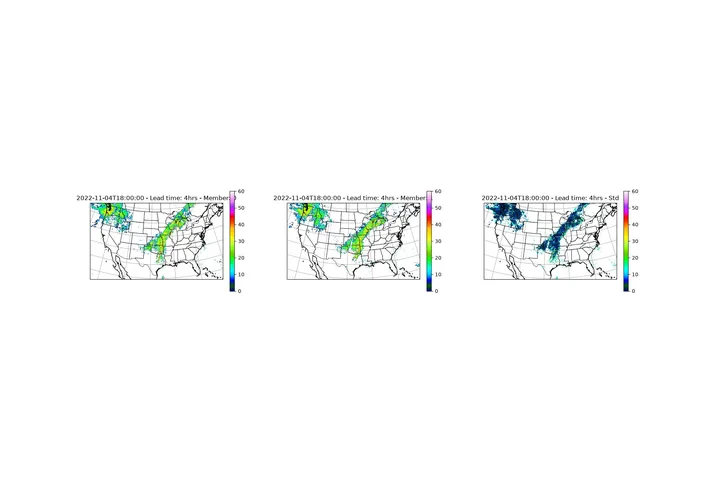
StormCastCONUS
NANWC202624 GBNVIDIAPyTorch
Import path: earth2studio.models.px.StormCastCONUS
View source on GitHub View install commands
Documentation
Bases: Module, AutoModelMixin, PrognosticMixin
StormCast-CONUS generative convection-allowing model for the full CONUS domain.
- High-resolution (3km) HRRR state over the Continental United States (99 vars)
- High-resolution land-sea mask and orography invariants
- Coarse resolution (25km) global state (26 vars)
The high-resolution grid is the HRRR Lambert conformal projection Coarse-resolution inputs are regridded to the HRRR grid internally.
Note
For more information see the following references:
Parameters:
-
diffusion_model(Module) –Configured diffusion model (e.g. a
_SplitModelWrapperinstance created byload_model). Must be a_SplitModelWrapperinstance to sethrrr_lat_limorhrrr_lon_limto non-default values. -
means(Tensor) –Per-channel mean for normalising the high-resolution state.
-
stds(Tensor) –Per-channel standard deviation for normalising the high-resolution state.
-
invariants(Tensor) –Static invariant fields (e.g. land-sea mask, orography).
-
conditioning_means(Tensor) –Per-channel mean for normalising the low-resolution conditioning.
-
conditioning_stds(Tensor) –Per-channel standard deviation for normalising the low-resolution conditioning.
-
hrrr_lat_lim(tuple[int, int], default:(17, 1041)) –HRRR grid latitude limits, defaults to be the StormCastCONUS region in Continental United States, by default (17, 1041)
-
hrrr_lon_lim(tuple[int, int], default:(3, 1795)) –HRRR grid longitude limits, defaults to be the StormCastCONUS region in Continental United States, by default (3, 1795)
-
variables(ndarray, default:array(VARIABLES)) –High-resolution variable names, by default
np.array(VARIABLES). -
conditioning_variables(ndarray, default:array(CONDITIONING_VARIABLES)) –Low-resolution conditioning variable names, by default
np.array(CONDITIONING_VARIABLES). -
conditioning_data_source(DataSource or ForecastSource or None, default:None) –Data source for global conditioning. Required for inference, by default None.
-
conditioning_init_time(datetime, list[datetime], TimeArray, or None, default:None) –Fixed initialisation time for
conditioning_data_source. When None, uses the same conditioning initialization time as the forecast. Useful when the conditioning is from a forecast source available on a coarser cycle (e.g. GFS_FX every 6 h while HRRR initialises hourly), by default None. -
sampler_args(dict, default:None) –Overrides for the EDM sampler/scheduler. Recognised keys:
sigma_min,sigma_max,rho(scheduler), andS_churn,S_min,S_max,S_noise(solver). Unspecified keys use sensible defaults. -
num_diffusion_steps(int, default:18) –Number of diffusion sampling steps for the EDM (no-obs) path, by default 18.
-
num_sda_diffusion_steps(int, default:36) –Number of diffusion sampling steps for the SDA (obs-guided) path, by default 36.
-
batch_size(int, default:1) –Maximum batch size processed in one forward pass, by default 1.
-
time_tolerance(np.timedelta64, tuple[np.timedelta64, np.timedelta64], or None, default:None) –Time window for filtering observations around each target time. A single
np.timedelta64creates a symmetric window; a 2-tuple(lower, upper)is passed directly toObsGridMapping.obs_to_grid.Nonedisables time filtering, by default None. -
sda_std_obs(float or dict[str, float], default:0.1) –Observation noise standard deviation (in physical units) used by the SDA denoiser when observations are provided. A scalar applies uniformly; a dict maps variable names to per-variable values (default 0.1 for unlisted variables). Dict values are converted to normalised units internally, by default 0.1.
-
sda_dps_norm(float, default:2) –Gradient normalisation factor for DPS guidance, by default 2.
-
sda_gamma(float, default:0.001) –DPS guidance step size / scale, by default 0.001.
-
use_amp(bool, default:True) –Whether to run the diffusion forward pass under
torch.autocastwith bfloat16, by default True. -
clamp_values(bool, default:True) –Whether to apply reflectivity clipping in
_forward. When the model is loaded viaload_model, this flag is also forwarded to_SplitModelWrapperto enable per-variable physical-minimum clamping, by default True.
__call__ 
__call__(
    x: Tensor,
    coords: CoordSystem,
    obs: DataFrame | tuple[Tensor, Tensor] | None = None,
) -> tuple[Tensor, CoordSystem]
Runs prognostic model 1 step
Parameters:
-
x(Tensor) –Input tensor
-
coords(CoordSystem) –Input coordinate system
-
obs(pd.DataFrame, tuple[torch.Tensor, torch.Tensor], or None, default:None) –Observations for SDA guidance. Either a dataframe with columns
variable,lat,lon,observation,time, or a pre-gridded(y_obs, mask)tuple.Noneruns unconditional diffusion.
Returns:
Raises:
-
RuntimeError–If conditioning data source is not initialized
create_iterator 
Iterator wrapper around create_generator without observation input.
load_model
classmethod

load_model(
    package: Package,
    conditioning_data_source: (
        DataSource | ForecastSource
    ) = GFS_FX(),
    **model_kwargs: Any
) -> StormCastCONUS
Load a StormCastCONUS model from a package.
Parameters:
-
package(Package) –Package to load model from
-
conditioning_data_source(DataSource | ForecastSource, default:GFS_FX()) –Data source to use for global conditioning, by default GFS_FX
-
**model_kwargs(Any, default:{}) –Additional keyword arguments forwarded to the model constructor (e.g.
hrrr_lat_lim,num_diffusion_steps,use_amp,clamp_values).clamp_valuesis additionally applied to the internal_SplitModelWrapper.
Returns:
-
StormCastCONUS–StormCast-CONUS model