MEP-0008: KWOK Integration
Author: Roman Hlushko
- Summary
- Motivation
- Background
- Goals
- Non-Goals
- Proposal
- User Stories
- Risks and Mitigations
- Design Details
- KWOK Integration
- Milestones
- Drawbacks
- Alternatives
- Decisions
- TODO
Summary
The proposal explores how to incorporate the relevant portion of Run:ai Fake GPU Operator (FGO) functionality directly into Mokka. This MEP covers KWOK support; MEP0009 and MEP0010 cover the other parts.
Motivation
The integration will enable Mokka to:
- consolidate the Mokka and Run:ai teams' efforts in one project, saving time and effort on FGO maintenance.
- replace FGO in Run:ai and KAI Scheduler CI/CD pipelines.
- extend Mokka's functionality with optional KWOK (no kubelet, virtual nodes) support for cheap, massive load testing where access to nvidia-smi and other on-host tools and libraries aren't needed.
Background
Fake GPU Operator (FGO) is a Kubernetes operator for testing Run:ai's GPU scheduling capabilities without wasting real, expensive GPUs on that activity.
FGO supports two backends:
fake- the primary FGO mode. It uses custom, fake instances ofnvidia-smi, the device driver, the DRA plugin, etc. to simulate the presence of GPUs on the node.mock- the prior integration with Mokka during the early days of the Mokka project.
Fake Backend
The idea behind the fake backend is to fake the NVIDIA GPU infrastructure to propagate simulated GPUs to Kubernetes:
- FGO is deployed to the
gpu-operatornamespace to mimic the presence of the real GPU Operator - FGO comes with a custom device plugin that propagates the node's GPU capacity
- FGO comes with the
status-exporterDaemonSet that mimics DCGM metrics - FGO installs a custom
nvidia-smibinary that supports a subset of commands and flags of the originalnvidia-smi.
This gives GPU simulation at the Kubernetes API level.
Node Lifecycle
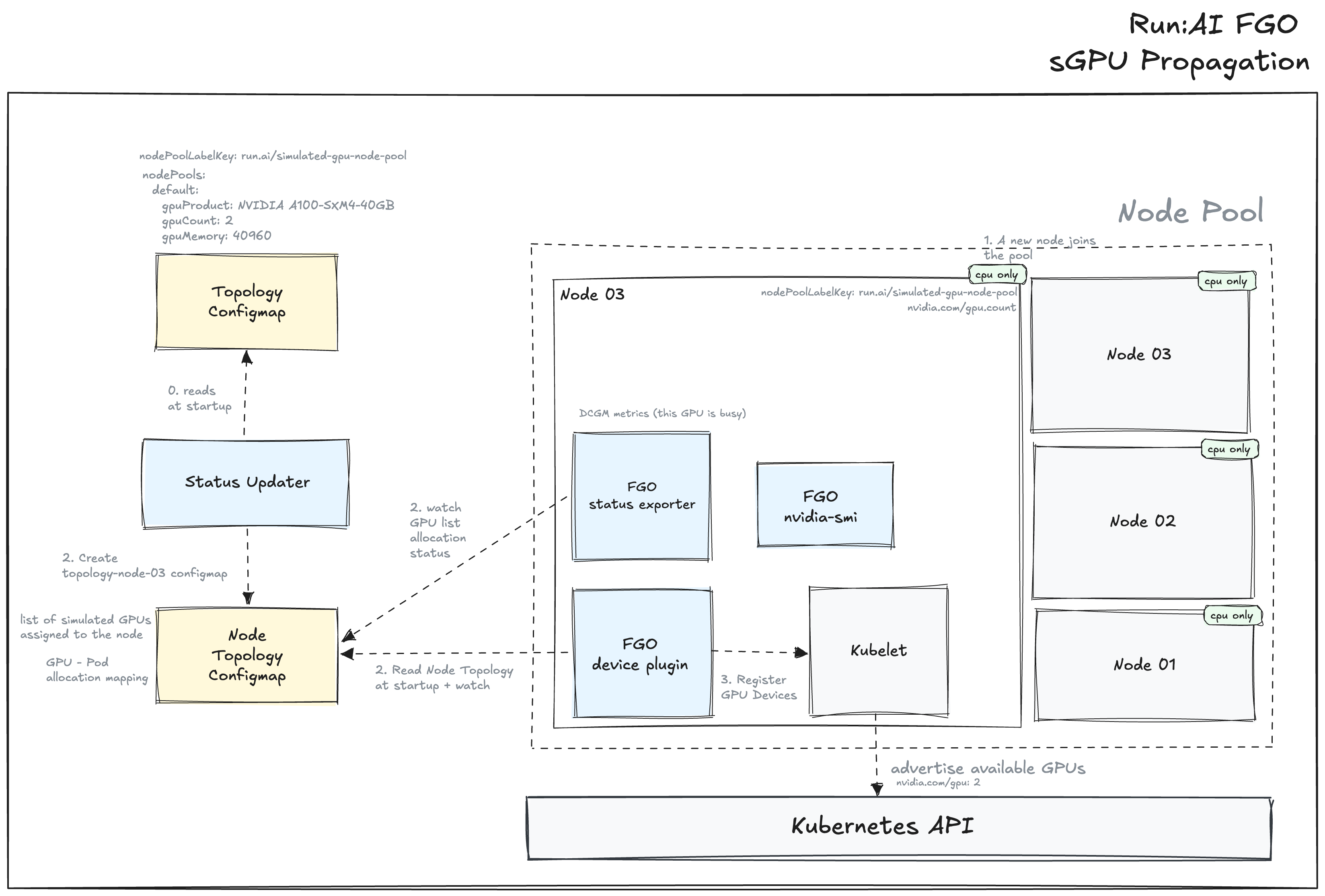
KWOK
FGO reaches fleet scale with KWOK (Kubernetes WithOut Kubelet), which creates Node objects and drives the lifecycle of the pods bound to them, with no kubelet and no containers behind either.
KWOK resources are just Node resources:
apiVersion: v1
kind: Node
metadata:
  name: kwok-node-1
  annotations:
    kwok.x-k8s.io/node: fake
    node.alpha.kubernetes.io/ttl: "0"
  labels:
    fgo-lab/managed: "true"
    kubernetes.io/role: worker
    node.kubernetes.io/instance-type: gpu-node
    run.ai/simulated-gpu-node-pool: g1
    type: kwok # KWOK label
spec:
  taints:
    - effect: NoSchedule
      key: kwok.x-k8s.io/node # regular pods won't be scheduled on kwok nodes
      value: fake
status:
  allocatable:
    cpu: "32"
    memory: 128Gi
    pods: "110"
  capacity:
    cpu: "32"
    memory: 128Gi
    pods: "110"
  nodeInfo:
    architecture: amd64
    containerRuntimeVersion: fake
    kernelVersion: fake
    kubeProxyVersion: fake
    kubeletVersion: fake
    operatingSystem: linux
    osImage: fake
Then, a test workload looks like this:
apiVersion: v1
kind: Pod
metadata:
  name: kwok-pod
  namespace: fgo-lab-07
  annotations:
    run.ai/simulated-gpu-utilization: "40"
spec:
  nodeSelector:
    type: kwok
  tolerations:
    - key: kwok.x-k8s.io/node
      operator: Equal
      value: fake
      effect: NoSchedule
  containers:
    - name: main
      image: ubuntu:22.04
      command: ["sleep", "infinity"]
      resources:
        limits:
          nvidia.com/gpu: 2
FGO comes with a few KWOK plugins that are deployed as a Deployment per cluster:
| Deployment | On by default | Watches | Writes | Replaces |
|---|---|---|---|---|
kwok-gpu-device-plugin |
yes | Nodes' GPU state ConfigMaps (topology-<node>), only when one is created |
Merge-patch of Node.status capacity and allocatable: nvidia.com/gpu = number of GPUs, plus any otherDevices (see Non-Goals) |
device-plugin DaemonSet, which reports to the kubelet |
nvidia-dcgm-exporter-kwok (status-exporter-kwok) |
yes, whenever statusExporter.enabled is set |
Nodes' GPU state ConfigMaps: add, update, delete | One :9400 for every KWOK node, nvidia.com/gpu.* node labels, and an NRT if enabled |
per-node exporter DaemonSet |
kwok-dra-plugin |
no | Nodes' GPU state ConfigMaps: add, update, delete | ResourceSlice kwok-<node>-gpu, driver gpu.nvidia.com, one device per GPU (UUID, model, memory) |
dra-plugin-gpu DaemonSet |
kwok-compute-domain-dra-plugin |
no | Nodes, not ConfigMaps | ResourceSlice kwok-<node>-compute-domain-channel with one device, channel-0 |
compute-domain kubelet plugin |
The node topology ConfigMaps of KWOK nodes are no different from those of normal CPU nodes.
The KWOK plugins are nothing but servers that update Kubernetes objects based on FGO's node topology ConfigMaps. In Mokka, the KWOK data plane takes their place.
FGO doesn't use any experimental KWOK CRDs like ClusterExec, ClusterAttach, ClusterLogs, etc.
ResourceSlices and ComputeDomains
FGO can also publish its simulated GPUs through Dynamic Resource Allocation (DRA), the resource.k8s.io API in which a driver lists each Node's devices in ResourceSlice objects and the scheduler allocates them to the ResourceClaims of Pods. FGO uses the driver names of NVIDIA's DRA driver, gpu.nvidia.com for GPUs and compute-domain.nvidia.com for ComputeDomain channels, so a claim for NVIDIA's gpu.nvidia.com DeviceClass gets a simulated GPU. All of FGO's DRA components are off by default.
GPU ResourceSlices
A Node's GPU ResourceSlice comes from its topology ConfigMap, topology-<node>, which the status-updater creates when a Node with the node pool label appears and deletes with the Node:
- The GPU model, memory and count come from the pool's profile, with its overrides.
- Each GPU's UUID is derived from the Node's name and the GPU's index, so a Node re-created under the same name gets the same UUIDs.
- The ConfigMap is written once per Node, so a change to the pool's profile reaches only Nodes that appear after it.
A plugin for each kind of Node publishes the ConfigMap's GPUs:
| Nodes with a kubelet | KWOK Nodes | |
|---|---|---|
| Plugin | dra-plugin-gpu, a kubelet DRA plugin DaemonSet (draPlugin.enabled) |
kwok-dra-plugin Deployment (kwokDraPlugin.enabled) |
| Reads the GPUs | Once, at startup, from FGO's topology server, which serves the ConfigMap | From the ConfigMap, on every change |
| Slice owner | The Node, set by the kubelet plugin library | None: the plugin deletes the slice when it sees the ConfigMap deleted |
| Preparing a claim | Adds GPU_DEVICE_* environment variables and FGO's nvidia-smi to the container |
Nothing prepares it: there's no kubelet, and KWOK marks the Pod running anyway |
Both publish the same pool and devices: one pool per Node, named after it, with one device per GPU, named by its UUID. For kwok-node-1 above, with two A100 GPUs in its pool, the KWOK plugin writes:
apiVersion: resource.k8s.io/v1
kind: ResourceSlice
metadata:
  name: kwok-kwok-node-1-gpu
spec:
  driver: gpu.nvidia.com
  nodeName: kwok-node-1
  pool:
    name: kwok-node-1
    generation: 0
    resourceSliceCount: 1
  devices:
    - name: gpu-c0d51a86-cacb-55e1-adce-b022f48aaaae # the UUID in lowercase
      attributes:
        uuid: {string: GPU-c0d51a86-cacb-55e1-adce-b022f48aaaae}
        model: {string: "NVIDIA A100-SXM4-40GB"}
        gpu.nvidia.com/type: {string: gpu}
        gpu.nvidia.com/uuid: {string: GPU-c0d51a86-cacb-55e1-adce-b022f48aaaae}
        gpu.nvidia.com/productName: {string: "NVIDIA A100-SXM4-40GB"}
      capacity:
        memory: {value: 40Gi}
    - name: gpu-6f2d2583-ee96-58a3-87f1-c45b296668bb
      # ... the same attributes for the second GPU
FGO keeps the unqualified (e.g. have no domain prefix like gpu.nvidia.com/*) uuid and model for compatibility. DRA puts unqualified names in the driver's domain, so uuid is the same attribute as gpu.nvidia.com/uuid. NVIDIA's driver names its devices gpu-<minor>, has no model, and adds the brand, architecture, CUDA compute capability, driver and CUDA driver versions, and PCI bus ID.
The chart also creates the gpu.nvidia.com DeviceClass, which selects devices of type gpu, unless nvidiaDraDriver.enabled installs NVIDIA's DRA driver chart, which brings its own. On a cluster that serves resource.k8s.io/v1, FGO's class is:
apiVersion: resource.k8s.io/v1
kind: DeviceClass
metadata:
  name: gpu.nvidia.com
spec:
  selectors:
    - cel:
        expression: "device.driver == 'gpu.nvidia.com' && device.attributes['gpu.nvidia.com'].type == 'gpu'"
  extendedResourceName: nvidia.com/gpu
With the DRAExtendedResource Kubernetes feature gate, extendedResourceName lets the scheduler serve a Pod's nvidia.com/gpu request from this class's devices, but only on a Node whose allocatable has no nvidia.com/gpu. kwok-gpu-device-plugin, on by default, gives KWOK Nodes that resource, so nvidia.com/gpu requests on them still use the Node's capacity rather than the slice. In Mokka's DRA mode, KWOK Nodes have no nvidia.com/gpu, so these requests use the slice (Publishing the GPUs).
The status-updater follows DRA Pods as it does Pods that request nvidia.com/gpu: it reads the devices allocated to a Pod's claims and records the Pod on the GPUs with those UUIDs in the topology ConfigMap, so their simulated metrics follow the Pod. Mokka's data plane keeps that record on the Pod instead (GPU Allocation).
ComputeDomains
A ComputeDomain is the NVIDIA DRA driver's object for multi-node NVLink workloads, whose Pods on several Nodes share GPU memory through one IMEX (Internode Memory Exchange) domain. A workload doesn't claim a domain directly. The domain's controller creates a ResourceClaimTemplate, and each Pod that uses the template gets a claim for a channel, a compute-domain.nvidia.com device on the Pod's Node:
apiVersion: resource.nvidia.com/v1beta1
kind: ComputeDomain
metadata:
  name: training
  namespace: fgo-lab-07
spec:
  numNodes: 2
  channel:
    resourceClaimTemplate:
      name: training-channel # created by the controller
To join the domain, the KWOK Pod above would add:
spec:
  containers:
    - name: main
      resources:
        claims:
          - name: channel
  resourceClaims:
    - name: channel
      resourceClaimTemplateName: training-channel
NVIDIA's controller also runs an IMEX daemon on each Node the workload's Pods land on, and when numNodes is set, it reports the domain Ready once that many daemons are ready.
FGO ships NVIDIA's ComputeDomain CRD and replaces the rest:
- Controller.
compute-domain-controllercreates the template. Its claims ask for one device of thecompute-domain-default-channel.nvidia.comDeviceClass and pass the domain's UID to the driver as opaque config. There are no IMEX daemons, so the controller builds the status from claims instead: it lists each Node where a claim of the domain is allocated as Ready, and marks the domain Ready oncenumNodesNodes are listed, or right away whennumNodesis 0. - Channels.
kwok-compute-domain-dra-pluginpublishes a channel for every KWOK Node, and thecompute-domain-dra-pluginkubelet plugin for Nodes with a kubelet. Like NVIDIA's plugin, each publishes a single channel per Node,channel-0, so only one Pod on a Node can hold a channel claim at a time. On a Node with a kubelet, preparing a claim gives the container a channel device backed by/dev/null. - Chart values.
computeDomainDraPlugin.enableddeploys the controller, the channel DeviceClass and the kubelet plugin, so KWOK Nodes need it as well askwokComputeDomainDraPlugin.enabled.
A domain's readiness in FGO depends only on claim allocation: it's Ready once the scheduler has allocated channels on enough Nodes, whether or not their Pods run. Mokka keeps NVIDIA's controller instead, and its data plane makes the reports NVIDIA's IMEX daemons would (DRA and ComputeDomains).
Run:ai x Mokka Integration (Mock Backend)
FGO creates Mokka's profiles as ConfigMaps and uses some information from them in the fake backend mode, such as:
- product name
- memory
- GPU count
- driver and CUDA versions
When the node pool is defined to be mock, FGO actually deploys a Mokka instance on the nodes it manages:
cluster:
  nodePoolLabelKey: run.ai/simulated-gpu-node-pool
  migStrategy: none
  nodePools:
    a100-pool:
      gpu:
        backend: mock
        profile: a100
        overrides:
          device_count: 2
On the Mokka end, with integrations.fakeGpuOperator.enabled,
the Mokka chart publishes one ConfigMap per Mokka GPU profile, such as gb300, h100 or a100, in the form FGO expects
(e.g. named gpu-profile-<profile>, with the profile under the profile.yaml key, in integrations.fakeGpuOperator.targetNamespace).
That's the only place Mokka knows about FGO.
NVIDIA Ecosystem Integrations
FGO mocks or uses the following NVIDIA components:
- device-plugin
- DRA
- compute domains
- nvidia-smi
- DCGM
- MIG Manager
Goals
- Propose an actionable plan for FGO incorporation into Mokka.
- Reach the feature parity required to migrate Run:ai and KAI Scheduler off FGO.
Non-Goals
- Mokka remains a generic project, so functionality specific to Run:ai and KAI won't be included directly.
- MIG support is out of scope for this MEP.
- Fault injection in KWOK mode is out of scope for this MEP.
- Making SSH into a virtual pod (e.g. a pod scheduled to a KWOK virtual node) work is out of scope for this MEP.
- FGO tests expects not only GPU device capabilities on the KWOK nodes but also networking devices like
rdma/rdma_shared_device_a,vpc.amazonaws.com/efaandrdma/hca. Those device will be covered in a separate technical specifically once we have networking proposal implemented.
Proposal
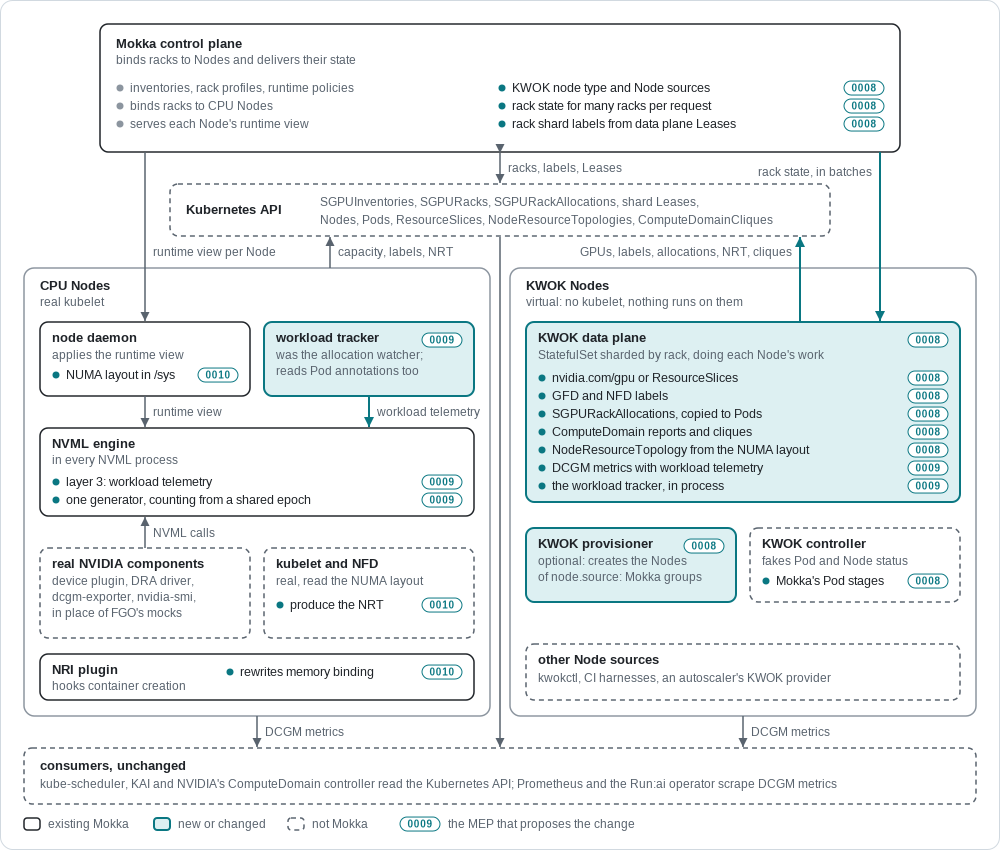
Looking through the list of FGO features, there are three that Mokka should support:
- KWOK Integration. Completely new functionality and the biggest piece of work.
- Workload-aware dynamic metrics, proposed in MEP0009.
- NUMA-aware scheduling, proposed in MEP0010.
The NVIDIA component mocks should be replaced by Mokka and the real NVIDIA components on top of it.
Together, the three MEPs change Mokka as below. Teal marks what's new or changed, and each change carries the number of the MEP that proposes it:
User Stories
- A scheduler load test. A scheduler team adds a KWOK rack group of 1,000
gb300-nvl72racks withnode.source: Mokkato an inventory. The KWOK provisioner creates 18,000 Nodes, the control plane binds each Node to a rack slot, the KWOK data plane publishes its GPUs and labels, and the team runs its load test on a cluster with a few CPU Nodes and no GPUs. - Run:ai on virtual Nodes. Run:ai's test harness keeps creating KWOK Nodes for its node pools, as it does for FGO, and adds Mokka's two labels to them. A KWOK rack group selects each pool. Run:ai's cluster operator health-checks the
mokka-kwok-dcgm-exporterService, Prometheus scrapes the GPUs' metrics, and anSGPURuntimePolicywith aBurstypattern moves the GPUs' utilization, as on CPU Nodes. - Two kinds of Node in one inventory. An inventory has a CPU rack group for tests that run
nvidia-smiin Pods and a KWOK rack group for scale, both with the same profile. GPUs on both keep stable UUIDs, PCI addresses and NUMA placement. A test reads the Node bound to rack 0, Node 0 from the rack'snodeRefand pins a Pod to it withkubernetes.io/hostname. - From the device plugin to DRA. A platform team moving its GPU Nodes from NVIDIA's device plugin to its DRA driver runs its workloads in two clusters, with
kwok.dataPlane.gpuPublishingset toDevicePluginin one andDRAin the other. In the first, KWOK Nodes carrynvidia.com/gpu, and the data plane picks each Pod's GPUs, as the kubelet would. In the second, each KWOK Node has a ResourceSlice with the devices NVIDIA's DRA driver would publish, and the scheduler allocates them to claims and, on Kubernetes 1.36 or later, to Pods that still requestnvidia.com/gpu. In both, each Pod'smokka.nvidia.com/gpu-allocationannotation names its GPUs, and their DCGM metrics carry the Pod. - Multi-node NVLink jobs. A team building a job controller for multi-node NVLink training installs NVIDIA's DRA driver with ComputeDomains and enables
kwok.dataPlane.computeDomains, which works in either GPU mode. The controller creates a ComputeDomain withnumNodes: 4and four Pods that claim its channel. Once the scheduler binds them to KWOK Nodes ofgb300-nvl72racks, the data plane does what NVIDIA's compute-domain plugin and IMEX daemons would do on those Nodes, and NVIDIA's controller marks the domain Ready, as on GPU Nodes. The team runs the controller's tests on hundreds of racks in a cluster without GPUs.
Risks and Mitigations
- Large inventories load the API server. Each KWOK Node adds a projection patch from the control plane, and a status patch or a ResourceSlice, a label patch and an NRT from the data plane. The provisioner adds the Node itself in groups that ask Mokka for their Nodes. Each GPU Pod, and each Guaranteed Pod while NodeResourceTopology is on, adds a share of an
SGPURackAllocationwrite, batched with the rack's other new Pods, a Pod patch and an NRT update. KWOK mode is off by default, the provisioner creates Nodes at a limited rate, and Mokka writes only when slot counts, bindings or Pods change. Metrics stay in memory. - DaemonSets that tolerate every taint run on KWOK Nodes. KWOK fakes their Pods, but each such DaemonSet adds a Pod object per KWOK Node. Mokka keeps its node daemon off them with node affinity on
mokka.nvidia.com/node-type, and the GPU Operator's operands withnvidia.com/gpu.deploy.operands=false. Cluster admins add the same affinity to their own DaemonSets, such as CNI or log agents. - DCGM metrics load Prometheus. The example inventory's 72,000 GPUs serve 216,000 series. The
ServiceMonitoris optional, andkwok.dataPlane.metrics.enabled: falseleaves metrics out of tests that don't need them. - Node sources set GPU keys themselves. A Node template written for FGO may already carry
nvidia.com/gpucapacity ornvidia.com/gpu.*labels. InDRAmode, that capacity would offer the Node's GPUs a second time, next to its ResourceSlice. The data plane doesn't force ownership of those keys: it reports them as an Event on the Node, and the migration guide tells sources to drop them.
Design Details
KWOK Integration
KWOK integration adds the KWOK data plane and an optional KWOK provisioner next to the control plane, which binds KWOK Nodes to rack slots and assigns their racks to data plane shards:
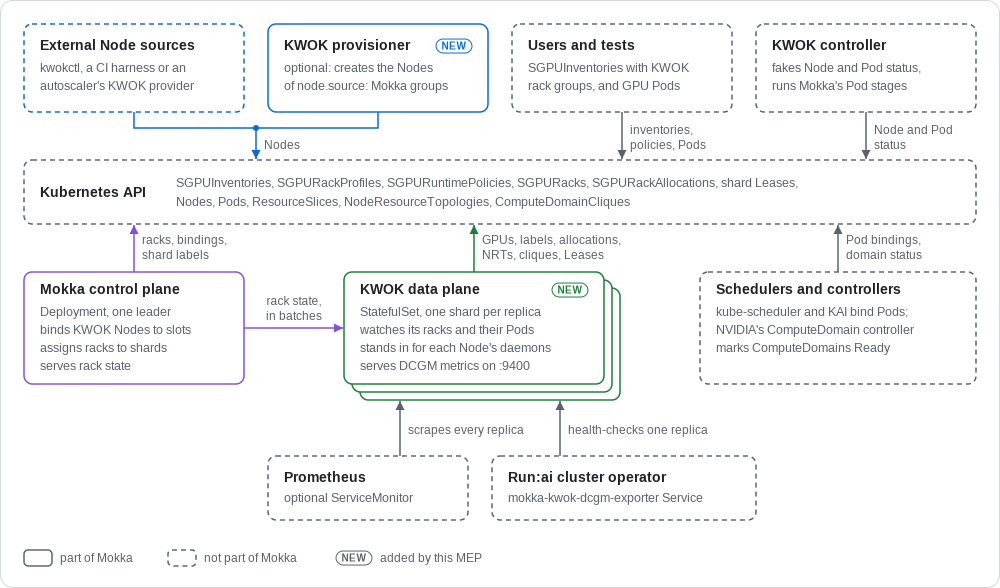
A rack group's Nodes are one of two types:
CPU(default): real Nodes with a kubelet. The control plane binds racks to them, and the node daemon simulates the GPUs on them.KWOK: virtual Nodes that KWOK runs. The control plane binds racks to them the same way, and the KWOK data plane stands in for the daemons that would run on them.
They come from one of two sources:
External(default): created outside Mokka. That's every CPU Node, and KWOK Nodes fromkwokctl, a CI harness or an autoscaler's KWOK provider (KWOK Nodes).Mokka: KWOK Nodes that Mokka's KWOK provisioner creates, as many as the group has rack slots.
A rack group sets both in its node block in SGPUInventory, so one inventory can mix CPU and KWOK rack groups:
apiVersion: mokka.nvidia.com/v1alpha1
kind: SGPUInventory
metadata:
  name: dev
spec:
  rackGroups:
    - id: training
      node:
        type: CPU # the default
      count: 10
      profileRef:
        name: gb300-nvl72

      placement:
        nodeSelector:
          matchLabels:
            mokka.nvidia.com/sgpu: training

    - id: ci
      node:
        type: KWOK # with the default source: External
      count: 1000 # a thousand gb300-nvl72 racks
      profileRef:
        name: gb300-nvl72

      placement: # selects KWOK Nodes, whoever created them
        nodeSelector:
          matchLabels:
            run.ai/simulated-gpu-node-pool: ci
The KWOK group ci binds up to rackGroup.count × profile.nodesPerRack KWOK Nodes (18,000 in this example). A group with node.source: Mokka gets that many from the KWOK provisioner instead.
The CRD validation enforces these rules on a rack group:
node.typeisCPUorKWOK, defaults toCPU, and can't change, so a rack is simulated by the same component for its whole life. To change a group's node type, replace the group with one under a newid.node.sourceisExternalorMokka, defaults toExternal, and can't change, since a change would leave open whether the Nodes already there are deleted or left behind.Mokkarequiresnode.type: KWOK.node.templateis allowed only withnode.source: Mokka.nodedefaults to an empty block, so a group that leaves it out still storestype: CPUandsource: External.placement.nodeSelectorcan't referencemokka.nvidia.com/node-type, which the node type already decides (see Separating CPU and KWOK Racks).
The Mokka Control Plane (MEP0001) watches SGPUInventory and creates SGPURacks as usual, and copies node.type from the rack group into each SGPURack's spec.nodeType. The field stays flat on the rack, where spec.nodes lists the slots. node.source and node.template stay in the inventory, since only the KWOK provisioner reads them. A KWOK rack looks like this:
apiVersion: mokka.nvidia.com/v1alpha1
kind: SGPURack
metadata:
  name: dev-ci-0-3f9c2a17b04e
  labels:
    mokka.nvidia.com/inventory: dev
    mokka.nvidia.com/rack-group: ci
    mokka.nvidia.com/rack-index: "0"
    mokka.nvidia.com/kwok-shard: mokka-kwok-data-plane-2 # the data plane replica that serves the rack
  annotations:
    mokka.nvidia.com/inventory-uid: <inventory UID>
  finalizers:
    - mokka.nvidia.com/rack-cleanup
  ownerReferences:
    - apiVersion: mokka.nvidia.com/v1alpha1
      kind: SGPUInventory
      name: dev
      uid: <inventory UID>
      controller: true
      blockOwnerDeletion: false
spec:
  nodeType: KWOK # copied from the rack group's node.type
  inventoryRef:
    name: dev
    uid: <inventory UID>
  profileRef:
    name: gb300-nvl72
    uid: <profile UID>
    generation: 1
    revision: <profile revision>
  identity:
    rackGroup: ci
    rackIndex: 0
    fabricUUID: <fabric UUID>
    cliqueID: 0
  nodes:
    - index: 0
      nodeRef: # the KWOK Node bound to the slot, as on CPU racks
        name: kwok-node-17
        uid: <Node UID>
      gpus:
        - index: 0
          uuid: GPU-<UUID>
          serial: "<serial>"
          minorNumber: 0
          pciAddress: "0008:01:00.0"
          rootComplex: pci0008:00
          numaNode: 0
          hostProcessorIndex: 0
        # GPUs 1-3
    # Nodes 1-17
KWOK racks are rendered and bound exactly like CPU racks, so their simulated GPUs keep stable UUIDs, serials, PCI addresses, and NUMA placement, and their Nodes get the same projection: mokka.nvidia.com/sgpu-assigned, nvidia.com/gpu.clique and the mokka.nvidia.com/sgpu-assignment annotation. The mokka.nvidia.com/kwok-shard label names the data plane replica that serves the rack (Sharding).
KWOK Components
A KWOK Node involves three parties:
- its Node source,
- the control plane,
- and the KWOK data plane.
KWOK mode always adds the data plane, and the KWOK provisioner is an optional Node source for groups that ask Mokka for their Nodes:
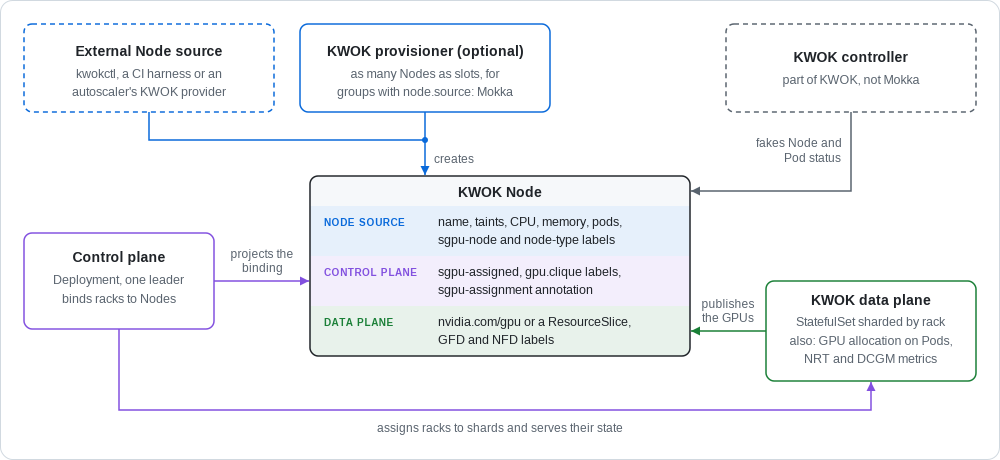
| Node source | Control plane | KWOK data plane | |
|---|---|---|---|
| Owns | the machine | rack slots and shards | what the Node's daemons would publish |
| Writes | the Node: name, taints, CPU, memory and pod capacity, Mokka's two labels | nodeRef, the Node projection, rack shard labels |
nvidia.com/gpu capacity or ResourceSlices, GFD and NFD labels, SGPURackAllocations and their copies on Pods, NodeResourceTopology |
| Serves | - | racks' states | DCGM metrics |
| Load follows | the test scenario | inventories, Nodes and shard Leases | Pods, scrapes and racks' states |
| Runs as | anything that creates Nodes, such as the optional KWOK provisioner | Deployment with leader election |
StatefulSet sharded by rack |
| Stands in for | Node registration | nothing: it does what it does for CPU Nodes | the device plugin, GFD, NFD, the DRA driver's node-side parts and dcgm-exporter |
The split follows load and ownership:
- Load. The control plane's work follows inventories, Node registrations and shard membership, which change rarely, so one leader is enough. The data plane's work grows with the test scenario: the GPUs of every bound Node, an allocation and a NodeResourceTopology update for every GPU Pod, and 216,000 metric series for the example inventory's 72,000 GPUs. It scales by sharding racks across replicas.
- Ownership. Per-Node state needs one writer per Node, not one for the whole cluster. Sharding gives each Node exactly one owning replica, as a real cluster runs one set of daemons per Node, so only cluster-wide decisions need the control plane leader.
- Failures. A Pod burst or a slow scrape can't stall binding, and a control plane failover doesn't interrupt allocation or metrics.
- Sources. Node creation stays out of the control plane, even when Mokka does it via KWOK provisioner. The control plane binds a provisioned Node exactly as it binds one from
kwokctl, so binding never depends on who created a Node. - Future surfaces. GPU health, MIG reconfiguration, ComputeDomain readiness and InfiniBand counters all change while a Node runs, so they'll be added to the data plane instead of adding components (it would be the case with FGO-like archtecture).
KWOK Nodes
Mokka uses KWOK Nodes whoever creates them:
- kwokctl scale with a Node template,
- a CI harness's own manifests, as FGO's users write them today,
- an autoscaler's KWOK provider,
- or, for groups with node.source: Mokka, the KWOK provisioner.
The docs give a Node template and a kwokctl command for the other sources. A Node joins with two labels next to the ones its rack group selects:
apiVersion: v1
kind: Node
metadata:
  name: kwok-node-17 # any name the source picks
  annotations:
    kwok.x-k8s.io/node: fake # matched by KWOK's default annotation selector
  labels:
    mokka.nvidia.com/sgpu-node: "true" # asks for a rack slot, as on CPU Nodes
    mokka.nvidia.com/node-type: KWOK # keeps CPU groups and the node daemon off the Node
    run.ai/simulated-gpu-node-pool: ci # matched by the KWOK group's placement
    nvidia.com/gpu.deploy.operands: "false" # keeps the GPU Operator from scheduling its DaemonSets on the virtual Node
spec:
  taints:
    - key: kwok.x-k8s.io/node # keeps regular pods off the virtual Nodes
      value: fake
      effect: NoSchedule
status:
  capacity:
    cpu: "144" # the profile's node.host values make a realistic Node
    memory: 960Gi
    pods: "250"
  allocatable:
    cpu: "144"
    memory: 960Gi
    pods: "250"
The source owns the Node: its name, taints, and CPU, memory and pod capacity. The control plane and the data plane never change or delete them.
Once the control plane binds the Node to a rack slot, two things happens to it:
- the control plane projects the binding, exactly as on a CPU Node:
mokka.nvidia.com/sgpu-assigned,nvidia.com/gpu.cliqueand themokka.nvidia.com/sgpu-assignmentannotation; - the KWOK data plane publishes the GPUs, as
nvidia.com/gpuin Node's capacity and allocatable or as a ResourceSlice, and GFD and NFD labels (Publishing the GPUs).
The control plane binds KWOK Nodes as it binds CPU Nodes: - valid bindings stay, - and new Nodes are ordered by creation time, - name and UID and fill free slots in rack and index order.
Nodes beyond the group's capacity stay pending without GPUs, and the inventory reports them as pendingNodes. When a binding goes away, the data plane removes the Node's GPUs before the release completes, and the Node stays with its source. When a source deletes a bound Node, the control plane releases its slot, and the next pending Node takes it.
KWOK Provisioner
We will introduce an optional component, the KWOK provisioner, as a Deployment named mokka-kwok-provisioner.
[!NOTE] KWOK provisioner and data plane could be just one binary with two different entrypoint CLI commands and one image
mokka-kwokfor simplicity. They will be deployed as separate Deployments though because they have different reasons to be enabled and scale.
It creates the Nodes of the KWOK rack groups that set node.source: Mokka, as Cluster API or a cloud's node groups create the machines of a real cluster.
It's a Node source like any other:
- it writes only Nodes,
- the control plane binds them as it binds Nodes from
kwokctl, - and the KWOK data plane publishes their GPUs.
apiVersion: mokka.nvidia.com/v1alpha1
kind: SGPUInventory
metadata:
  name: load-test
spec:
  rackGroups:
    - id: scale
      node:
        type: KWOK
        source: Mokka # External, the default, uses Nodes others create
        template: # only with source: Mokka
          labels:
            topology.kubernetes.io/zone: zone-a
          # taints: left out, so the Nodes get KWOK's kwok.x-k8s.io/node=fake:NoSchedule
          capacity: # what the profile doesn't define, as the Node's capacity and allocatable
            pods: "250" # defaults to 110, the kubelet's default
            ephemeral-storage: 1Ti # Pods that request it fit only Nodes that report it
      count: 100
      profileRef:
        name: gb300-nvl72

      placement:
        nodeSelector:
          matchLabels:
            run.ai/simulated-gpu-node-pool: scale # the provisioner puts these on its Nodes
Rack's slot count means something different for each source. For external Nodes, it's a ceiling: the group binds up to that many. For the provisioner, it's a target.
For each such group, the provisioner keeps as many Nodes as the group has slots, status.rackGroups[].capacity.nodes, so it follows the racks the control plane materialized instead of computing them. Its Nodes look like this:
apiVersion: v1
kind: Node
metadata:
  name: load-test-scale-x7k2p # <inventory>-<rack group>-<random suffix>
  annotations:
    kwok.x-k8s.io/node: fake # matched by KWOK's default annotation selector
  labels:
    app.kubernetes.io/managed-by: mokka-kwok-provisioner
    mokka.nvidia.com/inventory: load-test # the group the Node was made for, not a slot
    mokka.nvidia.com/rack-group: scale
    mokka.nvidia.com/sgpu-node: "true"
    mokka.nvidia.com/node-type: KWOK
    run.ai/simulated-gpu-node-pool: scale # from the group's placement
    topology.kubernetes.io/zone: zone-a # from node.template
    nvidia.com/gpu.deploy.operands: "false"
    kubernetes.io/hostname: load-test-scale-x7k2p
    kubernetes.io/os: linux
    kubernetes.io/arch: arm64 # from the profile's node.host.cpu.architecture
  ownerReferences:
    - apiVersion: mokka.nvidia.com/v1alpha1
      kind: SGPUInventory
      name: load-test
      uid: <inventory UID>
      blockOwnerDeletion: false
spec:
  taints: # node.template's default
    - key: kwok.x-k8s.io/node
      value: fake
      effect: NoSchedule
status:
  capacity:
    cpu: "144" # from the profile's node.host.cpu.cores
    memory: 960Gi # from the profile's node.host.memory.capacity
    pods: "250" # from node.template.capacity
    ephemeral-storage: 1Ti # from node.template.capacity
  allocatable: # the same as capacity, since no kubelet reserves any of it
    cpu: "144"
    memory: 960Gi
    pods: "250"
    ephemeral-storage: 1Ti
  nodeInfo:
    architecture: arm64
    operatingSystem: linux
    kubeletVersion: fake
- Counting. It counts the Nodes it made for a group by their labels and owner, and creates more until there are as many as the group has slots. Nodes from other sources that match the same placement compete for the slots and show up as
pendingNodes, as usual. - Names. A Node's name is the inventory, the group and a random suffix. The provisioner picks the suffix itself instead of using
generateName, sokubernetes.io/hostnamecarries the name from the start. If the name is taken, it picks another. Names never point at a slot: the control plane picks the slot and can later bind the Node elsewhere. - Nothing about slots or GPUs. It never writes
nodeRef, a projection key or a GPU key. Those come from the control plane and the data plane, as on any other KWOK Node. - Shape. CPU, memory and architecture come from the profile's
node.host, and the rest of the Node's capacity, such aspodsandephemeral-storage, fromnode.template.capacity, since there's no kubelet to report it. Allocatable equals capacity. A Pod that requests a resource the Node doesn't report, such asephemeral-storagewhen the template leaves it out, doesn't fit on the Node. A group whose profile has no host CPU cores or memory gets no Nodes, and the provisioner reports why as an Event on the inventory. - Replacement. When a Node it created is deleted, it creates another, as a cloud's node group replaces a terminated instance, and the control plane binds the new Node to the free slot. A test that needs a host gone for good cordons it or marks it NotReady with a KWOK
Stageinstead. - Changes. The provisioner never updates a Node after creating it, so tests can change its labels, taints and conditions. A template change applies to Nodes created after it, and deleting a Node replaces it with one from the current template.
- Scale-down. When a group has fewer slots, it deletes surplus Nodes that aren't bound, those without
mokka.nvidia.com/sgpu-assigned, and waits for the control plane to release the rest. It deletes every Node of a group that leaves the inventory. When the inventory itself is deleted, the garbage collector deletes its Nodes through their owner reference.
The CRD validation adds the following rules and defaults for groups with node.source: Mokka:
placement.nodeSelectorusesmatchLabelsonly, so the provisioner can put those labels on its Nodes.node.template.labelscan't set a key thatplacementsets, or keys undermokka.nvidia.com/,nvidia.com/orfeature.node.kubernetes.io/, which Mokka writes.node.template.taintsdefaults to KWOK'skwok.x-k8s.io/node=fake:NoSchedule, so only Pods that tolerate it land on the virtual Nodes and get faked Running. An explicit empty list leaves the Nodes untainted.node.template.capacitycan't setcpuormemory, which come from the profile, or keys undernvidia.com/, which the data plane publishes. Itspodsis at least 1 and defaults to 110, the kubelet's default.- The inventory name and the group ID have at most 56 characters together, so a Node name fits the 63-character limit of the
kubernetes.io/hostnamelabel.
The provisioner runs one active replica under leader election and creates Nodes at a rate the Helm chart sets. It watches SGPUInventory (much cheaper to watch than SGPURacks) and SGPURackProfile objects and the metadata of the Nodes it created. It reads no racks, shard Leases or rack state.
KWOK Data Plane
We will introduce a new component, the KWOK data plane, as an StatefulSet named mokka-kwok-data-plane. It will be enabled when kwok integration is on (otherwise, it would be just regular KWOK functionality).
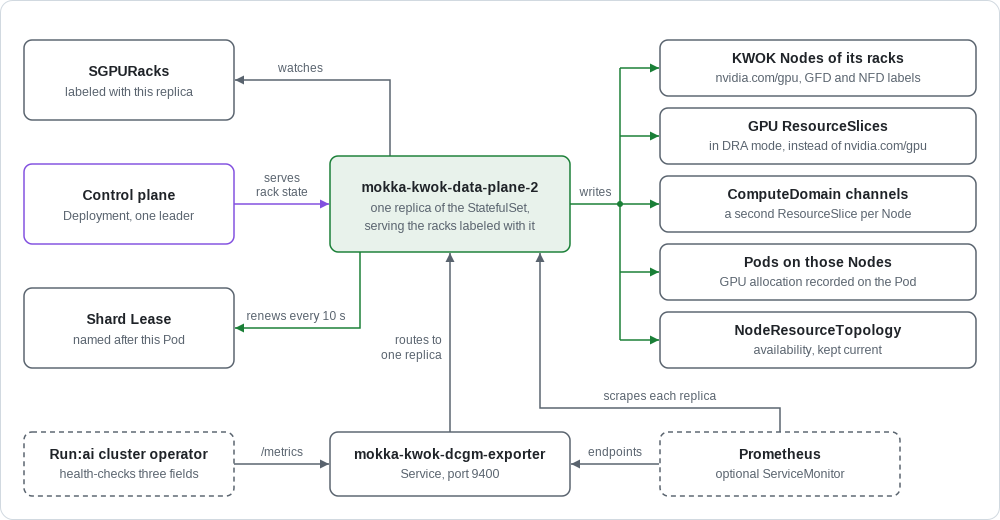
It stands in for the daemons of a GPU Node for as long as a KWOK Node is bound:
- it publishes the Node's GPUs,
- records which of the Pods bound to the Node use them,
- keeps the Node's NodeResourceTopology current,
- and serves DCGM metrics for them.
It takes over FGO's KWOK plugins: kwok-gpu-device-plugin, kwok-dra-plugin, kwok-compute-domain-dra-plugin and nvidia-dcgm-exporter-kwok.
Each replica serves the racks the control plane assigns to it, as Sharding describes.
Publishing the GPUs
There's no device plugin, GFD, NFD or DRA driver on a KWOK Node, so the data plane publishes what they would once the control plane serves the Node's assignment and its state. It advertises a Node's GPUs in one of two ways, which kwok.dataPlane.gpuPublishing selects for all KWOK Nodes:
DevicePlugin, the default:nvidia.com/gpuin the Node's capacity and allocatable, as a merge patch of that key only, as FGO'skwok-gpu-device-plugindoes (Device Plugin Mode).allocatablestays at the total as Pods come and go: the scheduler subtracts requests itself, so lowering it would count them twice.DRA: a DRAResourceSliceper Node, owned by the Node, with the devices NVIDIA's GPU kubelet plugin would publish for the slot (DRA and ComputeDomains).
In both modes, it also publishes:
- GFD and NFD labels, such as
nvidia.com/gpu.product,nvidia.com/gpu.count,nvidia.com/gpu.memory,nvidia.com/mig.strategyandfeature.node.kubernetes.io/pci-10de.present, with server-side apply. - With
computeDomainsenabled, a secondResourceSlicefor each Node of a rack with an NVLink fabric, with thecompute-domain.nvidia.comdevices NVIDIA's compute-domain kubelet plugin would publish (DRA and ComputeDomains). NVIDIA's DRA driver enables GPUs and ComputeDomains separately, so these devices don't depend on the mode.
A GPU Node runs either NVIDIA's device plugin or its DRA driver for its GPUs, never both (the scheduler counts nvidia.com/gpu capacity and DRA devices separately, so a Node with both would give each GPU out twice).
In DRA mode, Pods that request nvidia.com/gpu still schedule from Kubernetes 1.36, where the DRAExtendedResource feature is on by default: the gpu.nvidia.com DeviceClass of NVIDIA's DRA driver names nvidia.com/gpu as its extended resource, and the scheduler serves those requests from the slice because the Node has no nvidia.com/gpu capacity.
[!WARNING] In DRA mode, if a extenal Node source that sets
nvidia.com/gpu, then the scheduler will give each GPU out twice, by count and through ResourceClaims. The data plane will warn about that duplication via Events on the Node.
If a Node source already set one of these keys to a different value, the data plane doesn't overwrite it: it applies its other keys and reports the conflict as an Event on the Node.
A binding's release waits for the data plane to remove what it published on the Node, whatever the control plane releases it for, the rack's deletion included:
- The control plane removes its projection from the Node, as on a CPU Node, and keeps the slot's Node in the rack state, marked
releasing. - The data plane deletes the objects it created for the Node, its ResourceSlices and NodeResourceTopology, drops the Node's entries from the rack's
SGPURackAllocation, and only then removes its own fields from the Node, so a Node without them has nothing else left. - Once the Node carries no field of the data plane's field manager, which the control plane sees in the managed fields of the Nodes it already watches, the control plane clears the slot. The rack's
mokka.nvidia.com/rack-cleanupfinalizer goes only once every slot is clear, as on CPU racks.
The rack and the slot stay until then, and the control plane keeps assigning the rack to a live shard, so a replica that was down when a release began, or the replica that takes over its racks, finds the release and finishes it. A rack that leaves a replica's watch, because it moved to another replica or finished its releases, needs no cleanup. All replicas apply with the same field manager, so the new replica takes over the fields the old one applied, and can change or remove them later. With kwok.enabled off, no data plane runs, so releases don't wait for one.
GPU Allocation
There's no kubelet on a KWOK Node, so the data plane records which GPUs each Pod bound to the Nodes of its racks got.
In DevicePlugin mode, it also picks them, as the kubelet's device manager would. With NodeResourceTopology on, that's under the single-numa-node policy it advertises: all of a container's GPUs from one zone, and for a Guaranteed container, from a zone where its CPUs and memory also fit. Without it, nothing advertises a Topology Manager policy, so the data plane takes free GPUs from any zone, as a kubelet does under its default none policy.
In DRA mode, the scheduler has already picked every GPU, for claims and nvidia.com/gpu requests alike, and the data plane copies its picks from the Pod's claims, including the claim the scheduler creates for nvidia.com/gpu requests, which the Pod's status.extendedResourceClaimStatus names.
The record for a rack lives in an SGPURackAllocation named after the rack. Only the data plane writes it and reads it:
apiVersion: mokka.nvidia.com/v1alpha1
kind: SGPURackAllocation
metadata:
  name: dev-ci-7-9b1e04c2a6d1 # the rack's name, so one read finds it
  ownerReferences: # deleted with the rack
    - apiVersion: mokka.nvidia.com/v1alpha1
      kind: SGPURack
      name: dev-ci-7-9b1e04c2a6d1
      uid: <rack UID>
nodes:
  - name: kwok-node-17
    pods:
      - pod: team-a/train-0
        uid: <Pod UID>
        containers:
          - name: main
            gpus: [GPU-<UUID>, GPU-<UUID>]
            numaZone: 0 # with NodeResourceTopology on: the zone of a Guaranteed container's CPUs and memory
The data plane keeps each rack's record through this object:
- Pick and record. When Pods on the rack are bound, it picks their GPUs and zones from its copy of the object and updates the object with its
resourceVersionas a precondition, in one write for the Pods that arrived together. - Retry on conflict. A conflict means another writer changed the rack's allocations first, which only happens while two replicas act on the rack during a join. The data plane re-reads the object and picks again, so no GPU or zone ever goes to two Pods.
- Copy to the Pod. Only after the update succeeds does it copy each Pod's share to the Pod's annotations, which Mokka's Pod stages wait for, since they see only the Pod.
- Release. When a Pod ends, it removes the Pod's entries the same way, batched.
The copy on train-0 reads:
apiVersion: v1
kind: Pod
metadata:
  name: train-0
  namespace: team-a
  annotations:
    mokka.nvidia.com/gpu-allocation: '{"main":["GPU-<UUID>","GPU-<UUID>"]}' # GPU UUIDs per container
    mokka.nvidia.com/numa-zone: '{"main":0}' # the zone of each Guaranteed container's CPUs and memory
spec:
  nodeName: kwok-node-17
  containers:
    - name: main
      resources:
        limits: {cpu: "16", memory: 64Gi, nvidia.com/gpu: 2} # requests default to limits, so the Pod is Guaranteed
With NodeResourceTopology enabled, numaZone records the zone each Guaranteed container's CPUs and memory are charged to, as the kubelet's static CPU and Memory Managers would pin them.
The data plane builds two surfaces from the record: - each NUMA zone's free GPUs, CPUs and memory in NodeResourceTopology, - and the namespace, pod and container labels on DCGM metrics.
The record has the same format in both modes, so neither surface depends on the mode. This mirrors a real Node, where one kubelet API, PodResources, reports device plugin and DRA allocations, exclusive CPUs and memory.
The record is stored in the API rather than in the replica's memory, so a replica that restarts or takes over a rack reads it back, with one read per rack. It then drops entries for Pods that have ended and rewrites any copy a Pod is missing. Picking again, GPUs in DevicePlugin mode or zones in either mode, could move a running Pod: if Pod A got GPU 0 and Pod B got GPU 1, a fresh pick after A ends might give B GPU 0.
Pod Admission
A real GPU Node's kubelet admits a Pod before running it:
- the device manager allocates its GPUs and,
- under single-numa-node, the Topology Manager checks that they fit one zone.
A Pod that fails admission ends up Failed and never runs.
KWOK's default Pod stages run every bound Pod on their own, so on a KWOK Node a GPU Pod could show Running before the data plane has allocated its GPUs, such as while a data plane replica restarts, and a test that reads its GPUs right after Running would race.
Mokka's docs ship KWOK Pod stages (see TODO) that gate those Pods on the data plane instead:
- Which Pods. Pods that request
nvidia.com/gpuor have resource claims. A stage sees only the Pod, so it can't tell a claim for GPUs from a claim for another driver's devices. - Running and Ready.
mokka-pod-readymoves such a Pod to Running and Ready only once the data plane has allocated its GPUs and, with NodeResourceTopology on, its zone. Once the rack'sSGPURackAllocationrecords them, the data plane writesmokka.nvidia.com/gpu-allocationin the same patch asmokka.nvidia.com/numa-zone, so the stage checks one annotation, and writes it for every such Pod on its racks, empty if the Pod holds no GPU. - Failed. A Pod the data plane can't admit never matches
mokka-pod-ready, so the data plane marks itFaileditself, with the reason and message a kubelet would give:TopologyAffinityErrorwhen, with NodeResourceTopology on, no zone fits, orUnexpectedAdmissionErrorwhen too few GPUs are free. It waits until KWOK has created the Pod and set its Pod IP, since KWOK'spod-createstage setsphase: Pendingon any Pod without one and would undo an earlierFailed. - The rest stays KWOK's. The docs ship KWOK's
pod-readywith these Pods excluded, and KWOK's other Pod stages unchanged.
mokka-pod-ready keeps the selector of KWOK's pod-ready and adds the gate and the data plane's annotation. Its delay and status template stay KWOK's:
apiVersion: kwok.x-k8s.io/v1alpha1
kind: Stage
metadata:
  name: mokka-pod-ready
spec:
  resourceRef:
    apiGroup: v1
    kind: Pod
  selector:
    matchExpressions:
    # KWOK's pod-ready selector: a Pending, initialized Pod whose containers aren't running yet
    - key: '.metadata.deletionTimestamp'
      operator: 'DoesNotExist'
    - key: '.status.phase'
      operator: 'In'
      values: ['Pending']
    - key: '.status.conditions.[] | select( .type == "Initialized" ) | .status'
      operator: 'In'
      values: ['True']
    - key: '.status.containerStatuses.[].state.running.startedAt'
      operator: 'DoesNotExist'
    # a gated Pod: it requests nvidia.com/gpu or has resource claims
    - key: '(([(.spec.containers // [])[], (.spec.initContainers // [])[] | .resources.requests["nvidia.com/gpu"] // empty] | length) > 0) or (((.spec.resourceClaims // []) | length) > 0)'
      operator: 'In'
      values: ['true'] # KWOK compares a boolean result as "true" or "false"
    # the data plane has allocated its GPUs and zone
    - key: '.metadata.annotations["mokka.nvidia.com/gpu-allocation"]'
      operator: 'Exists'
  delay: # as in KWOK's pod-ready
    durationMilliseconds: 1000
    jitterDurationMilliseconds: 5000
  next:
    statusTemplate: '...' # KWOK's pod-ready template: Ready and ContainersReady, a running status per container, phase Running
The pod-ready the docs ship is KWOK's, with the gate's expression added and values: ['false'].
KWOK has to use this pod-ready in place of its default one (KWOK Installation). Adding Mokka's stages next to the default isn't enough: when only one stage matches a Pod, KWOK runs it whatever its weight, so the default pod-ready would run a gated Pod before its allocation exists.
The stages have two limits, which a change in KWOK itself could lift (TD2). A Pod whose claims are for another driver's devices waits forever on a KWOK Node that no data plane serves. And a Guaranteed Pod without GPUs or claims, which the stages don't gate, runs even when no zone fits it, and only gets an Event.
Device Plugin Mode
In DevicePlugin mode, the data plane stands in for a GPU Node's device plugin stack: NVIDIA's device plugin, GFD and NFD, and the kubelet's device manager, which picks each container's GPUs. kube-scheduler and every other reader of the Node's capacity and labels, such as KAI and Run:ai, see the same values as for a GPU Node.
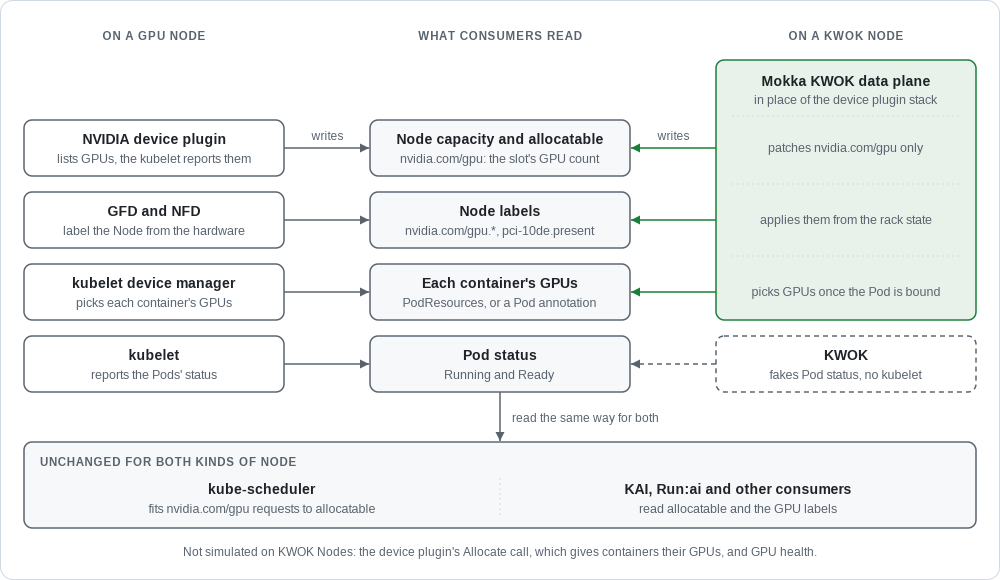
| Step | GPU Node | KWOK Node |
|---|---|---|
Advertise nvidia.com/gpu in the Node's capacity and allocatable |
NVIDIA's device plugin, through the kubelet | data plane, as a merge patch of that key |
Label the Node, such as nvidia.com/gpu.count and feature.node.kubernetes.io/pci-10de.present |
GFD and NFD | data plane, from the rack state |
Fit nvidia.com/gpu requests to allocatable and bind the Pod |
kube-scheduler | kube-scheduler |
| Pick each container's GPUs | the kubelet's device manager, at admission | data plane, once the Pod is bound |
| Make the pick visible to NodeResourceTopology and DCGM metrics | the kubelet's PodResources API | data plane, in the rack's SGPURackAllocation, copied to the Pod as mokka.nvidia.com/gpu-allocation |
| Give containers their GPUs | NVIDIA's device plugin | not simulated in KWOK mode |
| Report Pod status | kubelet | KWOK |
| Free the GPUs when the Pod ends | the kubelet's device manager | data plane |
PodResources. On a GPU Node, dcgm-exporter and NFD's topology updater learn each container's GPUs from the kubelet's PodResources API, which only components on the Node can reach. A KWOK Node has no kubelet to serve it, so the data plane keeps the record in each rack's SGPURackAllocation, with a copy on each Pod (GPU Allocation), and builds the Node's NodeResourceTopology and DCGM metrics from it.
Allocatable. On a GPU Node, the device plugin drops an unhealthy GPU from allocatable. KWOK Nodes keep allocatable at the slot's GPU count, since GPU health is out of scope until fault injection is (Non-Goals).
Not simulated. The device plugin's Allocate call, which gives containers their GPUs; nothing runs in a KWOK Pod to use them.
DRA and ComputeDomains
The data plane stands in only for the parts of NVIDIA's DRA driver that run on a GPU Node: - its two kubelet plugins - and the report its IMEX daemon makes.
kube-scheduler, and the DeviceClasses, CRDs and ComputeDomain controller of NVIDIA's DRA driver, run unchanged and read the same objects for a KWOK Node as for a GPU Node, so no FGO-style ComputeDomain controller is needed. Claims and ComputeDomains behave on KWOK Nodes as on CPU Nodes that run NVIDIA's DRA driver on Mokka's mock, which Mokka's DRA and ComputeDomain end-to-end tests already cover.
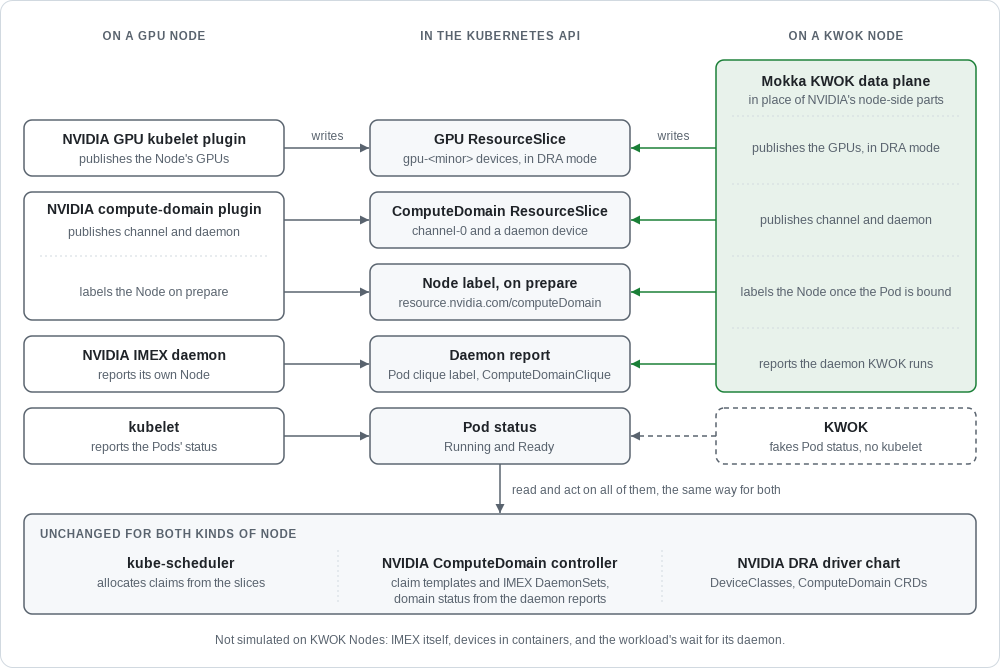
| Step | GPU Node | KWOK Node |
|---|---|---|
| Publish the GPUs as DRA devices | NVIDIA's GPU kubelet plugin | data plane, in DRA mode |
Publish channel-0 and a daemon device for ComputeDomains |
NVIDIA's compute-domain kubelet plugin | data plane, for Nodes of racks with an NVLink fabric |
| Create a domain's claim templates and its DaemonSet of IMEX daemons | NVIDIA's controller | NVIDIA's controller |
| Allocate devices to claims | kube-scheduler | kube-scheduler |
Prepare a channel claim: label the Node resource.nvidia.com/computeDomain=<domain UID> |
NVIDIA's compute-domain kubelet plugin | data plane, once the Pod is bound |
| Run the IMEX DaemonSet's Pod on each labeled Node | kubelet | KWOK, which marks the Pod Running and Ready without starting a container |
Report the daemon: a clique label on its Pod and its Node in the domain's ComputeDomainClique |
IMEX daemon | data plane, with the rack's clique ID and the Node's slot index |
List the Nodes in status.nodes and mark the domain Ready once numNodes of them are |
NVIDIA's controller | NVIDIA's controller |
| Give containers their devices and hold the workload until its daemon is ready | NVIDIA's kubelet plugins | not simulated |
| Unprepare: remove the Node label once no Pod on the Node holds the claim | NVIDIA's compute-domain kubelet plugin | data plane |
GPU devices. In DRA mode, the slice holds the devices NVIDIA's GPU kubelet plugin would publish for the slot, so a claim written for GPU Nodes selects the same devices on KWOK Nodes. Each GPU is a device named gpu-<minor> with the plugin's attributes and capacity, such as its UUID, product name, architecture, CUDA compute capability, driver versions, memory, PCI bus ID, PCIe root and NUMA node, all from the rack state. FGO names its devices by UUID and adds a model attribute, so the migration guide covers selectors that use them. For kwok-node-17, a Node of a gb300-nvl72 rack, the data plane writes:
apiVersion: resource.k8s.io/v1
kind: ResourceSlice
metadata:
  name: 0-gpu.nvidia.com-kwok-node-17-x7k2p # generated, as the plugin's slices are
  ownerReferences:
    - apiVersion: v1
      kind: Node
      name: kwok-node-17
      uid: <Node UID>
      controller: true
spec:
  driver: gpu.nvidia.com # configurable from mokka helm values, expecyed to be created by the DRA chart
  nodeName: kwok-node-17
  pool:
    name: kwok-node-17
    generation: 1
    resourceSliceCount: 1
  devices:
    - name: gpu-0 # gpu-<minor>
      attributes:
        type: {string: gpu}
        uuid: {string: GPU-<UUID>}
        productName: {string: "NVIDIA GB300 NVL"}
        brand: {string: Nvidia}
        architecture: {string: Blackwell}
        cudaComputeCapability: {version: 10.0.0}
        driverVersion: {version: 580.65.6} # 580.65.06, as the plugin normalizes it to semver
        cudaDriverVersion: {version: 13.0.0}
        addressingMode: {string: ATS}
        resource.kubernetes.io/pciBusID: {string: "0000:0a:00.0"}
        resource.kubernetes.io/pcieRoot: {string: "pci0000:00"}
        resource.kubernetes.io/numaNode: {int: 0}
      capacity:
        memory: {value: 278Gi}
    # gpu-1 to gpu-3 carry the same attributes with their own UUIDs and PCI bus IDs
    # (0000:0b:00.0, 0000:4a:00.0, 0000:4b:00.0); gpu-2 and gpu-3 sit under
    # pci0000:40 on NUMA node 1, where the rack profile places them.
ComputeDomains. NVIDIA's controller runs an IMEX daemon on every Node labeled for a domain and builds the domain's status from what the daemons report. On a KWOK Node, the data plane sets that label when a Pod with an allocated channel claim is bound to the Node, as the plugin does when it prepares the claim.
KWOK runs the IMEX daemon Pod that gets scheduled to a virtual node and reports it Ready, but no real daemon process runs, so the data plane need to make the daemon's report:
- it labels the IMEX daemon Pod with the rack's clique ID
- and adds the Node to the domain's ComputeDomainClique with the daemon Pod's IP and the Node's slot index.
For a domain with numNodes: 2 on kwok-node-17 and kwok-node-18, in slots 5 and 6 of the rack, the clique is:
apiVersion: resource.nvidia.com/v1beta1
kind: ComputeDomainClique
metadata:
  name: <ComputeDomain UID>.612ee4ea-82ff-5045-bb7e-04c5f9617370.0 # <domain UID>.<clique ID>
  namespace: nvidia # the DRA driver's namespace
  labels:
    resource.nvidia.com/computeDomain: <ComputeDomain UID>
    resource.nvidia.com/computeDomain.cliqueID: 612ee4ea-82ff-5045-bb7e-04c5f9617370.0
  ownerReferences: # every daemon Pod in the clique, so the clique goes when they do
    - {apiVersion: v1, kind: Pod, name: <daemon Pod on kwok-node-17>, uid: <Pod UID>}
    - {apiVersion: v1, kind: Pod, name: <daemon Pod on kwok-node-18>, uid: <Pod UID>}
daemons:
  - nodeName: kwok-node-17
    ipAddress: 10.0.0.12 # the daemon Pod's IP, which KWOK assigned
    cliqueID: 612ee4ea-82ff-5045-bb7e-04c5f9617370.0 # the rack's fabric UUID and clique ID
    index: 5 # the Node's slot index in the rack
    status: Ready # the daemon Pod's readiness, which KWOK reports
  - nodeName: kwok-node-18
    ipAddress: 10.0.0.13
    cliqueID: 612ee4ea-82ff-5045-bb7e-04c5f9617370.0
    index: 6
    status: Ready
NVIDIA's controller then lists the Node in status.nodes and marks the domain Ready once numNodes listed Nodes are Ready, as for GPU Nodes. When no Pod on the Node holds the channel claim any more, the data plane removes the label, the DaemonSet deletes the daemon Pod, and the controller drops the Node's entry. A rack is one clique and one replica serves it, so each Node's entry has a single writer.
With computeDomains enabled, each Node of a rack with an NVLink fabric gets a ComputeDomain slice with the two devices NVIDIA's compute-domain kubelet plugin publishes: channel-0, which a workload's channel claim gets, and daemon-0, which the IMEX daemon Pod's claim gets. Neither has capacity, and the plugin leaves channels above 0 off the Node's slice. For kwok-node-17:
apiVersion: resource.k8s.io/v1
kind: ResourceSlice
metadata:
  name: 0-compute-domain.nvidia.com-kwok-node-17-m4q9z # generated, as the plugin's slices are
  ownerReferences:
    - apiVersion: v1
      kind: Node
      name: kwok-node-17
      uid: <Node UID>
      controller: true
spec:
  driver: compute-domain.nvidia.com
  nodeName: kwok-node-17
  pool:
    name: kwok-node-17
    generation: 1
    resourceSliceCount: 1
  devices:
    - name: channel-0 # the compute-domain-default-channel.nvidia.com class selects it
      attributes:
        type: {string: channel}
        id: {int: 0}
    - name: daemon-0 # the compute-domain-daemon.nvidia.com class selects it
      attributes:
        type: {string: daemon}
        id: {int: 0}
Not simulated. IMEX itself and the devices the plugins give containers. On a GPU Node, the plugin also keeps the workload's containers from starting until the Node's daemon is Ready, while KWOK runs the workload Pod at once, so tests can't observe that wait on KWOK Nodes.
What the cluster needs. NVIDIA's DRA driver chart, with its default driver-managed IMEX and ComputeDomainCliques feature. DRA mode needs the chart's GPUs enabled, which brings the gpu.nvidia.com DeviceClass, and computeDomains needs its ComputeDomains enabled, which brings the CRDs, DeviceClasses and controller. The chart's kubelet plugin DaemonSet stays off KWOK Nodes through node affinity, as other DaemonSets do (Risks and Mitigations), while the IMEX DaemonSets its controller creates are meant to run on them.
NVIDIA's contract. The data plane follows what NVIDIA's node-side parts write: device names and attributes, the Node label, the daemon's clique label and ComputeDomainClique. Mokka's end-to-end suite pins the DRA driver version and will run its DRA and ComputeDomain scenarios on KWOK racks too, so a change in that contract fails a test before it reaches users.
NodeResourceTopology
The data plane creates a NodeResourceTopology for each Node of its racks and keeps each zone's available GPUs, CPUs and memory current from the allocations, as NFD's topology updater does on a real Node. Zones and their capacity come from the GPUs' NUMA placement in the rack state, so they match what NFD reports for a CPU Node with the same profile (MEP0010).
Each zone also lists an even share of the Node's allocatable CPUs and memory, as on a CPU Node with MEP0010's NUMA setup. Their availability follows what the kubelet's static CPU and Memory Managers pin on such a Node, since that's what NFD subtracts there:
- Guaranteed containers are charged to one zone. A Guaranteed container's memory, and its CPUs if it requests whole CPUs, come off one zone's availability and return when its Pod ends. Burstable and BestEffort Pods run in the shared pool and leave availability alone, as they do on a CPU Node.
- The zone follows the Topology Manager. Under
single-numa-node, a container's resources share one zone. InDevicePluginmode, that's the zone of its GPUs, which the data plane picks where its CPUs and memory also fit. A container without GPUs goes to the lowest-numbered zone where its CPUs and memory fit, and so does every container inDRAmode, since the Topology Manager takes no hints from DRA devices. - The zone is recorded in the rack's
SGPURackAllocationand copied to the Pod inmokka.nvidia.com/numa-zone, so a replica that restarts or takes over the rack reads it back. - A container that fits no zone isn't charged. On a CPU Node, the kubelet would reject its Pod with
TopologyAffinityError. The data plane marks a Pod that Mokka's Pod stages gate asFailedwith that reason, as the kubelet would, and reports any other Pod's misfit as an Event.
For kwok-node-17, a gb300-nvl72 Node with 72 CPUs and 480Gi, while train-0 from GPU Allocation, a Guaranteed Pod with 16 CPUs and 64Gi, holds the two GPUs of zone 0:
apiVersion: topology.node.k8s.io/v1alpha2
kind: NodeResourceTopology
metadata:
  name: kwok-node-17
  ownerReferences:
    - apiVersion: v1
      kind: Node
      name: kwok-node-17
      uid: <Node UID>
topologyPolicies: [SingleNUMANodeContainerLevel] # deprecated; older schedulers read it instead of the attributes
attributes:
  - {name: topologyManagerPolicy, value: single-numa-node}
  - {name: topologyManagerScope, value: container}
zones:
  - name: node-0 # NUMA node 0: gpu-0 and gpu-1, under pci0000:00
    type: Node
    costs:
      - {name: node-0, value: 10}
      - {name: node-1, value: 21}
    resources:
      - {name: nvidia.com/gpu, capacity: 2, allocatable: 2, available: 0} # both held by train-0
      - {name: cpu, capacity: 36, allocatable: 36, available: 20} # 16 pinned to train-0
      - {name: memory, capacity: 240Gi, allocatable: 240Gi, available: 176Gi} # 64Gi pinned to train-0
  - name: node-1 # NUMA node 1: gpu-2 and gpu-3, under pci0000:40
    type: Node
    costs:
      - {name: node-0, value: 21}
      - {name: node-1, value: 10}
    resources:
      - {name: nvidia.com/gpu, capacity: 2, allocatable: 2, available: 2}
      - {name: cpu, capacity: 36, allocatable: 36, available: 36}
      - {name: memory, capacity: 240Gi, allocatable: 240Gi, available: 240Gi}
Rack State
The data plane applies the same compiled state the node daemon applies on CPU racks (MEP0003), but it doesn't compile it. The state holds everything the daemons of a GPU Node would report: software versions such as the driver and CUDA, the GPU model, each GPU's identity with its PCIe and NUMA placement, the fabric clique, and each GPU's effective runtime state, its profile defaults with the accepted SGPURuntimePolicy overrides applied. MEP0001 gives policy acceptance and this compilation to the control plane, which compiles the state on request and never stores it. DRA devices, ComputeDomain reports, NodeResourceTopology zones and metric labels need the static part, and the runtime part drives telemetry now and GPU health once fault injection is in scope, so the data plane fetches the whole state instead of reading racks and profiles itself. It publishes a Node's GPUs only once the control plane serves the Node's assignment with its state, as the node daemon waits for its assignment on a CPU Node.
Of the runtime settings a SGPURuntimePolicy can make, KWOK Nodes show only GPU utilization, through DCGM_FI_DEV_GPU_UTIL (DCGM Metrics). A GPU Node shows the rest through NVML and through DCGM fields the data plane doesn't serve: deviceState, modes, and the performance state, memory utilization, power, temperature and clocks in telemetry. The data plane ignores them, but the control plane still accepts a policy that sets them, since one policy can select both CPU and KWOK racks, and on CPU racks they take effect. When an accepted policy sets them for KWOK racks, the control plane records a Warning Event on the policy that names those settings and the KWOK rack groups they don't affect. The control plane keeps the list of settings KWOK Nodes show.
The data plane takes each input from where it's published:
- Which racks it owns, and when they change, come from Kubernetes. It watches only the racks labeled with its shard, for their delivery generation (Separating CPU and KWOK Racks).
- Everything about a rack's Nodes comes from the control plane API, for many racks per request: the Node bound to each slot and the compiled state.
- Profiles and policies aren't watched. No KWOK component watches
SGPUInventory,SGPURackProfileorSGPURuntimePolicy. The data plane could compile the state withinternal/sgpu/rackrenderandinternal/sgpu/policy, which make no API calls, but it would then be a second compiler of what a GPU Node looks like. While the two caches disagree, it could publish a profile revision the control plane hasn't delivered, apply a policy the control plane reports as rejected, or one already deleted.
The control plane API serves the state of many racks in one request, so the data plane's requests don't grow with its rack count:
{
  "racks": [
    {"name": "dev-ci-0-3f9c2a17b04e", "uid": "<rack UID>", "minRackDeliveryGeneration": 13},
    {"name": "dev-ci-7-9b1e04c2a6d1", "uid": "<rack UID>", "minRackDeliveryGeneration": 4}
  ]
}
The response has one entry per requested rack, in request order. Facts that every Node of the rack shares sit on the rack, and each slot lists its bound Node and its GPUs. A slot whose binding is being released lists only its Node, marked releasing. Two Nodes and one GPU are shown, and most hardware fields are left out:
{
  "apiVersion": "v1alpha1",
  "racks": [
    {
      "rack": {"name": "dev-ci-0-3f9c2a17b04e", "uid": "<rack UID>"},
      "rackDeliveryGeneration": 13,
      "software": {"driverVersion": "570.124.06", "cudaVersion": "12.8"},
      "gpuModel": {"productName": "NVIDIA GB300 NVL", "architecture": "blackwell", "computeCapability": "10.0", "memory": "288Gi"},
      "fabric": {"fabricUUID": "<fabric UUID>", "cliqueID": 0},
      "nodes": [
        {
          "index": 0,
          "node": {"name": "kwok-node-17", "uid": "<Node UID>"},
          "assignmentRevision": 3,
          "gpus": [
            {
              "index": 0,
              "uuid": "GPU-<UUID>",
              "minorNumber": 0,
              "pciAddress": "0008:01:00.0",
              "rootComplex": "pci0008:00",
              "numaNode": 0,
              "runtime": {
                "deviceState": "Healthy",
                "telemetry": {
                  "utilization": {
                    "mode": "Pattern",
                    "pattern": {"type": "Bursty", "gpuPercent": {"minimum": 20, "maximum": 90}}
                  }
                }
              }
            }
          ]
        },
        {
          "index": 1,
          "node": {"name": "kwok-node-18", "uid": "<Node UID>"},
          "assignmentRevision": 2,
          "releasing": true
        }
      ]
    },
    {
      "rack": {"name": "dev-ci-7-9b1e04c2a6d1", "uid": "<rack UID>"},
      "status": "NotReady"
    }
  ]
}
It's a POST because a request names up to 100 racks (a proposed value, may need to increase it based on experiments), more than fits in a URL, but it only reads.
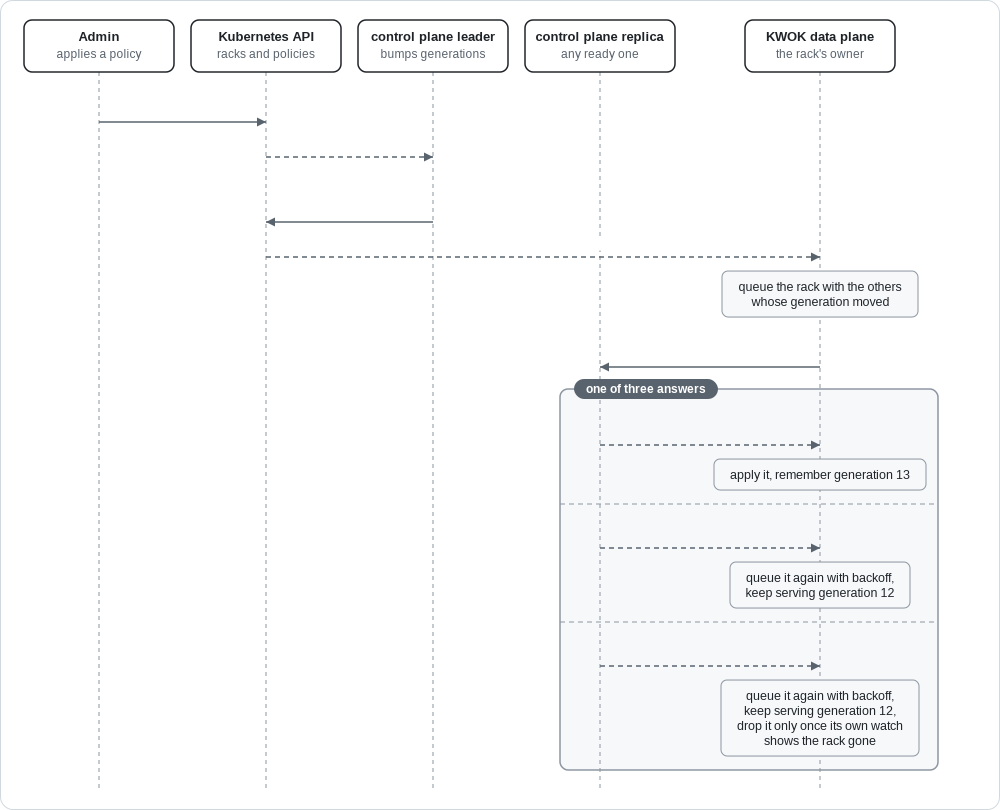
A rack's state is compiled from the delivery generation it names. For each rack,
- the data plane passes the generation it last saw on the rack as the minimum.
- A rack the replica can't serve at that generation yet, because its cache is behind, comes back NotReady,
- and a rack it doesn't know under that name and UID comes back NotFound, without failing the rest of the batch.
Only a replica that isn't ready at all answers 503, and the data plane retries the batch with backoff.
This is MEP0001's publication-floor check, applied per rack. Each Node entry names the Kubernetes Node bound to the slot and its assignment revision, and the data plane applies the node daemon's ordering to each Node: it accepts a Node's state only if the pair of assignment revision and rack delivery generation doesn't go backwards. The control plane includes a Node only once its projection is published, so the data plane never publishes GPUs for an unsettled binding, and keeps a Node whose binding it's releasing, marked releasing, until the data plane has removed what it published. The endpoint is a batch form of the per-Node one the node daemon polls.
Batching keeps both sides cheap:
- The data plane queues racks. A rack whose generation in Kubernetes is ahead of the one applied joins a queue once, however many events arrive for it. The queue goes out as one request when it holds 100 racks or a second after its first rack arrived, with at most two requests in flight per replica.
NotReadyracks rejoin the queue with backoff while the replica keeps the values it applied last.NotFoundracks rejoin it too, since the control plane replica that answered may not have seen a new rack yet. A rack leaves the queue only when the data plane's own watch shows it gone: deleted, recreated under a new UID or moved to another shard. The Helm chart makes these limits configurable. - Bursts turn into a few requests. A replica that starts with 125 racks fetches them in two requests. A policy that selects all 1,000 racks of the example inventory costs each of eight replicas two requests, 16 in total instead of 1,000.
- The control plane shares work. Any ready control plane replica serves batches, as it serves the node daemon's polls, so the load spreads across replicas. A replica looks up what racks share, such as their profile and the policies selecting their inventory or rack group, once per request, and answers
429withRetry-Afterwhen it already serves its limit of concurrent batches.
The rack tells the data plane when to fetch. The control plane leader bumps a rack's delivery generation whenever anything feeding its state changes: - a slot is bound, or its release starts or completes, - a policy that selects the rack is added, edited or deleted, the set of accepted policies changes, - or the rack's profile changes.
For each rack UID, the data plane keeps the generation it last applied and queues the rack for the next batch whenever the generation in Kubernetes is ahead. The check compares two numbers, so a missed watch event only delays a fetch, and after a restart a replica fetches each of its racks once, in batches. A rack recreated under the same name has a new UID and starts a new generation sequence, so it counts as a new rack.
Values that change on their own never trigger a fetch. The state carries settings, such as a Bursty utilization pattern and its range, and DCGM Metrics describes how the data plane turns them into values.
This puts two requirements on the control plane: a batch endpoint for racks next to the per-Node one, and releases of KWOK Nodes that wait for the data plane. Both endpoints serve the state from the same compilation, so a KWOK Node and a CPU Node bound to slots of the same profile get the same facts. KWOK racks go through allocation like CPU racks, so their delivery generation advances with bindings, policies and profile changes without extra work.
Everything the data plane publishes for a Node waits for the Node's first state. After that, GPU allocation and NodeResourceTopology availability follow Pods and don't wait for the endpoint.
DCGM Metrics
Each data plane replica serves DCGM metrics for the GPUs of its racks behind the mokka-kwok-dcgm-exporter Service. The Run:ai cluster operator health-checks that Service, and Prometheus scrapes every replica through the chart's ServiceMonitor, as MEP0009 specifies.
Sharding
KWOK virtual nodes are cheap. We can have a gigantic number of KWOK nodes to care about, much more than a typical, real Kubernetes CPU cluster can afford. KWOK data plane needs to emit K8s resources and then metrics for every single sGPU node it owns. So we need a way to distibute that ownership load across multiple KWOK Data Plane replicas. We propose to use sharding here.
Each rack has exactly one owning data plane replica, so the data plane needs no leader election even though it writes. The rack is the shard unit because it's also the unit of the rack state and the delivery generation, so everything about a rack stays in one replica. With eight replicas, each owns 2,250 Nodes and 9,000 GPUs of the example inventory and serves 27,000 series.
Which replica owns a rack is an assignment, so the control plane makes it, as it assigns Nodes to slots. It labels each KWOK rack with its owner, mokka.nvidia.com/kwok-shard: mokka-kwok-data-plane-2, and each replica watches only the racks labeled with its own name. The control plane learns which replicas exist from their shard Leases rather than from a replica count, so an autoscaler can change the count without telling it. A similar idea is employed by kubernetes-controller-sharding PoC.
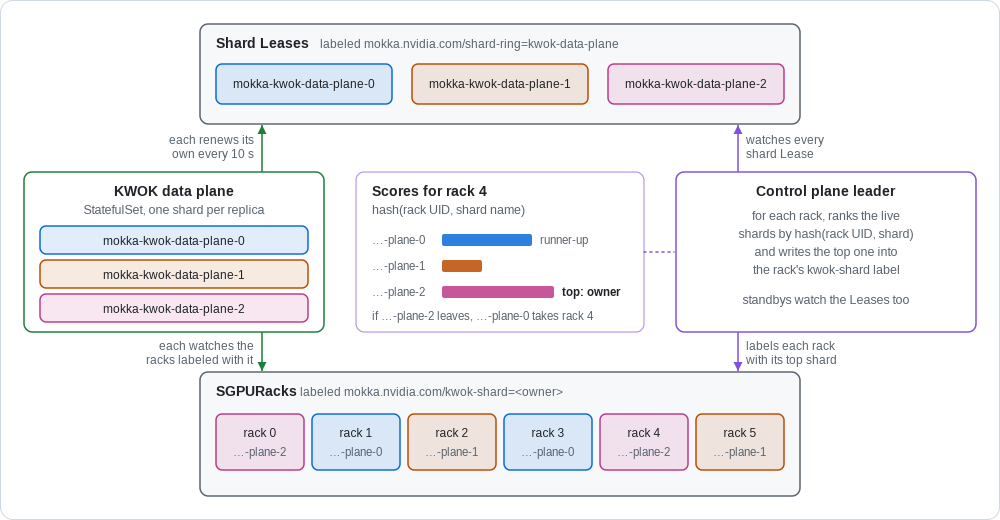
Shard Leases
Each data plane replica holds a Lease while it serves:
apiVersion: coordination.k8s.io/v1
kind: Lease
metadata:
  name: mokka-kwok-data-plane-2 # the replica's Pod name, stable across restarts
  namespace: mokka
  labels:
    mokka.nvidia.com/shard-ring: kwok-data-plane # what the control plane watches
  ownerReferences: # removed with the StatefulSet
    - apiVersion: apps/v1
      kind: StatefulSet
      name: mokka-kwok-data-plane
      uid: <StatefulSet UID>
spec:
  holderIdentity: mokka-kwok-data-plane-2
  leaseDurationSeconds: 30 # this long without a renewal, and the shard is gone
  renewTime: "2026-11-09T10:04:10.000000Z" # renewed every 10 seconds
A replica:
- joins once its caches sync. It creates its Lease, or renews the one its previous incarnation left if the control plane hasn't deleted it yet, since the name is the same.
- renews every 10 seconds. If it can't renew for 20 seconds, it stops serving, since the control plane may already be moving its racks. If it finds its Lease deleted, it creates a new one and joins again.
The control plane watches Leases with the mokka.nvidia.com/shard-ring=kwok-data-plane label. For each one, it notes on its own clock when it last saw renewTime change and schedules a check one leaseDurationSeconds later, since a dead replica sends no events. A Lease is live if it has a holder and a renewal was seen within its duration, and the live Leases are the shards. When a check finds no renewal, the control plane deletes the Lease, with the resourceVersion it last saw as a precondition, so it can't delete a Lease renewed in the meantime. A new Lease or a deleted one triggers a rebalance, batched over a couple of seconds; renewals only reset timers. So a replica that comes back after its Lease expired creates a new one, joins like any new replica and wins back its former racks. The Helm chart makes the durations configurable.
Every control plane replica watches the shard Leases, so a standby takes over with a warm view, but only the leader computes owners, writes rack labels and deletes expired Leases. Timing renewals on its own clock, as client-go's leader election does, keeps clock skew between Nodes from expiring a live shard. A new leader starts with fresh timers, so it never drops a shard early. Racks leave a shard only once its Lease is deleted, so a new leader sees the same shards as the old one, computes the same labels, and a failover moves no racks.
Rebalancing
The control plane assigns racks to shards with rendezvous hashing, also called highest random weight hashing. It gives the guarantee consistent hashing is known for, that a membership change only moves racks to or from the shard that joined or left, without a ring. For each KWOK rack, the leader scores every live shard and labels the rack with the highest:
score(rack, shard) = xxHash64("<rack UID>/<shard name>")
owner(rack)        = the live shard with the highest score; equal scores go to the lower shard name
The hash only supplies the scores. Movement stays small because a rack's score for a shard doesn't depend on which other shards exist, so a membership change only moves racks whose top shard changed:
- when a shard joins, the racks that rank it first move to it, about 1 in N, taken evenly from the others;
- when a shard leaves, only its racks move, each to its runner-up.
No rack moves between two shards that stay, and a new owner fetches the state of the racks it gains in a few batches. A rack moves through its label:
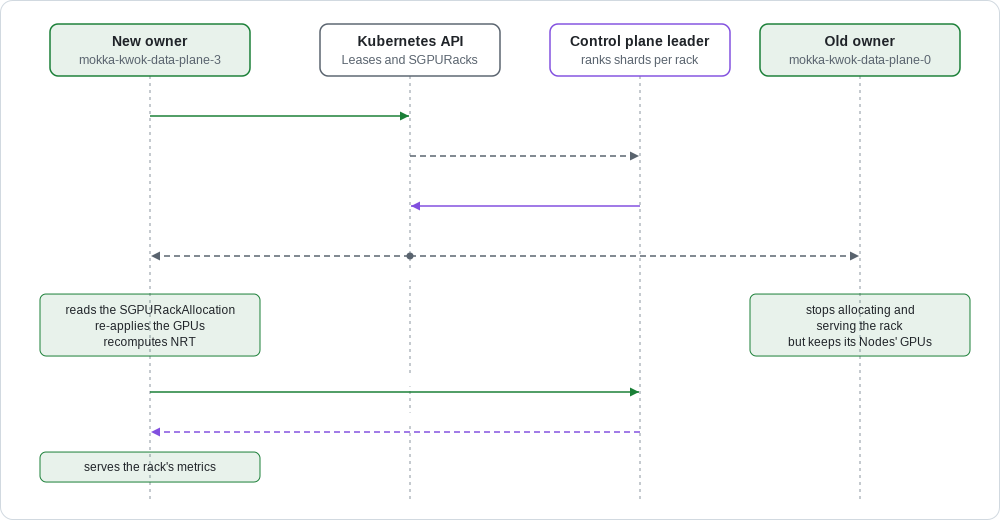
The old owner keeps the Nodes' GPUs because the binding hasn't changed, and the new owner re-applies them with the same field manager. Allocations live in the rack's SGPURackAllocation, so the new owner reads them back instead of recomputing them. Metric series keep their identity, since the ServiceMonitor sets instance from the KWOK Node name.
| Event | The replica's Lease | What the control plane does |
|---|---|---|
| An autoscaler adds a replica | The new Pod creates its Lease once its caches sync | Adds the shard and relabels the racks it now wins |
| An autoscaler removes a replica | The Pod finds its ordinal at or above spec.replicas and deletes its Lease |
Relabels the shard's racks at once, while the Pod finishes its grace period |
| A rolling update or eviction | The Pod's ordinal is below spec.replicas, so it keeps its Lease, and its replacement renews it |
Nothing if the replacement is back within 30 seconds: the racks wait for it |
| A crash or a lost Node | Renewals stop | Deletes the Lease 30 seconds after its last renewal and relabels its racks |
| A replica returns after expiry | Its Lease is gone, so it creates a new one | Adds the shard and relabels the racks it wins back |
| A control plane failover | Unchanged | The new leader computes the same labels |
The scheme accepts three limits:
- Overlap on join. Until the old owner's watch delivers the relabel, both replicas may act on the rack. Their allocations meet in the rack's
SGPURackAllocation: the first write wins, and the other replica re-reads the object and picks again, so no GPU or zone goes to two Pods. Everything else they write comes from the same rack state and converges, and both may serve the rack's metrics for a few seconds. A leaving replica stops serving before it deletes its Lease, so a leave can't overlap. - Gaps on restart. While a replica restarts, new GPU Pods on its racks stay Pending until they get an allocation (Pod Admission), their NodeResourceTopology goes stale, and their GPUs have no metrics, as on a real Node whose kubelet, topology updater or dcgm-exporter restarts. Releases of its racks' Nodes wait for it too.
- No empty replicas. A replica without racks serves no DCGM series. The chart defaults to one replica, and an autoscaler's maximum should stay well below the number of racks.
Separating CPU and KWOK Racks
Each service lists and watches only the objects it needs, and the API server applies the selectors, so little else reaches the service's cache.
The control plane's first two filters exist today, and the Lease watch is new:
| Resource | Server-side selector | Result |
|---|---|---|
SGPUInventory, SGPURackProfile, SGPURack |
none | creates and retires every rack |
Node |
mokka.nvidia.com/sgpu-node=true |
receives every Node that asks for a slot, CPU or KWOK |
Lease |
mokka.nvidia.com/shard-ring=kwok-data-plane |
the data plane's shard Leases |
The KWOK provisioner reads its groups and sees only the Nodes it created:
| Resource | Server-side selector | Result |
|---|---|---|
SGPUInventory, SGPURackProfile |
none | groups with node.source: Mokka, their slot counts and host values |
Node, metadata only |
app.kubernetes.io/managed-by=mokka-kwok-provisioner |
only the Nodes it created |
The KWOK data plane sees only its own racks. Its Pod watch is the exception: a field selector matches one Node name, not a set:
| Resource | Server-side selector | Result |
|---|---|---|
SGPURack |
mokka.nvidia.com/kwok-shard=<its Pod name> |
only the racks it owns |
SGPURackAllocation |
none: read by name | each owned rack's allocations, read when it gains the rack and after a write conflict |
Pod |
spec.nodeName!= |
receives every bound Pod, keeps those on its racks' Nodes |
ResourceClaim |
none | keeps the claims allocated on its racks' Nodes, only in DRA mode or with computeDomains |
StatefulSet |
metadata.name=mokka-kwok-data-plane |
its replica count, read when it shuts down |
- The node type picks the path. The group's
node.type, copied into each rack'sspec.nodeType, is the source of truth. A KWOK group's compiled placement selector requiresmokka.nvidia.com/node-type=KWOK, and a CPU group's excludes it, which unlabeled CPU Nodes still match. A Node with KWOK'skwok.x-k8s.io/nodeannotation also counts as a KWOK Node, so a source that forgets the label can't put a virtual Node in a CPU group. - Each field has one writer. The Node source writes the Node, and for groups with
node.source: Mokkathat's the KWOK provisioner. The control plane writesSGPURack, including its status and shard label, and the Node projection. The KWOK data plane writes the GPUs on its Nodes, their ResourceSlices, its racks'SGPURackAllocationsand their copies on Pods, the NodeResourceTopology of its Nodes, and its own shard Lease. Server-side apply field managers keep the writers of a Node's fields apart. - KWOK groups use placement like CPU groups. They go through allocation, Node event routing and usage reporting, so the inventory reports bound, pending and available KWOK Nodes. They count towards capacity and the rack group limit.
- The node daemon stays off KWOK Nodes. Mokka Node Daemon DaemonSet tolerates every taint, so the chart adds the node affinity
mokka.nvidia.com/node-type NotIn [KWOK], which unlabeled CPU nodes still match.
GPU Footprint in KWOK Virtual Nodes
KWOK nodes are completely virtual entities. In most cases, the real NVIDIA components can't run on them or interact with them.
Still, we would like to simulate a few surfaces based on SGPURackProfile information to make them look like real GPU nodes from the outside:
- Add NFD/GFD labels e.g.
nvidia.com/gpu.*,nvidia.com/mig.strategy,feature.node.kubernetes.io/pci-10de.present - DRA ResourceSlices
- ComputeDomain channels for multi-node NVLink workloads
- NodeResourceTopology resources for NUMA-aware workload placement
- DCGM metrics
The KWOK data plane simulates all five. It publishes the labels, ResourceSlices and ComputeDomain channels once a Node is bound (Publishing the GPUs), and keeps the NodeResourceTopology resources and the DCGM metrics current while the Node runs.
The data plane writes GPU ResourceSlices only in DRA mode, and ComputeDomain channels and NodeResourceTopology only when their chart values enable them, so cluster admins don't need the DRA API, the NVIDIA DRA driver's CRDs or NFD's CRD to try out KWOK integration.
KWOK Installation
The KWOK functionality in Mokka should be disabled by default.
The Mokka Helm chart will get a new flag, kwok.enabled, that decides whether to deploy the KWOK data plane, lets the control plane watch shard Leases, and makes the control plane's releases of KWOK Nodes wait for the data plane's cleanup. kwok.dataPlane.replicas sets its starting number of shards, which an autoscaler can change later, and kwok.dataPlane.serviceMonitor.enabled adds a Prometheus Operator ServiceMonitor that scrapes the DCGM metrics of every replica behind the mokka-kwok-dcgm-exporter Service.
kwok.provisioner.enabled also deploys the KWOK provisioner, which groups with node.source: Mokka need. Without it, such a group gets no Nodes, and its status shows free slots and no requested Nodes.
The mokka-crds chart adds the SGPURackAllocation CRD next to Mokka's other CRDs.
One value selects how KWOK Nodes advertise their GPUs (Publishing the GPUs). Each other surface the data plane simulates, besides the GFD and NFD labels, has a switch of its own, so a test pays only for what it uses and a cluster needs only the APIs those surfaces write:
kwok:
  dataPlane:
    # -- How KWOK Nodes advertise their GPUs: DevicePlugin, as nvidia.com/gpu in the Node's capacity, or DRA, as a ResourceSlice per Node. DRA needs the resource.k8s.io API and NVIDIA's DRA driver with GPUs enabled.
    gpuPublishing: DevicePlugin
    computeDomains:
      # -- Publish ComputeDomain devices for KWOK Nodes and stand in for their IMEX daemons, in either GPU mode. Needs the resource.k8s.io API and NVIDIA's DRA driver with ComputeDomains enabled.
      enabled: false
    nodeResourceTopology:
      # -- Keep a NodeResourceTopology per KWOK Node. Needs NFD's NodeResourceTopology CRD.
      enabled: false
    metrics:
      # -- Serve DCGM metrics for the GPUs of KWOK Nodes.
      enabled: true
A replica checks at startup that the cluster serves the APIs its GPU mode and each enabled surface need, and stays unready with the reason in its log if it doesn't. In DRA mode, it also reads the gpu.nvidia.com DeviceClass and logs a warning if the class is missing or doesn't name nvidia.com/gpu as its extended resource, since Pods that request nvidia.com/gpu then can't schedule on KWOK Nodes. Claims still work, so the replica stays ready. An API server with the DRAExtendedResource feature off doesn't store extendedResourceName, so the warning also shows on Kubernetes before 1.36, where the feature is off by default.
[!NOTE] The chart's other values for the KWOK components, such as images, Lease durations and batch limits, will also go under
kwok.
Cluster admins are expected to install KWOK before enabling Mokka's KWOK functionality, and the docs will say so.
The KWOK chart won't be included in the Mokka Helm chart. Clusters that use KWOK already run its controller, set up for kwokctl, a CI harness or an autoscaler's KWOK provider with their own version and Stages, and a second controller would manage the same Nodes. NVIDIA's DRA driver and NFD stay out of the chart too: users install them the same way for CPU racks, and the CRDs they bring, such as ComputeDomain and NodeResourceTopology, have to match the driver and NFD releases that use them. If one is missing, the startup check above keeps the data plane unready and logs the API it needs. The docs also give a KWOK Node template with Mokka's two labels and a kwokctl command that creates Nodes from it, for groups whose Nodes come from elsewhere.
KWOK also has to run Mokka's Pod stages. The docs give them as two Stage manifests, mokka-pod-ready and a pod-ready that replaces KWOK's default one, so the KWOK controller needs its Stage resources enabled, as kwokctl create cluster --enable-crds=Stage does.
KAI Use Cases
| Consumer | Required resources or behavior | How Mokka Can Help? |
|---|---|---|
| Run:ai installer | The clusterpolicies.nvidia.com CRD and a gpu.*operator Deployment in gpu-operator. No ClusterPolicy instance is necessary. |
✅KAI Test Setup should install GPU Operator CRD |
| Run:ai cluster operator | Exactly one DCGM exporter Service. Its /metrics must contain DCGM_FI_DEV_GPU_UTIL, DCGM_FI_DEV_FB_USED, and DCGM_FI_DEV_FB_FREE. A failed check sets DependenciesFulfilled=False. This does not apply when dependency checks are disabled. |
In KWOK mode, the KWOK data plane's mokka-kwok-dcgm-exporter Service, which sends the check to one replica. |
| KAI | nvidia.com/gpu and the node labels nvidia.com/gpu.count and nvidia.com/gpu.memory |
Mokka + real device plugin and GFD. In KWOK mode, the KWOK data plane sets the labels from the rack state, and the nvidia.com/gpu capacity in DevicePlugin mode. In DRA mode, KAI 0.17 or later serves nvidia.com/gpu from the ResourceSlices on Kubernetes 1.36 or later |
| KAI NUMA | A current NodeResourceTopology for each node. It contains policy, scope, zones, and per-zone availability. Availability changes with allocation and release. |
Mokka node daemon does NUMA setup + real NFD deployment. In KWOK mode, the KWOK data plane creates NRT resources |
| DRA | Claims with the same behavior on KWOK nodes and nodes that use the GPU Operator's DRA driver. | Mokka + real DRA deployment. In KWOK mode, the KWOK data plane creates ResourceSlice resources in DRA mode |
Milestones
We propose five milestones following the "make it work, make it right, make it scale" approach, each ending with something users can run. The FGO migration comes first and scale second. M2 and M3 each need only M1, so they can run in parallel. The KWOK provisioner is optional and can run alongside M2 to M4:
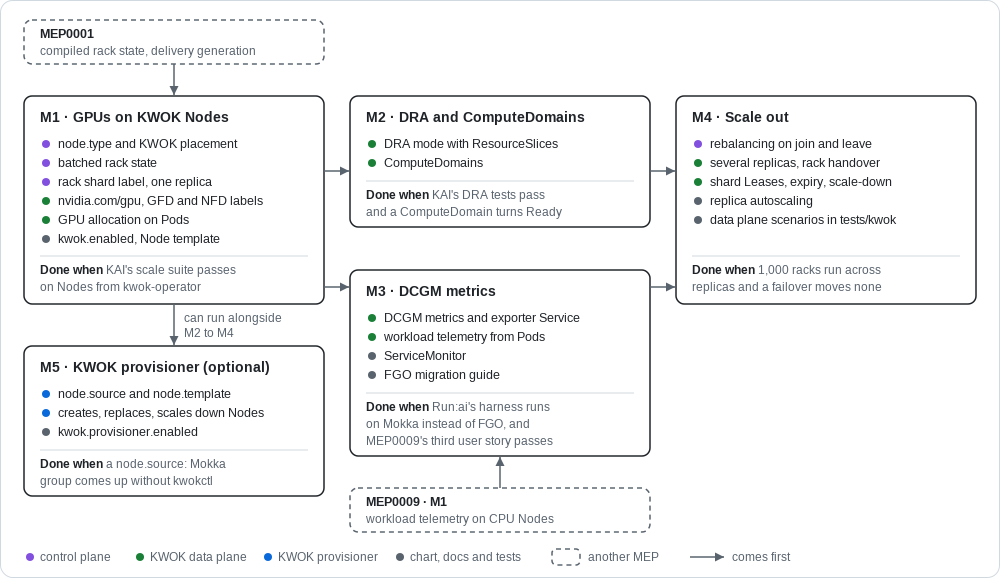
- M1: GPUs on KWOK Nodes. The control plane binds KWOK Nodes into KWOK groups by
node.type, serves rack state in batches, and gives every KWOK rack the shard label of the only data plane replica, whose name the chart passes to it. That replica publishesnvidia.com/gpuand the GFD and NFD labels, removes them before the control plane completes a release, and allocates GPUs to Pods, recording them inSGPURackAllocations. The chart getskwok.enabled, with the data plane fixed at one replica, and the docs get the Node template and thekwokctlcommand. Done when KAI's scale suite passes with Mokka in place of FGO, on the KWOK Nodes its kwok-operatorNodePools create. Control Plane MEP0001 should be in a sufficient state to incorporate most of the KWOK nodes. It lacks REST API, though, so that part should be implemented first. - M2: DRA and ComputeDomains. The data plane adds
DRAmode, with ResourceSlices and allocations copied from claims, and ComputeDomains with NVIDIA's controller. Done when KAI's DRA tests pass on KWOK Nodes and the ComputeDomain of the fifth user story turns Ready. - M3: DCGM metrics. The data plane adds DCGM metrics on every replica, behind the
mokka-kwok-dcgm-exporterService, and applies workload telemetry from Pods' annotations to them. The chart gets theServiceMonitor, and the docs get an FGO migration guide. The data plane runs the metrics generator and the workload tracker of MEP0009's M1, so that milestone comes first. Done when Run:ai's harness runs on Mokka instead of FGO, as the second user story describes, and MEP0009's third user story runs unchanged on KWOK Nodes. - M4: Scale out. Several data plane replicas share the racks. The control plane learns them from their shard Leases instead of M1's fixed name, and the milestone adds rebalancing on join and leave, the rack handover, Lease expiry, scale-down and autoscaling. A single replica keeps its racks through the upgrade, since rendezvous hashing over one replica picks it. The
tests/kwokharness, which already exercises control plane binding with up to 100,000 KWOK Nodes, gets data plane scenarios. Done when 1,000 racks run across replicas and a control plane failover moves no racks. - M5: KWOK provisioner.
node.source,node.template, the provisioner andkwok.provisioner.enabled. It needs only M1'snodeblock and binding, so it can run alongside M2 to M4. Done when anode.source: Mokkagroup comes up withoutkwokctl.
MEP0009 and MEP0010 plan their parts the same way, and NodeResourceTopology for KWOK Nodes is MEP0010's M2. Together, the three MEPs' milestones fall into four phases, each starting once the milestones it builds on are done. The FGO migration, M2, M3 and MEP0010's M2, comes in the third, M3 after MEP0009's M1 and MEP0010's M2 after MEP0010's M1:
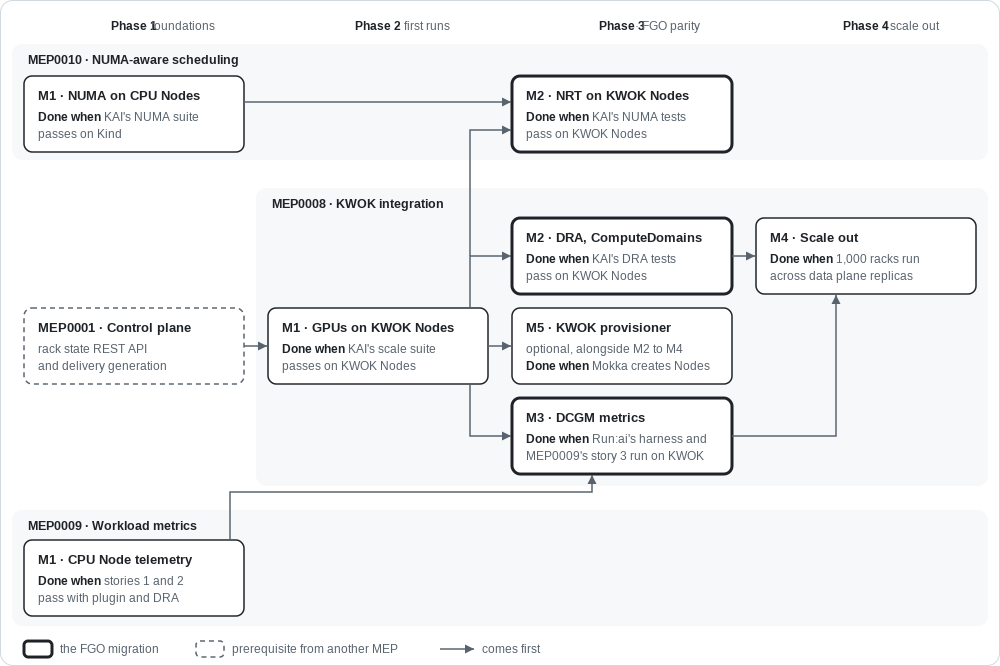
Drawbacks
- Complexity. KWOK integration greatly expands Mokka's footprint and surface.
- Components need wider permissions. The data plane needs permission to write
SGPURackAllocations, to patch any Pod to copy its allocation and its status to fail it when it can't admit it, and to patch Nodes, Node status and ResourceSlices to publish their GPUs. InDRAmode or withcomputeDomains, it also reads every ResourceClaim, and withcomputeDomainsit labels Nodes and IMEX daemon Pods and writesComputeDomainCliqueobjects in the DRA driver's namespace. The control plane needs to watch and delete Leases in its namespace. - Releases wait for the data plane. A KWOK Node's release, and with it a rack's or an inventory's deletion, waits while no data plane replica runs. Turning
kwok.enabledoff first leaves the data plane's fields on KWOK Nodes, so the docs say to delete KWOK inventories before turning it off, as they already say for the control plane. - The provisioner can delete any Node. It needs permission to create and delete Nodes, and RBAC can't limit
deleteto Nodes with a label, so only its code keeps it to the Nodes it created. It's off by default, and on Kubernetes 1.30 and later a ValidatingAdmissionPolicy can enforce the limit.
Alternatives
- The provisioner creates a Node for each rack slot. It could name each Node by its slot's coordinates, such as
dev-ci-0-0, make the rack its owner, and have the control plane bind each slot to the Node made for it. Names would point at slots, and the garbage collector would delete a rack's Nodes with it. But the control plane would need a second way to bind, one for Mokka's Nodes and one for everyone else's, and tests on Mokka's Nodes would no longer cover the path that harness Nodes take. - The provisioner fills every KWOK group's free slots. No group would need
node.source. But free slots look the same whether a harness hasn't created its Nodes yet or never will, so a harness that brings 100 Nodes to a 1,000-rack group would get 17,900 more. - A third node type. A value such as
node.type: KWOKProvisionedcould replacenode.source. But every component that reads the node type, from the selector compiler to the data plane and the node daemon's affinity, would have to learn a value that means nothing to it. - The control plane creates the Nodes. A controller in the control plane could share its Node cache. But the control plane would need permission to create and delete Nodes, and the code that binds Nodes would sit next to code that knows which Nodes Mokka created, which makes it easy to bind those differently.
- Replicas pick their own racks. Each data plane replica could hash rack UIDs against its ordinal and the StatefulSet's
spec.replicas, as kube-state-metrics does. Nothing in the API would show which replica serves a rack,spec.replicascounts Pods that aren't serving yet or are already leaving, and replicas that see a new count at different moments can leave a rack with two owners or none. - A hash ring. The control plane could place the shards on a consistent hash ring, as kubernetes-controller-sharding does with xxHash and 100 virtual nodes per shard. It moves racks just as little, but it spreads them evenly only through the virtual nodes. Rendezvous hashing needs no extra state and costs one hash per shard and rack, which stays small with tens of shards.
- The control plane publishes the GPUs. It could write
nvidia.com/gpu, GFD and NFD labels and ResourceSlices with the projection. But on a CPU Node they come from daemons on the Node, part of them follows runtime state such as GPU health, and every write would go through the single control plane leader, which would also need the DRA API. - The data plane holds its own finalizer on each rack. Together with every Node it published to, listed in the rack's
SGPURackAllocation, it would keep a deleted rack until the data plane cleaned up. But the control plane's release gate already keeps the rack, and each slot's Node, until a release is acknowledged, so a second finalizer and a second list of Nodes would duplicate that gate and have to agree with it. - The data plane sweeps released Nodes when it starts. Each replica could list KWOK Nodes without
mokka.nvidia.com/sgpu-assignedand remove its fields from any that still carry them. It would need no control plane change, but an inventory could be gone while its Nodes still advertise GPUs, and every start would list Nodes, pending ones included. - Record allocations on the Pods alone. Each Pod would carry its GPUs, with its
resourceVersionas a precondition. But a precondition guards one object, and "no GPU goes to two Pods" spans several, so two replicas acting on a rack during a join could each give GPU-0 to a different Pod, and both writes would succeed. - Record allocations on the
SGPURackor the Node. Either would avoid a new type. But the control plane writes theSGPURackand every control plane replica watches it, and many components write and watch Nodes. AresourceVersionprecondition would collide with their unrelated updates, and every allocation would reach all their watchers. - Fence rack ownership during a move. The leader could take a rack away before handing it over, and each replica could list the racks it acts on in its shard Lease, so no two replicas ever act on a rack and Pods alone could hold allocations. But it adds a custom protocol with ordering rules and fresh reads, pauses every moved rack on a join, and stalls racks whose old owner never lets go, while a conflict-checked record per rack catches the only writes that can clash.
- Mokka runs its own ComputeDomain controller, as FGO does, creating the claim templates and marking domains Ready from allocated claims. It would work without NVIDIA's controller. But it would reimplement NVIDIA's claim templates and readiness rule and drift from them, and in an inventory with CPU racks, where NVIDIA's controller runs too, two controllers would reconcile the same domains.
Decisions
The main decisions this MEP makes, numbered for review. Each links to the sections that explain it and the smaller choices that follow from it, and Alternatives explains the options not taken.
| ID | Decision | Rather than | Why | See |
|---|---|---|---|---|
| D1 | Replace FGO's mocks of NVIDIA components with the real components, running on Mokka's simulated GPUs | porting FGO's mock device plugin, DRA plugins, nvidia-smi and DCGM exporter |
Mokka simulates the GPUs and driver underneath, so NVIDIA's real components run unchanged | Proposal |
| D2 | Make KWOK a node type of a rack group, next to CPU, so one inventory can mix both, and KWOK racks get the same profiles, binding and capacity accounting as CPU racks |
— | KWOK GPUs get the same stable UUIDs, PCI addresses and NUMA placement as on CPU racks, and inventories report KWOK groups like any other | KWOK Integration, Separating CPU and KWOK Racks |
| D3 | Bind KWOK Nodes from any source, such as kwokctl, a CI harness or an autoscaler, and create Nodes only for groups that ask with node.source: Mokka, through an optional provisioner |
Mokka creating the Nodes of every KWOK group | Harnesses and autoscalers keep creating Nodes as they do with FGO, and Mokka can't tell a free slot a harness will fill from one it won't | KWOK Nodes, KWOK Provisioner, Alternatives |
| D4 | Add a KWOK data plane, separate from the control plane, that publishes what a GPU Node's daemons would, from the rack state the control plane compiles for the node daemon | the control plane publishing the GPUs, or the data plane compiling rack state itself | Its load grows with Nodes, Pods and scrapes rather than inventories, so it scales on its own, a Pod burst can't stall binding, and one component decides what a GPU Node looks like | KWOK Components, Rack State, Alternatives |
| D5 | Publish every KWOK Node's GPUs in one mode for the whole install: DevicePlugin, as nvidia.com/gpu capacity, or DRA, as a ResourceSlice |
publishing both for the same GPUs | The scheduler counts nvidia.com/gpu and DRA devices separately, so a Node with both would hand out each GPU twice |
Publishing the GPUs |
| D6 | Record each rack's GPU and NUMA zone allocations in an SGPURackAllocation that only the data plane writes, with its resourceVersion as a precondition, and copy each Pod's share to the Pod |
allocations on Pods alone, on the SGPURack or on the Node |
Replicas that both act on a rack during a join can't give one GPU to two Pods, a replica that restarts or takes over a rack reads it back, and neither the control plane nor Node watchers see allocation churn | GPU Allocation, Alternatives |
| D7 | In DRA mode and for ComputeDomains, stand in only for what NVIDIA's DRA driver does on the Node, and publish the devices it would: gpu-<minor> GPUs with NVIDIA's attributes |
Mokka's own ComputeDomain controller and FGO's UUID-named devices | NVIDIA's controller, DeviceClasses and kube-scheduler run unchanged, and a claim written for GPU Nodes selects the same devices on KWOK Nodes | DRA and ComputeDomains, Alternatives |
| D8 | Shard the data plane by rack, with the control plane assigning each rack to one replica and learning the replicas from their Leases | replicas picking their own racks from spec.replicas |
Each rack has one owner without leader election, the API shows which replica serves a rack, and an autoscaler can resize the data plane without telling the control plane | Sharding, Alternatives |
| D9 | Keep KWOK out of Mokka's Helm chart, so cluster admins install it themselves | including KWOK's chart as a subchart | Clusters that use KWOK already run its controller, set up for kwokctl, a CI harness or an autoscaler's KWOK provider with their own version and Stages, and a second controller would manage the same Nodes |
KWOK Installation |
| D10 | Keep NVIDIA's DRA driver and NFD out of Mokka's Helm chart, along with the DeviceClasses and CRDs they bring | including their charts, or just their CRDs, as subcharts | Users install them the same way for CPU racks, each CRD has to match the driver or NFD release that uses it, and the data plane's startup check reports any API that's missing | KWOK Installation |
| D11 | Make GPU Pods on KWOK Nodes Running and Ready only once the data plane has allocated their GPUs and zone, with a KWOK Pod stage Mokka's docs ship | a mutating webhook, or KWOK's default stages running them regardless | Tests see a GPU Pod Ready only once it holds its GPUs and zone, as on a GPU Node, and a Pod the data plane can't admit ends up Failed, as a kubelet would leave it | Pod Admission, KWOK Installation |
| D12 | Complete the release of a KWOK Node's binding, and with it a rack's deletion, only once the data plane has removed what it published on the Node | a data plane finalizer on each rack, or a sweep of released Nodes on startup | A Node that outlives its binding never keeps advertising GPUs, even if its replica was down when the release began, and the control plane's existing release gate does the waiting | Publishing the GPUs, Alternatives |
TODO
- TD1. Networking devices in FGO tests. TODO: investigate whether KAI tests require networking devices.
- TD2. Gating Pod stages in KWOK itself. Pod Admission replaces KWOK's default
pod-ready, since KWOK runs a lone matching stage whatever its weight, and its stages see only the Pod, not its Node or what its claims are for. A KWOK feature that lets one stage hold another back, such as stage priorities, and selectors that can see a Pod's Node, would let Mokka add its stages without replacing KWOK's, gate only Pods on its own Nodes, and gate Guaranteed Pods without GPUs too, so the data plane can fail those that fit no zone before they run. Explore it with the KWOK maintainers, next to their DRA simulations (kubernetes-sigs/kwok#1731).