MEP-0016: NIC Declaration and Simulation
Author: Oleg Leizerov
- Summary
- Motivation
- Goals
- Non-Goals
- Proposal
- The NIC model and the NIC instance
- Configurations declare their result
- Slots place PCI devices
- The declaration stops at the boot state
- Generic generation and stable identifiers
- Where profiles live and how a cluster chooses them
- Checking declarations against hardware
- User Stories
- Notes/Constraints/Caveats
- Risks and Mitigations
- Design Details
- API
- Generation rules
- Node agent
- Control plane
- Helm chart
- Test plan
- Implementation order
- Open Questions
- Drawbacks
- Alternatives
- Appendix A: Design validation
- Appendix B: Samples
Summary
Mokka has to show a node's NICs the way Linux shows real ones: PCI functions, RDMA devices, ports, netdevs and /dev/infiniband. This MEP proposes to declare NIC hardware as data, generate every OS surface from that declaration with rules that know nothing about a specific vendor or model, and check the result against captures of real nodes.
A new SNICProfile resource describes one NIC model and the firmware configurations it can run, each declared by the device layout it produces (ports, PCI functions, RDMA devices). NIC slots in SGPURackProfile place NIC instances on a node, and SGPUInventory selects the configuration the NICs run in a specific simulated cluster. The node agent compiles the declaration into its desired state, as it already does for GPUs, and its simulators render the surfaces. The same profile files serve file mode and control-plane mode. A prototype of the schema and the generator is compared with five real captures, and every difference has a cause (Appendix A).
Motivation
Today a node's NICs come from a small infiniband block in each GPU profile:
# deployments/nvml-mock/helm/nvml-mock/profiles/gb300.yaml
infiniband:
  enabled: true
  hca_type: "MT4129"
  hcas_per_gpu: 1
  # …
That shape can't describe the NICs the captures show, and parts of it are wrong:
- Every HCA reports a ConnectX-5 PCI device ID (0x1017, fixed in internal/ib/sysfs/render.go).
- The NIC count is GPUs × hcas_per_gpu, all of one HCA type, so a node can't hold a front-end NIC next to its scale-out NICs.
- NIC functions are missing from the node's PCI bus tree (/sys/bus/pci); each HCA's PCI function exists only inside the InfiniBand tree.
Real nodes vary in ways software depends on:
- One NIC across PCIe domains. On GB300, each ConnectX-8 has its network function in one domain and its Data Direct function next to a GPU in another. Topology discovery software associates the network and Data Direct PCI functions by matching their VPD V3 identifiers.
- The layout depends on the firmware configuration. The same ConnectX-8 shows one PF on InfiniBand and four PFs on Ethernet.
- Different kinds of NIC. Next to its two network PFs, which have RDMA devices, a BlueField-3 shows a SoC management function (15b3:c2d5, bound to vfio-pci) without one; AWS EFA has no netdev of its own, and a cloud VM sees VFs without their PF.
MEP-0014 describes the node-local network surfaces Mokka simulates. MEP-0015 (in review) declares fabrics and their topology. This MEP declares the NIC hardware those surfaces come from, and takes over the NIC sections of MEP-0015.
Goals
- NIC models and configurations are declarative. Adding a new NIC model that conforms to the supported schema requires no changes to the resolver or surface renderers.
- NICs sit in the node's one PCIe topology, including NICs that span PCIe domains.
- One file per NIC model serves both file mode and control-plane mode.
- Generated surfaces match captures of real nodes, and every difference has a stated cause.
- Identifiers are stable across runs and unique per node.
Non-Goals
- Changes made by cluster software.
SNICProfiledescribes the NIC's initial state, before Kubernetes operators modify it. Simulation of the resulting changes is deferred to the work enabling the corresponding cluster software to run unchanged on Mokka (see the operations table). - Fabric topology and network state: cabling, port state, LIDs, partitions. MEP-0015 covers them.
- Interpreting firmware parameters, or covering every possible firmware configuration.
- Physical connectors, optical modules, cable breakout and the mapping of lanes to connectors.
portsare logical ports and their fabric-facing planes, not sockets. - NIC fault injection.
- Built-in rack profiles, and delivering per-node state from the control plane, which belong to MEP-0001.
Proposal
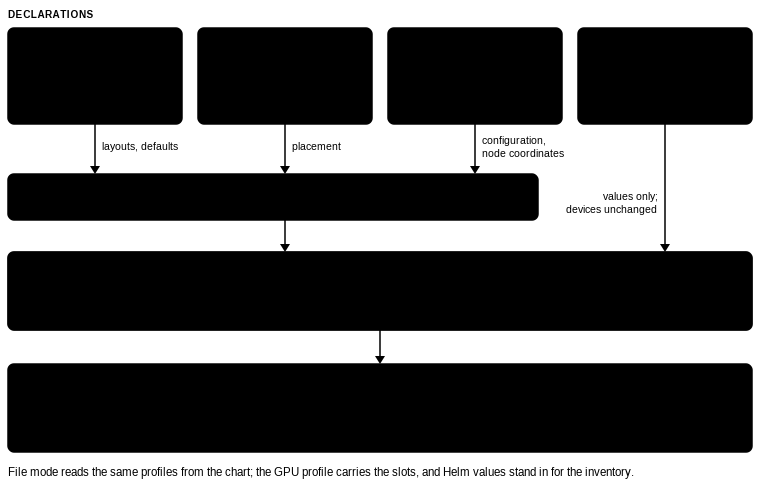
The profiles describe the hardware, and the inventory describes one simulated cluster and the configuration each slot runs. Resolve decides every value for one node, and the node agent's simulators render those values as the surfaces Linux software reads. A runtime policy changes values the devices report, never which devices exist.
The NIC model and the NIC instance
SNICProfileis one NIC model as packaged on a card, for examplecx8-c8280z. It holds what the NIC reports about itself: PCI IDs, firmware, HCA type, VPD. It also defines every firmware configuration the card can run. It holds nothing about a particular node: no addresses, no GUIDs, no NIC counts.- A NIC slot in
SGPURackProfileis one NIC instance on a node. It names the profile, says where each PCI device sits, and which GPUs the NIC serves. A rack with another NIC model is another rack design, with its own rack profile. - A rack group in
SGPUInventorycan select one of the NIC profile's configurations by name for its slots; otherwise the NIC profile's default applies. The configuration is how a cluster's NICs are set up, so the cluster chooses it.
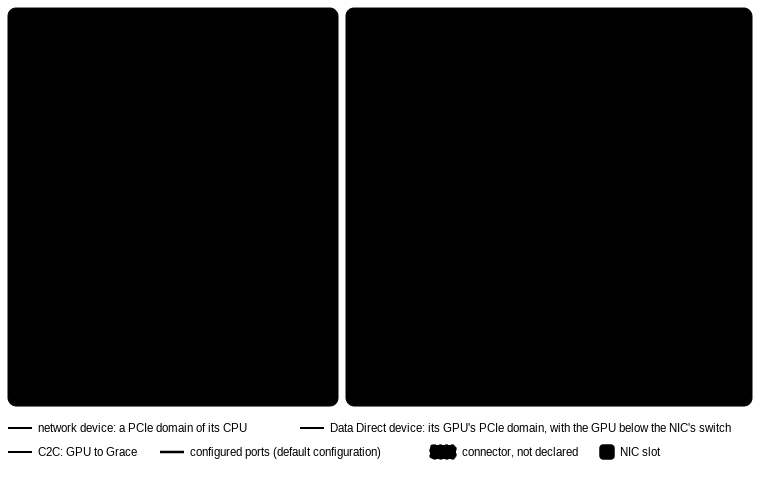
One GB300 tray, as the gb300 rack profile declares it, laid out after the compute tray diagram in NVIDIA's NVL72 AI factory reference architecture. Each slot names a NIC profile, its board and the GPUs it serves, and its devices' numaNode puts it with a Grace CPU: nic0 serves GPU 1 and nic1 GPU 0, as on the captured tray. Each ConnectX-8 has its network device in a PCIe domain of its CPU and its Data Direct device in its GPU's domain (Slots place PCI devices). The ports come from the configuration; in the default ib-xdr-4plane, each ConnectX-8 has one 800 Gb/s port split into four planes. The OSFP and QSFP modules are drawn for orientation only, since connectors aren't declared (Non-Goals).
# SNICProfile cx8-c8280z, trimmed
kind: SNICProfile
metadata:
  name: cx8-c8280z
spec:
  identity:
    model: ConnectX-8
    hcaType: MT4131
    firmwareVersion: "40.47.3576"
    # …
  functionTypes:
    - name: network
      # … PCI IDs, driver mlx5_core, 16 VFs possible
    - name: dataDirect
      # … PCI IDs, driver mlx5_ib
  defaultConfiguration: ib-xdr-4plane
  configurations:
    - name: ib-xdr-4plane
      # …
    - name: eth-multiplane
      # …
# SGPURackProfile gb300: the slot names the profile
nics:
  - slot: nic0
    profile: cx8-c8280z
    board: 0
    # … device placement
# SGPUInventory: a rack group selects a configuration
rackGroups:
  - id: training
    profileRef: {name: gb300}
    nicConfigurations:
      - {slots: [nic0, nic1, nic2, nic3], configuration: eth-multiplane}
The profile is the menu and the inventory places the order: configuration data never lives in the rack profile or the inventory, only the choice. A GB300 tray has four slots pointing at the same profile. Running them in another mode only requires selecting another configuration; a tray with another NIC model is another rack profile, which reuses the NIC profiles. The full cx8-c8280z profile is in Appendix B.
Configurations declare their result
A configuration explicitly declares what Linux will show: these ports, these PCI functions with these classes, these RDMA devices. It doesn't carry firmware parameters for a device-specific generator to interpret. The generator stays device-agnostic: it turns whatever is declared into surfaces and never needs to know what a ConnectX or an EFA is.
# SNICProfile cx8-c8280z: the same ASIC in two configurations
configurations:
  # NUM_OF_PF=1, LINK_TYPE_P1=IB(1), NUM_OF_PLANES_P1=4, MODULE_SPLIT_M0[0..3]=1.
  - name: ib-xdr-4plane
    ports:
      - {id: p0, technology: ib, width: 4, laneSpeed: XDR, planes: 4, capMask: "0xa751ec48"}
    functions:
      - {id: pf0, type: network, pciDevice: network, function: 0, class: "0x020700", ports: [p0]}
      - {id: dd0, type: dataDirect, pciDevice: dataDirect, function: 0, class: "0x080100"}
    rdmaDevices:
      - {id: rdma0, function: pf0, ports: [p0]}
  - name: eth-multiplane
    ports:
      - {id: p0, technology: roce, width: 2, laneSpeed: NDR, planes: 0}
      # … p1–p3 the same
    functions:
      - {id: pf0, type: network, pciDevice: network, function: 0, class: "0x020000", ports: [p0]}
      # … pf1–pf3 on functions 1–3, one port each
      - {id: dd0, type: dataDirect, pciDevice: dataDirect, function: 0, class: "0x080100"}
    rdmaDevices:
      - {id: rdma0, function: pf0, ports: [p0]}
      # … rdma1–rdma3, one per PF
The same physical NIC can support multiple configurations with different link types, numbers of network ports, port speeds, planes and PCI physical functions, as illustrated by the ConnectX-8 port configurations. Each supported configuration is therefore declared separately, without requiring Mokka to interpret vendor-specific firmware settings.
If a new firmware version changes the OS-visible device representation, we can declare a new SNICProfile. If it doesn't, the profile's firmwareVersion is the default. The firmware version changes during a cluster's life, as the GPU driver version does, so a cluster that runs another version sets it through runtime policies (SGPURuntimePolicy), in a follow-up (see the gb300-cx7 sample).
Full sample: cx8-c8280z.
Slots place PCI devices
A NIC model has one or more PCI devices. Each function in a configuration says which device it's on (pciDevice) and its function number. The slot says where each device sits: its PCIe domain, its parent, the NIC's switch ports above it, its bus address and its NUMA node.
# SGPURackProfile gb300, slot nic0
- slot: nic0
  profile: cx8-c8280z
  board: 0
  gpus: [1]
  devices:
    - name: network
      rootComplex: pci0000:00
      bridges:
        - {address: "0000:01:00.0", parent: "0000:00:00.0"}   # parent: a root port
        # … five more switch ports
      address: "0000:03:00"
      parent: "0000:02:00.0"
      numaNode: 0
      vpdPosition: "-Prime"
    - name: dataDirect
      rootComplex: pci0009:00
      # … switch ports, shown below
      address: "0009:03:00"
      parent: "0009:02:00.0"
      numaNode: 0
      vpdPosition: "-Aux[1]"
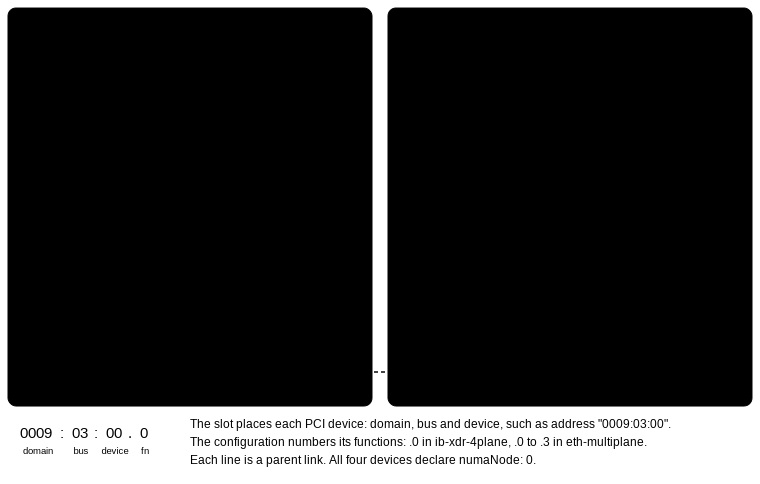
The same slot on PCIe. Its two devices sit in two PCIe domains, each below a root port and the NIC's own switch ports (bridges), and GPU 1 sits below the switch in the Data Direct device's domain. Both functions report the same VPD V3, which is how software pairs them.
The configuration decides how many functions exist, so switching configuration changes the functions and never the placement: ib-xdr-4plane has one PF on the network device and eth-multiplane has four (.0–.3) on the same device.
Placing devices separately covers every way the captures show a NIC spanning PCIe domains:
- GB300 ConnectX-8: the network device in one domain, the Data Direct device next to its GPU in another (gb300).
- A ConnectX-7 front-end card: two x8 links in two domains, one port on each (cx7-hhhl, gb300-cx7).
- BlueField-4: two host links, each showing a PF for every port. A port belongs to one function per PCI device (bf4-vr):
functions:
  - {id: a0, type: network, pciDevice: hostA, function: 0, class: "0x020000", ports: [p0]}
  - {id: a1, type: network, pciDevice: hostA, function: 1, class: "0x020000", ports: [p1]}
  - {id: b0, type: network, pciDevice: hostB, function: 0, class: "0x020000", ports: [p0]}
  - {id: b1, type: network, pciDevice: hostB, function: 1, class: "0x020000", ports: [p1]}
GPUs and NICs share one PCIe tree. Root ports are declared once per node, and each GPU slot, NIC device and NIC switch port can name its parent: a root port, or a switch port from any slot. The tree follows the real node, so rdma_topo, nvidia-smi topo -m and DRA drivers that match GPUs to NICs by PCIe position see the same relations as on real hardware. On VR NVL72, GPUs and NICs sit on separate root ports and share only a NUMA node (vrnvl72). On GB300, each GPU sits below a switch port of the NIC that serves it, the same switch that leads to the NIC's Data Direct function:
# SGPURackProfile gb300
topology:
  rootPorts:
    - {address: "0009:00:00.0", rootComplex: pci0009:00, id: {vendorID: "10de", deviceID: "22b1"}}
    # … one per root port on the node
  gpuSlots:
    - {index: 1, rootComplex: "pci0009:00", pciAddress: "0009:06:00.0", parent: "0009:05:00.0", numaNode: 0}
    # …
  nics:
    - slot: nic0
      devices:
        - name: dataDirect
          bridges:
            - {address: "0009:01:00.0", parent: "0009:00:00.0"}
            # … three more switch ports
            - {address: "0009:05:00.0", parent: "0009:04:00.0"}   # GPU 1's parent
NUMA attributes follow that topology; MEP-0010 proposes how NUMA is simulated. gpus records which GPUs the NIC serves, for locality reporting; it doesn't restrict which GPUs may use the NIC.
The declaration stops at the boot state
The declaration describes what Linux shows after boot, before any cluster software runs: the hardware, the firmware configuration and the driver.
Everything cluster software creates stays out: VFs, switchdev representors, SMI devices, renamed netdevs, IPoIB child interfaces, GIDs from IP addresses, MTU. This MEP doesn't emulate the driver's reaction to those operations. The profile only says how many VFs the hardware allows (totalVFs: 16), not how many are enabled.
For example, in the GB300 Ethernet capture, PF0's RDMA device has 72 ports. That is switchdev mode with a multiport eswitch, which an operator turned on: mlx5 gives each PF's vports (the host PF, 16 possible VFs and the uplink, so 18) to PF0's device. The declaration has four PFs with one port each. Producing the 72 would need Mokka to answer devlink, which it can't yet.
Operations cluster software performs. Whether Mokka can emulate the driver's reaction depends on the kernel interface the operation uses:
| Operation | Done by | Kernel interface | Mokka can see it |
|---|---|---|---|
| Enable VFs | SR-IOV or NIC configuration operator | sysfs write to sriov_numvfs |
Yes: the file is Mokka's |
| Switchdev mode, multiport eswitch | Network Operator, NIC configuration operator | devlink (generic netlink) | No |
| VF representors | The driver, in switchdev mode | Follows switchdev | No |
| SMI plane devices | A cluster DaemonSet (rdma dev add … type SMI) |
RDMA netlink | No: MEP-0014 leaves RDMA netlink to the host kernel |
| Device and netdev renames | udev, the rdma tool |
rtnetlink, RDMA netlink | No; names aren't compared |
| IPoIB child interfaces | ip link add … type ipoib |
rtnetlink | No |
| MTU, IP addresses | Network configuration, CNIs | rtnetlink | Once interfaces are kernel links (#1356); the kernel applies them, and RDMA GIDs must follow address changes |
This MEP emulates none of these operations; each needs its own proposal.
A few choices belong to the node image, not the NIC: whether the umad and IPoIB modules load, and the mode of umad files (600 on one image, 666 on another). They go in the rack profile:
# SGPURackProfile gb300-cx7
software:
  rdma: {umad: true, ipoib: true, umadMode: "666", driverVersion: 26.01-1.0.0}
Values the subnet manager or the fabric sets, such as port state, LIDs, partitions and the IPoIB MTU, are network state from MEP-0015.
Generic generation and stable identifiers
Generation is a set of rules, one per family of surfaces (Generation rules). Each reads only declared values. The only branch is on the declared port technology (ib, roce or efa).
Where hardware differs, the declaration says so instead of a rule guessing:
# SNICProfile efa-c5n: what the efa driver reports, declared on the function type
efa:
  driver: efa
  rdmaNamePrefix: efa_
  rdmaNodeType: "7: unspecified"
  rdmaOmit: [hca_type, board_id, hw_rev]   # files the driver doesn't create
  rdmaEmpty: [fw_ver]                      # a file it creates empty
# Slots: the system image GUID, where no rule fits every model
- slot: nic1                  # gb300: the board's second ASIC
  systemImageGUID: distinct
- slot: frontend0             # vrnvl72: BlueField-4
  systemImageGUID: rdma-b0    # the node GUID of RDMA device rdma-b0, on host link B's first PF
Identifiers (GUIDs, MACs, serial numbers, VPD V3, switch IDs) are hashes of where something sits: the node's coordinates, then the slot, and within it the PCI device, function number and port number, or the board and board position. So:
- the same declaration gives the same identifiers on every run;
- removing one NIC doesn't change the others';
- identifiers are generated to minimize the probability of collisions across nodes. That's checked for 4,608 nodes. MACs have 46 random bits, so 100,000 nodes with 16 RoCE ports each have about a 2% chance of one collision, and separate file-mode installs that reuse node names reuse identifiers;
- things at the same coordinate share an identifier. The profile says which VPD keyword is shared at which level: one serial number per board, one V3 per ASIC (its PF and its Data Direct function), one VU per board position.
Where profiles live and how a cluster chooses them
Each NIC model is one file in the nvml-mock chart, holding a full SNICProfile. Both modes read that file, and there is no other copy.
- Built-in or custom. A profile shipped in the chart is built-in; one an administrator adds is custom. They share the schema and validation. The only difference is ownership: Helm owns built-in profiles, so
helm upgraderesets edits to them, and a lasting change uses a custom profile under its own name. For example, a cluster whose front-end ConnectX-7 is an OEM variant, with the OEM's part number and board ID, adds its own profile and a rack profile whose slot names it. - File mode. A GPU profile, such as
gb300, carries the node's NIC slots, its root ports and each GPU's parent (nics.slots,nics.rootPorts,nics.gpuParents) and its RDMA software (software.rdma, which Helm values can override throughnics.rdma). The GPU addresses stay where the GPU profile already declares them. Untilibandpcibusrender from the resolved state (#1355, #1354), the profile also keeps itsinfinibandblock, which still drives what the node shows. Helm values select each slot's configuration, add custom profiles, and can replace the slots for a platform the GPU profile doesn't describe. - Control-plane mode. The chart renders the files as
SNICProfileobjects. A rack profile's slots name them, and a rack group inSGPUInventoryselects the configuration of its slots (nicConfigurations), so clusters with the same racks can run their NICs in different modes without a new rack profile. A rack with another NIC model, or an extra card, is another rack design: it gets its own rack profile, which reuses the NIC profiles. - Selection order. The rack group's choice, then the profile's default, the configuration the card ships with. The fabric doesn't choose a configuration, because one technology can have several; it only validates the choice.
- Defaults and runtime values. Profiles hold the facts of a NIC model and a rack design, and defaults for the values that change during a cluster's life, such as the firmware version. The inventory selects only the configuration. Changing a runtime value on running racks belongs with runtime policies, in a follow-up.
- Changes. Profiles are mutable. An edit reaches every rack that uses the profile, as an
SGPURackProfileedit does. Selecting another configuration is a simulated firmware reset. For now it re-probes all the node's NICs, like a reboot: every NIC disappears and returns, and RDMA device names are reassigned in PCI order. Keeping the names and device files of unaffected NICs through one slot's reset, as Linux does, comes later. Placement doesn't change, so the GPU association and Data Direct pairing stay. As on real hardware, the reset clears what cluster software created, and the operators create it again.
Checking declarations against hardware
mokka-capture collect network records a node's network surfaces as plain-text files, one per source (RDMA sysfs, the NIC functions' PCI sysfs, VPD fields, RDMA character devices, firmware configuration and others), in the node's capture directory. mokka-capture nic-surfaces <node dir> turns them into one list of object, attribute, value and source file, keyed by what the hardware fixes, such as a PCI function's address. mokka-capture diff nic <real node dir> <mock node dir> compares two capture directories (#1353, in review). How the generator's output reaches diff nic is still open (Open Questions).
# mokka-capture nic-surfaces tests/hardware-captures/gb300-ib/node-a (scrubbed capture)
pci/0000:03:00.0    class   0x020700    pci-nic-sysfs.txt
pci/0000:03:00.0    upstream    0x10de:0x22b2,0x15b3:0x197c,0x15b3:0x197c   pci-nic-sysfs.txt
pci/0000:03:00.0    vpd.V3  00000000000000000000000000000001    pci-vpd-fields.txt
pci/0009:03:00.0    class   0x080100    pci-nic-sysfs.txt
pci/0009:03:00.0    upstream    0x10de:0x22b1,0x15b3:0x197c,0x15b3:0x197c   pci-nic-sysfs.txt
pci/0009:03:00.0    vpd.V3  00000000000000000000000000000001    pci-vpd-fields.txt
The comparison checks relations, not identifier values: that a Data Direct function's V3 equals its PF's, that both ASICs on a board share one serial number, whose node GUID a system image GUID is (its own, another function's or none), and whether a BlueField's VPD VU starts with its serial number. It makes one check per attribute that either side has. Every difference needs a cause in a causes file per capture:
- schema gap: the schema can't express it yet;
- rule bug: a generation rule is wrong;
- capture blind spot: the capture doesn't record it: the capturing pod lacked the tool, the connection dropped, or the source file is absent. A tool that ran and failed counts as captured;
- by design: outside the declaration on purpose: cluster software, network state;
- deferred: compared later, at the rendered level or once a planned feature exists, such as the attributes the node agent renders. diff nic has the first four today; #1268 adds this one.
An accepted gap and a planned feature can both explain a difference, but they are different commitments, so they get different causes. A schema gap or a rule bug fails the check: those causes record a known defect while it's fixed, they don't make a difference pass.
# The first matching entry gives a difference its cause
- match: '^\S+ \S+/(0000|0002|0010|0012):03:00\.4(/|$)'
  cause: by design
  note: a VF that cluster software enabled on PF0; VFs aren't declared
A difference without a cause fails the check. Test plan lists the levels at which this runs.
User Stories
Story 1: one rack, two fabrics
A platform team simulates two GB300 clusters, one on InfiniBand and one on Ethernet. Both inventories use the gb300 rack profile; the Ethernet inventory's rack group selects eth-multiplane for slots nic0–nic3. Each node shows the PFs, RDMA devices and netdevs its real counterpart does.
Story 2: adding a NIC model
A developer brings up a node with a NIC Mokka doesn't ship. They run mokka-capture collect network on it, or capture read-only through a pod the cluster already runs with -exec-in, write an SNICProfile and a slot, and run the conformance check until every difference has a cause. The profile then ships as built-in.
Story 3: an OEM variant
An administrator's cluster uses an OEM ConnectX-7 card with its own part number and board ID. They add a custom NIC profile under a new name and a rack profile whose slot names it, as objects, or in file mode as values that add the profile and replace the slots. helm upgrade leaves them alone.
Story 4: testing a network operator
An SR-IOV operator runs against a simulated node and finds the PFs in their boot state, with the VF limit the profile declares. Creating the VFs when it writes sriov_numvfs is outside this MEP, as are operators that switch the eswitch to switchdev or create SMI devices.
Story 5: pairing GPUs with their nearest NIC
A topology tool, such as Topograph, reads PCI sysfs on a simulated GB300 node. It finds each ConnectX-8's Data Direct function next to a GPU, pairs it with the NIC's network function by VPD V3, and reports which NIC is nearest each GPU, so a DRA driver can allocate the two together. It gets the same pairs as on the real tray.
Notes/Constraints/Caveats
- Slots exist in two places. File mode has no rack profile, so its slots live in the GPU profile; control-plane mode has them in the rack profile. A unit test keeps the two equal until built-in rack profiles exist.
- Names aren't identities. Linux-visible names follow the node: netdev names come from the image's naming scheme, and RDMA device names from probe order, so they shift when an earlier NIC is removed, as on real nodes. Stable identity is the coordinate-derived identifiers (GUIDs, MACs, serial numbers). Names aren't compared. The generator uses predictable names; a per-image naming setting can come later.
- Capture coverage.
collect networkrecords PCI, VPD and interface records only for ConnectX functions (PCI vendor0x15b3), so EFA functions are missing; RDMA devices are captured whatever their vendor. A missing sysfs file is recorded as absent and an empty one as empty. #1268 tracks the remaining gaps. Captures of GB200 and of an InfiniBand cluster without SMI devices don't exist yet. - GPU parents in captures.
collect networkdoesn't record a GPU's parent yet (GPU records hold the device, NUMA node and root complex; #1268), so the samples take it from bus numbers and the captured PCI hierarchy. From implementation step 2, the GPU profiles place GPUs at their captured addresses (ongb300, domains0008,0009,0018and0019), so file mode builds the same tree. - GPU slots and
GPU_COUNT. In file mode a slot'sgpusmay name any GPU the profile declares, so loweringGPU_COUNTnever invalidates a slot. A NIC can then be associated with a GPU the node doesn't show. - Rendering during the transition. Until
ibrenders fromState.NICs(#1355) andpcibusrenders NIC functions (#1354), every GPU profile keeps rendering NICs through today'sinfinibandblock.gb300andvrnvl72also declare slots, so their resolved NIC state exists for those changes to build on, but slots and configuration choices don't change what a node shows until then. A temporary shape derived from the resolved state was considered and rejected: it can show one model and link layer per node, so a mixed tray or one slot in another configuration would show devices other than the declared ones. A GPU profile without captured NICs moves to slots once a capture backs its NIC profile.
Risks and Mitigations
| Risk | Mitigation |
|---|---|
| Declarations drift from real hardware | Conformance against captures, with a cause for every difference, plus deliberate breakages that must be caught |
| The two copies of a platform's slots diverge | A unit test compares them |
| Two nodes report the same GUIDs | Node coordinates are part of every identifier |
| Putting NIC functions in the shared PCI tree breaks GPU consumers | The rendered-level check and the existing pcibus tests |
| Control-plane delivery isn't built | File mode ships first; control-plane NIC state lands with per-node delivery |
| A profile ships without real evidence | Only profiles with a capture that passes conformance ship as built-in |
| The privileged node agent gets an API token, where today the DaemonSet mounts none | The token can only create and patch Events in the release namespace and is mounted only in the node-agent container; a chart test pins the Role to Events |
Design Details
API
The Go types are the schema; controller-gen generates the CRDs from them, and a unit test strictly decodes every shipped profile file with them. Below, ? marks an optional field and # new marks a field added to an existing resource.
SNICProfile (new, cluster-scoped)
apiVersion: mokka.nvidia.com/v1alpha1
kind: SNICProfile
metadata:
  name: string                      # what slots refer to, such as cx8-c8280z
spec:
  identity:                         # what the NIC reports about itself, the same in every configuration
    model: string                   # model name, such as ConnectX-8
    hcaType: string?                # RDMA hca_type, such as MT4131
    boardID: string?                # RDMA board_id, such as MT_0000001513
    firmwareVersion: string?        # RDMA fw_ver; the default, which runtime policies will be able to change
    partNumber: string?             # board part number; the default for VPD PN
    hwRev: string?                  # RDMA hw_rev and ibv_devinfo hw_ver; empty means 0x0
    vendorOUI: string?              # IEEE OUI that verbs report as vendor_id, such as "0x02c9"
  sources: [string]?                # captures or documents the values come from
  switchPort: {vendorID, deviceID}? # IDs of the NIC's own PCIe switch ports, which slots place as bridges
  vpd:                              # optional: vital product data, on function types with vpd: true
    keywords: {string: string}?     # model values by keyword (PN, EC, V2…); "name" is the product name, to which a device's vpdPosition is appended
    identities: {string: scope}?    # keywords whose value is a generated identifier, and which scope shares one value: board | asic | boardPosition, or another identity keyword with one of those three scopes, whose generated value this one reuses before its function suffix (BlueField-3's VU starts with its SN); one level only
  functionTypes:                    # kinds of PCI function the configurations use
    - name: string                  # unique; what a function's type and a vfType name
      vendorID: string              # four lowercase hex digits, no 0x
      deviceID: string
      subsystemVendorID: string?
      subsystemDeviceID: string?
      driver: string                # bound kernel driver, such as mlx5_core; matches ^[a-z0-9_-]+$
      rdmaNamePrefix: string?       # kernel's RDMA device name prefix, such as mlx5_; matches ^[a-z0-9_]+$
      rdmaNodeType: string?         # node_type the driver reports; empty means "1: CA"
      rdmaOmit: [string]?           # RDMA attributes the driver doesn't create: the file is absent. Any of fw_ver, hca_type, board_id, hw_rev
      rdmaEmpty: [string]?          # RDMA attributes the driver creates with an empty value. Same choices as rdmaOmit
      totalVFs: int?                # sriov_totalvfs; 0 means no SR-IOV. Enabling VFs is cluster software's job
      vfType: string?               # the function type of the VFs this function can enable; needs totalVFs
      revision: string?             # PCI revision ID, such as "0x00"
      pcieLink:                     # optional: the link the function trains to; omitted when no capture shows it, and then no link attributes are generated
        speed: string               # as sysfs reports it, such as "64.0 GT/s PCIe"
        width: int
        maxWidth: int?              # only when it differs from width, as on a VF reporting 0 of 255
      vpd: bool?                    # whether the function exposes the profile's VPD
      vpdSuffixes: {string: string}? # appended to an identity keyword's value on this function; {function} is the PCI function number
      vpdOmit: [string]?            # identity keywords this function doesn't report
  defaultConfiguration: string      # the configuration the card ships with; used when the cluster selects none
  configurations:                   # firmware configurations, each declared as its result
    - name: string
      ports:                        # optional: logical network ports, in physical order: a port's position is its number (p0 first), which names it and keys its identifiers
        - id: string
          technology: ib | roce | efa
          width: int                # lanes in the rate text, such as 4 in "800 Gb/sec (4X XDR)"
          laneSpeed: SDR | DDR | QDR | FDR10 | FDR | EDR | HDR | NDR | XDR
          planes: int               # fabric planes the port carries; 0 is a single endpoint
          capMask: string?          # capability mask of an ib or efa port, which firmware sets; roce follows a rule
          lmc: int?                 # LID mask count; empty means 0
      functions:                    # PCI functions this configuration produces
        - id: string
          type: string              # a function type's name
          pciDevice: string         # the PCI device a slot places, such as network or hostA
          function: int             # PCI function number within that device
          class: string             # PCI class code this configuration gives the function, such as "0x020700"
          ports: [string]?          # ports this function owns; one owner per PCI device
      rdmaDevices:                  # optional: RDMA devices the driver creates, at most one per function
        - id: string
          function: string          # a function id
          ports: [string]           # port k of the device is the k-th entry
SGPURackProfile (existing; new fields)
apiVersion: mokka.nvidia.com/v1alpha1
kind: SGPURackProfile
spec:
  software:
    rdma:                           # new: the node image's optional RDMA modules
      umad: bool                    # ib_umad loaded: umad and issm files, the infiniband_mad class
      ipoib: bool                   # ib_ipoib loaded: an IPoIB netdev per InfiniBand port
      umadMode: string?             # udev file mode of umad and issm files, such as "666"; empty means the kernel's 600
      driverVersion: string?        # the RDMA stack's version, as /sys/module/mlx5_core/version shows it, such as 26.01-1.0.0
  node:
    gpus:
      pci: {vendorID, deviceID}     # existing; pairs GPUs with NICs in the GPU records
    topology:
      network: removed              # MEP-0001's out-of-band adapter block; nics replaces it
      rootPorts:                    # new: the platform's PCIe root ports, once per node
        - address: string           # such as "0009:00:00.0"
          rootComplex: string       # pciDDDD:BB
          id: {vendorID, deviceID}? # upstream IDs are generated only where this is known
      gpuSlots:                     # existing: index, rootComplex, pciAddress, numaNode
        - parent: string?           # new: the root port or switch port the GPU sits below, from any slot; empty when unknown
      nics:                         # new: one entry per NIC instance on the node
        - slot: string              # unique per node, such as nic0 or frontend0
          profile: string           # an SNICProfile name
          board: int?               # slots whose ASICs share one physical board; node-wide
          systemImageGUID: string?  # empty: node GUID of the lowest-addressed RDMA device
                                    # <rdma device id>: node GUID of that RDMA device
                                    # distinct: a GUID that is no device's node GUID
          gpus: [int]?              # GPU indexes the NIC serves; locality, not a routing rule. Any GPU the profile declares
          vpd: {string: string}?    # overrides model VPD keywords, such as EC
          devices:                  # placement of each PCI device the configurations name
            - name: string          # unique; a pciDevice of the configurations, such as network or hostA
              rootComplex: string   # pciDDDD:BB
              bridges:              # the NIC's switch ports above or beside the device, parents first
                - address: string
                  parent: string    # a root port, or an earlier switch port
              address: string       # DDDD:BB:DD; function numbers come from the configuration
              parent: string?       # a root port or a switch port; omitted for a device on the root bus
              numaNode: int
              vpdPosition: string?  # suffix of the VPD product name, such as -Prime or -Aux[1]
nics replaces topology.network, the out-of-band adapter block MEP-0001 defined (adapter model, link speed, adapters per GPU). Keeping both would let one rack profile describe its NICs twice, so the block is removed; Mokka has no users who depend on it.
SGPUInventory (existing; new field)
File mode takes the same shape from Helm values (nics.configurations).
apiVersion: mokka.nvidia.com/v1alpha1
kind: SGPUInventory
spec:
  rackGroups:
    - id: string
      profileRef: {name: string}    # existing
      nicConfigurations:            # new: the configuration each slot runs; a slot not listed runs its profile's default
        - slots: [string]           # at least one, each an existing slot, and each slot in one entry only
          configuration: string     # one of the slots' profile's configurations
# Example: the Ethernet inventory from Story 1
rackGroups:
  - id: training
    count: 4
    profileRef: {name: gb300}
    nicConfigurations:
      - {slots: [nic0, nic1, nic2, nic3], configuration: eth-multiplane}
Validation
The CRD checks field shapes. These rules need more than one field, so the loader checks them in file mode, and the controller checks them and reports failures in status in control-plane mode:
- Decoding: strict, on the raw document: an unknown field, a missing required field or a repeated item in a set or map list is an error in file mode too, as the API server would reject it; zero values aren't filled in.
- Profile: VPD scopes are
board,asic,boardPosition, or another identity keyword whose own scope is one of those three, so reuse is one level deep:{SN: asic, VU: SN}is valid and{SN: VU, VU: SN}isn't. A keyword is either a model value or an identity. Every function type has a driver.driverandrdmaNamePrefixare kernel names, lowercase letters, digits and_(and-in a driver), so neither can form a path outside the staged tree.rdmaOmitandrdmaEmptyname onlyfw_ver,hca_type,board_idorhw_rev, and no attribute is in both. AvfTypenames another function type, on a function type withtotalVFs. Configuration names are unique, and the default is one of them. - Configuration: port and function IDs are unique. Technology and lane speed come from the lists above; width is positive and planes aren't negative. A function's type exists, its PCI device is named, and each device and function number is used once. The class is
0xplus six hex digits. Every port has an owner, and at most one per PCI device. An RDMA device names a function and at least one port, and its ports are ports that function owns, each listed once. A function has at most one RDMA device, since its identifiers come from the function's position. - Rack profile: slot names, GPU slots and PCI addresses are unique. One board holds one NIC model. A slot's GPUs and profile exist. A VPD identity shared per board or per board position needs the slot's
board, and one per board position also needs avpdPositionon every device the slot places.systemImageGUIDisdistinctor an RDMA device of the selected configuration. Root ports are unique and inside their root complex. Addresses are well-formed and inside their root complex. Every parent, of a GPU slot, a NIC device or a switch port, names a root port or a switch port of the node in the same root complex, and switch ports form no cycle. Every address is in its root complex's PCI domain. A root port, and a NIC device without a parent, sit on the root complex's bus. A switch port's children share one bus, which is neither the port's own bus nor the bus of any other switch port's children. Root ports are exempt from that last check while platform bridges aren't modeled: a cloud VM's capture doesn't record them, soaws-gb300names root ports as parents. A NIC device without a parent sits on its root complex's root bus, so its address is on that bus and it has no switch ports, as the EFA device inaws-c5nshows. Bridges need the profile'sswitchPort. Every PCI device a configuration uses is placed. - Configuration choices: each entry names existing slots, each slot appears in one entry at most, and the configuration is one of every listed slot's profile. The rack-profile rules then run on the selection, so a configuration whose PCI devices a slot doesn't place, or that lacks the RDMA device a
systemImageGUIDnames, is rejected.
Samples by feature
Appendix B holds the full samples. Each shows a part of the schema:
| Sample | Shows |
|---|---|
cx8-c8280z, gb300 |
Two configurations of one ASIC; Data Direct in a GPU's domain; VPD by board, ASIC and board position; systemImageGUID: distinct |
gb300-cx7 |
A second GB300 rack design, with a ConnectX-7 front-end card; per-slot VPD; umadMode; an inventory selecting eth-multiplane |
cx7-hhhl |
One card with two links in two domains |
bf3-b3240 |
A SoC management function without an RDMA device, next to PFs with one; a function type without a VPD identity |
bf4-vr, vrnvl72 |
Two host links sharing ports; the system image GUID taken from a named RDMA device |
cx9-vr |
The VR NVL72 scale-out NIC |
cx8-aws-vf, aws-gb300 |
A cloud VM's VFs and Data Direct functions, with no PF |
efa-c5n, aws-c5n |
EFA: declared node type, absent and empty attributes; a device on the root bus |
Generation rules
Back to: Generic generation and stable identifiers
Generation has two halves. Resolve turns the declaration into a typed NIC state in which every value is decided. Render turns that state into surfaces; the node agent's simulators do it. Both halves read only declared values and branch only on port technology.
| Rule | When | Surfaces | Reads |
|---|---|---|---|
| G1 PCI | Every function of the selected configuration. SR-IOV attributes only when totalVFs is set, link attributes only when pcieLink is, upstream IDs only where they're declared |
IDs, class, revision, link, driver, modalias, upstream IDs, SR-IOV totals | Function type, configuration class, placement |
| G2 VPD | Functions whose type has vpd: true; each identity keyword unless the type lists it in vpdOmit |
VPD keywords | Profile keywords and identity scopes, suffixes, slot VPD values, vpdPosition |
| G3 Bridges | Each bridge a device placement lists | The NIC's switch ports | Slot bridges, profile switchPort |
| G4 RDMA device | Each RDMA device of the selected configuration. Attributes in rdmaOmit are left out; those in rdmaEmpty are empty |
Node type, node and system image GUIDs, firmware, board ID, HCA type, hardware revision | Function type, identity, slot systemImageGUID |
| G5 Names | All RDMA devices on the node, in PCI address order, numbered per prefix as the kernel numbers them per driver | RDMA device names, such as mlx5_0 and efa_0 |
rdmaNamePrefix |
| G6 Rate | Each port of each RDMA device | Rate text, link layer | Width, lane speed, technology |
| G7 Ports | Each port of each RDMA device, by technology: ib gets its capability mask and a port GUID (the node GUID on port 1, its own on each later port), with GID 0 from the port GUID; roce gets GIDs 0 and 1, the same link-local address from its netdev's MAC, typed RoCE v1 and RoCE v2 and both tied to that netdev; efa gets LID 0 and one link-local GID with no netdev |
LIDs, capability mask, P_Keys, GIDs | Port |
| G8 Netdevs | Each roce port. ib ports get netdevs only from G12; efa ports get none |
Netdev names, MACs, one switch ID per NIC | Port, function, placement |
| G9 Device files | uverbs per RDMA device and one rdma_cm always; umad per port when software.rdma.umad; issm per ib port without planes, also only with umad |
Device files and their modes | software.rdma |
| G10 Verbs | Each RDMA device | ibv_devinfo fields |
As G4, G6 and G7 |
| G11 ethtool | Each netdev from G8 or G12 | Driver, firmware and board ID, bus address | Function type, identity, placement |
| G12 IPoIB | Each ib port, when software.rdma.ipoib |
An IPoIB netdev: its name, from the PCI address, and its 20-byte address: queue pair number 0, as the capture shows, then GID 0, which ends in the port GUID | Port, RDMA device |
| G13 GPUs | Each GPU slot | GPU PCI records and their NIC association | GPU slots, and each NIC instance's gpus |
Rules that decide values (G1–G5, G13, and the values in G7, G8 and G12) belong to resolve; rules that format values (G6, G9–G11, and the rest of G12) belong to render. So the state names every netdev, Ethernet and IPoIB alike, with its address.
Identifiers are name-based (UUIDv5) hashes of coordinates, using the scheme GPU UUIDs already use (internal/sgpu/rackrender/identity.go), shared so NICs and GPUs have one identity function. Control-plane mode names a node by its inventory UID, rack group, rack index and node index. File mode names it by an empty inventory UID followed by the node name; no control-plane node has an empty inventory UID, so the two modes never produce the same name. Then comes where the object sits within the node: the slot, then the PCI device, function number and port number (the port's position in the configuration's port list) for values per function or port, or the board and board position for VPD identities. The profile's ID strings for functions, ports and RDMA devices never enter an identifier, so renaming them changes nothing; a configuration switch keeps a function's GUIDs and MACs when the function keeps its position, as on hardware. Each kind of identifier (GUID, MAC, 128-bit ID) hashes in its own domain, so a GUID and a MAC of the same object are unrelated, and MACs are locally administered.
Node agent
NICs follow the GPU path through the node agent (MEP-0003). The agent loop doesn't change.
ConfigMap ──FileSource.reload──▶ compileState ──▶ agent.State ──reconcileLoop──▶ Stage → Apply → Daemon.Run/Reload
                                   └─ compileNICs ─▶ State.NICs ─▶ pcibus, ib, new simulators
Input. The profile document the agent already reads. In file mode the chart appends the NIC profiles the slots name and the configuration choices from values, so FileSource watches one file as today:
# The profile document in the node agent's ConfigMap, file mode
system:
  # … GPU profile, unchanged
nics:                      # from profiles/gb300.yaml
  rootPorts:
    - {address: "0009:00:00.0", rootComplex: pci0009:00, id: {vendorID: "10de", deviceID: "22b1"}}
    # …
  gpuParents:              # by GPU index; the GPU addresses stay in the GPU profile above
    1: "0009:05:00.0"
    # …
  slots:
    # …
nic_profiles:              # appended by the chart: the profiles the slots name
  - apiVersion: mokka.nvidia.com/v1alpha1
    kind: SNICProfile
    metadata: {name: cx8-c8280z}
    spec:
      # …
nic_configurations:        # appended by the chart from values
  - {slots: [nic0, nic1, nic2, nic3], configuration: eth-multiplane}
Compile. compileNICs joins compileState (internal/agent/source/file.go) and resolves the slots into State.NICs; compileNetwork keeps turning the infiniband block into NodeShape.Network, which drives rendering until #1355. Like compileNetwork, it parses the same bytes through its own schema, since the NVML engine never reads NICs. It validates them, applies the selection order, and resolves with the node's coordinates.
Failing open. The agent accepts a node's whole PCI tree, GPUs and NICs together, since GPUs can sit below a NIC's switch ports. A candidate is accepted only if its combined tree validates. When the NIC declaration is invalid, the agent keeps its last accepted NIC state if that state still forms a valid tree with the new GPU state. Otherwise, and on a node that never accepted one, it runs without NICs, and a GPU whose parent was a NIC switch port is placed directly below its root port. Either way the GPUs render. The error is logged, recorded as a Warning Event on the node agent's pod (with a Normal Event once a declaration is accepted again), and shown in /readyz under nics while the probe stays OK. The Helm chart grants the node agent the minimum Kubernetes permissions required to publish these Events. The kept state lives in the agent's memory, so a restarted agent starts like a fresh node. A Helm change to the profile document rolls the node agents, so the chart's render-time checks are the first line of defense: everything the chart can check fails helm template before any pod changes. Control-plane mode follows the same rule.
State. State.NICs takes over from NodeShape.Network once ib renders from it (#1355). The infiniband block goes from gb300 and vrnvl72 then; the block and NodeShape.Network go for good once the other GPU profiles have NIC slots from captures (implementation step 4, #1269). Every value is resolved, so simulators never derive anything and a change is detected by comparing states. Nothing downstream reads the NIC YAML, so there is no raw copy of it.
// NICs is a node's resolved NIC state. Every value is decided.
type NICs struct {
    RDMA      RDMA         // umad, ipoib, umadMode, driverVersion
    Instances []Instance   // one per slot: profile, configuration, model, firmware, board ID, board, GPUs, switch ID
    Bridges   []Bridge     // address, parent, root complex, IDs, slot
    Functions []Function   // address, IDs, class, revision, driver, placement, upstream IDs, NUMA node, SR-IOV and VF type, link, VPD
    Devices   []RDMADevice // name, function, node type, node and system image GUIDs, attributes, firmware, ports
    Netdevs   []Netdev     // Ethernet and IPoIB: name, function, port, MAC or IPoIB address
}
Kernel modules. gpudriver follows the infiniband block until ib renders from State.NICs, then the node's resolved RDMA devices and their drivers. ib_umad and ib_ipoib will follow software.rdma's umad and ipoib when #1358 adds them, so the module list and the device files agree.
Simulators.
| Simulator | Change |
|---|---|
pcibus |
Renders NIC functions and bridges into the same /sys/bus/pci tree as the GPUs; GPUs, NIC functions and switch ports form one tree, each under its declared parent. Its NFD feature file gains the NIC vendors |
ib |
Renders class/infiniband, infiniband_mad, infiniband_verbs, /dev/infiniband and RoCE netdevs from NetworkShape (the infiniband block) today, and from State.NICs with #1355. mock-ib reloads when the NIC state changes, as today |
| Netdevs (new, if needed) | IPoIB netdevs and ethtool answers, if they don't fit in ib. ethtool uses ioctl and netlink, so it needs a shim like the IB tools |
Today an HCA's PCI function exists only in ib's own tree. A Data Direct function has to sit under its GPU's root complex, so all PCI functions move to one tree. How the libmockfs and libibmocksys path redirections share that tree is part of the implementation.
A new state from a profile edit or a configuration change runs Stage again. For now every NIC on the node is removed and created again in the new layout, as Changes in Where profiles live says; keeping the unaffected NICs in place comes later.
Control plane
| Area | Change |
|---|---|
| Watches | A new SNICProfile informer and RBAC (get, list, watch). NIC profile events re-route inventories as SGPURackProfile events do. Slots are part of the rack profile's spec, so they already change its revision; nicConfigurations counts as a rendering input |
| Rack rendering | A rack's NIC inputs, each SNICProfile revision its slots name and the inventory revision that supplies nicConfigurations, join the accepted inputs MEP-0001's delivery generation records, and an accepted change advances it. The rack validates the NIC references and the cross-field rules; a rejected change becomes a condition. The revision ignores the order of unordered lists (root ports, NIC slots, a slot's GPUs). No NIC state is stored in SGPURack: it is deterministic |
| Per-node view | When a node agent asks for its state, the control plane resolves the node's NICs with the same code file mode uses, from the exact accepted revisions only. A replica that can't read one, because it hasn't synced yet or the profile was deleted or edited since, answers with retry, as MEP-0001 specifies for its other inputs |
| Status | A missing or invalid SNICProfile becomes a condition on the inventory and rack. As with any profile under MEP-0001, delivery to the nodes of the racks that name it pauses until the profile is restored or fixed, GPU policy changes included: a node keeps its last applied state, and a node with none waits |
| Unchanged | Allocation, capacity, Node projection and runtime policies |
# SGPURack: the accepted NIC inputs, recorded with MEP-0001's delivery generation
profileRef: {name: gb300, uid: …, generation: 3, revision: …}   # existing
nicProfileRefs:                                                         # new
  - {name: cx8-c8280z, uid: …, generation: 1, revision: …}
  - {name: bf3-b3240, uid: …, generation: 1, revision: …}
Delivery of per-node state to the agent is MEP-0001's and isn't built yet: the agent's control-plane source is a stub (#614). Control-plane NIC state arrives with it.
Helm chart
deployments/mokka-crds/helm/mokka-crds/templates/
└── mokka.nvidia.com_snicprofiles.yaml   new CRD, generated
deployments/nvml-mock/helm/nvml-mock/
├── profiles/
│   ├── gb300.yaml                       GPU profile; NIC slots replace the infiniband block
│   ├── mig/                             existing MIG profile tables
│   └── nics/                            one SNICProfile per NIC model
│       ├── cx8-c8280z.yaml
│       └── …
└── templates/controlplane/
    └── snicprofiles.yaml                built-in objects, when controlPlane.enabled
GPU profiles are read from profiles/*.yaml, which doesn't descend into mig/ or nics/. The control-plane template renders one object per file in profiles/nics/ and checks that its name matches the file name:
{{- if .Values.controlPlane.enabled }}
{{- range $path, $_ := .Files.Glob "profiles/nics/*.yaml" }}
{{- $p := $.Files.Get $path | fromYaml }}
{{- $name := base $path | trimSuffix ".yaml" }}
{{- if ne $p.metadata.name $name }}{{ fail (printf "%s: metadata.name must be %s" $path $name) }}{{ end }}
{{- $_ := set $p.metadata "labels" (dict "mokka.nvidia.com/profile-source" "builtin") }}
---
{{ toYaml $p }}
{{- end }}
{{- end }}
The CRDs come from mokka-crds, installed first as today. The objects belong to nvml-mock because Helm can't create objects of a kind whose CRD the same release installs.
File-mode values:
nics:
  rdma: {}                         # overrides the GPU profile's software.rdma, such as {umadMode: "666", driverVersion: 26.01-1.0.0}
  configurations:                  # the file-mode nicConfigurations
    - slots: [nic0, nic1, nic2, nic3]
      configuration: eth-multiplane
  customProfiles:                  # SNICProfiles in the same schema as the shipped files
    - apiVersion: mokka.nvidia.com/v1alpha1
      kind: SNICProfile
      metadata: {name: cx7-oem}
      spec:
        # …
  slots: []                        # replaces the GPU profile's slots, root ports and GPU parents together, for a platform it doesn't describe
  rootPorts: []                    # the root ports those slots' devices name
  gpuParents: {}                   # each GPU's parent by index, such as {0: "0008:05:00.0"}
The chart fails the render on mistakes it can see: a configuration choice without slots, naming an unknown slot or configuration, or naming a slot twice; a custom profile without apiVersion, reusing a shipped profile's name, or with a default configuration it doesn't define; a profile document with a repeated NIC key.
Test plan
- Schema. Every shipped profile decodes strictly into the Go type and passes validation. Every shipped profile also passes the generated CRD schema, and every invalid case for a rule the CRD can enforce (field types, enums, patterns, required fields) fails both, so file mode and the API server can't drift apart. Rules that span fields or objects, such as a slot naming a profile that exists, can't live in a CRD; file mode and the controller run them from one validation package, and a test gives both the same cases. The NIC slots, GPU slots and root ports in each GPU profile equal those of the matching rack profile, so the capture checks cover the addresses file mode uses.
- Declaration level. For each capture, the generator's output is compared with the capture through
diff nic; every difference must match a cause. Deliberate breakages, such as swapping two NICs' Data Direct functions, dropping planes or putting both of a card's ports on one link, must each be caught. - Determinism. Generating twice gives identical output, removing one NIC leaves the others' identifiers unchanged, and renaming every function, port and RDMA device ID in a profile leaves every identifier unchanged.
- Configuration switch. Changing only a slot's configuration changes its functions and nothing in its placement or Data Direct pairing. The node's other NICs come back at the same addresses with the same identifiers; their RDMA device names can shift, since names follow PCI order.
- Rendered level. The simulators stage a node into a temporary host root, the capture scripts read it, and
diff niccompares the result with the same capture and causes. No cluster is needed. Thecollect networkscripts read/sysand/devdirectly today; a root-directory option for a staged tree is in #1268. - Both modes. File mode and control-plane mode give the same
State.NICsfor the same declaration and node coordinates. - Consumer level. Real tools find and use the simulated NICs in a Mokka pod:
lspci,ibv_devinfo,ethtool,nvidia-smi topo -m, and laterrdma link,ip linkand the network operator's components. The declaration level shows the model is right and the rendered level that the files are there; only this level shows applications can use them.
Implementation order
- API types, CRD, chart profile files, validation.
- Node agent in file mode:
compileNICs,State.NICs, the rendered-level check; rendering stays on theinfinibandblock.gb300's GPUs move from their synthetic addresses (0000:0A:00.0,0000:0B:00.0,0000:4A:00.0,0000:4B:00.0) to the captured ones (0008:06:00.0,0009:06:00.0,0018:06:00.0,0019:06:00.0), so the PCI bus IDs NVML reports for that profile change.pcibus(#1354) andib(#1355) then render fromState.NICs, which retires the block forgb300andvrnvl72. - Control plane: watches, pins, status; the per-node view once delivery exists.
- Captures and profiles for the remaining platforms, then removal of the
infinibandblock,compileNetworkandNetworkShape.
Open Questions
The first is a tooling choice still to make. The others depend on topics this MEP doesn't settle: how a node attaches to a fabric (MEP-0015), and how driver reactions work. They're recorded so the design leaves room for them; the answers belong in follow-up changes to this MEP or in their own proposals.
Comparing a declaration with a capture
diff nic compares two capture directories, and the generator's output has to reach it in one of two ways:
- the generator writes a capture directory in the layout collect network writes, so diff nic runs unchanged on both sides;
- diff nic also reads nic-surfaces output for one side, so the generator writes that normalized list.
The first tests the capture layout end to end; the second keeps the generator independent of the per-source files. Undecided.
Reconciling boot, runtime and network state
NIC surfaces come from three inputs, each with its own owner:
| Input | Owner | Examples |
|---|---|---|
| Boot state | The declaration: profiles, slots, configuration choices | PFs, RDMA devices, ports |
| Driver runtime state | Driver reactions to operator actions | VFs, representors, SMI devices |
| Network state | The fabric (MEP-0015) | Port state, LIDs, partitions |
Settled so far: a configuration change is a firmware reset and clears the runtime state. Open: how the three inputs combine into what the simulators render, and what survives a restage. A test case for any answer: a NIC with one PF and four InfiniBand planes; the network operator creates an SMI device, once Mokka can answer RDMA netlink; the fabric reports plane 2 down; the node agent reconciles. The SMI device should remain, and its second port should show the failure.
A likely direction is one effective NIC state, resolved from the three inputs, that the simulators consume. This MEP doesn't commit to it.
Fabric endpoints for MEP-0015
Settled: fabric endpoints come from a configuration's logical ports, not from PCI functions or RDMA devices. A BlueField-4 with two host links has four PFs and four RDMA devices but two endpoints, because both links share its two ports.
Open: how endpoints are named, whether a port with planes gives one endpoint per plane, how an endpoint's identity survives reconciliation, and how the state of each plane rolls up into the RDMA port.
Reporting surface fidelity
A simulated file isn't always a working interface. A netdev under /sys/class/net doesn't appear in ip link, which asks the kernel over rtnetlink. For each surface (PCI sysfs, RDMA sysfs, network sysfs, rtnetlink, RDMA netlink, verbs, ethtool, NVML topology), Mokka should tell apart one that is:
- simulated;
- turned off on purpose;
- unsupported in this environment;
- not implemented.
Otherwise the declaration and rendered checks can pass while applications still can't find the NIC. Where this is declared and reported is open; it overlaps with the interface tiers in MEP-0014.
Drawbacks
- Verbose declarations. Each simulated mode is a full configuration, and each slot repeats root ports and bridges.
- A new CRD to install, document and version.
- Slots in two places until built-in rack profiles exist.
- Every new NIC model needs a capture before it ships as built-in.
- A rack profile per NIC combination. A rack design with another NIC model or an extra card needs its own rack profile. NIC models are shared, so that profile only places slots; if such profiles multiply, a resource that connects cards to a rack can take over.
Alternatives
| Alternative | Why not |
|---|---|
| NIC models inline in each rack profile | A NIC model and its configurations are defined once and referenced wherever they're used; inline, every rack profile would copy its PCI IDs, VPD and every configuration. With a separate profile, rack profiles for the same GPU type with different NIC models, or with an OEM variant under its own name (Story 3), reuse one definition of each model |
| The inventory overrides a slot's NIC model, firmware, VPD or system image GUID | Another NIC model makes another rack design, and swapping a NIC built into a tray, such as GB300's ConnectX-8, gives a node with no real counterpart. VPD values and the system image GUID are facts of the card and the board. The firmware version changes during a cluster's life, so changing it belongs with runtime policies. The inventory keeps only the configuration choice |
| A resource that connects cards to a rack | The rack profile would declare sockets, each NIC profile its card's own layout, and the inventory or a connector resource would choose the card per socket, so one rack profile would serve every NIC combination. A prototype reproduces all five captures this way (Appendix A). Every user would have to learn to wire sockets, and no case needs it yet. If rack profiles per GPU type grow to dozens, this is the way to go |
Keep the infiniband block, extended |
It counts NICs per GPU and has one shape per node; it can't express several NIC models, NICs across PCIe domains, or a mode change |
| A NIC catalog where the link type drives the layout | The generator would derive PFs and classes from link type and planes, which is ConnectX knowledge in Mokka |
Firmware parameters (mlxconfig) as input |
The same parameters mean different layouts per technology; interpreting them makes the generator device-specific |
| Profiles compiled into the controller, kept in sync with the chart by a CI check | A second copy and a drift check, where one chart file serves both modes |
NIC state stored in SGPURack |
It is deterministic from the declaration and coordinates, so storing it adds writes and nothing else |
| NIC profiles in a separately mounted file | FileSource would watch and hash another file; appending to the one profile document needs no change |
| NIC PCI functions only in the InfiniBand tree | A Data Direct function couldn't sit under its GPU's root complex, and lspci-style consumers wouldn't see NICs |
| One placement per function instead of per PCI device | Function counts change with the configuration, so placement would change with every mode switch |
Appendix A: Design validation
A prototype implements the schema, the validation, the generator, and the declaration-level and determinism checks above. It compares the samples in Appendix B with five captures:
| Capture | Checks | Passed | Differences, all with a cause |
|---|---|---|---|
| VR NVL72 | 792 | 666 | 122 blind spots of an older capture format, 4 by design |
| GB300 InfiniBand | 935 | 669 | 266 by design: SMI devices, partitions, IPoIB MTU, kernel modules, rendered attributes |
| GB300 Ethernet, at a cloud provider | 1,715 | 936 | 779 by design: a VF, its representor, switchdev with a multiport eswitch, MTU, rendered attributes |
| AWS GB300 instance | 385 | 123 | 242 blind spots of a trimmed listing, 20 by design (VF netdevs moved into pods, an IPv4-mapped GID) |
AWS EFA (c5n.9xlarge) |
58 | 52 | 3 by design: host kernel and architecture, udev directories. 3 capture blind spots: attributes the driver doesn't create, which the converted capture recorded as empty |
No difference is a schema gap or a rule bug. Fifteen deliberate breakages are each caught. The by-design differences are surfaces the declaration leaves out on purpose: cluster software creates them, and this MEP doesn't emulate it. The AWS sources predate collect network and were converted into the prototype's format.
These counts come from the prototype's comparison tool and its single-file captures. #1353's diff nic reads capture directories and makes one check per attribute either side has, so an object one side lacks fails once per attribute; its totals aren't comparable with these. It also adds two relations: whose node GUID a system image GUID is, and whether a BlueField's VPD VU starts with its serial number.
Not covered yet:
- GB200's ConnectX-7 on InfiniBand, and an InfiniBand cluster without SMI devices: no captures.
- collect network captures of the AWS instances.
- Node coordinates in identifiers: the prototype hashes declaration coordinates only, so it models one node.
- nicConfigurations, the rendered level and control-plane mode, which need the implementation.
- Firmware set by runtime policies. The GB300 Ethernet counts above were taken with the capture's firmware version on the ConnectX-8 slots. Without it, the sample's RDMA devices and netdevs report the profile's default instead, a difference whose cause is the missing runtime policy.
Connecting cards to a rack. A second prototype declares the same five captures the alternative way: sockets in the rack profile, each card's own switch layout in its NIC profile, the card chosen per socket. Lowered to the slots above, it gives the same PCI tree, the same resolved NIC state and the same conformance results for every capture, and one rack profile serves both GB300 clusters. It takes about 281 YAML lines where the slots take about 595. It needed three additions: a socket that hides the card's switch (a VR NVL72 ConnectX-9 shows it only where an NVMe drive sits below it), pinned addresses where a cloud guest hides bridges, and the system image GUID declared by the board or the card. Unsettled: PCIe switches of servers with add-in cards, for which no capture exists.
Appendix B: Samples
The prototype's samples. Rack profiles hold only the fields this MEP adds or reads; rack, the GPU model and the other existing fields are left out. Captures under tests/hardware-captures/ come with #1353.
- NIC profiles:
cx8-c8280z,cx9-vr,bf3-b3240,bf4-vr,cx7-hhhl,cx8-aws-vf,efa-c5n - Rack profiles:
gb300,vrnvl72,gb300-cx7,aws-gb300,aws-c5n
NIC profiles
cx8-c8280z
Back to: The NIC model and the NIC instance
One ConnectX-8 ASIC of the dual-ASIC C8280Z mezzanine board in GB300 trays.
kind: SNICProfile
metadata:
  name: cx8-c8280z
spec:
  identity:
    model: ConnectX-8
    hcaType: MT4131
    boardID: MT_0000001513
    firmwareVersion: "40.47.3576"
    partNumber: 900-9X86E-00CX-ST0
    vendorOUI: "0x02c9"
  sources:
    - tests/hardware-captures/gb300-ib/node-a
    - tests/hardware-captures/gb300-roce/node-a
  switchPort: {vendorID: "15b3", deviceID: "197c"}
  vpd:
    keywords:
      name: NVIDIA Dual ConnectX-8 SuperNIC C8280Z Mezzanine Board for GB300 systems, Crypto Enabled, Secure Boot Enabled, Partner cooled.
      EC: A3
      V2: 900-9X86E-00CX-ST0
      VA: MLX:MN=MLNX:CSKU=V2:UUID=V3:PCI=V0:MODL=C8280Z
      V0: PCIeGen6 x48
    # Serial number per board, V3 UUID per ASIC (it pairs a network function
    # with its Data Direct function), VU per board position.
    identities: {SN: board, V3: asic, VU: boardPosition}
  functionTypes:
    - name: network
      vendorID: "15b3"
      deviceID: "1023"
      subsystemVendorID: "15b3"
      subsystemDeviceID: "0208"
      revision: "0x00"
      pcieLink: {speed: 64.0 GT/s PCIe, width: 16}
      driver: mlx5_core
      rdmaNamePrefix: mlx5_
      totalVFs: 16
      vfType: vf
      vpd: true
      vpdSuffixes: {VU: "MLNXS0D0F{function}"}
    - name: dataDirect
      vendorID: "15b3"
      deviceID: "2100"
      subsystemVendorID: "15b3"
      subsystemDeviceID: "0208"
      revision: "0x00"
      pcieLink: {speed: 64.0 GT/s PCIe, width: 16}
      driver: mlx5_ib
      vpd: true
      vpdSuffixes: {VU: MLNXDDIS0D0F0}
    # A VF that cluster software enables on a network function, as the
    # Ethernet capture shows on PF0. It reports its current link as Unknown and
    # its maximum as 64.0 GT/s x16, which pcieLink can't express, so no link is
    # declared.
    - name: vf
      vendorID: "15b3"
      deviceID: "101e"
      subsystemVendorID: "15b3"
      subsystemDeviceID: "0208"
      revision: "0x00"
      driver: mlx5_core
      rdmaNamePrefix: mlx5_
  defaultConfiguration: ib-xdr-4plane
  configurations:
    # NUM_OF_PF=1, LINK_TYPE_P1=IB(1), NUM_OF_PLANES_P1=4, MODULE_SPLIT_M0[0..3]=1.
    - name: ib-xdr-4plane
      ports:
        - {id: p0, technology: ib, width: 4, laneSpeed: XDR, planes: 4, capMask: "0xa751ec48"}
      functions:
        - {id: pf0, type: network, pciDevice: network, function: 0, class: "0x020700", ports: [p0]}
        - {id: dd0, type: dataDirect, pciDevice: dataDirect, function: 0, class: "0x080100"}
      rdmaDevices:
        - {id: rdma0, function: pf0, ports: [p0]}
    # Ethernet multi-plane: four PFs (NUM_OF_PF=4), one 200G port each. As
    # captured on a cloud provider's nodes, read without mlxconfig. Each PF has
    # its own RDMA device until cluster software switches the eswitch to
    # switchdev with a multiport eswitch, which shares PF0's device.
    - name: eth-multiplane
      ports:
        - {id: p0, technology: roce, width: 2, laneSpeed: NDR, planes: 0}
        - {id: p1, technology: roce, width: 2, laneSpeed: NDR, planes: 0}
        - {id: p2, technology: roce, width: 2, laneSpeed: NDR, planes: 0}
        - {id: p3, technology: roce, width: 2, laneSpeed: NDR, planes: 0}
      functions:
        - {id: pf0, type: network, pciDevice: network, function: 0, class: "0x020000", ports: [p0]}
        - {id: pf1, type: network, pciDevice: network, function: 1, class: "0x020000", ports: [p1]}
        - {id: pf2, type: network, pciDevice: network, function: 2, class: "0x020000", ports: [p2]}
        - {id: pf3, type: network, pciDevice: network, function: 3, class: "0x020000", ports: [p3]}
        - {id: dd0, type: dataDirect, pciDevice: dataDirect, function: 0, class: "0x080100"}
      rdmaDevices:
        - {id: rdma0, function: pf0, ports: [p0]}
        - {id: rdma1, function: pf1, ports: [p1]}
        - {id: rdma2, function: pf2, ports: [p2]}
        - {id: rdma3, function: pf3, ports: [p3]}
cx9-vr
ConnectX-9 as fitted in a VR NVL72 compute tray.
kind: SNICProfile
metadata:
  name: cx9-vr
spec:
  identity:
    model: ConnectX-9
    hcaType: MT4133
    boardID: MT_0000001658
    firmwareVersion: "82.48.4222"
    partNumber: 900-9X9BE-00PB-TS5EC
    vendorOUI: "0x02c9"
  sources:
    - tests/hardware-captures/vr-nvl72/node-a
  switchPort: {vendorID: "15b3", deviceID: "197c"}
  functionTypes:
    - name: network
      vendorID: "15b3"
      deviceID: "1025"
      subsystemVendorID: "15b3"
      subsystemDeviceID: "0671"
      driver: mlx5_core
      rdmaNamePrefix: mlx5_
      totalVFs: 1
      vpd: true
  defaultConfiguration: eth-1x200
  configurations:
    # Firmware settings not read; the layout is what the capture shows.
    - name: eth-1x200
      ports:
        - {id: p0, technology: roce, width: 1, laneSpeed: XDR, planes: 0}
      functions:
        - {id: pf0, type: network, pciDevice: network, function: 0, class: "0x020000", ports: [p0]}
      rdmaDevices:
        - {id: rdma0, function: pf0, ports: [p0]}
bf3-b3240
BlueField-3 B3240 DPU as a front-end NIC, two Ethernet ports, as in GB300 trays.
kind: SNICProfile
metadata:
  name: bf3-b3240
spec:
  identity:
    model: BlueField-3
    hcaType: MT41692
    boardID: MT_0000001188
    firmwareVersion: "32.47.3576"
    partNumber: 900-9D3B6-00CN-PA0
    hwRev: "0x1"
    vendorOUI: "0x02c9"
  sources:
    - tests/hardware-captures/gb300-ib/node-a
  vpd:
    keywords:
      name: BlueField-3 B3240 P-Series FHHL DPU for Cold Aisle, 400GbE / NDR IB, Dual-port QSFP, PCIe Gen5.0 x16 with x16 PCIe extension option, 16 Arm cores, 32GB on-board DDR, integrated BMC
      EC: A5
      V2: 900-9D3B6-00CN-PA0
      VA: MLX:MN=MLNX:CSKU=V2:UUID=V3:PCI=V0:MODL=D3B6
      V0: PCIeGen5 x16
    identities: {SN: asic, V3: asic, VU: SN}
  functionTypes:
    - name: network
      vendorID: "15b3"
      deviceID: "a2dc"
      subsystemVendorID: "15b3"
      subsystemDeviceID: "0041"
      revision: "0x01"
      pcieLink: {speed: 32.0 GT/s PCIe, width: 16}
      driver: mlx5_core
      rdmaNamePrefix: mlx5_
      totalVFs: 16
      vpd: true
      vpdSuffixes: {VU: "MLNXS0D0F{function}"}
    - name: socManagement
      vendorID: "15b3"
      deviceID: "c2d5"
      subsystemVendorID: "15b3"
      subsystemDeviceID: "0041"
      revision: "0x01"
      pcieLink: {speed: 32.0 GT/s PCIe, width: 16}
      driver: vfio-pci
      vpd: true
      vpdOmit: [VU]
  defaultConfiguration: eth-2x400
  configurations:
    - name: eth-2x400
      ports:
        - {id: p0, technology: roce, width: 4, laneSpeed: NDR, planes: 0}
        - {id: p1, technology: roce, width: 4, laneSpeed: NDR, planes: 0}
      functions:
        - {id: pf0, type: network, pciDevice: host, function: 0, class: "0x020000", ports: [p0]}
        - {id: pf1, type: network, pciDevice: host, function: 1, class: "0x020000", ports: [p1]}
        - {id: soc, type: socManagement, pciDevice: host, function: 2, class: "0x080100"}
      rdmaDevices:
        - {id: rdma0, function: pf0, ports: [p0]}
        - {id: rdma1, function: pf1, ports: [p1]}
bf4-vr
BlueField-4 in a VR NVL72 tray: one ASIC with two Ethernet ports and two PCIe host links, each link showing a PF for each port.
kind: SNICProfile
metadata:
  name: bf4-vr
spec:
  identity:
    model: BlueField-4
    hcaType: MT41695
    boardID: MT_0000001875
    firmwareVersion: "82.48.4238"
    partNumber: 900-9D4A4-00CB-TS6EC
    vendorOUI: "0x02c9"
  sources:
    - tests/hardware-captures/vr-nvl72/node-a
  functionTypes:
    - name: network
      vendorID: "15b3"
      deviceID: "a2df"
      subsystemVendorID: "15b3"
      subsystemDeviceID: "2000"
      driver: mlx5_core
      rdmaNamePrefix: mlx5_
      totalVFs: 46
      vpd: true
  defaultConfiguration: eth-2x400-2host
  configurations:
    - name: eth-2x400-2host
      ports:
        - {id: p0, technology: roce, width: 4, laneSpeed: NDR, planes: 0}
        - {id: p1, technology: roce, width: 4, laneSpeed: NDR, planes: 0}
      functions:
        - {id: a0, type: network, pciDevice: hostA, function: 0, class: "0x020000", ports: [p0]}
        - {id: a1, type: network, pciDevice: hostA, function: 1, class: "0x020000", ports: [p1]}
        - {id: b0, type: network, pciDevice: hostB, function: 0, class: "0x020000", ports: [p0]}
        - {id: b1, type: network, pciDevice: hostB, function: 1, class: "0x020000", ports: [p1]}
      rdmaDevices:
        - {id: rdma-a0, function: a0, ports: [p0]}
        - {id: rdma-a1, function: a1, ports: [p1]}
        - {id: rdma-b0, function: b0, ports: [p0]}
        - {id: rdma-b1, function: b1, ports: [p1]}
cx7-hhhl
ConnectX-7 HHHL dual-port card used as a front-end NIC, its two x8 links in two PCIe domains, each link carrying one port.
kind: SNICProfile
metadata:
  name: cx7-hhhl
spec:
  identity:
    model: ConnectX-7
    hcaType: MT4129
    boardID: ORC0000000014
    firmwareVersion: "28.47.1026"
    partNumber: "8219495"
    vendorOUI: "0x02c9"
  sources:
    - tests/hardware-captures/gb300-roce/node-a
  vpd:
    keywords:
      name: ConnectX-7 HHHL adapter Card, 200GbE (default mode) / NDR200 IB, Dual-port QSFP112, PCIe 5.0 x16, Crypto and Secure Boot, Short Bracket
      EC: "03"
      V2: "8219495"
      VA: MLX:MN=MLNX:CSKU=V2:UUID=V3:PCI=V0:MODL=CX755106A
      V0: PCIeGen5 x16
    identities: {SN: board, V3: asic, VU: boardPosition}
  functionTypes:
    - name: network
      vendorID: "15b3"
      deviceID: "1021"
      subsystemVendorID: "15b3"
      subsystemDeviceID: "1103"
      revision: "0x00"
      pcieLink: {speed: 32.0 GT/s PCIe, width: 8}
      driver: mlx5_core
      rdmaNamePrefix: mlx5_
      totalVFs: 252
      vpd: true
      vpdSuffixes: {VU: MLNXS0D0F0}
  defaultConfiguration: eth-2x200-2host
  configurations:
    - name: eth-2x200-2host
      ports:
        - {id: p0, technology: roce, width: 4, laneSpeed: HDR, planes: 0}
        - {id: p1, technology: roce, width: 4, laneSpeed: HDR, planes: 0}
      functions:
        - {id: a0, type: network, pciDevice: hostA, function: 0, class: "0x020000", ports: [p0]}
        - {id: b0, type: network, pciDevice: hostB, function: 0, class: "0x020000", ports: [p1]}
      rdmaDevices:
        - {id: rdma-a0, function: a0, ports: [p0]}
        - {id: rdma-b0, function: b0, ports: [p1]}
cx8-aws-vf
ConnectX-8 as an AWS p6e-gb300r instance shows it: two RoCE virtual functions the hypervisor assigns, and a Data Direct function, with no PF visible.
kind: SNICProfile
metadata:
  name: cx8-aws-vf
spec:
  identity:
    model: ConnectX-8
    hcaType: MT4126
    firmwareVersion: "40.47.1088"
    partNumber: 900-9X86E-B4CX-ST0
    vendorOUI: "0x02c9"
  sources:
    - Trimmed capture of an AWS p6e-gb300r.36xlarge instance (see internal/nic/conformance/testdata/converted)
  vpd:
    identities: {VU: asic}
  functionTypes:
    - name: vf
      vendorID: "15b3"
      deviceID: "101e"
      driver: mlx5_core
      rdmaNamePrefix: mlx5_
      vpd: true
      vpdOmit: [VU]
    - name: dataDirect
      vendorID: "15b3"
      deviceID: "2100"
      driver: mlx5_ib
      vpd: true
      vpdSuffixes: {VU: MLNXDDIS0D0F0}
  defaultConfiguration: roce-2x400-vf
  configurations:
    - name: roce-2x400-vf
      ports:
        - {id: p0, technology: roce, width: 4, laneSpeed: NDR, planes: 0}
        - {id: p1, technology: roce, width: 4, laneSpeed: NDR, planes: 0}
      functions:
        - {id: vf0, type: vf, pciDevice: vfA, function: 0, class: "0x020000", ports: [p0]}
        - {id: vf1, type: vf, pciDevice: vfB, function: 0, class: "0x020000", ports: [p1]}
        - {id: dd0, type: dataDirect, pciDevice: dataDirect, function: 0, class: "0x080100"}
      rdmaDevices:
        - {id: rdma0, function: vf0, ports: [p0]}
        - {id: rdma1, function: vf1, ports: [p1]}
efa-c5n
AWS EFA adapter as a c5n.9xlarge instance shows it: one EFA function on the root bus, next to a separate ENA function that has the netdev.
kind: SNICProfile
metadata:
  name: efa-c5n
spec:
  identity:
    model: EFA
    firmwareVersion: "0.0.0.0"
    hwRev: "0xEFA0"
    vendorOUI: "0x1d0f"
  sources:
    - EFA capture on an AWS c5n.9xlarge instance (see internal/nic/conformance/testdata/converted)
  functionTypes:
    - name: efa
      vendorID: "1d0f"
      deviceID: "efa0"
      subsystemVendorID: "1d0f"
      subsystemDeviceID: "efa0"
      revision: "0x00"
      pcieLink: {speed: Unknown, width: 0, maxWidth: 255}
      driver: efa
      rdmaNamePrefix: efa_
      rdmaNodeType: "7: unspecified"
      # The efa driver doesn't create hca_type, board_id or hw_rev, and
      # leaves fw_ver empty; ibv_devinfo still reports firmware 0.0.0.0 and
      # hw_ver 0xEFA0.
      rdmaOmit: [hca_type, board_id, hw_rev]
      rdmaEmpty: [fw_ver]
  defaultConfiguration: efa-1x50
  configurations:
    - name: efa-1x50
      ports:
        - {id: p0, technology: efa, width: 1, laneSpeed: HDR, planes: 0, capMask: "0x00000000", lmc: 1}
      functions:
        - {id: efa0, type: efa, pciDevice: efa, function: 0, class: "0x020000", ports: [p0]}
      rdmaDevices:
        - {id: rdma0, function: efa0, ports: [p0]}
Rack profiles
gb300
NIC slots of one GB300 tray (tests/hardware-captures/gb300-ib/node-a): four ConnectX-8 ASICs on two dual-ASIC boards, each with a Data Direct function in a GPU's PCIe domain. Only the NIC-related fields of the rack profile, plus the BlueField-3 front-end NIC.
The capture records each bridge's IDs and the IDs above each function, not the bridges' parents: the parents below are inferred from the layout the VR NVL72 capture shows in full.
kind: SGPURackProfile
metadata:
  name: gb300
spec:
  software:
    rdma: {umad: true, ipoib: true, driverVersion: 25.10-2.4.1}
  node:
    gpus:
      pci: {vendorID: "10de", deviceID: "31c2"}
    topology:
      rootPorts:
        - {address: "0000:00:00.0", rootComplex: pci0000:00, id: {vendorID: "10de", deviceID: "22b2"}}
        - {address: "0002:00:00.0", rootComplex: pci0002:00, id: {vendorID: "10de", deviceID: "22b2"}}
        - {address: "0008:00:00.0", rootComplex: pci0008:00, id: {vendorID: "10de", deviceID: "22b1"}}
        - {address: "0009:00:00.0", rootComplex: pci0009:00, id: {vendorID: "10de", deviceID: "22b1"}}
        - {address: "0010:00:00.0", rootComplex: pci0010:00, id: {vendorID: "10de", deviceID: "22b2"}}
        - {address: "0012:00:00.0", rootComplex: pci0012:00, id: {vendorID: "10de", deviceID: "22b2"}}
        - {address: "0016:00:00.0", rootComplex: pci0016:00, id: {vendorID: "10de", deviceID: "22b2"}}
        - {address: "0018:00:00.0", rootComplex: pci0018:00, id: {vendorID: "10de", deviceID: "22b1"}}
        - {address: "0019:00:00.0", rootComplex: pci0019:00, id: {vendorID: "10de", deviceID: "22b1"}}
      gpuSlots:
        - {index: 0, rootComplex: "pci0008:00", pciAddress: "0008:06:00.0", parent: "0008:05:00.0", numaNode: 0}
        - {index: 1, rootComplex: "pci0009:00", pciAddress: "0009:06:00.0", parent: "0009:05:00.0", numaNode: 0}
        - {index: 2, rootComplex: "pci0018:00", pciAddress: "0018:06:00.0", parent: "0018:05:00.0", numaNode: 1}
        - {index: 3, rootComplex: "pci0019:00", pciAddress: "0019:06:00.0", parent: "0019:05:00.0", numaNode: 1}
      nics:
        - slot: nic0
          profile: cx8-c8280z
          board: 0
          gpus: [1]
          devices:
            - name: network
              rootComplex: pci0000:00
              bridges:
                - {address: "0000:01:00.0", parent: "0000:00:00.0"}
                - {address: "0000:02:00.0", parent: "0000:01:00.0"}
                - {address: "0000:02:03.0", parent: "0000:01:00.0"}
                - {address: "0000:04:00.0", parent: "0000:02:03.0"}
                - {address: "0000:05:08.0", parent: "0000:04:00.0"}
                - {address: "0000:05:0c.0", parent: "0000:04:00.0"}
              address: "0000:03:00"
              parent: "0000:02:00.0"
              numaNode: 0
              vpdPosition: "-Prime"
            - name: dataDirect
              rootComplex: pci0009:00
              bridges:
                - {address: "0009:01:00.0", parent: "0009:00:00.0"}
                - {address: "0009:02:00.0", parent: "0009:01:00.0"}
                - {address: "0009:02:01.0", parent: "0009:01:00.0"}
                - {address: "0009:04:00.0", parent: "0009:02:01.0"}
                - {address: "0009:05:00.0", parent: "0009:04:00.0"}
              address: "0009:03:00"
              parent: "0009:02:00.0"
              numaNode: 0
              vpdPosition: "-Aux[1]"
        - slot: nic1
          profile: cx8-c8280z
          board: 0
          systemImageGUID: distinct
          gpus: [0]
          devices:
            - name: network
              rootComplex: pci0002:00
              bridges:
                - {address: "0002:01:00.0", parent: "0002:00:00.0"}
                - {address: "0002:02:00.0", parent: "0002:01:00.0"}
                - {address: "0002:02:01.0", parent: "0002:01:00.0"}
                - {address: "0002:04:00.0", parent: "0002:02:01.0"}
                - {address: "0002:05:08.0", parent: "0002:04:00.0"}
                - {address: "0002:05:0c.0", parent: "0002:04:00.0"}
              address: "0002:03:00"
              parent: "0002:02:00.0"
              numaNode: 0
              vpdPosition: "-Aux[1]"
            - name: dataDirect
              rootComplex: pci0008:00
              bridges:
                - {address: "0008:01:00.0", parent: "0008:00:00.0"}
                - {address: "0008:02:00.0", parent: "0008:01:00.0"}
                - {address: "0008:02:03.0", parent: "0008:01:00.0"}
                - {address: "0008:04:00.0", parent: "0008:02:03.0"}
                - {address: "0008:05:00.0", parent: "0008:04:00.0"}
              address: "0008:03:00"
              parent: "0008:02:00.0"
              numaNode: 0
              vpdPosition: "-Prime"
        - slot: nic2
          profile: cx8-c8280z
          board: 1
          gpus: [3]
          devices:
            - name: network
              rootComplex: pci0010:00
              bridges:
                - {address: "0010:01:00.0", parent: "0010:00:00.0"}
                - {address: "0010:02:00.0", parent: "0010:01:00.0"}
                - {address: "0010:02:03.0", parent: "0010:01:00.0"}
                - {address: "0010:04:00.0", parent: "0010:02:03.0"}
                - {address: "0010:05:08.0", parent: "0010:04:00.0"}
                - {address: "0010:05:0c.0", parent: "0010:04:00.0"}
              address: "0010:03:00"
              parent: "0010:02:00.0"
              numaNode: 1
              vpdPosition: "-Prime"
            - name: dataDirect
              rootComplex: pci0019:00
              bridges:
                - {address: "0019:01:00.0", parent: "0019:00:00.0"}
                - {address: "0019:02:00.0", parent: "0019:01:00.0"}
                - {address: "0019:02:01.0", parent: "0019:01:00.0"}
                - {address: "0019:04:00.0", parent: "0019:02:01.0"}
                - {address: "0019:05:00.0", parent: "0019:04:00.0"}
              address: "0019:03:00"
              parent: "0019:02:00.0"
              numaNode: 1
              vpdPosition: "-Aux[1]"
        - slot: nic3
          profile: cx8-c8280z
          board: 1
          systemImageGUID: distinct
          gpus: [2]
          devices:
            - name: network
              rootComplex: pci0012:00
              bridges:
                - {address: "0012:01:00.0", parent: "0012:00:00.0"}
                - {address: "0012:02:00.0", parent: "0012:01:00.0"}
                - {address: "0012:02:01.0", parent: "0012:01:00.0"}
                - {address: "0012:04:00.0", parent: "0012:02:01.0"}
                - {address: "0012:05:08.0", parent: "0012:04:00.0"}
                - {address: "0012:05:0c.0", parent: "0012:04:00.0"}
              address: "0012:03:00"
              parent: "0012:02:00.0"
              numaNode: 1
              vpdPosition: "-Aux[1]"
            - name: dataDirect
              rootComplex: pci0018:00
              bridges:
                - {address: "0018:01:00.0", parent: "0018:00:00.0"}
                - {address: "0018:02:00.0", parent: "0018:01:00.0"}
                - {address: "0018:02:03.0", parent: "0018:01:00.0"}
                - {address: "0018:04:00.0", parent: "0018:02:03.0"}
                - {address: "0018:05:00.0", parent: "0018:04:00.0"}
              address: "0018:03:00"
              parent: "0018:02:00.0"
              numaNode: 1
              vpdPosition: "-Prime"
        - slot: frontend0
          profile: bf3-b3240
          devices:
            - name: host
              rootComplex: pci0016:00
              address: "0016:01:00"
              parent: "0016:00:00.0"
              numaNode: 1
vrnvl72
NIC slots of one VR NVL72 compute tray (tests/hardware-captures/vr-nvl72/node-a). Only the NIC-related fields of the rack profile, including the BlueField-4.
kind: SGPURackProfile
metadata:
  name: vrnvl72
spec:
  software:
    rdma: {umad: false, ipoib: false}
  node:
    gpus:
      pci: {vendorID: "10de", deviceID: "3041"}
    topology:
      rootPorts:
        - {address: "0001:00:00.0", rootComplex: pci0001:00, id: {vendorID: "10de", deviceID: "2f95"}}
        - {address: "0002:80:00.0", rootComplex: pci0002:80}
        - {address: "0002:c0:00.0", rootComplex: pci0002:c0}
        - {address: "0003:00:00.0", rootComplex: pci0003:00, id: {vendorID: "10de", deviceID: "2f95"}}
        - {address: "0004:00:00.0", rootComplex: pci0004:00, id: {vendorID: "10de", deviceID: "2f95"}}
        - {address: "0005:40:00.0", rootComplex: pci0005:40, id: {vendorID: "10de", deviceID: "2f96"}}
        - {address: "0006:00:00.0", rootComplex: pci0006:00, id: {vendorID: "10de", deviceID: "2f95"}}
        - {address: "0009:00:00.0", rootComplex: pci0009:00, id: {vendorID: "10de", deviceID: "2f95"}}
        - {address: "000a:80:00.0", rootComplex: pci000a:80}
        - {address: "000a:e0:00.0", rootComplex: pci000a:e0}
        - {address: "000b:00:00.0", rootComplex: pci000b:00, id: {vendorID: "10de", deviceID: "2f95"}}
        - {address: "000c:00:00.0", rootComplex: pci000c:00, id: {vendorID: "10de", deviceID: "2f95"}}
        - {address: "000d:40:00.0", rootComplex: pci000d:40, id: {vendorID: "10de", deviceID: "2f96"}}
        - {address: "000e:00:00.0", rootComplex: pci000e:00, id: {vendorID: "10de", deviceID: "2f95"}}
      gpuSlots:
        - {index: 0, rootComplex: "pci0002:80", pciAddress: "0002:81:00.0", parent: "0002:80:00.0", numaNode: 0}
        - {index: 1, rootComplex: "pci0002:c0", pciAddress: "0002:c1:00.0", parent: "0002:c0:00.0", numaNode: 0}
        - {index: 2, rootComplex: "pci000a:80", pciAddress: "000a:81:00.0", parent: "000a:80:00.0", numaNode: 1}
        - {index: 3, rootComplex: "pci000a:e0", pciAddress: "000a:e1:00.0", parent: "000a:e0:00.0", numaNode: 1}
      nics:
        - slot: nic0
          profile: cx9-vr
          gpus: [0, 1]
          devices:
            - name: network
              rootComplex: pci0001:00
              # The NIC's own PCIe switch; an NVMe drive sits behind 05:04.0.
              bridges:
                - {address: "0001:01:00.0", parent: "0001:00:00.0"}
                - {address: "0001:02:00.0", parent: "0001:01:00.0"}
                - {address: "0001:02:01.0", parent: "0001:01:00.0"}
                - {address: "0001:04:00.0", parent: "0001:02:01.0"}
                - {address: "0001:05:04.0", parent: "0001:04:00.0"}
              address: "0001:03:00"
              parent: "0001:02:00.0"
              numaNode: 0
        - slot: nic1
          profile: cx9-vr
          gpus: [0, 1]
          devices:
            - name: network
              rootComplex: pci0003:00
              address: "0003:01:00"
              parent: "0003:00:00.0"
              numaNode: 0
        - slot: nic2
          profile: cx9-vr
          gpus: [0, 1]
          devices:
            - name: network
              rootComplex: pci0004:00
              # The NIC's own PCIe switch; an NVMe drive sits behind 05:04.0.
              bridges:
                - {address: "0004:01:00.0", parent: "0004:00:00.0"}
                - {address: "0004:02:00.0", parent: "0004:01:00.0"}
                - {address: "0004:02:01.0", parent: "0004:01:00.0"}
                - {address: "0004:04:00.0", parent: "0004:02:01.0"}
                - {address: "0004:05:04.0", parent: "0004:04:00.0"}
              address: "0004:03:00"
              parent: "0004:02:00.0"
              numaNode: 0
        - slot: nic3
          profile: cx9-vr
          gpus: [0, 1]
          devices:
            - name: network
              rootComplex: pci0006:00
              address: "0006:01:00"
              parent: "0006:00:00.0"
              numaNode: 0
        - slot: nic4
          profile: cx9-vr
          gpus: [2, 3]
          devices:
            - name: network
              rootComplex: pci0009:00
              # The NIC's own PCIe switch; an NVMe drive sits behind 05:04.0.
              bridges:
                - {address: "0009:01:00.0", parent: "0009:00:00.0"}
                - {address: "0009:02:00.0", parent: "0009:01:00.0"}
                - {address: "0009:02:01.0", parent: "0009:01:00.0"}
                - {address: "0009:04:00.0", parent: "0009:02:01.0"}
                - {address: "0009:05:04.0", parent: "0009:04:00.0"}
              address: "0009:03:00"
              parent: "0009:02:00.0"
              numaNode: 1
        - slot: nic5
          profile: cx9-vr
          gpus: [2, 3]
          devices:
            - name: network
              rootComplex: pci000b:00
              address: "000b:01:00"
              parent: "000b:00:00.0"
              numaNode: 1
        - slot: nic6
          profile: cx9-vr
          gpus: [2, 3]
          devices:
            - name: network
              rootComplex: pci000c:00
              # The NIC's own PCIe switch; an NVMe drive sits behind 05:04.0.
              bridges:
                - {address: "000c:01:00.0", parent: "000c:00:00.0"}
                - {address: "000c:02:00.0", parent: "000c:01:00.0"}
                - {address: "000c:02:01.0", parent: "000c:01:00.0"}
                - {address: "000c:04:00.0", parent: "000c:02:01.0"}
                - {address: "000c:05:04.0", parent: "000c:04:00.0"}
              address: "000c:03:00"
              parent: "000c:02:00.0"
              numaNode: 1
        - slot: nic7
          profile: cx9-vr
          gpus: [2, 3]
          devices:
            - name: network
              rootComplex: pci000e:00
              address: "000e:01:00"
              parent: "000e:00:00.0"
              numaNode: 1
        - slot: frontend0
          profile: bf4-vr
          # One ASIC; its system image GUID is the node GUID of host link B's p0 PF.
          systemImageGUID: rdma-b0
          devices:
            - name: hostA
              rootComplex: pci0005:40
              address: "0005:41:00"
              parent: "0005:40:00.0"
              numaNode: 0
            - name: hostB
              rootComplex: pci000d:40
              address: "000d:41:00"
              parent: "000d:40:00.0"
              numaNode: 1
gb300-cx7
Back to: Configurations declare their result
NIC slots of one GB300 tray at a cloud provider (tests/hardware-captures/gb300-roce/node-a): the same ConnectX-8 boards as gb300, and a ConnectX-7 front-end card on other root ports, so it is a rack profile of its own. The cluster's inventory selects the boards' Ethernet multi-plane configuration. The boards run newer firmware (40.48.1102) than the profile's default; until runtime policies can set it, the sample shows the default.
kind: SGPURackProfile
metadata:
  name: gb300-cx7
spec:
  software:
    rdma: {umad: true, ipoib: true, umadMode: "666", driverVersion: 26.01-1.0.0}
  node:
    gpus:
      pci: {vendorID: "10de", deviceID: "31c2"}
    topology:
      rootPorts:
        - {address: "0000:00:00.0", rootComplex: pci0000:00, id: {vendorID: "10de", deviceID: "22b2"}}
        - {address: "0002:00:00.0", rootComplex: pci0002:00, id: {vendorID: "10de", deviceID: "22b2"}}
        - {address: "0007:00:00.0", rootComplex: pci0007:00, id: {vendorID: "10de", deviceID: "22b8"}}
        - {address: "0008:00:00.0", rootComplex: pci0008:00, id: {vendorID: "10de", deviceID: "22b1"}}
        - {address: "0009:00:00.0", rootComplex: pci0009:00, id: {vendorID: "10de", deviceID: "22b1"}}
        - {address: "0010:00:00.0", rootComplex: pci0010:00, id: {vendorID: "10de", deviceID: "22b2"}}
        - {address: "0012:00:00.0", rootComplex: pci0012:00, id: {vendorID: "10de", deviceID: "22b2"}}
        - {address: "0017:00:00.0", rootComplex: pci0017:00, id: {vendorID: "10de", deviceID: "22b8"}}
        - {address: "0018:00:00.0", rootComplex: pci0018:00, id: {vendorID: "10de", deviceID: "22b1"}}
        - {address: "0019:00:00.0", rootComplex: pci0019:00, id: {vendorID: "10de", deviceID: "22b1"}}
      gpuSlots:
        - {index: 0, rootComplex: "pci0008:00", pciAddress: "0008:06:00.0", parent: "0008:05:00.0", numaNode: 0}
        - {index: 1, rootComplex: "pci0009:00", pciAddress: "0009:06:00.0", parent: "0009:05:00.0", numaNode: 0}
        - {index: 2, rootComplex: "pci0018:00", pciAddress: "0018:06:00.0", parent: "0018:05:00.0", numaNode: 1}
        - {index: 3, rootComplex: "pci0019:00", pciAddress: "0019:06:00.0", parent: "0019:05:00.0", numaNode: 1}
      nics:
        - slot: nic0
          profile: cx8-c8280z
          board: 0
          gpus: [1]
          devices:
            - name: network
              rootComplex: pci0000:00
              bridges:
                - {address: "0000:01:00.0", parent: "0000:00:00.0"}
                - {address: "0000:02:00.0", parent: "0000:01:00.0"}
                - {address: "0000:02:03.0", parent: "0000:01:00.0"}
                - {address: "0000:04:00.0", parent: "0000:02:03.0"}
                - {address: "0000:05:08.0", parent: "0000:04:00.0"}
                - {address: "0000:05:0c.0", parent: "0000:04:00.0"}
              address: "0000:03:00"
              parent: "0000:02:00.0"
              numaNode: 0
              vpdPosition: "-Prime"
            - name: dataDirect
              rootComplex: pci0009:00
              bridges:
                - {address: "0009:01:00.0", parent: "0009:00:00.0"}
                - {address: "0009:02:00.0", parent: "0009:01:00.0"}
                - {address: "0009:02:01.0", parent: "0009:01:00.0"}
                - {address: "0009:04:00.0", parent: "0009:02:01.0"}
                - {address: "0009:05:00.0", parent: "0009:04:00.0"}
              address: "0009:03:00"
              parent: "0009:02:00.0"
              numaNode: 0
              vpdPosition: "-Aux[1]"
        - slot: nic1
          profile: cx8-c8280z
          board: 0
          systemImageGUID: distinct
          gpus: [0]
          devices:
            - name: network
              rootComplex: pci0002:00
              bridges:
                - {address: "0002:01:00.0", parent: "0002:00:00.0"}
                - {address: "0002:02:00.0", parent: "0002:01:00.0"}
                - {address: "0002:02:01.0", parent: "0002:01:00.0"}
                - {address: "0002:04:00.0", parent: "0002:02:01.0"}
                - {address: "0002:05:08.0", parent: "0002:04:00.0"}
                - {address: "0002:05:0c.0", parent: "0002:04:00.0"}
              address: "0002:03:00"
              parent: "0002:02:00.0"
              numaNode: 0
              vpdPosition: "-Aux[1]"
            - name: dataDirect
              rootComplex: pci0008:00
              bridges:
                - {address: "0008:01:00.0", parent: "0008:00:00.0"}
                - {address: "0008:02:00.0", parent: "0008:01:00.0"}
                - {address: "0008:02:03.0", parent: "0008:01:00.0"}
                - {address: "0008:04:00.0", parent: "0008:02:03.0"}
                - {address: "0008:05:00.0", parent: "0008:04:00.0"}
              address: "0008:03:00"
              parent: "0008:02:00.0"
              numaNode: 0
              vpdPosition: "-Prime"
        - slot: nic2
          profile: cx8-c8280z
          vpd: {EC: A5}
          board: 1
          gpus: [3]
          devices:
            - name: network
              rootComplex: pci0010:00
              bridges:
                - {address: "0010:01:00.0", parent: "0010:00:00.0"}
                - {address: "0010:02:00.0", parent: "0010:01:00.0"}
                - {address: "0010:02:03.0", parent: "0010:01:00.0"}
                - {address: "0010:04:00.0", parent: "0010:02:03.0"}
                - {address: "0010:05:08.0", parent: "0010:04:00.0"}
                - {address: "0010:05:0c.0", parent: "0010:04:00.0"}
              address: "0010:03:00"
              parent: "0010:02:00.0"
              numaNode: 1
              vpdPosition: "-Prime"
            - name: dataDirect
              rootComplex: pci0019:00
              bridges:
                - {address: "0019:01:00.0", parent: "0019:00:00.0"}
                - {address: "0019:02:00.0", parent: "0019:01:00.0"}
                - {address: "0019:02:01.0", parent: "0019:01:00.0"}
                - {address: "0019:04:00.0", parent: "0019:02:01.0"}
                - {address: "0019:05:00.0", parent: "0019:04:00.0"}
              address: "0019:03:00"
              parent: "0019:02:00.0"
              numaNode: 1
              vpdPosition: "-Aux[1]"
        - slot: nic3
          profile: cx8-c8280z
          vpd: {EC: A5}
          board: 1
          systemImageGUID: distinct
          gpus: [2]
          devices:
            - name: network
              rootComplex: pci0012:00
              bridges:
                - {address: "0012:01:00.0", parent: "0012:00:00.0"}
                - {address: "0012:02:00.0", parent: "0012:01:00.0"}
                - {address: "0012:02:01.0", parent: "0012:01:00.0"}
                - {address: "0012:04:00.0", parent: "0012:02:01.0"}
                - {address: "0012:05:08.0", parent: "0012:04:00.0"}
                - {address: "0012:05:0c.0", parent: "0012:04:00.0"}
              address: "0012:03:00"
              parent: "0012:02:00.0"
              numaNode: 1
              vpdPosition: "-Aux[1]"
            - name: dataDirect
              rootComplex: pci0018:00
              bridges:
                - {address: "0018:01:00.0", parent: "0018:00:00.0"}
                - {address: "0018:02:00.0", parent: "0018:01:00.0"}
                - {address: "0018:02:03.0", parent: "0018:01:00.0"}
                - {address: "0018:04:00.0", parent: "0018:02:03.0"}
                - {address: "0018:05:00.0", parent: "0018:04:00.0"}
              address: "0018:03:00"
              parent: "0018:02:00.0"
              numaNode: 1
              vpdPosition: "-Prime"
        - slot: frontend0
          profile: cx7-hhhl
          board: 2
          devices:
            - name: hostA
              rootComplex: pci0007:00
              address: "0007:01:00"
              parent: "0007:00:00.0"
              numaNode: 0
              vpdPosition: "-Prime"
            - name: hostB
              rootComplex: pci0017:00
              address: "0017:01:00"
              parent: "0017:00:00.0"
              numaNode: 1
              vpdPosition: "-Aux[1]"
kind: SGPUInventory
spec:
  rackGroups:
    - id: gb300-roce
      profileRef: {name: gb300-cx7}
      nicConfigurations:
        - {slots: [nic0, nic1, nic2, nic3], configuration: eth-multiplane}
aws-gb300
NIC slots of one AWS p6e-gb300r.36xlarge instance. The guest sees two ConnectX-8 VFs and a Data Direct function per GPU, no PFs. Which VFs a Data Direct function serves isn't visible from inside the instance, so the slots group them by NUMA node and PCIe adjacency. The bridges above each function aren't ConnectX bridges and their IDs aren't recorded.
kind: SGPURackProfile
metadata:
  name: aws-gb300
spec:
  software:
    rdma: {umad: true, ipoib: true}
  node:
    gpus:
      pci: {vendorID: "10de", deviceID: "31c2"}
    topology:
      rootPorts:
        - {address: "0000:98:00.0", rootComplex: pci0000:98}
        - {address: "0000:9e:00.0", rootComplex: pci0000:9e}
        - {address: "0000:a3:00.0", rootComplex: pci0000:a3}
        - {address: "0000:a9:00.0", rootComplex: pci0000:a9}
        - {address: "0000:b5:00.0", rootComplex: pci0000:b5}
        - {address: "0000:bb:00.0", rootComplex: pci0000:bb}
        - {address: "0000:c0:00.0", rootComplex: pci0000:c0}
        - {address: "0000:c6:00.0", rootComplex: pci0000:c6}
      gpuSlots:
        - {index: 0, rootComplex: "pci0000:98", pciAddress: "0000:9d:00.0", numaNode: 0}
        - {index: 1, rootComplex: "pci0000:a3", pciAddress: "0000:a8:00.0", numaNode: 0}
        - {index: 2, rootComplex: "pci0000:b5", pciAddress: "0000:ba:00.0", numaNode: 1}
        - {index: 3, rootComplex: "pci0000:c0", pciAddress: "0000:c5:00.0", numaNode: 1}
      nics:
        - slot: aws0
          profile: cx8-aws-vf
          gpus: [0]
          devices:
            - {name: vfA, rootComplex: pci0000:9e, address: "0000:a1:00", parent: "0000:9e:00.0", numaNode: 0}
            - {name: vfB, rootComplex: pci0000:9e, address: "0000:a2:00", parent: "0000:9e:00.0", numaNode: 0}
            - {name: dataDirect, rootComplex: pci0000:98, address: "0000:9c:00", parent: "0000:98:00.0", numaNode: 0}
        - slot: aws1
          profile: cx8-aws-vf
          gpus: [1]
          devices:
            - {name: vfA, rootComplex: pci0000:a9, address: "0000:ac:00", parent: "0000:a9:00.0", numaNode: 0}
            - {name: vfB, rootComplex: pci0000:a9, address: "0000:ad:00", parent: "0000:a9:00.0", numaNode: 0}
            - {name: dataDirect, rootComplex: pci0000:a3, address: "0000:a7:00", parent: "0000:a3:00.0", numaNode: 0}
        - slot: aws2
          profile: cx8-aws-vf
          gpus: [2]
          devices:
            - {name: vfA, rootComplex: pci0000:bb, address: "0000:be:00", parent: "0000:bb:00.0", numaNode: 1}
            - {name: vfB, rootComplex: pci0000:bb, address: "0000:bf:00", parent: "0000:bb:00.0", numaNode: 1}
            - {name: dataDirect, rootComplex: pci0000:b5, address: "0000:b9:00", parent: "0000:b5:00.0", numaNode: 1}
        - slot: aws3
          profile: cx8-aws-vf
          gpus: [3]
          devices:
            - {name: vfA, rootComplex: pci0000:c6, address: "0000:c9:00", parent: "0000:c6:00.0", numaNode: 1}
            - {name: vfB, rootComplex: pci0000:c6, address: "0000:ca:00", parent: "0000:c6:00.0", numaNode: 1}
            - {name: dataDirect, rootComplex: pci0000:c0, address: "0000:c4:00", parent: "0000:c0:00.0", numaNode: 1}
aws-c5n
NIC slots of one AWS c5n.9xlarge instance: one EFA adapter on the root bus.