MEP-0010: NUMA-aware Scheduling
Authors: Roman Hlushko, Jonathan Rosenboim
- Summary
- Motivation
- Background
- Goals
- Non-Goals
- Proposal
- User Stories
- Risks and Mitigations
- Design Details
- NUMA Setup
- Milestones
- Drawbacks
- Decisions
Summary
NUMA-aware schedulers, such as KAI Scheduler, place GPU Pods using each Node's NodeResourceTopology (NRT). The Run:ai Fake GPU Operator (FGO) fabricates that object. This MEP instead simulates the Node's NUMA layout from its GPU profile, so the real kubelet and Node Feature Discovery (NFD) produce the NRT.
- CPU Nodes: the node daemon mounts the profile's NUMA zones into
/sysand configures the kubelet's NUMA-aware managers. This changes the Node itself and restarts the kubelet and NFD, so it's opt-in and meant for disposable test Nodes, such as Kind Nodes. - KWOK Nodes: the KWOK data plane of MEP0008 writes the NRT from the same layout.
This proposal is a part of Run:ai Fake GPU Operator (FGO) incorporation.
Motivation
Many schedulers, including KAI Scheduler, need to consider NUMA topology for workload placement.
This is also needed to incorporate Run:ai FGO functionality into Mokka.
Background
NUMA-aware schedulers (KAI, the Kubernetes scheduler-plugins) place GPU pods by reading one NodeResourceTopology (NRT) object per node:
Name:         fgo-lab-worker
Namespace:
Labels:       <none>
Annotations:  <none>
API Version:  topology.node.k8s.io/v1alpha2
Attributes:
  Name:   topologyManagerPolicy
  Value:  single-numa-node
  Name:   topologyManagerScope
  Value:  container
Kind:     NodeResourceTopology
Metadata:
  Creation Timestamp:  2026-10-28T17:05:25Z
  Generation:          1
  Owner References:
    API Version:     v1
    Kind:            Node
    Name:            fgo-lab-worker
    UID:             0ec5ff95-72a6-4db8-a9ff-d41c3fffcb38
  Resource Version:  922551
  UID:               01ea8497-64d0-4cd6-9fb0-6a91591e38f5
Topology Policies:
  SingleNUMANodeContainerLevel
Zones:
  Costs:
    Name:   node-0
    Value:  10
    Name:   node-1
    Value:  21
  Name:     node-0
  Resources:
    Allocatable:  4
    Available:    4
    Capacity:     4
    Name:         nvidia.com/gpu
    Allocatable:  9
    Available:    9
    Capacity:     9
    Name:         cpu
    Allocatable:  8211190Ki
    Available:    8211190Ki
    Capacity:     8211190Ki
    Name:         memory
  Type:           Node
  Costs:
    Name:   node-0
    Value:  21
    Name:   node-1
    Value:  10
  Name:     node-1
  Resources:
    Allocatable:  4
    Available:    4
    Capacity:     4
    Name:         nvidia.com/gpu
    Allocatable:  9
    Available:    9
    Capacity:     9
    Name:         cpu
    Allocatable:  8211190Ki
    Available:    8211190Ki
    Capacity:     8211190Ki
    Name:         memory
  Type:           Node
Events:           <none>
FGO can fabricate those from a numa block in a pool.
On a real node, though, NFD creates the NRT resources. This is roughly the information NFD considers:
| Path on the node | Used for |
|---|---|
/sys/devices/system/node/node<N>/ (the directory list) |
Which zones exist. Each node<N> becomes zone node-<N> |
/sys/devices/system/node/node<N>/cpu<M>/ and …/cpu<M>/topology/core_id |
Which CPUs belong to which zone. Maps CPU IDs to zones. CPUs the kubelet doesn't list as allocatable count as reserved and are added to that zone's CPU capacity |
/sys/devices/system/node/node<N>/distance |
Zone costs (e.g. 10 21) |
/sys/bus/node/devices/node<N>/meminfo (MemTotal line) |
Memory capacity per zone |
/sys/bus/node/devices/node<N>/hugepages/hugepages-<size>kB/nr_hugepages |
Hugepages capacity per zone (hugepages-2Mi, hugepages-1Gi) |
/sys/devices/cpu_*/cpus |
cpu_core / cpu_atom attributes, only on hybrid CPUs |
Goals
- Give a Node the NUMA layout of its GPU profile, so the real kubelet admits and places Pods by it and NFD publishes the matching NRT.
- Give KWOK Nodes the same NRT as CPU Nodes with the same profile.
- Make the setup opt-in and reversible, and keep it across node daemon restarts and Node reboots.
- Let NUMA-aware schedulers, such as KAI Scheduler, run on Mokka Nodes unchanged. KAI's NUMA e2e suite passes with Mokka instead of FGO.
Non-Goals
- Physical locality. The kubelet places Pods by the simulated zones, but their CPUs and memory keep the host's real locality.
- Sizing zones independently of the host, as FGO's
cpuPerZoneandmemPerZonesettings do. Zones split the host's real CPUs and memory. - Changing a Node's NUMA layout or kubelet policy without disrupting the Pods on it.
Proposal
Mokka should simulate NUMA information according to the GPU rack profile that NFD uses for NRT resource creation.
User Stories
- KAI's NUMA suite on Kind. The KAI team installs Mokka with the
a100profile and NUMA setup under thesingle-numa-nodepolicy, then NFD's topology updater and KAI as on real GPU Nodes. NFD publishes an NRT with two zones of four GPUs each, and KAI runs a four-GPU Pod in one zone and leaves a five-GPU Pod Pending. - A placement a real Node would reject. Under
single-numa-node, a scheduler places a Guaranteed Pod that needs more CPUs than any zone of its Node has. The kubelet rejects it withTopologyAffinityError, as a real Node would, so the test catches the bad placement. - NUMA-aware scheduling at scale. A KWOK rack group with the same profile gets NRTs from the KWOK data plane that match the CPU Nodes', so KAI's NUMA plugin can be load-tested on thousands of virtual Nodes.
Risks and Mitigations
- A bad setup keeps the kubelet down, as Drawbacks describes. The node daemon's container outlives the kubelet's restart, so it reverts the setup if the kubelet doesn't come back healthy. A reboot also restores the kubelet configuration Mokka found.
- Guaranteed Pods fail to start without Mokka's NRI plugin, which rewrites their memory binding (NUMA Setup). The chart refuses NUMA setup while
nri.enabledis off. - Kubelet or NFD releases can change how they read the NUMA tree. An e2e scenario checks the NRT that NFD publishes, so bumping either version in CI catches the change.
- KAI's NUMA tests may rely on FGO's zone sizes. KAI's FGO values give each zone 1 CPU and 2Gi, while Mokka's zones split the Kind host. Profile CPU lists and kubelet reservations can shrink a zone, and tests that still need fixed sizes get adjusted with the KAI team.
Design Details
NUMA Setup
On a CPU Node, Mokka doesn't create the NodeResourceTopology.
The node daemon gives the Node the NUMA layout of its GPU profile, and the real kubelet and NFD topology updater produce the NRT from it.
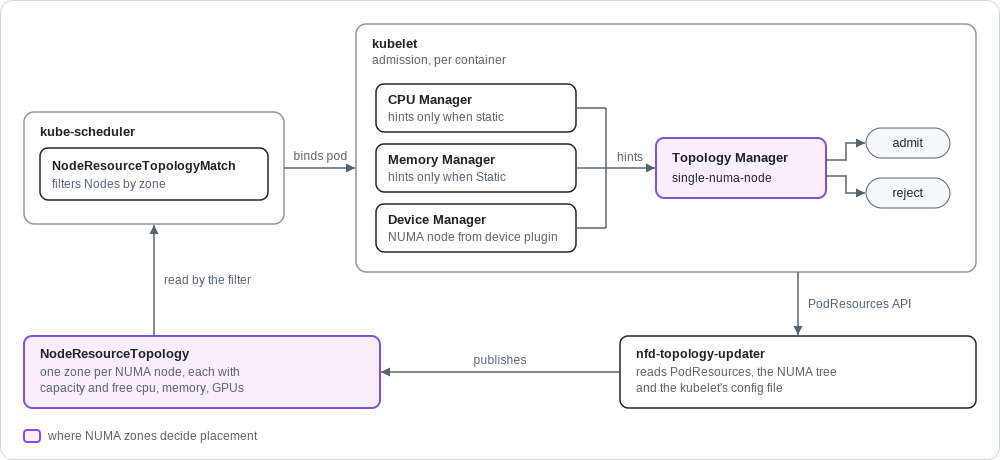
Jonathan Rosenboim has prototyped this idea in #1147 and #1148.
Each part of the NRT traces back to something Mokka has to put in place on the Node:
| In the NRT | NFD reads it from | Mokka provides |
|---|---|---|
| Zones and their costs | The NUMA tree, /sys/devices/system/node |
A zone for each NUMA node of the profile's PCIe root complexes, numbered from 0. Distance 10 within a zone and 21 between zones |
nvidia.com/gpu per zone |
PodResources. The kubelet takes each GPU's zone from the device plugin, which reads the GPU's PCI numa_node |
Each GPU's numa_node set to its root complex's zone. Its local_cpulist and NVML CPU affinity name that zone's CPUs |
cpu per zone |
PodResources, only under the static CPU Manager. The NUMA tree maps CPU IDs to zones | The Node's real CPU IDs, split across zones without separating a core's hyperthreads, or the profile's per-zone lists. The kubelet's static CPU Manager |
memory per zone |
PodResources, only under the static Memory Manager. Capacity comes from /sys/bus/node |
Host memory, split evenly across zones. The kubelet's static Memory Manager, and the memory-binding rewrite below |
topologyManagerPolicy and topologyManagerScope attributes |
The kubelet's config file | The policy, e.g. single-numa-node, and the scope, set on the kubelet |
| Availability | PodResources, rescanned on pod changes | Nothing. It's the kubelet's real allocations |
The NUMA trees look like this for a two-zone profile with GPU 0 in zone 0, on a host with 8 cores and 2 hyperthreads per core (CPUs N and N+8 are siblings). Like a real kernel's, they include files that neither the kubelet nor NFD reads. [Mokka] marks what the node daemon adds, [existing] what Mokka already serves, and [kernel] what stays as the kernel has it:
/sys
├── devices/system/
│   ├── node/                                   [Mokka] replaces the kernel's directory
│   │   ├── online, possible, has_cpu, …        0-1
│   │   ├── node0/                              zone 0
│   │   │   ├── cpu0 → ../../cpu/cpu0           CPUs 0-3 and their hyperthreads 8-11 (1)
│   │   │   ├── …
│   │   │   ├── cpulist                         0-3,8-11, read by KAI
│   │   │   ├── cpumap                          the same CPUs as a hex mask
│   │   │   ├── distance                        10 21, the zone's NRT costs (2)
│   │   │   ├── meminfo                         Node 0 MemTotal: host's ÷ 2 (2)
│   │   │   ├── memory0 → ../../memory/memory0  half the real blocks
│   │   │   ├── …
│   │   │   └── hugepages/                      empty (2)
│   │   └── node1/                              zone 1: CPUs 4-7,12-15, distance 21 10
│   ├── cpu/                                    [kernel] what the cpu<K> links point at (3)
│   └── memory/                                 [kernel] what the memory<M> links point at
└── bus/
    ├── node/devices/                           [Mokka] (4)
    │   ├── node0 → ../../../devices/system/node/node0
    │   └── node1 → ../../../devices/system/node/node1
    └── pci/devices/0000:18:00.0/               [existing] GPU 0
        ├── numa_node                           0
        └── local_cpulist                       0-3,8-11

/proc
├── meminfo                                     [kernel] MemTotal, split across the zones
└── <pid>/status                                [kernel] Mems_allowed_list
- The links point at the real CPU directories, so
online,core_id,physical_package_idand the caches stay the kernel's. The kubelet and NFD build cores fromcore_id, so a core's hyperthreads have to stay in one zone. Otherwise the kubelet counts that core as two. - Every zone needs
distance,meminfowith aMemTotalline, and ahugepages/directory, even an empty one. If a zone lacks one, NFD stops reading zones there and publishes only the ones before it, without an error. The kubelet tolerates a missing file, and that zone just loses the data. But if it can't parse a file, it can't detect the Node's CPUs and doesn't start. - The kernel's own
cpu<K>/node<N>links stay and point at the real zones. A tool that looks up a CPU's zone from the CPU side gets the kernel's answer, not Mokka's. The kubelet and NFD only look from the zone side. - These links point into the tree above, as on a real kernel, so NFD reads memory capacity from the same
meminfoandhugepages/. Without them, NFD sees only the kernel's own NUMA nodes, usually justnode0. Those resolve into Mokka's tree, so only they get the simulated capacity, and the other zones fall back to their allocatable. On kernels without NUMA support this directory doesn't exist, and NFD's topology updater exits at startup.
The kubelet and NFD each read the layout only once, when they start, so the order matters:
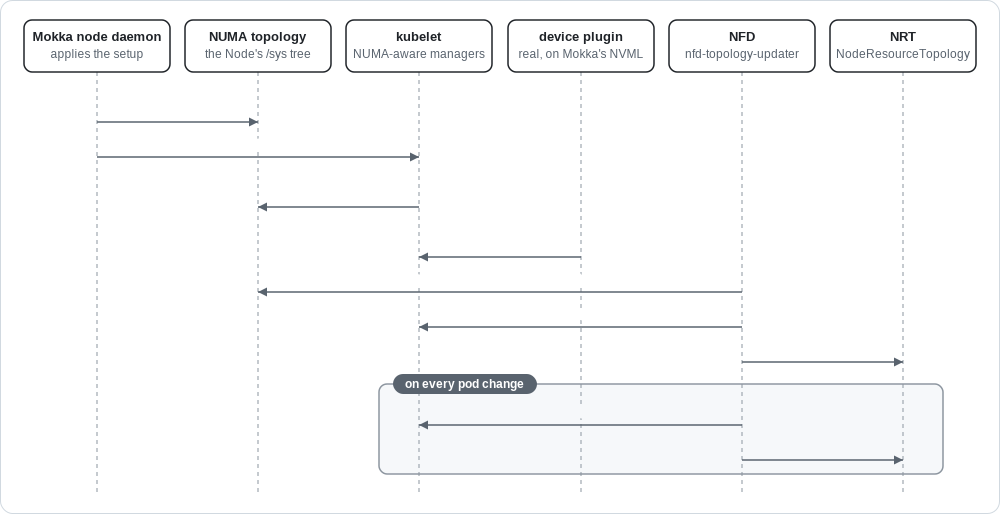
So a NUMA layout change means restarting the kubelet, and any NUMA layout or GPU change means restarting NFD.
Two constraints shape how Mokka does this:
- The NUMA topology lives in the Node's mount namespace. The node daemon mounts it there, read-only. The kubelet reads it directly, and NFD reads it through its hostPath mount of
/sys, so the kubelet and the NRT agree. A pod sees it only if it mounts the Node's/sys. It must not leak to other Kind Nodes on the same kernel. - Memory binding falls back to the kernel's real memory nodes. The static Memory Manager binds containers to the memory of zones the kernel doesn't have, and such containers fail to start. Mokka's NRI plugin rewrites the binding to the memory nodes the kernel allows. The kubelet's memory placement is simulated; physical memory locality isn't.
NUMA setup changes the Node itself:
- its sysfs topology
- its kubelet configuration
So it's opt-in and meant for disposable test Nodes. How the kubelet treats its state decides what changing the setup involves:
- Kubelet checkpoints. The kubelet keeps CPU and Memory Manager checkpoints in
/var/lib/kubeletand checks them against its policy and the layout it reads. So every policy or NUMA topology change deletes them. - A restarted kubelet admits every Pod again. With the checkpoints gone, the kubelet managers allocate CPUs and memory to running Pods as if they were new, and the CPU Manager moves their containers onto the new CPUs. A Pod the new policy can't fit is marked
Failedand stopped. Draining the Node first avoids that.
Each step follows from these:
- Apply. When the node daemon starts and doesn't find the setup in place, it mounts the NUMA topology, configures the kubelet managers, deletes the checkpoints, and restarts the kubelet and NFD.
- Restart the node daemon. When its Pod stops, the node daemon reverts the rest of what it set up on the Node, but leaves this setup in place, because undoing it restarts the kubelet. The new Pod finds the setup in place and doesn't apply it again.
- Reboot the Node. The
/sysmounts are gone, but the kubelet configuration and checkpoints remain. A customsystemdunit, installed with the Mokka node daemon setup, runs before the kubelet. It restores the kubelet configuration Mokka found and deletes the checkpoints, so the kubelet starts with the kernel's layout. As with the rest of Mokka's Node state, the node daemon applies the setup again when it starts. - Change the NUMA layout. Undo the setup, then apply the new layout.
- Revert. The node daemon unmounts the NUMA topology, removes the
systemdunit, restores the kubelet configuration, deletes the checkpoints, and restarts the kubelet and NFD.
In KWOK mode, KWOK virtual nodes have no kubelet or NFD. The KWOK data plane writes their NRT from the same layout, taking each GPU's NUMA node from the rack.
Milestones
We propose two milestones, each ending with something users can run. CPU Nodes come first, since the KWOK data plane reuses their layout. MEP0008's Milestones put them together with MEP0008's and MEP0009's in one plan.
- M1: NUMA setup on CPU Nodes. The node daemon gives a Node its profile's NUMA layout, one zone for each NUMA node of the profile's PCIe root complexes with the host's CPUs and memory split across them, and configures the kubelet's NUMA-aware managers. Mokka's NRI plugin rewrites containers' memory binding, and the setup is opt-in. Done when the first two user stories pass on Kind.
- M2: NodeResourceTopology on KWOK Nodes. The KWOK data plane writes each KWOK Node's NRT from M1's layout, taking each GPU's NUMA node from the rack. It charges each Guaranteed container to one zone, picks its GPUs from that zone in
DevicePluginmode, and fails a GPU Pod that fits no zone withTopologyAffinityError, as the kubelet would. The chart getskwok.dataPlane.nodeResourceTopology.enabled. It builds on the data plane, GPU allocation and Pod admission of MEP0008's M1, and can run alongside MEP0008's M2 and M3. Done when KAI's NUMA tests pass on KWOK Nodes and a KWOK rack group gets NRTs that match its CPU Nodes', as the third user story describes.
Drawbacks
- NUMA setup is invasive. It changes the Node itself, not only what Mokka simulates on it. As NUMA Setup describes, the node daemon rewrites the kubelet configuration, deletes the kubelet's checkpoints, restarts the kubelet and NFD, and installs a
systemdunit that runs before the kubelet on every boot. The restarted kubelet admits every running Pod again and marks any Pod the new policy can't fit asFailed, and a NUMA file it can't parse keeps it from starting at all. The setup also relies on how the kubelet and NFD read the NUMA tree today, such as NFD silently dropping every zone from the first one that lacks a file, and either project can change that in a release. So it suits only Nodes that Mokka is free to reconfigure, such as Kind Nodes, and it depends on Mokka's NRI plugin to rewrite containers' memory binding.
Decisions
The main decisions this MEP makes, numbered for review. Each links to the sections that explain it and the smaller choices that follow from it.
| ID | Decision | Rather than | Why | See |
|---|---|---|---|---|
| D1 | On CPU Nodes, give the Node its GPU profile's NUMA layout and configure the kubelet's NUMA-aware managers, so the real kubelet and NFD produce the NRT | fabricating the NRT, as FGO does from a pool's numa block |
The kubelet admits and places Pods by the same zones the NRT shows, so a placement a real Node would reject fails here too | Background, NUMA Setup |
| D2 | Make one zone for each NUMA node of the profile's PCIe root complexes, and split the host's real CPUs and memory across the zones | sizing zones independently of the host, as FGO's cpuPerZone and memPerZone do |
The real kubelet hands out the host's own CPUs and memory, so zones can only regroup what the host has | NUMA Setup, Non-Goals |
| D3 | Mount the NUMA topology read-only into the Node's own mount namespace, where the kubelet reads it directly and NFD through its hostPath mount of /sys |
— | The kubelet and the NRT see the same zones, and the layout doesn't leak to other Kind Nodes on the same kernel | NUMA Setup |
| D4 | Rewrite containers' memory binding to the kernel's real memory nodes with Mokka's NRI plugin, and refuse NUMA setup while the plugin is off | — | The static Memory Manager binds containers to the memory of zones the kernel doesn't have, and such containers fail to start | NUMA Setup, Risks and Mitigations |
| D5 | Make NUMA setup opt-in and meant for disposable test Nodes, such as Kind Nodes | — | It rewrites the kubelet's configuration, deletes its checkpoints and restarts the kubelet and NFD, and the restarted kubelet admits every running Pod again | NUMA Setup, Drawbacks |
| D6 | Keep the setup when the node daemon restarts, and install a systemd unit that restores the kubelet's own configuration before the kubelet starts after a reboot |
reverting it whenever the node daemon's Pod stops, like the rest of its Node state | Undoing the setup restarts the kubelet, and after a reboot the kubelet's configuration and checkpoints remain while the /sys mounts are gone |
NUMA Setup |
| D7 | On KWOK Nodes, have MEP0008's KWOK data plane write the NRT from the same layout, taking each GPU's NUMA node from the rack | — | KWOK Nodes have no kubelet or NFD, and they get the same NRT as CPU Nodes with the same profile | NUMA Setup, MEP0008's NodeResourceTopology |