

state_accuracy (FET022 Driven Joints)#
Property |
Value |
|---|---|
Test name |
state_accuracy |
Feature(s) |
|
Engine |
Kit / Isaac Sim (>=2024.2.0) |
Test version |
1.2.9 |
Wall-clock timeout |
600 seconds |
Nominal Initial Settling#
Before measuring the response, the phase requests complete ctx.step_one()
ticks for the configured initial settling interval, rounded up from
settle_seconds * physics_fps. Zero settling is allowed; FPS must be finite
and positive, and settling seconds finite and nonnegative. Invalid timing
configuration or failed ticks remain execution errors, not asset verdicts.
This is nominal requested tick time, not measured solver or wall-clock time;
render/capture work is separate. The processing-only ctx.physics_steps()
helper is not used to establish this interval.
Summary#
Commands each driven joint through a five-waypoint sequence and verifies that the reported joint position matches the commanded position within tolerance at each waypoint.
Optional Motion Evidence#
An optional sta_joint_NNN history records the existing position and velocity
readbacks, the actual smoothstep command (target), the final waypoint
(final_goal), and both command and final-goal errors. A ramp command is not
labelled as the final goal. Each bounded ramp completes its full smoothstep
command sequence and sends its endpoint before settling, even when readbacks
enter a coarse goal band sooner. The hold records that actual last command;
recording sends no commands or ticks. Each waypoint has separate ramp/settle
phases in one cumulative per-joint clock.
Joint metadata identifies radians/radians-per-second for revolute joints.
Prismatic tensor scaling is unqualified and remains unknown_native, with
stage meters-per-unit recorded as context; unresolved identity also stays
unknown. Raw USD body/bounding-box distances remain stage lengths.
Time is estimated from observed physics steps and
configured physics_fps, excluding capture/render and setup ticks. A capture
references the preceding retained observation rather than an exact video-frame
timestamp. Up to 4096 samples are retained per history, normally every fourth
sample plus phase changes. Diagnostic recording failures mark evidence partial
and warn without changing finite response criteria. Unavailable or invalid
required verdict readbacks stop as setup/runtime errors. Older runners without
the motion API execute normally.
Independent Control Ownership#
Declared mimic followers, passive coordinates and identified loop joints receive no independent position, target or velocity writes, including restoration where used. Their live motion remains determined by authored coupling/dynamics. Other independent coordinates retain the existing starting hold targets; eligibility, target selection and response criteria are unchanged. Sparse commands must use a genuine indexed runtime API: an unqualified backend stops with a setup/capability error before excitation, never an asset-response FAIL. Core requires the selected PhysX engine for this procedure. Newton’s separately owned implementation and backend qualification are not established by this page. No-applicable-joint cases still skip before control checks.
Required Runtime State#
Missing, non-finite or wrong-shaped runtime state needed by control or the verdict stops the test as a setup/runtime error, not conformance PASS or an evaluated asset-response FAIL. Optional extra motion readbacks remain nullable and can mark diagnostic evidence partial. Position criteria and timing are unchanged; all five waypoints are now kept inside valid reported joint limits.
Spatial Safety Observation#
The safety guard compares required finite live articulation geometry with a
frozen setup reach reference derived from owned body geometry, joint-anchor
offsets and bounded prismatic travel, when that topology can be qualified.
The configured volume-margin factor is applied as its cube root to this span;
ordinary bending from a slender initial pose is not judged against that pose’s
small volume. Unsupported topology retains an explicitly unqualified initial
volume proxy. sta_guard_reference records the basis and qualification;
sta_guard_abort retains a detected guard interruption when diagnostics
are available. Raw initial-box metrics remain observations, not the qualified
reach reference.
A guard trip interrupts execution as a runtime/setup error with incomplete response coverage, not an evaluated joint/target failure or an asset-defect diagnosis. Required geometry errors also propagate; optional diagnostic persistence cannot disable the guard or replace its original cause. Inspect completed observations/timing records where supplied, rather than assuming all planned motion ran. No extra physics steps or acceptance tolerances are introduced; native qualification of the reported asset remains separate.
What Pass Guarantees#
A passing result confirms that sampled position readbacks satisfy the existing waypoint criterion after the bounded smoothstep ramp has commanded its final goal. Only the following hold may end early on consecutive settled samples; the ramp does not truncate or jump to its endpoint. Consult actual command and final-goal channels separately. It does not provide an independent calibration of joint-state reporting or rule out noise and tracking errors between those samples.
What It Checks#
The test commands each non-passive, non-mimic-follower joint through five
waypoints: a zero-derived center clamped to the legal interior, a positive step,
back to center, a negative step, and back to center again. The step size is the smaller of max_step_deg (default
15 degrees) and step_range_fraction (default 10 percent) of the full joint
range. test_duration_seconds (default 3.0 s) budgets the five-waypoint motion
sequence, not a separate three-second settle for each waypoint or a strict
whole-sequence deadline. The per-waypoint settle budget is half a nominal
second (at least 30 ticks), and each ramp retains a minimum of 30 ticks after
deducting those holds from the configured sequence window. At the default
240 Hz this permits 750 nominal ticks (3.125 seconds) before hold early exits,
excluding initial setup and capture/render work. The eventual readback is
compared against the final goal. A joint
fails if the position error at any waypoint exceeds position_tolerance_deg
(default 5 degrees for angular evaluation). This legacy angular configuration
does not establish a calibrated linear-joint distance tolerance. The test skips when no
testable joints are found.
How It Works#
Joints are tested in isolation. For each joint, the drive is commanded to each of the five waypoints in sequence. The test waits for the settling duration at each waypoint and then samples the current joint position from the articulation state. The absolute position error is computed and compared to the tolerance. If any waypoint error exceeds the tolerance, the joint is counted as failed, and the test fails.
Core owns this PhysX/Isaac implementation and retains its existing scene setup
and timing. This wrapper explicitly requests zero gravity: it measures command
tracking, not gravity compensation. Authored world constraints remain in effect;
a qualified standalone gripper can receive the shared setup’s temporary world
pin, but this procedure does not attach a carrier or guarantee a fixed base for
every articulation. It commands and reads back the asset’s authored drives without
rewriting their gains. Newton owns a separate implementation and its own scene
setup; see the Newton tier’s
source guide
nv_core/tiers/simready_foundation_tier_newton/simready/foundation/tier_newton/runtime_tests/docs/runtime-tests.md
for its behavior and diagnostic caveats.
Failure Cases#
Symptom |
Checks before assigning a cause |
|---|---|
Position error exceeds the configured criterion |
Compare actual command and final goal, selected variant, readback units, drive/axis mapping, gravity and settling setup |
Error only on one direction |
Check limit clipping, center/goal assumptions and imported coupling before changing authored offsets |
Error grows with each waypoint |
Inspect sampled commands/readbacks and phase timing; drift alone does not identify an unsafe gain value |
How to Fix#
Preserve the original asset and run. Match the exact provider/test/version, selected variant, actual commands and final goals to the raw motion evidence. Verify authored versus runtime units, drive/state API mappings, limits, coupling, mass/inertia and solver/test setup before calling this an asset defect.
Only repair a demonstrated contract violation. A test assumption about center, timing or linear units can instead require a provider issue. Retuning belongs outside Evaluate; do not paste generic gains, change ratings or relax tolerance solely to force a pass.
Expected Result#
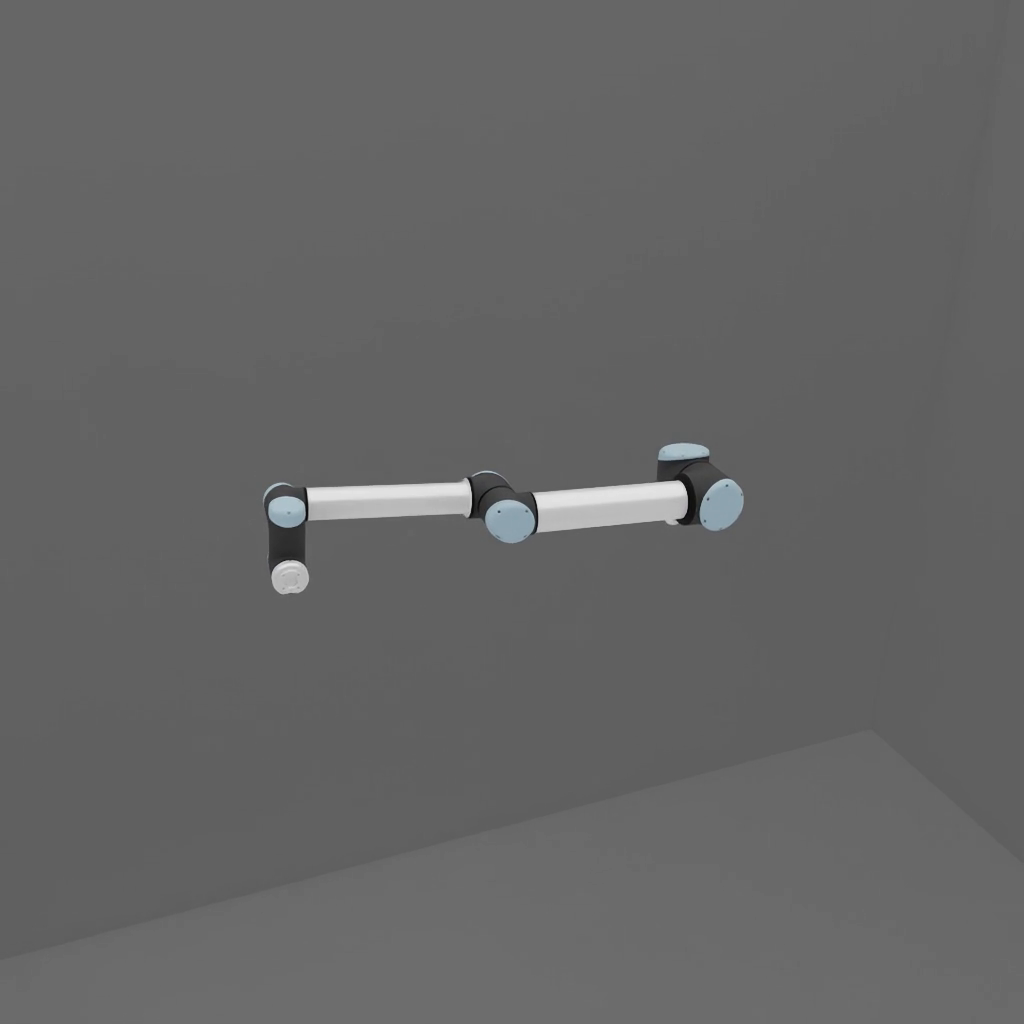
Each joint visits five waypoints in sequence: the legal center, a positive directional target, center again, a negative directional target, and center again. Clipping can make a directional target coincide with center for an offset range. The video and graphs show the observed response. Drift, oscillation or failure to reach a final goal warrants investigation; it does not by itself identify drive stiffness or damping as the cause.
Notes and Caveats#
The test skips when no eligible joints remain after passive, mimic-follower, loop and runtime-range selection. A skip supplies no measured response coverage.
The waypoint sequence is designed to exercise both the positive and negative direction of the drive and to confirm that the joint returns reproducibly to the center goal. The center is the nearest legal interior point to zero, not the asset’s authored home. The interior margin is the smaller of 0.05 native units and 10 percent of the reported range, so narrow ranges are not inverted. When zero lies outside the range, one directional step can coincide with center; the sequence does not guarantee two distinct excursions. Nonfinite, inverted or native ranges narrower than 0.01 are not selected; this is a procedure eligibility threshold, not a universal authored travel requirement. Never expand authored limits to fit a zero-centered test assumption.
The corresponding Newton FET022 tests are maintained by the Newton tier. Their implementation and controls are separate from Core’s PhysX/Isaac code; this page describes only the Core test listed in the metadata table above.