

velocity_limit (FET022 Driven Joints)#
Property |
Value |
|---|---|
Test name |
velocity_limit |
Feature(s) |
|
Engine |
Kit / Isaac Sim (>=2024.2.0) |
Test version |
1.1.11 |
Wall-clock timeout |
600 seconds |
Nominal Initial Settling#
Before measuring the response, the phase requests complete ctx.step_one()
ticks for the configured initial settling interval, rounded up from
settle_seconds * physics_fps. Zero settling is allowed; FPS must be finite
and positive, and settling seconds finite and nonnegative. Invalid timing
configuration or failed ticks remain execution errors, not asset verdicts.
This is nominal requested tick time, not measured solver or wall-clock time;
render/capture work is separate. The processing-only ctx.physics_steps()
helper is not used to establish this interval.
Summary#
Drives each non-passive, non-mimic-follower joint individually and verifies that
the measured velocity stays within the resolved runtime/authored/actuator
comparison ceiling during the evaluated simulation-step window. Inspect
max_velocity_source; a PASS does not establish authored hard-cap enforcement.
Optional Motion Evidence#
An optional vel_joint_NNN history records the existing signed velocity
readback, the actual position command, the resolved speed ceiling, and the
ceiling with the configured tolerance. The unchanged verdict compares the
absolute velocity with the allowed speed, not the signed velocity alone.
Metadata identifies the limit source and joint type; angular tensor values
are in radians/radians-per-second. Prismatic tensor scaling is unqualified,
so the diagnostic channels use unknown_native; stage meters-per-unit does
not prove their scale. Unresolved identities also remain unknown. Raw USD
body/bounding-box distances remain stage lengths. This evidence-unit caveat
does not convert comparison inputs or change the existing verdict policy.
Time is estimated from observed physics steps and configured physics_fps,
excluding setup and capture/render ticks. Captures reference the preceding
retained observation, not an exact solver/video time mapping. Histories retain
at most 4096 samples, normally every fourth sample plus phase changes. Optional
recording failures warn and mark evidence partial; no extra physics steps or
required readbacks are added, and old runners without motion support execute
normally. Sparse plotted evidence is diagnostic and does not replace the
evaluated velocity observations used by the verdict (including its startup
exclusion below).
Independent Control Ownership#
Declared mimic followers, passive coordinates and identified loop joints receive no independent position, target or velocity writes, including restoration where used. Their live motion remains determined by authored coupling/dynamics. Other independent coordinates retain the existing starting hold targets; eligibility, target selection and response criteria are unchanged. Sparse commands must use a genuine indexed runtime API: an unqualified backend stops with a setup/capability error before excitation, never an asset-response FAIL. Core requires the selected PhysX engine for this procedure. Newton’s separately owned implementation and backend qualification are not established by this page. No-applicable-joint cases still skip before control checks.
Required Runtime State#
Missing, non-finite or wrong-shaped runtime state needed by control or the verdict stops the test as a setup/runtime error, not conformance PASS or an evaluated asset-response FAIL. Optional extra motion readbacks remain nullable and can mark diagnostic evidence partial. Eligible-joint goals, finite response criteria, timing and configured failure policies are unchanged; command ownership now leaves dependent/passive control buffers untouched.
Spatial Safety Observation#
The safety guard compares required finite live articulation geometry with a
frozen setup reach reference derived from owned body geometry, joint-anchor
offsets and bounded prismatic travel, when that topology can be qualified.
The configured volume-margin factor is applied as its cube root to this span;
ordinary bending from a slender initial pose is not judged against that pose’s
small volume. Unsupported topology retains an explicitly unqualified initial
volume proxy. vel_guard_reference records the basis and qualification;
vel_guard_abort retains a detected guard interruption when diagnostics
are available. Raw initial-box metrics remain observations, not the qualified
reach reference.
A guard trip interrupts execution as a runtime/setup error with incomplete response coverage, not an evaluated joint/target failure or an asset-defect diagnosis. Required geometry errors also propagate; optional diagnostic persistence cannot disable the guard or replace its original cause. Inspect completed observations/timing records where supplied, rather than assuming all planned motion ran. No extra physics steps or acceptance tolerances are introduced; native qualification of the reported asset remains separate.
What Pass Guarantees#
A passing result confirms that the recorded absolute joint velocities in this evaluated window do not exceed the resolved ceiling plus tolerance. The existing criterion excludes the first five observations when more than ten were collected; shorter windows evaluate every collected observation. This does not establish a universal speed guarantee under other commands, loads, or excluded startup steps.
What It Checks#
The test drives each non-passive, non-mimic-follower joint individually from its
rest position toward a commanded target, measuring the actual joint velocity at
every frame during a test_duration_seconds window (default 2.0 s). For revolute
joints, physxJoint:maxJointVelocity is authored in degrees per second. The test
converts this value to radians per second and compares it against the per-frame
measured velocity, which is also in radians per second. The evaluated peak excludes
the first five startup observations when more than ten observations were collected.
A joint fails if the
peak measured velocity exceeds the resolved ceiling by more than
tolerance_percent (default 5 percent, that is, 0.05). If independent
coordinates exist but none has the required comparison ceiling and bounded
travel, execution stops with NO VERDICT. If every coordinate is excluded,
the existing skip records no_independent_coordinates only after complete
concrete owned composition and actual control-source inspection establish
that no independent coordinate exists. Cached exclusions or uninspected proxy
controls cannot provide that proof. When it is unavailable, the same skip
remains unmarked and reported as Could not assess, not measured asset FAIL or PASS.
The resolver combines runtime DOF ceilings with supported authored joint/actuator
velocity inputs; inspect max_velocity_source and typed histories. Passive,
mimic-follower and closed-loop joints are excluded. A separate spatial safety
guard can interrupt execution; that incomplete observation is not a measured
speed exceedance or independently failed joint response.
Version 1.1.6 treats the SDK’s rounded float32-maximum unlimited sentinel as missing comparison evidence, not a real speed ceiling or position stop. Raw authored sentinel values are rejected before angular unit conversion. A valid supported authored ceiling can still supply the comparison when the runtime reports unlimited speed; its provenance remains visible. Reversed, locked, one-sided or unbounded ranges do not receive an invented excursion or enormous setpoint. Such joints are omitted with visible prerequisite coverage limits; if none remain despite independent coordinates, execution supplies NO VERDICT. Finite eligible targets retain the opposite-range 5-percent inset and floating command construction preserves their fractional coordinates.
VEL’s authored fallback requires a uniquely resolved composed revolute or
prismatic joint and the matching angular/linear envelope instance. Duplicate
joint basenames (even when one has no ceiling) cannot arbitrarily supply a
rating, and a mismatched-axis value is not converted into the other joint’s
units. These limitations do not discard an independently meaningful native
ceiling. vel_joints_not_evaluated counts ineligible nonexcluded joints;
vel_joint_eligibility_omissions retains up to 64 names/reasons and
vel_joint_eligibility_omissions_truncated discloses omitted diagnostics.
A bounded warning states that the result covers only the eligible subset.
Missing optional schema support and absent/unusable authored values preserve the existing fallback policy. A supported selected joint’s schema, attribute, presence or value query failure is a required read error; it cannot become a native comparison ceiling or an applicability skip. The original exception propagates with the qualified property path noted best-effort. Core initialization also treats this as failed setup and attempts required teardown, retiring the session if cleanup fails.
Host regressions in test_authored_velocity_query_errors.py exercise real USD,
the installed legacy schema, VEL eligibility, IKR input gathering and Core
initialization with bounded native adapters. They establish input and
first-cause/cleanup behavior, not native speed-cap enforcement or asset PASS.
How It Works#
Velocity-cap requests contain positive finite values for tested coordinates; NaN slots mean preserve the existing native limit. The runtime boundary never submits those NaNs. It reads a complete live native row to preserve omitted coordinates, including existing zero caps and SDK unlimited defaults, or fails before writing if preservation is unavailable. Core initialization uses the same policy for unauthored coordinates and invents no substitute ceiling. Malformed requests, infinity, nonpositive requested caps and float32 overflow/underflow are rejected before native submission. Available readback must match the complete submitted float32 row exactly; an absent getter can acknowledge a fully specified safe request, with that limitation recorded in the helper detail, but cannot preserve omitted coordinates.
For a positively identified native revolute coordinate, the degree-to-radian conversion of the SDK’s float32-maximum default is also absent comparison evidence. This classification uses selected physical joint identity and the native rad/s contract. Authored ratings, linear coordinates and unqualified units are not discarded merely for matching that converted number. Native defaults retained as state do not become mechanical ratings.
vel_velocity_limit_application records reported_success, not_applied or
unknown from the runtime application helper; false/unknown outcomes warn and
are also retained in motion metadata. A successful helper return is not proof
that the engine physically enforces a hard cap:
vel_velocity_limit_enforcement remains not_verified. An application
exception stops execution instead of becoming a sampled PASS. These setup
observations do not replace the velocity criterion or create an arrival test.
Each joint is tested in isolation. The test sends a drive command that
can induce a fast response. The simulation runs at the configured rate (default
240 Hz), and the evaluated peak velocity is recorded. After
the window closes, the peak is compared against the resolved ceiling with the
tolerance margin applied, with the startup exclusion above. The window can end
early after the configured consecutive near-zero velocity condition is met.
If the evaluated peak exceeds limit * (1 + tolerance_percent),
the joint is counted as failed.
This test does not attach a carrier fixture. Authored world constraints remain
in effect, and qualified standalone grippers may receive a temporary world pin.
Inspect scene_info.pinned_to_world, the configured gravity and the authored
constraints when interpreting motion; not every robot base is fixed.
Failure Cases#
Symptom |
Likely cause |
|---|---|
Measured velocity exceeds resolved ceiling |
Check |
No evaluated joints |
Missing comparison ceilings or qualified travel leave execution incomplete. All excluded coordinates qualify Not applicable only with positive complete composition/control-inspection proof; otherwise the original unmarked skip is Could not assess. |
How to Fix#
First distinguish a measured speed exceedance from a spatial-guard interruption in the per-joint warnings. Preserve the original run and verify the selected variant, comparison-ceiling provenance, imported units, actuator controls and test setup; the observed failure does not establish its cause. Do not raise a rating to the observed peak, paste generic gains or relax tolerance solely to force a pass.
If the joint limit is the demonstrated source, verify that physxJoint:maxJointVelocity is
authored on the correct prim (the joint prim that carries PhysxJointAPI), and
that the value is in degrees per second for revolute joints or stage-distance per second
for prismatic joints. Confirm the joint type is one that PhysX applies a velocity
cap to (revolute and prismatic are supported; spherical and fixed joints are not).
If comparison inputs are demonstrably missing and velocity limiting is required by the governing contract, author the correct mechanism-specific rating in the required schema. Missing imported prerequisites or unqualified linear scaling can instead be a runtime/test issue; incomplete execution supplies no measured coverage.
Expected Result#
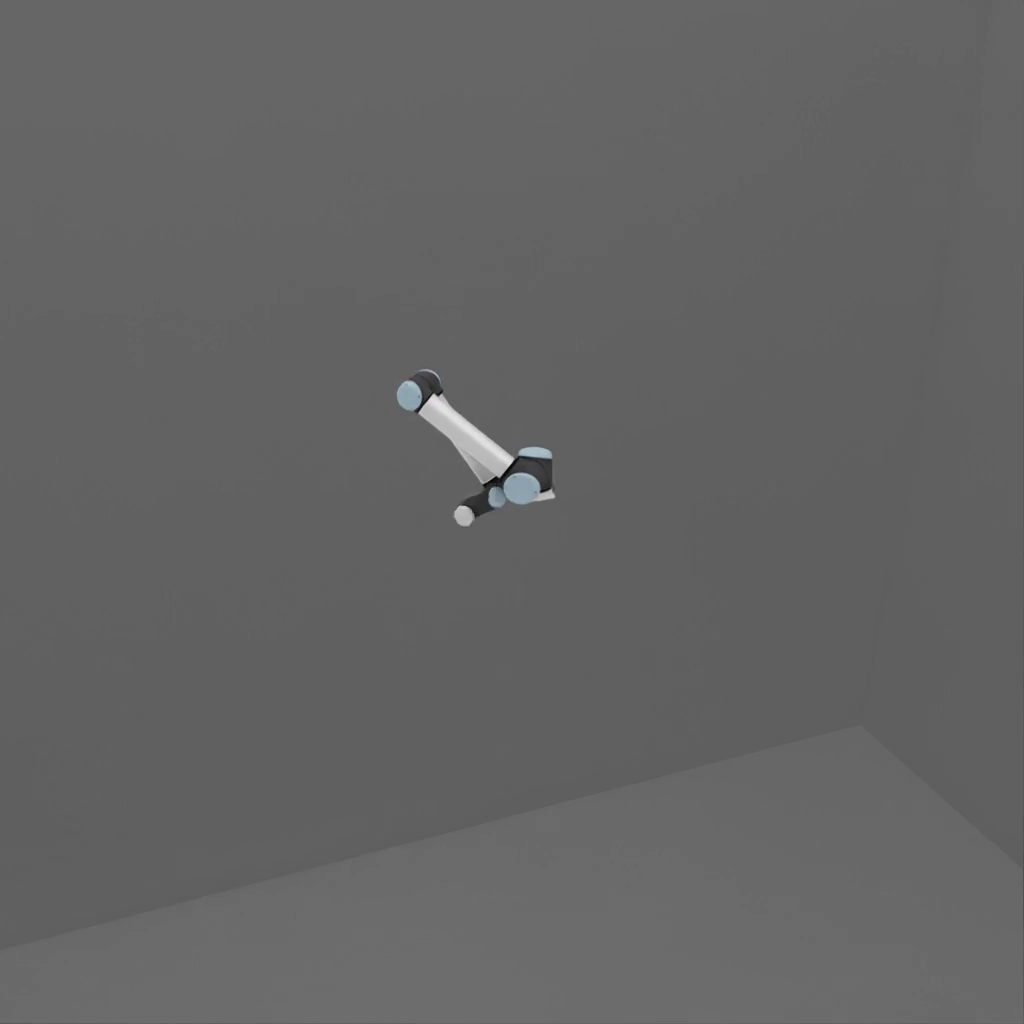
One joint receives a command per segment toward the opposite-range target; coupled joints and an unconstrained base may also move. Consult measured velocities and the resolved ceiling: smoothness in a sparse video is not itself a pass criterion or proof of hard-cap enforcement.
Notes and Caveats#
Not applicable requires positive complete inspection proof that no independent coordinates exist. An unqualified original skip stays unmarked/Could not assess; neither its message nor cached exclusions establish that proof. Missing resolved comparison ceilings or qualified bounded travel leave NO VERDICT. Mixed eligibility covers only the tested subset; omitted joints remain visible prerequisite limitations. A skip supplies no measured velocity coverage; it does not itself prove an asset defect or that all possible authoring/import paths lack a rating.
The tolerance margin (default 5 percent) accommodates one-frame overshoot at the simulation timestep boundary. A very stiff joint or a very fast drive might exhibit single-frame spikes; if those spikes are below the tolerance margin, the test passes.