AIDA
GlobalDAWindbornePyTorch40 GB
Import path: earth2studio.models.da.AIDA
View source on GitHub View install commands
Documentation
Bases: Module, AutoModelMixin
WindBorne's AI data assimilation model.
AIDA updates an ECMWF IFS ensemble background and NOAA OISST sea surface temperature every three hours using satellite radiances and winds, GPS radio occultation, radiosondes, and surface reports. WindBorne soundings are optional. The input time is the analysis valid time: the background precedes it by nine hours (six for two updates). The result is one analysis at lead zero, with instantaneous surface and pressure-level fields on a global 0.25° latitude-longitude grid (720 × 1440).
Parameters:
-
core_model(Module) –WeatherMesh-5c network with AIDA.
-
assimilation_steps(int, default:3) –Two or three three-hour updates, by default 3
-
max_observations(int | None, default:None) –Per-source, per-update report cap, by default None
-
variables(tuple[str, ...] | None, default:None) –Instantaneous analysis fields, by default all supported instantaneous fields
Note
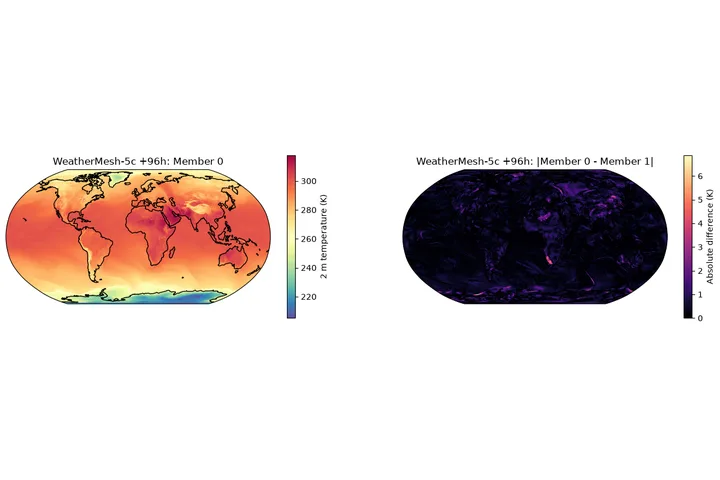
For forecasts and learned ensemble branching, use
AIDAWeatherMesh5C with
[CoupledRunner][earth2studio.coupling.CoupledRunner] and set source_member
to choose the IFS background for each member. See the WindBorne AI DA article, the
model card, and the
runtime.
__call__ 
__call__(
    background: DataArray,
    sst: DataArray,
    mhs: ObservationInput = None,
    amsua: ObservationInput = None,
    atms: ObservationInput = None,
    iasi: ObservationInput = None,
    gpsro: ObservationInput = None,
    radiosonde: ObservationInput = None,
    windborne: ObservationInput = None,
    satwnd: ObservationInput = None,
    surface: ObservationInput = None,
) -> DataArray
Compute an analysis from background fields and observation frames.
Parameters:
-
background(DataArray) –Background fields at the declared negative lead time.
-
sst(DataArray) –Background fields at the declared negative lead time.
-
mhs(DataFrame | DataFrame | None, default:None) –Wide raw observations as declared by
input_coords(), by default None. Satellite frames carry the source channel axis in their attrs; IASI uses raw radiances in the model's selected channel order. -
amsua(DataFrame | DataFrame | None, default:None) –Wide raw observations as declared by
input_coords(), by default None. Satellite frames carry the source channel axis in their attrs; IASI uses raw radiances in the model's selected channel order. -
atms(DataFrame | DataFrame | None, default:None) –Wide raw observations as declared by
input_coords(), by default None. Satellite frames carry the source channel axis in their attrs; IASI uses raw radiances in the model's selected channel order. -
iasi(DataFrame | DataFrame | None, default:None) –Wide raw observations as declared by
input_coords(), by default None. Satellite frames carry the source channel axis in their attrs; IASI uses raw radiances in the model's selected channel order. -
gpsro(DataFrame | DataFrame | None, default:None) –Wide raw observations as declared by
input_coords(), by default None. Satellite frames carry the source channel axis in their attrs; IASI uses raw radiances in the model's selected channel order. -
radiosonde(DataFrame | DataFrame | None, default:None) –Wide raw observations as declared by
input_coords(), by default None. Satellite frames carry the source channel axis in their attrs; IASI uses raw radiances in the model's selected channel order. -
windborne(DataFrame | DataFrame | None, default:None) –Wide raw observations as declared by
input_coords(), by default None. Satellite frames carry the source channel axis in their attrs; IASI uses raw radiances in the model's selected channel order. -
satwnd(DataFrame | DataFrame | None, default:None) –Wide raw observations as declared by
input_coords(), by default None. Satellite frames carry the source channel axis in their attrs; IASI uses raw radiances in the model's selected channel order. -
surface(DataFrame | DataFrame | None, default:None) –Wide raw observations as declared by
input_coords(), by default None. Satellite frames carry the source channel axis in their attrs; IASI uses raw radiances in the model's selected channel order.
Returns:
-
DataArray–Instantaneous analysis fields at analysis time.
set_rng 
input_coords 
Declare IFS, SST and nine optional raw-observation slots.
Returns:
-
tuple[CoordinateSystem | FrameSchema, ...]–Background fields at -9h (or -6h), followed by per-sensor frames.
output_coords 
output_coords(
    background: DataArray,
    sst: DataArray,
    mhs: FrameSchema | None = None,
    amsua: FrameSchema | None = None,
    atms: FrameSchema | None = None,
    iasi: FrameSchema | None = None,
    gpsro: FrameSchema | None = None,
    radiosonde: FrameSchema | None = None,
    windborne: FrameSchema | None = None,
    satwnd: FrameSchema | None = None,
    surface: FrameSchema | None = None,
) -> DataArray
Plan instantaneous physical fields at analysis time.
Parameters:
-
background(CoordinateSystem) –IFS and SST background signatures.
-
sst(CoordinateSystem) –IFS and SST background signatures.
-
mhs(FrameSchema | None, default:None) –Optional raw observation schemas, by default None
-
amsua(FrameSchema | None, default:None) –Optional raw observation schemas, by default None
-
atms(FrameSchema | None, default:None) –Optional raw observation schemas, by default None
-
iasi(FrameSchema | None, default:None) –Optional raw observation schemas, by default None
-
gpsro(FrameSchema | None, default:None) –Optional raw observation schemas, by default None
-
radiosonde(FrameSchema | None, default:None) –Optional raw observation schemas, by default None
-
windborne(FrameSchema | None, default:None) –Optional raw observation schemas, by default None
-
satwnd(FrameSchema | None, default:None) –Optional raw observation schemas, by default None
-
surface(FrameSchema | None, default:None) –Optional raw observation schemas, by default None
Returns:
-
CoordinateSystem–Instantaneous analysis at lead zero for the declared input offsets.
default_sources 
Recommend standard Earth2 inputs in declared slot order.
Returns:
-
tuple–IFS (Google Cloud mirror), prior-day OISST, standard satellite and conventional sources. The WindBorne slot is empty unless the caller supplies a source.
load_default_package
classmethod

load_default_package() -> Package
Load the default WeatherMesh-5c/AIDA package.
load_model
classmethod

load_model(
    package: Package,
    variables: tuple[str, ...] | None = None,
    *,
    assimilation_steps: int = 3,
    max_observations: int | None = None
) -> AIDA
Load AIDA on CPU in evaluation mode.
Parameters:
-
package(Package) –Checkpoint and assets resolved through the standard package cache.
-
variables(tuple[str, ...] | None, default:None) –Output fields, by default all supported fields for this model
-
assimilation_steps(int, default:3) –Number of three-hour AIDA updates, by default 3
-
max_observations(int | None, default:None) –Maximum reports per source per update, by default None
Returns:
-
AIDA–Loaded analysis model in evaluation mode.