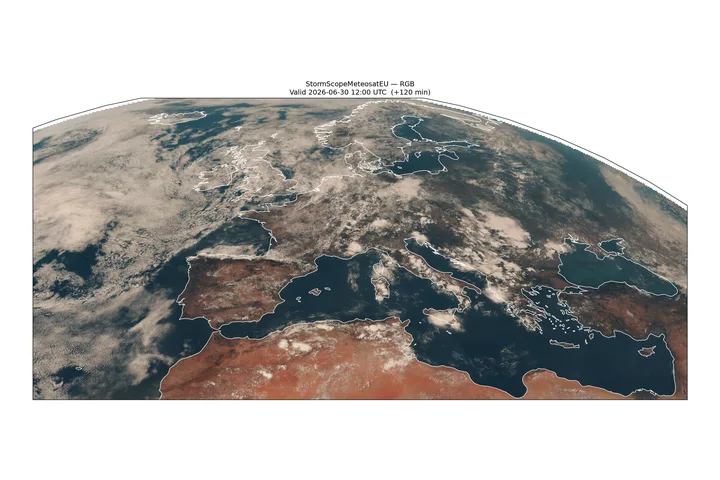
StormScopeMeteosatEU
EUNWC202680 GBNVIDIAPyTorch
Import path: earth2studio.models.px.StormScopeMeteosatEU
Documentation
Bases: Module, AutoModelMixin, PrognosticMixin
Generative diffusion nowcasting model for MTG-I1 FCI satellite imagery.
Predicts MTG Full Combined Imager (FCI) frames from len(input_times)
consecutive input frames at 10-min resolution. Uses an "ensemble of experts"
denoising strategy: the diffusion sampler is invoked in stages, each using a
different set of model weights applicable to a specific sigma range, as defined
by model_spec.
The model runs on a crop of the 2 km FCI full-disk grid
(mtg-fci-fulldisk-2km) over Europe, labelled by FCI scan angles.
default_sources fetches every channel on that crop, block-averaging the
1 km visible and near-infrared channels. Regional views from
with_region run on the full domain, because the networks' positional
embeddings fix their input size, and crop_output crops forecasts to the
requested region.
Parameters:
-
model_spec(list[dict[str, Any]]) –Sequence of stage specifications. Each entry must contain:
model: torch.nn.Modulesigma_min: floatsigma_max: float
The sigma interval determines which expert is applied during denoising. The ranges must combine to a single continuous interval with no gaps or overlaps.
-
means(Tensor) –Per-channel mean of raw pixel counts used for normalisation, shape
(C, 1, 1). -
stds(Tensor) –Per-channel standard deviation of raw pixel counts used for normalisation, shape
(C, 1, 1). -
scale_factor(Tensor) –Per-channel multiplicative factor for the raw-to-physical radiance conversion, shape
(C, 1, 1). -
add_offset(Tensor) –Per-channel additive offset for the raw-to-physical radiance conversion, shape
(C, 1, 1). -
invariants(Tensor) –Static invariant fields (e.g. orography, land-sea mask) on the model grid, shape
(1, C_inv, H, W). -
latitudes(Tensor) –Latitudes of the model grid used for solar angles, shape
(H, W). -
longitudes(Tensor) –Longitudes of the model grid used for solar angles, shape
(H, W). -
earth_mask(Tensor) –Boolean mask where
Trueindicates pixels over Earth (land or ocean), shape(H, W). -
y_coords(ndarray) –FCI y scan angles (radians) of the model grid rows, a contiguous run of the 2 km full-disk grid, shape
(H,). -
x_coords(ndarray) –FCI x scan angles (radians) of the model grid columns, a contiguous run of the 2 km full-disk grid, shape
(W,). -
variables(ndarray, default:array(VARIABLES)) –Channel names corresponding to the 16 FCI bands, by default
np.array(VARIABLES) -
sampler_args(dict[str, float | int] | None, default:None) –Overrides for the EDM sampler/scheduler. Recognised keys:
sigma_min,sigma_max,rho(scheduler),num_steps(sampling steps, 48 by default) andS_churn,S_min,S_max,S_noise(solver).sigma_min/sigma_maxmust fall within the combined sigma range spanned bymodel_specand default to that combined range if not given. Other unspecified keys use sensible defaults, by default None -
input_times(ndarray, default:arange(-5, 1) * timedelta64(10, 'm')) –Context-window time offsets relative to the analysis time; each element is a
np.timedelta64. The number of elementsLdetermines the sliding-window length, by default a 6-frame window[-50 min, …, 0 min] -
output_times(ndarray, default:array([timedelta64(10, 'm')])) –Output time offsets relative to the analysis time; single-step prediction only, by default
[10 min] -
ir_38_warm_scale_factor(float, default:0.024222141) –Multiplier applied to the above-threshold branch of the ir_38 channel after raw-to-physical conversion, by default 0.024222141
-
ir_38_warm_threshold(float, default:4095.0) –Raw digital-count boundary (the 12-bit maximum) above which the warm/HDR ir_38 scaling is applied, by default 4095.0
-
batch_size(int, default:1) –Maximum number of samples processed per forward pass, by default 1
-
amp(bool, default:True) –Whether to use automatic mixed precision (bfloat16) during the diffusion forward pass, by default True
-
compile(bool, default:False) –Compile each denoising expert with
torch.compile; seecompile_experts. Default is False.
__call__ 
create_iterator 
load_model
classmethod

Load the prognostic model from a package.
Parameters:
-
package(Package) –Model package containing checkpoints and metadata.
-
amp(bool, default:True) –Use automatic mixed precision (bfloat16) in the experts, by default True
-
compile(bool, default:False) –Compile each expert with
torch.compile, by default False
Returns:
-
PrognosticModel–Loaded and initialised
StormScopeMeteosatEUmodel.