
Note
Go to the end to download the full example code.
Writing a Custom Hook: Radial Distribution Function#
The Hook protocol is nvalchemi-toolkit’s
primary extension point. Any object that has stage, frequency, and
__call__(ctx, stage) satisfies the protocol — no base class is
required. This duck-typing approach makes hooks easy to write and easy to
test in isolation.
The hook receives a DynamicsContext containing the
current workflow state (batch, step count, model, etc.) and the stage enum
value that triggered the call. The same protocol works for dynamics
and custom workflows — only the stage enum changes.
This example builds a full radial distribution function (RDF) accumulator as a custom hook. The RDF is the cornerstone structural observable in liquid simulations. For a homogeneous isotropic fluid it is defined as:
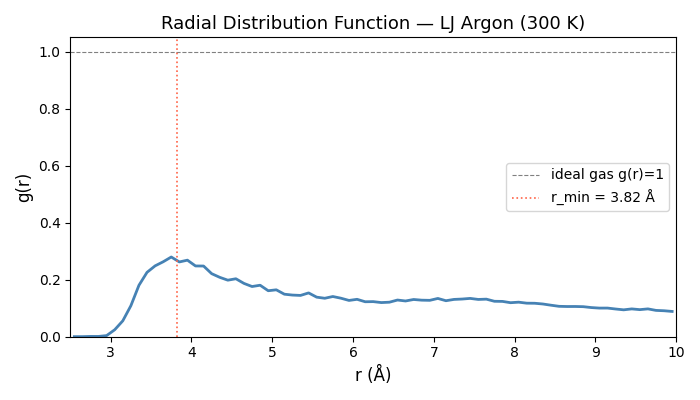
where V is the system volume, N the atom count, and the angle brackets denote a time average. A peak at ~3.8 Å in LJ argon corresponds to the nearest-neighbour shell.
Key concepts demonstrated#
The hook interface:
stage,frequency,__call__(ctx, stage).Accessing batch data via
ctx.batchand step info viactx.step_count.Accumulating statistics across steps with instance attributes.
Normalising the RDF and writing it to a text file.
from __future__ import annotations

import logging
import math
import os

import torch

from nvalchemi.data import AtomicData, Batch
from nvalchemi.dynamics import NVTLangevin
from nvalchemi.dynamics.base import DynamicsStage
from nvalchemi.hooks import DynamicsContext
from nvalchemi.models.lj import LennardJonesModelWrapper

logging.basicConfig(level=logging.INFO)
The Hook protocol#
A hook is any Python object with three things:
stage : EnumDeclares when the hook fires. Use a task-specific enum like
DynamicsStage. The engine dispatches hooks keyed by this attribute.frequency : intFire every N steps.
frequency=1fires every step;frequency=10fires on steps 0, 10, 20, … (step_count % frequency == 0).__call__(ctx: DynamicsContext, stage: Enum) -> NoneThe hook body.
ctx.batchgives you the current batch;ctx.step_countgives you the step number. Modify the batch in-place (post-compute hooks) or read it for observation.
No base class is needed. If a hook also implements __enter__ /
__exit__ the dynamics engine calls those around run() automatically,
which is useful for file handles and profilers.
class _MinimalHook:
    """A do-nothing hook that illustrates the protocol."""

    stage = DynamicsStage.AFTER_STEP
    frequency = 1  # fire every step

    def __call__(self, ctx: DynamicsContext, stage: DynamicsStage) -> None:
        pass  # read ctx.batch or ctx.step_count here
Implementing RadialDistributionHook#
The RDF accumulator fires at AFTER_STEP with a configurable frequency.
Pair distances are computed with torch.cdist() (O(N²) — fine for
small demo systems of ≤ 50 atoms).
When the run ends the accumulated histogram is normalised by the expected number of pairs in each spherical shell of an ideal gas at the same number density, yielding the dimensionless g(r).
class RadialDistributionHook:
    """Accumulate the radial distribution function during an MD run.

    Parameters
    ----------
    r_min : float
        Lower edge of the first bin (Å).  Pairs closer than this are ignored
        (avoids the divergence at r → 0 and the core repulsion region).
    r_max : float
        Upper edge of the last bin (Å).  Should be less than half the
        simulation box size for periodic systems.
    n_bins : int
        Number of histogram bins.
    output_path : str
        Path to write the normalised g(r) when :meth:`save_rdf` is called.
    frequency : int
        Accumulate every *frequency* steps.

    Attributes
    ----------
    rdf_histogram : torch.Tensor
        Accumulated raw pair-count histogram, shape ``(n_bins,)``.
    n_samples : int
        Number of times the histogram has been updated.
    """

    stage = DynamicsStage.AFTER_STEP

    def __init__(
        self,
        r_min: float = 2.0,
        r_max: float = 12.0,
        n_bins: int = 100,
        output_path: str = "rdf.dat",
        frequency: int = 5,
    ) -> None:
        self.r_min = r_min
        self.r_max = r_max
        self.n_bins = n_bins
        self.output_path = output_path
        self.frequency = frequency

        # Pre-compute bin edges and centres on CPU.
        self.bin_edges = torch.linspace(r_min, r_max, n_bins + 1)  # [n_bins+1]
        self.bin_centers = 0.5 * (self.bin_edges[:-1] + self.bin_edges[1:])  # [n_bins]
        self.bin_width = (r_max - r_min) / n_bins

        # Accumulators.
        self.rdf_histogram = torch.zeros(n_bins, dtype=torch.float64)
        self.n_samples: int = 0
        self._n_atoms: int = 0  # set from first batch

    def __call__(self, ctx: DynamicsContext, stage: DynamicsStage) -> None:
        """Accumulate pair distances into the histogram."""
        batch = ctx.batch
        # Process each graph (system) in the batch independently.
        ptr = batch.batch_ptr  # [B+1] — atom start/end indices per graph
        # NOTE: .cpu() forces a GPU→CPU synchronization here.  For a
        # production RDF hook on large systems, keep the histogram on GPU
        # (torch.histc works on CUDA) and only transfer the final g(r) result
        # once after the run.  The CPU path is used here for clarity.
        positions_cpu = batch.positions.detach().cpu()

        for g in range(batch.num_graphs):
            start = ptr[g].item()
            end = ptr[g + 1].item()
            pos_g = positions_cpu[start:end]  # [n_atoms, 3]
            n_atoms = pos_g.shape[0]

            if n_atoms < 2:
                continue

            # Pairwise distance matrix [n_atoms, n_atoms].
            dist_mat = torch.cdist(pos_g, pos_g)  # [n, n]

            # Extract upper triangle (i < j) to avoid double-counting.
            i_idx, j_idx = torch.triu_indices(n_atoms, n_atoms, offset=1)
            dists = dist_mat[i_idx, j_idx]  # [n_pairs]

            # Filter to [r_min, r_max).
            mask = (dists >= self.r_min) & (dists < self.r_max)
            dists_in_range = dists[mask]

            if dists_in_range.numel() > 0:
                counts = torch.histc(
                    dists_in_range.float(),
                    bins=self.n_bins,
                    min=self.r_min,
                    max=self.r_max,
                )
                self.rdf_histogram += counts.double()

            self._n_atoms = n_atoms  # record for normalisation

        self.n_samples += 1

    def get_rdf(
        self, density: float | None = None
    ) -> tuple[torch.Tensor, torch.Tensor]:
        """Compute the normalised g(r).

        Parameters
        ----------
        density : float | None
            Number density ρ = N/V in Å⁻³.  If ``None``, the denominator is
            the ideal-gas shell count for a box with N atoms in a volume
            inferred from N and a nominal density of 0.021 Å⁻³ (liquid Ar).
            Pass an explicit value for periodic-box simulations.

        Returns
        -------
        r : torch.Tensor
            Bin centres in Å, shape ``(n_bins,)``.
        g_r : torch.Tensor
            Normalised g(r), shape ``(n_bins,)``.
        """
        if self.n_samples == 0:
            return self.bin_centers, torch.zeros_like(self.bin_centers)

        n = max(self._n_atoms, 1)
        if density is None:
            density = 0.021  # approximate liquid argon Å⁻³

        # Ideal-gas pair count in each shell:
        # dn_ideal = ρ * N * 4π r² dr
        r = self.bin_centers.double()
        dr = float(self.bin_width)
        ideal_pairs_per_snapshot = density * n * 4.0 * math.pi * r**2 * dr

        # Scale by number of snapshots (frames) accumulated.
        total_ideal = ideal_pairs_per_snapshot * self.n_samples

        g_r = self.rdf_histogram / total_ideal.clamp(min=1e-12)
        return self.bin_centers.float(), g_r.float()

    def save_rdf(self, path: str | None = None, density: float | None = None) -> None:
        """Write the normalised g(r) to a two-column text file.

        Parameters
        ----------
        path : str | None
            Output path; falls back to ``self.output_path``.
        density : float | None
            Forwarded to :meth:`get_rdf`.
        """
        out_path = path if path is not None else self.output_path
        r, g_r = self.get_rdf(density=density)
        with open(out_path, "w") as fh:
            fh.write("# r(Angstrom)  g(r)\n")
            for ri, gi in zip(r.tolist(), g_r.tolist()):
                fh.write(f"{ri:.6f}  {gi:.6f}\n")
        logging.getLogger(__name__).info(
            "RDF written to %s (%d bins, %d samples)",
            out_path,
            self.n_bins,
            self.n_samples,
        )
Running with RadialDistributionHook#
Build a small LJ argon cluster and run 300 NVT steps. The RDF hook fires every 5 steps, accumulating 60 snapshots.
LJ_EPSILON = 0.0104
LJ_SIGMA = 3.40
LJ_CUTOFF = 8.5
_R_MIN_LJ = 2 ** (1 / 6) * LJ_SIGMA

model = LennardJonesModelWrapper(
    epsilon=LJ_EPSILON,
    sigma=LJ_SIGMA,
    cutoff=LJ_CUTOFF,
)


def _make_cluster(n_per_side: int = 2, seed: int = 0) -> AtomicData:
    n = n_per_side**3
    spacing = _R_MIN_LJ * 1.05
    coords = torch.arange(n_per_side, dtype=torch.float32) * spacing
    gx, gy, gz = torch.meshgrid(coords, coords, coords, indexing="ij")
    positions = torch.stack([gx.flatten(), gy.flatten(), gz.flatten()], dim=-1)
    torch.manual_seed(seed)
    positions = positions + 0.05 * torch.randn_like(positions)
    return AtomicData(
        positions=positions,
        atomic_numbers=torch.full((n,), 18, dtype=torch.long),
        forces=torch.zeros(n, 3),
        energy=torch.zeros(1, 1),
        velocities=0.1 * torch.randn(n, 3),
    )


batch = Batch.from_data_list([_make_cluster(n_per_side=4, seed=13)])

rdf_hook = RadialDistributionHook(
    r_min=2.5,
    r_max=10.0,
    n_bins=75,
    output_path="rdf_argon.dat",
    frequency=5,
)
nvt = NVTLangevin(
    model=model,
    dt=1.0,
    temperature=300.0,
    friction=0.1,
    n_steps=1000,
    random_seed=3,
)
for hook in model.make_neighbor_hooks():
    nvt.register_hook(hook, stage=DynamicsStage.BEFORE_COMPUTE)
nvt.register_hook(rdf_hook)

print(f"System: {batch.num_graphs} graph(s), {batch.num_nodes} atoms total")
batch = nvt.run(batch)

print(f"\nRun complete: {nvt.step_count} steps, {rdf_hook.n_samples} RDF snapshots")
rdf_hook.save_rdf()

# Print a brief summary of the RDF.
r_vals, g_vals = rdf_hook.get_rdf()
peak_idx = g_vals.argmax().item()
print(
    f"RDF peak at r ≈ {r_vals[peak_idx]:.2f} Å  "
    f"(expected ~{_R_MIN_LJ:.2f} Å for LJ Ar nearest-neighbour)"
)
System: 1 graph(s), 64 atoms total

Run complete: 1000 steps, 200 RDF snapshots
RDF peak at r ≈ 4.05 Å  (expected ~3.82 Å for LJ Ar nearest-neighbour)
Optional RDF plot#
Set NVALCHEMI_PLOT=1 to display the RDF figure.
Sphinx-gallery captures this as the example thumbnail.
if os.getenv("NVALCHEMI_PLOT", "0") == "1":
    try:
        import matplotlib.pyplot as plt

        r_vals, g_vals = rdf_hook.get_rdf()

        fig, ax = plt.subplots(figsize=(7, 4))
        ax.plot(r_vals.numpy(), g_vals.numpy(), color="steelblue", linewidth=2)
        ax.axhline(
            1.0, color="gray", linewidth=0.8, linestyle="--", label="ideal gas g(r)=1"
        )
        ax.axvline(
            _R_MIN_LJ,
            color="tomato",
            linewidth=1.2,
            linestyle=":",
            label=f"r_min = {_R_MIN_LJ:.2f} Å",
        )
        ax.set_xlabel("r (Å)", fontsize=12)
        ax.set_ylabel("g(r)", fontsize=12)
        ax.set_title("Radial Distribution Function — LJ Argon (300 K)", fontsize=13)
        ax.legend(fontsize=10)
        ax.set_xlim(rdf_hook.r_min, rdf_hook.r_max)
        ax.set_ylim(bottom=0)
        fig.tight_layout()
        plt.show()
    except ImportError:
        print("matplotlib not available — skipping plot.")
Total running time of the script: (0 minutes 1.094 seconds)