
Note
Go to the end to download the full example code.
Building a Custom Integrator by Subclassing BaseDynamics#
BaseDynamics is the single extension point
for writing new molecular dynamics integrators. Subclasses implement two
methods — pre_update(batch) and post_update(batch) — that bracket the
model forward pass (force computation).
The step sequence is:
BEFORE_STEP hooks
pre_update(batch)— BEFORE_PRE_UPDATE → update → AFTER_PRE_UPDATE hookscompute(batch)— BEFORE_COMPUTE → model forward → AFTER_COMPUTE hookspost_update(batch)— BEFORE_POST_UPDATE → update → AFTER_POST_UPDATE hooksAFTER_STEP hooks
Convergence check → ON_CONVERGE hooks
For Velocity Verlet this maps cleanly to the standard VV splitting:
pre_update: v(t + dt/2) = v(t) + (dt/2) F(t)/m; r(t+dt) = r(t) + dt v(t+dt/2)[model evaluates F(r(t+dt))]
post_update: v(t+dt) = v(t+dt/2) + (dt/2) F(t+dt)/m
This example implements a velocity-rescaling thermostat (Woodcock 1971) on top of Velocity Verlet. At every step velocities are rescaled so that the instantaneous kinetic temperature equals the target temperature exactly.
Warning
The velocity-rescaling thermostat is not a canonical (NVT) thermostat.
It samples a constant-kinetic-energy ensemble rather than the
Maxwell-Boltzmann distribution. It is included here solely to illustrate
the BaseDynamics API. Use NVTLangevin for
production NVT simulations.
from __future__ import annotations

import logging
import math
import os

import torch

from nvalchemi.data import AtomicData, Batch
from nvalchemi.dynamics import NVTLangevin
from nvalchemi.dynamics._units import fs_to_internal_time
from nvalchemi.dynamics.base import BaseDynamics, DynamicsStage

# KB_EV and kinetic_energy_per_graph are internal helpers used by the built-in
# integrators.  A stable public re-export may be added in a future release.
from nvalchemi.dynamics.hooks._utils import KB_EV, kinetic_energy_per_graph
from nvalchemi.hooks import DynamicsContext
from nvalchemi.models.lj import LennardJonesModelWrapper

logging.basicConfig(level=logging.INFO)
The BaseDynamics contract#
To create a new integrator, subclass BaseDynamics and override:
__needs_keys__ : set[str]Keys that the model must produce (validated after compute). Almost always
{"forces"}.__provides_keys__ : set[str]Keys that this dynamics writes to the batch. Declare
{"positions", "velocities"}for a velocity-based integrator.pre_update(batch) -> NoneUpdate positions (and half-kick velocities) in-place.
post_update(batch) -> NoneFinish the velocity update using the newly computed forces.
Optionally override _init_state(batch) and _make_new_state(n, batch)
if the integrator needs persistent per-system state (see the skeleton at the
end of this example).
Implementing VelocityRescalingThermostat#
The integrator performs a standard Velocity Verlet step, then rescales velocities so that the instantaneous temperature equals the target.
The rescaling factor is:
This is an O(1) operation — no Nose-Hoover chain, no stochastic noise.
class VelocityRescalingThermostat(BaseDynamics):
    """Velocity Verlet integrator with instantaneous velocity rescaling.

    At each step:

    1. Half velocity kick:  v(t + dt/2) = v(t) + (dt/2) F(t)/m
    2. Position update:     r(t + dt) = r(t) + dt v(t + dt/2)
    3. [model: F(r(t+dt))]
    4. Second half kick:    v(t + dt) = v(t + dt/2) + (dt/2) F(t+dt)/m
    5. Rescale velocities:  v ← v × sqrt(T_target / T_current)

    .. warning::
        This is **not** a canonical NVT thermostat.  It produces constant
        kinetic energy, not a Maxwell-Boltzmann distribution.  Use
        :class:`~nvalchemi.dynamics.NVTLangevin` for proper NVT sampling.

    Parameters
    ----------
    model : BaseModelMixin
        Neural network potential.
    dt : float
        Integration timestep in femtoseconds.
    temperature : float
        Target temperature in Kelvin.
    **kwargs
        Forwarded to :class:`~nvalchemi.dynamics.base.BaseDynamics`.
    """

    __needs_keys__: set[str] = {"forces"}
    __provides_keys__: set[str] = {"positions", "velocities"}

    def __init__(
        self,
        model,
        dt: float,
        temperature: float,
        **kwargs,
    ) -> None:
        super().__init__(model=model, **kwargs)
        self.dt = fs_to_internal_time(dt)
        self.temperature = temperature  # K

    def pre_update(self, batch: Batch) -> None:
        """Velocity Verlet first half: half kick then position update.

        Updates ``batch.velocities`` (to v(t+dt/2)) and
        ``batch.positions`` (to r(t+dt)) in-place.

        Parameters
        ----------
        batch : Batch
            Current batch.  ``forces``, ``velocities``, ``positions``,
            and ``atomic_masses`` must be present.
        """
        # atomic_masses: [N] or [N,1] — normalise to [N,1] for broadcasting.
        masses = batch.atomic_masses
        if masses.dim() == 1:
            masses = masses.unsqueeze(-1)  # [N, 1]

        # Half velocity kick: v(t+dt/2) = v(t) + (dt/2) * F(t) / m
        batch.velocities.add_(0.5 * self.dt * batch.forces / masses)

        # Full position update: r(t+dt) = r(t) + dt * v(t+dt/2)
        batch.positions.add_(self.dt * batch.velocities)

    def post_update(self, batch: Batch) -> None:
        """Velocity Verlet second half + velocity rescaling.

        Completes the velocity update using the newly computed forces,
        then rescales velocities to hit ``self.temperature``.

        Parameters
        ----------
        batch : Batch
            Current batch after compute; ``forces`` holds F(r(t+dt)).
        """
        masses = batch.atomic_masses
        if masses.dim() == 1:
            masses = masses.unsqueeze(-1)  # [N, 1]

        # Second half kick: v(t+dt) = v(t+dt/2) + (dt/2) * F(t+dt) / m
        batch.velocities.add_(0.5 * self.dt * batch.forces / masses)

        # --- Velocity rescaling ---
        # Compute instantaneous KE and temperature per graph.
        ke = kinetic_energy_per_graph(
            velocities=batch.velocities,
            masses=batch.atomic_masses,
            batch_idx=batch.batch_idx,
            num_graphs=batch.num_graphs,
        ).squeeze(-1)  # [B]

        n_atoms = batch.num_nodes_per_graph.float()  # [B]
        T_inst = (2.0 * ke) / (3.0 * n_atoms * KB_EV)  # [B]  in Kelvin
        T_inst = T_inst.clamp(min=1e-6)  # avoid division by zero

        # Rescaling factor λ[B] broadcast to per-atom [N,1].
        lam = (self.temperature / T_inst).sqrt()  # [B]
        lam_per_atom = lam[batch.batch_idx].unsqueeze(-1)  # [N, 1]
        batch.velocities.mul_(lam_per_atom)
Running VelocityRescalingThermostat#
LJ_EPSILON = 0.0104
LJ_SIGMA = 3.40
LJ_CUTOFF = 8.5
_R_MIN = 2 ** (1 / 6) * LJ_SIGMA

model = LennardJonesModelWrapper(
    epsilon=LJ_EPSILON,
    sigma=LJ_SIGMA,
    cutoff=LJ_CUTOFF,
)


def _make_cluster(n_per_side: int = 2, seed: int = 0) -> AtomicData:
    n = n_per_side**3
    spacing = _R_MIN * 1.05
    coords = torch.arange(n_per_side, dtype=torch.float32) * spacing
    gx, gy, gz = torch.meshgrid(coords, coords, coords, indexing="ij")
    positions = torch.stack([gx.flatten(), gy.flatten(), gz.flatten()], dim=-1)
    torch.manual_seed(seed)
    positions = positions + 0.05 * torch.randn_like(positions)
    # Maxwell-Boltzmann at 300 K: v_std = sqrt(kB * T / m), m_Ar = 39.948 amu
    _v_std = math.sqrt(KB_EV * 300.0 / 39.948)
    return AtomicData(
        positions=positions,
        atomic_numbers=torch.full((n,), 18, dtype=torch.long),
        forces=torch.zeros(n, 3),
        energy=torch.zeros(1, 1),
        velocities=_v_std * torch.randn(n, 3),
    )


# Temperature-logging hook shared across runs.


class _TempLogger:
    """Log instantaneous temperature every N steps."""

    stage = DynamicsStage.AFTER_STEP

    def __init__(self, label: str, storage: list, frequency: int = 20) -> None:
        self.label = label
        self.storage = storage
        self.frequency = frequency

    def __call__(self, ctx: DynamicsContext, stage_: DynamicsStage) -> None:
        batch = ctx.batch
        ke = kinetic_energy_per_graph(
            batch.velocities, batch.atomic_masses, batch.batch_idx, batch.num_graphs
        ).squeeze(-1)
        n_atoms = batch.num_nodes_per_graph.float()
        T_inst = (2.0 * ke) / (3.0 * n_atoms * KB_EV)
        self.storage.append(T_inst.mean().item())


print("=== VelocityRescalingThermostat ===")
T_RESCALE = 300.0
n_steps = 200

data = _make_cluster(seed=42)
batch_vr = Batch.from_data_list([data])

temps_rescaling: list[float] = []

integrator = VelocityRescalingThermostat(
    model=model,
    dt=0.5,
    temperature=T_RESCALE,
    n_steps=n_steps,
)
for hook in model.make_neighbor_hooks():
    integrator.register_hook(hook, stage=DynamicsStage.BEFORE_COMPUTE)
integrator.register_hook(_TempLogger("VR", temps_rescaling, frequency=20))

batch_vr = integrator.run(batch_vr)
print(f"Run complete: {integrator.step_count} steps")
print(
    f"Temperature mean = {sum(temps_rescaling) / len(temps_rescaling):.1f} K  "
    f"(std = {torch.tensor(temps_rescaling).std().item():.2f} K)"
)
=== VelocityRescalingThermostat ===
Run complete: 200 steps
Temperature mean = 300.0 K  (std = 0.00 K)
Comparing to NVTLangevin#
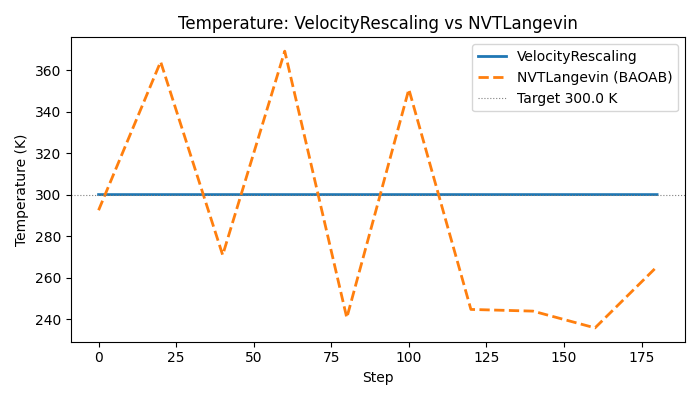
NVTLangevin (BAOAB) samples the canonical ensemble: the temperature fluctuates around the target according to the equipartition theorem, giving a non-zero standard deviation. The rescaling thermostat pins T exactly.
print("\n=== NVTLangevin for comparison ===")
data_nvt = _make_cluster(seed=42)
batch_nvt = Batch.from_data_list([data_nvt])
temps_langevin: list[float] = []

langevin = NVTLangevin(
    model=model,
    dt=0.5,
    temperature=T_RESCALE,
    friction=0.1,
    n_steps=n_steps,
    random_seed=42,
)
for hook in model.make_neighbor_hooks():
    langevin.register_hook(hook, stage=DynamicsStage.BEFORE_COMPUTE)
langevin.register_hook(_TempLogger("NVT", temps_langevin, frequency=20))

batch_nvt = langevin.run(batch_nvt)
print(f"Run complete: {langevin.step_count} steps")
print(
    f"Temperature mean = {sum(temps_langevin) / len(temps_langevin):.1f} K  "
    f"(std = {torch.tensor(temps_langevin).std().item():.2f} K)"
)

print("\nSummary:")
print(
    f"  VelocityRescaling std ≈ {torch.tensor(temps_rescaling).std().item():.3f} K  "
    "(should be near zero — temperature is pinned)"
)
print(
    f"  NVTLangevin std       ≈ {torch.tensor(temps_langevin).std().item():.3f} K  "
    "(canonical fluctuations expected)"
)
=== NVTLangevin for comparison ===
Run complete: 200 steps
Temperature mean = 283.0 K  (std = 55.68 K)

Summary:
  VelocityRescaling std ≈ 0.000 K  (should be near zero — temperature is pinned)
  NVTLangevin std       ≈ 55.677 K  (canonical fluctuations expected)
Optional temperature plot#
if os.getenv("NVALCHEMI_PLOT", "0") == "1":
    try:
        import matplotlib.pyplot as plt

        steps_vr = [i * 20 for i in range(len(temps_rescaling))]
        steps_nvt = [i * 20 for i in range(len(temps_langevin))]

        fig, ax = plt.subplots(figsize=(7, 4))
        ax.plot(steps_vr, temps_rescaling, label="VelocityRescaling", linewidth=2)
        ax.plot(
            steps_nvt,
            temps_langevin,
            label="NVTLangevin (BAOAB)",
            linewidth=2,
            linestyle="--",
        )
        ax.axhline(
            T_RESCALE,
            color="gray",
            linewidth=0.8,
            linestyle=":",
            label=f"Target {T_RESCALE} K",
        )
        ax.set_xlabel("Step")
        ax.set_ylabel("Temperature (K)")
        ax.set_title("Temperature: VelocityRescaling vs NVTLangevin")
        ax.legend()
        fig.tight_layout()
        plt.show()
    except ImportError:
        print("matplotlib not available — skipping plot.")
_init_state for stateful integrators#
Some integrators require per-system persistent state that must survive the addition and removal of systems during inflight batching. Examples include Nose-Hoover chain (NHC) variables or velocity-Verlet half-step velocities stored for the next step.
BaseDynamics provides two hooks for this:
_init_state(batch) -> NoneCalled lazily on the first step. Build
self._stateas a system-onlyBatchwith one row per system._make_new_state(n, template_batch) -> BatchCalled when n fresh systems replace graduated ones (inflight mode). Return a system-only Batch with n rows of default state.
The base class _sync_state_to_batch() calls these
automatically after every refill cycle, so subclass code never needs to
manage state synchronisation manually.
# _make_state_batch and _to_per_system are implementation-internal helpers for
# building system-only state Batches.  A stable public API for stateful
# integrators is planned; until then these are the correct entry points.
from nvalchemi.dynamics._ops._bridge import (  # noqa: E402
    _make_state_batch,
    _to_per_system,
)


class _SkeletonStatefulIntegrator(BaseDynamics):
    """Skeleton showing how to implement _init_state and _make_new_state.

    Replace the placeholder tensors with whatever per-system scalars your
    integrator needs (chain momenta, half-step velocities, etc.).
    """

    __needs_keys__: set[str] = {"forces"}
    __provides_keys__: set[str] = {"positions", "velocities"}

    def __init__(self, model, dt: float, **kwargs) -> None:
        super().__init__(model=model, **kwargs)
        self.dt = fs_to_internal_time(dt)

    def _init_state(self, batch: Batch) -> None:
        """Allocate per-system state from the first concrete batch."""
        M = batch.num_graphs
        dev = batch.device
        dtype = batch.positions.dtype
        self._state = _make_state_batch(
            {
                # Example: store per-system dt and a custom scalar 'xi'.
                "dt": _to_per_system(self.dt, M, dev, dtype),
                "xi": _to_per_system(0.0, M, dev, dtype),  # NHC chain variable
            },
            dev,
        )

    def _make_new_state(self, n: int, template_batch: Batch) -> Batch:
        """Return default state for *n* newly admitted systems."""
        dev = template_batch.device
        dtype = template_batch.positions.dtype
        return _make_state_batch(
            {
                "dt": _to_per_system(self.dt, n, dev, dtype),
                "xi": _to_per_system(0.0, n, dev, dtype),
            },
            dev,
        )

    def pre_update(self, batch: Batch) -> None:
        """Placeholder — insert your integrator's first-half update here."""
        pass

    def post_update(self, batch: Batch) -> None:
        """Placeholder — insert your integrator's second-half update here."""
        pass


print("\nSkeleton integrator class defined (not run — for illustration only).")
print("Override pre_update / post_update / _init_state / _make_new_state as needed.")
Skeleton integrator class defined (not run — for illustration only).
Override pre_update / post_update / _init_state / _make_new_state as needed.
Total running time of the script: (0 minutes 0.241 seconds)