

Topology-Aware Scheduling#
Overview#
Topology-aware scheduling ensures that tasks requiring high-bandwidth or low-latency communication are placed on nodes that are physically co-located—such as the same NVLink rack, spine switch, or availability zone.
This is critical for performance-sensitive workloads like multi-node NVLink training, where all shards of a model must communicate with each other at full NVLink bandwidth. Without topology-aware scheduling, the scheduler may place tasks on nodes in different racks, causing a drop in cross-node communication performance as NCCL reverts to a slower protocol.
Note
Topology-aware scheduling is only available on pools with topology keys configured. Contact your OSMO administrator to confirm which topology keys are available for your pool.
Topology Requirements#
Each entry in the topology list of a resource spec has three fields:
Field |
Default |
Description |
|---|---|---|
|
(required) |
The topology level to constrain. Must match one of the keys configured in the pool
(e.g., |
|
|
A name that groups tasks which must share the same physical location at the given
topology level. Tasks sharing the same |
|
|
Controls whether the constraint is hard or soft. |
Important
All tasks in a workflow that specify topology requirements must use the same set of
keys. Mixing different key sets across tasks (e.g., one task with zone + rack
and another with only zone) is not allowed and will be rejected at submission time.
How They Work Together#
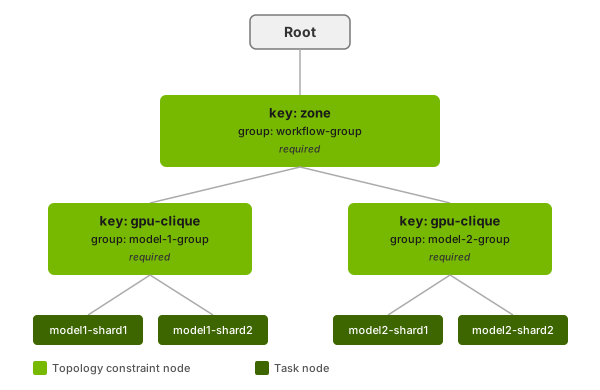
The three fields combine to form a constraint tree. Each task is a leaf node. Middle nodes represent co-location constraints at a given topology level—tasks in the same subtree must land on the same physical unit at that level. Coarser constraints sit higher in the tree; finer constraints are lower.
The following example uses two topology levels (zone and gpu-clique). The two model
instances each have their own gpu-clique group, but both share a single zone group,
so the whole workflow lands in one zone while the two model instances can sit on separate
racks.
resources:
  model-1:
    topology:
    - key: zone
      group: workflow-group
    - key: gpu-clique
      group: model-1-group
  model-2:
    topology:
    - key: zone
      group: workflow-group
    - key: gpu-clique
      group: model-2-group
See also
To add topology requirements to your workflow spec, see Resources.
Examples#
The following examples assume a pool with zone, spine, rack, and gpu-clique
topology keys configured by the administrator.
Single NVL72 Rack#
A 4-task tensor-parallel training workflow where all shards must communicate via NVLink and
must therefore be scheduled on the same gpu-clique.
Note
To properly use multi-node NVLink, confirm with your OSMO admin that the pool is configured to enable NVLink.
workflow:
  name: single-nvl72-rack
  groups:
  - name: group1
    tasks:
    - name: model1-shard1
      lead: true
      image: nvcr.io/nvidia/pytorch:24.03-py3
      ...
    - name: model1-shard2
      image: nvcr.io/nvidia/pytorch:24.03-py3
      ...
    - name: model1-shard3
      image: nvcr.io/nvidia/pytorch:24.03-py3
      ...
    - name: model1-shard4
      image: nvcr.io/nvidia/pytorch:24.03-py3
      ...
resources:
  default:
    gpu: 8
    topology:
    - key: gpu-clique
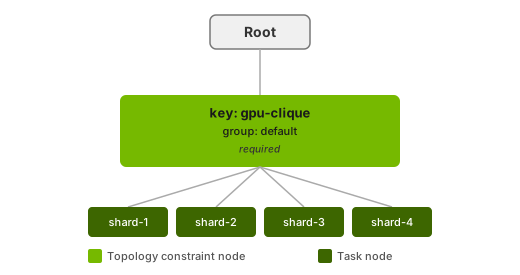
Because all tasks share the same resource spec and group defaults to default, they
will all be required to land on the same gpu-clique.
Multiple NVL72 Racks#
An 8-task workflow with 2× data parallel × 4× tensor parallel. Each model instance’s shards
must share a gpu-clique, but the two model instances can be placed on separate racks.
workflow:
  name: multiple-nvl72-racks
  groups:
  - name: group1
    tasks:
    - name: model1-shard1
      resource: model-1
      lead: true
      image: nvcr.io/nvidia/pytorch:24.03-py3
      ...
    - name: model1-shard2
      resource: model-1
      image: nvcr.io/nvidia/pytorch:24.03-py3
      ...
    - name: model1-shard3
      resource: model-1
      image: nvcr.io/nvidia/pytorch:24.03-py3
      ...
    - name: model1-shard4
      resource: model-1
      image: nvcr.io/nvidia/pytorch:24.03-py3
      ...
    - name: model2-shard1
      resource: model-2
      image: nvcr.io/nvidia/pytorch:24.03-py3
      ...
    - name: model2-shard2
      resource: model-2
      image: nvcr.io/nvidia/pytorch:24.03-py3
      ...
    - name: model2-shard3
      resource: model-2
      image: nvcr.io/nvidia/pytorch:24.03-py3
      ...
    - name: model2-shard4
      resource: model-2
      image: nvcr.io/nvidia/pytorch:24.03-py3
      ...
resources:
  model-1:
    gpu: 8
    topology:
    - key: gpu-clique
      group: model-1-group
  model-2:
    gpu: 8
    topology:
    - key: gpu-clique
      group: model-2-group
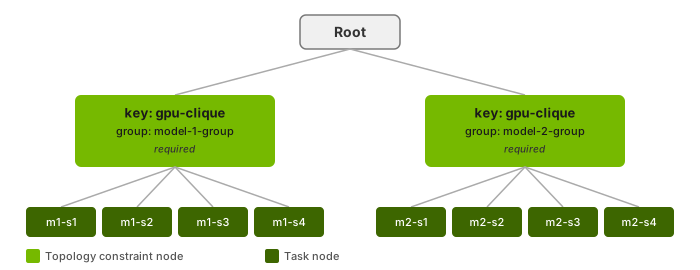
By assigning different group names (model-1-group and model-2-group), the
scheduler co-locates each model instance’s shards on one gpu-clique while allowing the
two model instances to land on different racks.
Multiple NVL72 Racks in Same Zone#
Extends the previous example by additionally requiring the entire workflow to land in the same availability zone, for example when cross-zone latency would degrade data-parallel communication between model instances.
workflow:
  name: multiple-nvl72-same-zone
  groups:
  - name: group1
    tasks:
    - name: model1-shard1
      resource: model-1
      lead: true
      image: nvcr.io/nvidia/pytorch:24.03-py3
      ...
    - name: model1-shard2
      resource: model-1
      image: nvcr.io/nvidia/pytorch:24.03-py3
      ...
    - name: model1-shard3
      resource: model-1
      image: nvcr.io/nvidia/pytorch:24.03-py3
      ...
    - name: model1-shard4
      resource: model-1
      image: nvcr.io/nvidia/pytorch:24.03-py3
      ...
    - name: model2-shard1
      resource: model-2
      image: nvcr.io/nvidia/pytorch:24.03-py3
      ...
    - name: model2-shard2
      resource: model-2
      image: nvcr.io/nvidia/pytorch:24.03-py3
      ...
    - name: model2-shard3
      resource: model-2
      image: nvcr.io/nvidia/pytorch:24.03-py3
      ...
    - name: model2-shard4
      resource: model-2
      image: nvcr.io/nvidia/pytorch:24.03-py3
      ...
resources:
  model-1:
    gpu: 8
    topology:
    - key: gpu-clique
      group: model-1-group
    - key: zone
      group: workflow-group
  model-2:
    gpu: 8
    topology:
    - key: gpu-clique
      group: model-2-group
    - key: zone
      group: workflow-group
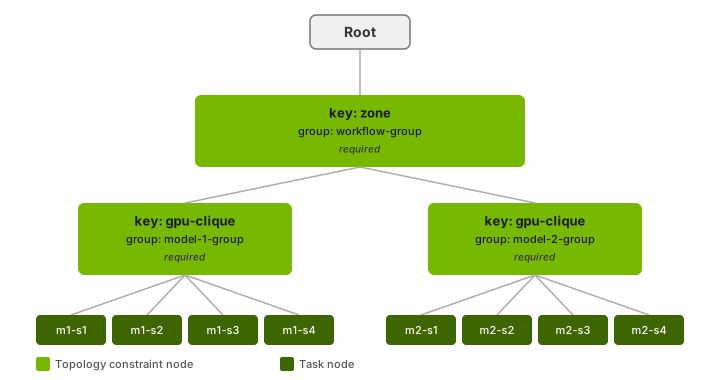
The gpu-clique requirements keep each model instance’s shards on the same rack. The
shared zone requirement with group: workflow-group ensures both model instances are
placed in the same availability zone.
Best-Effort Topology#
An 8-task workflow on a cluster with InfiniBand but without NVLink. Co-locating tasks on the same rack or spine still improves performance, but the workflow should run even if the constraints cannot be met.
workflow:
  name: best-effort-topology
  groups:
  - name: group1
    tasks:
    - name: model1-shard1
      resource: model-1
      lead: true
      image: nvcr.io/nvidia/pytorch:24.03-py3
      ...
    - name: model1-shard2
      resource: model-1
      image: nvcr.io/nvidia/pytorch:24.03-py3
      ...
    - name: model1-shard3
      resource: model-1
      image: nvcr.io/nvidia/pytorch:24.03-py3
      ...
    - name: model1-shard4
      resource: model-1
      image: nvcr.io/nvidia/pytorch:24.03-py3
      ...
    - name: model2-shard1
      resource: model-2
      image: nvcr.io/nvidia/pytorch:24.03-py3
      ...
    - name: model2-shard2
      resource: model-2
      image: nvcr.io/nvidia/pytorch:24.03-py3
      ...
    - name: model2-shard3
      resource: model-2
      image: nvcr.io/nvidia/pytorch:24.03-py3
      ...
    - name: model2-shard4
      resource: model-2
      image: nvcr.io/nvidia/pytorch:24.03-py3
      ...
resources:
  model-1:
    gpu: 8
    topology:
    - key: rack
      group: model-1-group
      requirementType: preferred
    - key: spine
      group: workflow-group
      requirementType: preferred
  model-2:
    gpu: 8
    topology:
    - key: rack
      group: model-2-group
      requirementType: preferred
    - key: spine
      group: workflow-group
      requirementType: preferred
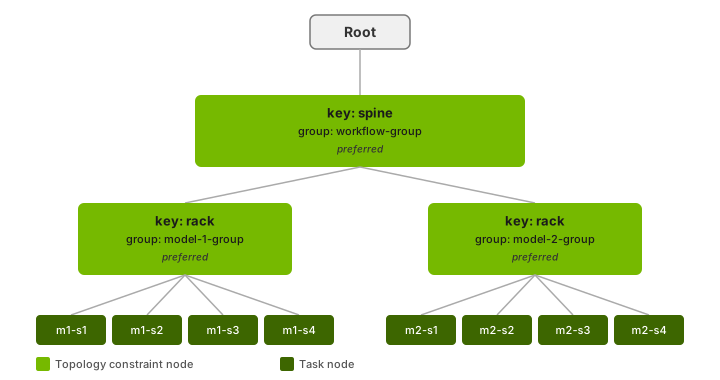
Using requirementType: preferred tells the scheduler to attempt co-location but not
block scheduling if the constraints cannot be satisfied.
Reused Group Names Do Not Imply Co-location#
This example demonstrates that sharing a group name at a finer topology level does not
guarantee co-location when the tasks belong to different groups at a coarser level.
Four tasks are split across two zones. Within zone-a, both task-1 and task-2
must share the same rack (rack-group-1). Within zone-b, task-3 is placed on a
rack also named rack-group-1, while task-4 is placed on rack-group-2.
workflow:
  name: scoped-group-example
  groups:
  - name: group1
    tasks:
    - name: task-1
      resource: rack-a
      lead: true
      image: nvcr.io/nvidia/pytorch:24.03-py3
      ...
    - name: task-2
      resource: rack-a
      image: nvcr.io/nvidia/pytorch:24.03-py3
      ...
    - name: task-3
      resource: rack-b1
      image: nvcr.io/nvidia/pytorch:24.03-py3
      ...
    - name: task-4
      resource: rack-b2
      image: nvcr.io/nvidia/pytorch:24.03-py3
      ...
resources:
  rack-a:
    gpu: 8
    topology:
    - key: zone
      group: zone-a
    - key: rack
      group: rack-group-1
  rack-b1:
    gpu: 8
    topology:
    - key: zone
      group: zone-b
    - key: rack
      group: rack-group-1
  rack-b2:
    gpu: 8
    topology:
    - key: zone
      group: zone-b
    - key: rack
      group: rack-group-2
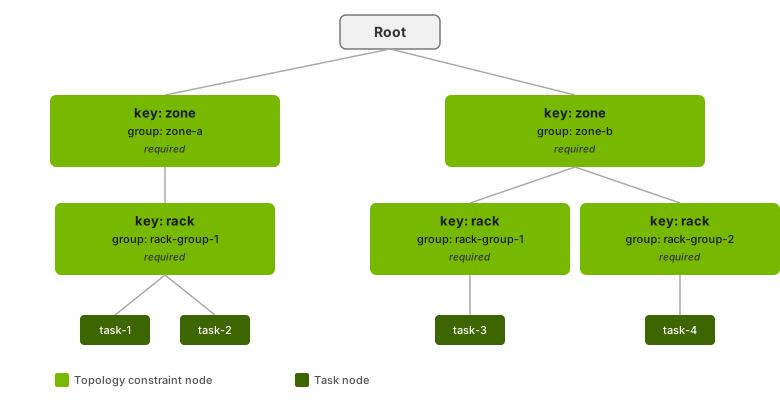
Although task-1, task-2, and task-3 all specify group: rack-group-1 for their rack
constraint, task-3 will not be placed on the same physical rack as task-1 and task-2.
Because their zone groups differ (zone-a vs. zone-b), the two rack-group-1
nodes sit in separate branches of the constraint tree and are resolved independently by the
scheduler.
Important
Group names are scoped by their position in the constraint tree. Tasks sharing the same
group name at a given key level are only guaranteed to be co-located if they also
share all ancestor group memberships at every coarser constraint level above them.