
Note
Go to the end to download the full example code.
Langevin Dynamics with Lennard-Jones Potential#
This example demonstrates GPU-accelerated molecular dynamics using the Langevin (BAOAB) thermostat with a Lennard-Jones potential.
We simulate liquid argon at 94.4 K (near the triple point) to demonstrate:
Building an FCC lattice system
Computing neighbor lists with periodic boundaries
Using the Lennard-Jones potential for energy and forces
Running Langevin dynamics in the NVT ensemble
Monitoring thermodynamic properties
Physical System: Liquid Argon#
LJ parameters: ε = 0.0104 eV, σ = 3.40 Å
Temperature: 94.4 K (near triple point)
Density: ~1.4 g/cm³
The BAOAB integrator uses the splitting: B (velocity half-step) → A (position half-step) → O (Ornstein-Uhlenbeck) → A (position half-step) → B (velocity half-step with new forces)
This provides excellent configurational sampling for the NVT ensemble.
Imports#
We import utilities from nvalchemiops for the Lennard-Jones potential, neighbor list construction, and MD integrators.
from __future__ import annotations

import matplotlib.pyplot as plt
import numpy as np
import warp as wp

# Local utilities for this example
from _dynamics_utils import (
    DEFAULT_CUTOFF,
    DEFAULT_SKIN,
    EPSILON_AR,
    SIGMA_AR,
    MDSystem,
    create_fcc_argon,
    run_langevin_baoab,
)

from nvalchemiops.dynamics.utils import compute_kinetic_energy
System setup#
print("=" * 95)
print("LANGEVIN DYNAMICS WITH LENNARD-JONES POTENTIAL")
print("=" * 95)
print()

device = "cuda:0" if wp.is_cuda_available() else "cpu"
print(f"Using device: {device}")

# Create FCC argon system (4x4x4 unit cells = 256 atoms)
print("\n--- Creating FCC Argon System ---")
positions, cell = create_fcc_argon(num_unit_cells=4, a=5.26)
print(f"Created {len(positions)} atoms in {cell[0, 0]:.2f} ų box")

print("\n--- Initializing MD System ---")
system = MDSystem(
    positions=positions,
    cell=cell,
    epsilon=EPSILON_AR,
    sigma=SIGMA_AR,
    cutoff=DEFAULT_CUTOFF,
    skin=DEFAULT_SKIN,
    device=device,
    dtype=np.float64,
)

print("\n--- Setting Initial Temperature ---")
system.initialize_temperature(temperature=94.4, seed=42)

print("\n--- Initial Energy Calculation ---")
wp_energies = system.compute_forces()
pe = float(wp_energies.numpy().sum())
ke_arr = wp.zeros(1, dtype=wp.float64, device=device)
compute_kinetic_energy(
    velocities=system.wp_velocities,
    masses=system.wp_masses,
    kinetic_energy=ke_arr,
    device=device,
)
ke = float(ke_arr.numpy()[0])
print(f"  Kinetic Energy:   {ke:>12.4f} eV")
print(f"  Potential Energy: {pe:>12.4f} eV")
print(f"  Total Energy:     {ke + pe:>12.4f} eV")
print(f"  Neighbors:        {system.neighbor_manager.total_neighbors()}")
===============================================================================================
LANGEVIN DYNAMICS WITH LENNARD-JONES POTENTIAL
===============================================================================================

Using device: cuda:0

--- Creating FCC Argon System ---
Created 256 atoms in 21.04 ų box

--- Initializing MD System ---
Initialized MD system with 256 atoms
  Cell: 21.04 x 21.04 x 21.04 Å
  Cutoff: 8.50 Å (+ 0.50 Å skin)
  LJ: ε = 0.0104 eV, σ = 3.40 Å
  Device: cuda:0, dtype: <class 'numpy.float64'>
  Units: x [Å], t [fs], E [eV], m [eV·fs²/Ų] (from amu), v [Å/fs]

--- Setting Initial Temperature ---
Initialized velocities: target=94.4 K, actual=90.4 K

--- Initial Energy Calculation ---
  Kinetic Energy:         2.9790 eV
  Potential Energy:     -21.5623 eV
  Total Energy:         -18.5833 eV
  Neighbors:        9984
Langevin dynamics (BAOAB)#
print("\n--- Equilibration (500 steps) ---")
_eq_stats = run_langevin_baoab(
    system=system,
    num_steps=500,
    dt_fs=1.0,
    temperature_K=94.4,
    friction_per_fs=0.01,
    log_interval=100,
    seed=42,
)

print("\n--- Production Run (2000 steps) ---")
prod_stats = run_langevin_baoab(
    system=system,
    num_steps=2000,
    dt_fs=1.0,
    temperature_K=94.4,
    friction_per_fs=0.01,
    log_interval=200,
    seed=1000,
)
--- Equilibration (500 steps) ---

Running 500 Langevin steps at T=94.4 K
  dt = 1.000 fs, friction = 0.0100 1/fs
===============================================================================================
    Step      KE (eV)      PE (eV)   Total (eV)      T (K)  Neighbors  min r (Å)     max|F|
===============================================================================================
       0       3.8089     -21.5620     -17.7531     115.56       9984      3.712  2.464e-03
     100       2.3677     -19.7744     -17.4067      71.83      10224      3.211  2.911e-01
     200       2.8758     -19.1837     -16.3078      87.25      10275      3.177  2.974e-01
     300       3.2061     -18.9713     -15.7652      97.27      10288      3.217  2.335e-01
     400       3.1138     -18.9738     -15.8600      94.47      10307      3.209  2.468e-01
     499       2.9896     -18.7750     -15.7854      90.70      10294      3.153  3.250e-01

--- Production Run (2000 steps) ---

Running 2000 Langevin steps at T=94.4 K
  dt = 1.000 fs, friction = 0.0100 1/fs
===============================================================================================
    Step      KE (eV)      PE (eV)   Total (eV)      T (K)  Neighbors  min r (Å)     max|F|
===============================================================================================
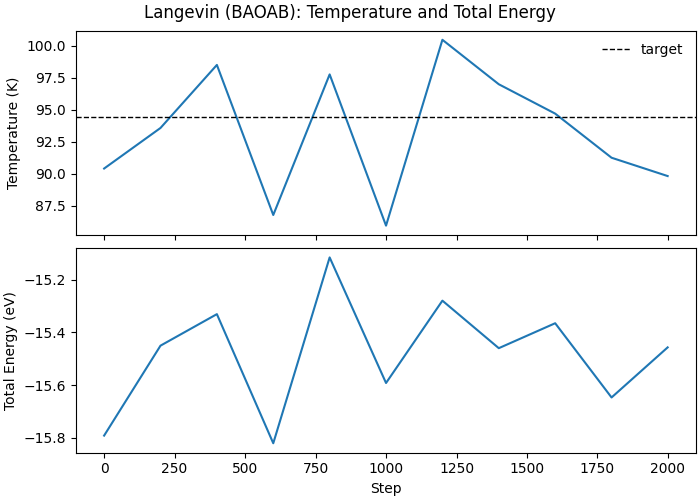
       0       2.9799     -18.7712     -15.7914      90.40      10293      3.155  3.270e-01
     200       3.0845     -18.5344     -15.4499      93.58      10296      3.204  2.917e-01
     400       3.2470     -18.5773     -15.3303      98.51      10309      3.177  3.001e-01
     600       2.8600     -18.6805     -15.8205      86.77      10310      3.202  2.857e-01
     800       3.2226     -18.3375     -15.1150      97.77      10314      3.132  3.371e-01
    1000       2.8326     -18.4243     -15.5917      85.94      10318      3.132  3.079e-01
    1200       3.3118     -18.5909     -15.2791     100.48      10300      3.197  3.035e-01
    1400       3.1972     -18.6567     -15.4595      97.00      10303      3.236  2.671e-01
    1600       3.1215     -18.4863     -15.3648      94.70      10318      3.203  2.890e-01
    1800       3.0077     -18.6543     -15.6466      91.25      10286      3.143  4.148e-01
    1999       2.9604     -18.4169     -15.4565      89.82      10293      3.188  2.695e-01
Analysis#
print("\n--- Analysis ---")
temps = np.array([s.temperature for s in prod_stats])
total_energies = np.array([s.total_energy for s in prod_stats])
steps = np.array([s.step for s in prod_stats])

print(f"  Mean Temperature:    {temps.mean():.2f} ± {temps.std():.2f} K")
print("  Target Temperature:  94.4 K")
print(f"  Temperature Error:   {abs(temps.mean() - 94.4) / 94.4 * 100:.2f}%")
print()
print(f"  Mean Total Energy:   {total_energies.mean():.4f} eV")
print(f"  Energy Fluctuation:  {total_energies.std():.4f} eV")
--- Analysis ---
  Mean Temperature:    93.29 ± 4.63 K
  Target Temperature:  94.4 K
  Temperature Error:   1.17%

  Mean Total Energy:   -15.4823 eV
  Energy Fluctuation:  0.2054 eV
Plot#
fig, ax = plt.subplots(2, 1, figsize=(7.0, 5.0), sharex=True, constrained_layout=True)
ax[0].plot(steps, temps, lw=1.5)
ax[0].axhline(94.4, color="k", ls="--", lw=1.0, label="target")
ax[0].set_ylabel("Temperature (K)")
ax[0].legend(frameon=False, loc="best")

ax[1].plot(steps, total_energies, lw=1.5)
ax[1].set_xlabel("Step")
ax[1].set_ylabel("Total Energy (eV)")
fig.suptitle("Langevin (BAOAB): Temperature and Total Energy")

print("\n" + "=" * 95)
print("SIMULATION COMPLETE")
print("=" * 95)
===============================================================================================
SIMULATION COMPLETE
===============================================================================================
Total running time of the script: (0 minutes 1.269 seconds)