
Note
Go to the end to download the full example code.
Variable-Cell FIRE Optimization with LJ Potential#
This example demonstrates joint optimization of atomic positions and cell parameters using the FIRE optimizer with the cell filter utilities on a realistic LJ argon crystal.
The workflow demonstrates: 1. align_cell() - Transform cell to upper-triangular form for stability 2. LJ energy/forces/virial - Compute realistic interatomic interactions 3. Virial → Stress → Cell Force - Convert atomic virial to cell driving force 4. pack_*_with_cell() - Combine atomic + cell DOFs into extended arrays 5. fire_step() - Standard FIRE optimization on extended arrays 6. unpack_positions_with_cell() - Extract optimized geometry
We optimize an FCC argon crystal under external pressure, demonstrating: - Atomic relaxation (force minimization) - Cell relaxation (pressure equilibration) - Simultaneous optimization of both
The external pressure creates a driving force on the cell to expand or contract until the internal stress matches the applied pressure.
from __future__ import annotations

import matplotlib.pyplot as plt
import numpy as np
import warp as wp
from _dynamics_utils import (
    AMU_TO_EV_FS2_PER_A2 as AMU_TO_INTERNAL,
)
from _dynamics_utils import (
    EPSILON_AR,
    MASS_AR,
    SIGMA_AR,
    MDSystem,
    create_fcc_lattice,
    pressure_ev_per_a3_to_gpa,
    pressure_gpa_to_ev_per_a3,
    virial_to_stress,
)

from nvalchemiops.dynamics.optimizers import fire_step
from nvalchemiops.dynamics.utils import (
    align_cell,
    compute_cell_volume,
    pack_forces_with_cell,
    pack_masses_with_cell,
    pack_positions_with_cell,
    stress_to_cell_force,
    unpack_positions_with_cell,
    wrap_positions_to_cell,
)

# LJ cutoff for argon
CUTOFF = 2.5 * SIGMA_AR  # ~8.5 Å


# ==============================================================================
# Main Example
# ==============================================================================

wp.init()
device = "cuda:0" if wp.is_cuda_available() else "cpu"
print(f"Using device: {device}")
Using device: cuda:0
Create Initial System#
Start with an FCC argon crystal at a non-equilibrium density. The optimization will find the equilibrium lattice constant that balances internal stress with external pressure.
n_cells = 3  # 3x3x3 = 108 atoms
a_initial = 5.5  # Å (slightly expanded from equilibrium ~5.26 Å)

positions_np, cell_np = create_fcc_lattice(n_cells, a_initial)
num_atoms = len(positions_np)

# Target external pressure (positive = compression)
# At ~0.01 GPa, argon should compress slightly from the initial density
target_pressure_gpa = 0.01
target_pressure = pressure_gpa_to_ev_per_a3(target_pressure_gpa)

print(f"System: {num_atoms} atoms in {n_cells}³ FCC lattice")
print(f"Initial lattice constant: {a_initial:.3f} Å")
print(f"Initial density: {num_atoms / np.linalg.det(cell_np):.4f} atoms/ų")
print(f"Target external pressure: {target_pressure_gpa:.3f} GPa")
print(f"LJ parameters: ε = {EPSILON_AR:.4f} eV, σ = {SIGMA_AR:.2f} Å")
System: 108 atoms in 3³ FCC lattice
Initial lattice constant: 5.500 Å
Initial density: 0.0240 atoms/ų
Target external pressure: 0.010 GPa
LJ parameters: ε = 0.0104 eV, σ = 3.40 Å
Initialize System#
# Create Warp arrays
positions = wp.array(positions_np, dtype=wp.vec3d, device=device)
cell = wp.array(cell_np.reshape(1, 3, 3), dtype=wp.mat33d, device=device)

# Create MD system for force computation (reuses _langevin_utils.MDSystem)
md_system = MDSystem(
    positions=positions_np,
    cell=cell_np,
    epsilon=EPSILON_AR,
    sigma=SIGMA_AR,
    cutoff=CUTOFF,
    skin=0.5,
    switch_width=1.0,  # Smooth cutoff for optimization
    device=device,
)
Initialized MD system with 108 atoms
  Cell: 16.50 x 16.50 x 16.50 Å
  Cutoff: 8.50 Å (+ 0.50 Å skin)
  LJ: ε = 0.0104 eV, σ = 3.40 Å
  Device: cuda:0, dtype: <class 'numpy.float64'>
  Units: x [Å], t [fs], E [eV], m [eV·fs²/Ų] (from amu), v [Å/fs]
Step 1: Align Cell#
--- Step 1: Align cell to upper-triangular form ---
Aligned cell:
[[16.5  0.   0. ]
 [ 0.  16.5  0. ]
 [ 0.   0.  16.5]]
Step 2: Pack Extended Arrays#
print("\n--- Step 2: Pack into extended arrays ---")

# Atomic masses (converted to internal units)
atom_masses_np = np.full(num_atoms, MASS_AR * AMU_TO_INTERNAL, dtype=np.float64)
atom_masses = wp.array(atom_masses_np, dtype=wp.float64, device=device)

# Cell DOF mass (controls how fast cell responds vs atoms)
# Larger mass = slower cell dynamics, more stable
cell_mass = 5000.0
cell_mass_arr = wp.array([cell_mass], dtype=wp.float64, device=device)

# Pack into extended arrays
N_ext = num_atoms + 2
ext_positions = wp.empty(N_ext, dtype=wp.vec3d, device=device)
pack_positions_with_cell(positions, cell, extended=ext_positions, device=device)
ext_velocities = wp.zeros(N_ext, dtype=wp.vec3d, device=device)
ext_masses = wp.empty(N_ext, dtype=wp.float64, device=device)
pack_masses_with_cell(atom_masses, cell_mass_arr, extended=ext_masses, device=device)
ext_forces = wp.empty(N_ext, dtype=wp.vec3d, device=device)

print(
    f"Extended array size: {ext_positions.shape[0]} ({num_atoms} atoms + 2 cell DOFs)"
)
--- Step 2: Pack into extended arrays ---
Extended array size: 110 (108 atoms + 2 cell DOFs)
Step 3: FIRE Parameters#
# FIRE optimization parameters
dt0 = 0.001
dt_max = 1.0
dt_min = 0.001
alpha0 = 0.1
f_inc = 1.1
f_dec = 0.5
f_alpha = 0.99
n_min = 5
maxstep = 0.1  # Conservative for stability

# Device-side FIRE state arrays
dt = wp.array([dt0], dtype=wp.float64, device=device)
alpha = wp.array([alpha0], dtype=wp.float64, device=device)
alpha_start = wp.array([alpha0], dtype=wp.float64, device=device)
f_alpha_arr = wp.array([f_alpha], dtype=wp.float64, device=device)
dt_min_arr = wp.array([dt_min], dtype=wp.float64, device=device)
dt_max_arr = wp.array([dt_max], dtype=wp.float64, device=device)
maxstep_arr = wp.array([maxstep], dtype=wp.float64, device=device)
n_steps_positive = wp.zeros(1, dtype=wp.int32, device=device)
n_min_arr = wp.array([n_min], dtype=wp.int32, device=device)
f_dec_arr = wp.array([f_dec], dtype=wp.float64, device=device)
f_inc_arr = wp.array([f_inc], dtype=wp.float64, device=device)

# Accumulators
vf = wp.zeros(1, dtype=wp.float64, device=device)
vv = wp.zeros(1, dtype=wp.float64, device=device)
ff = wp.zeros(1, dtype=wp.float64, device=device)
uphill_flag = wp.zeros(1, dtype=wp.int32, device=device)

# Scratch arrays for unpack/stress/volume
pos_scratch = wp.empty(num_atoms, dtype=wp.vec3d, device=device)
cell_scratch = wp.empty(1, dtype=wp.mat33d, device=device)
cell_force_scratch = wp.empty(1, dtype=wp.mat33d, device=device)
volume_scratch = wp.empty(1, dtype=wp.float64, device=device)
Step 4: Optimization Loop#
max_steps = 1000
force_tol = 1e-4  # Convergence: max force/stress component
log_interval = 100  # Print every N steps
check_interval = 50  # Check convergence every N steps

# History for plotting
energy_hist = []
max_force_hist = []
volume_hist = []
pressure_hist = []
lattice_const_hist = []

print("\n--- Step 4: Variable-cell FIRE optimization ---")
print(f"Force tolerance: {force_tol:.1e}")
print("=" * 90)
print(
    f"{'Step':>6} {'Energy':>12} {'max|F|':>10} {'Volume':>10} "
    f"{'ΔP (GPa)':>10} {'a (Å)':>10}"
)
print("=" * 90)

converged = False
for step in range(max_steps):
    # Unpack current state
    pos_current, cell_current = unpack_positions_with_cell(
        ext_positions,
        positions=pos_scratch,
        cell=cell_scratch,
        num_atoms=num_atoms,
        device=device,
    )

    # Update MD system with current geometry
    wp.copy(md_system.wp_positions, pos_current)
    md_system.update_cell(cell_current)

    # Wrap positions into cell (important for PBC consistency)
    wrap_positions_to_cell(
        positions=md_system.wp_positions,
        cells=md_system.wp_cell,
        cells_inv=md_system.wp_cell_inv,
        device=device,
    )

    # Compute LJ forces and virial
    energies, forces, virial = md_system.compute_forces_virial()

    # Convert virial to stress with external pressure contribution
    stress = virial_to_stress(virial, md_system.wp_cell, target_pressure, device)

    # Convert stress to cell force (for optimization)
    compute_cell_volume(md_system.wp_cell, volumes=volume_scratch, device=device)
    stress_to_cell_force(
        stress,
        md_system.wp_cell,
        volume=volume_scratch,
        cell_force=cell_force_scratch,
        keep_aligned=True,
        device=device,
    )

    # Pack forces into extended array
    pack_forces_with_cell(
        forces, cell_force_scratch, extended=ext_forces, device=device
    )

    # Re-pack positions (after wrapping)
    pack_positions_with_cell(
        md_system.wp_positions,
        md_system.wp_cell,
        extended=ext_positions,
        device=device,
    )

    # Zero accumulators before FIRE step
    vf.zero_()
    vv.zero_()
    ff.zero_()

    # FIRE step on extended arrays
    fire_step(
        positions=ext_positions,
        velocities=ext_velocities,
        forces=ext_forces,
        masses=ext_masses,
        alpha=alpha,
        dt=dt,
        alpha_start=alpha_start,
        f_alpha=f_alpha_arr,
        dt_min=dt_min_arr,
        dt_max=dt_max_arr,
        maxstep=maxstep_arr,
        n_steps_positive=n_steps_positive,
        n_min=n_min_arr,
        f_dec=f_dec_arr,
        f_inc=f_inc_arr,
        uphill_flag=uphill_flag,
        vf=vf,
        vv=vv,
        ff=ff,
    )

    # Check convergence and log only at intervals (avoid sync every step)
    if step % check_interval == 0 or step == max_steps - 1:
        wp.synchronize()
        ext_forces_np = ext_forces.numpy()
        max_force = np.max(np.abs(ext_forces_np))

        total_energy = float(energies.numpy().sum())
        compute_cell_volume(md_system.wp_cell, volumes=volume_scratch, device=device)
        volume = float(volume_scratch.numpy()[0])

        # Compute deviation from target pressure (trace of stress / 3)
        stress_np = stress.numpy()[0]
        stress_trace = (stress_np[0, 0] + stress_np[1, 1] + stress_np[2, 2]) / 3
        pressure_deviation_gpa = -pressure_ev_per_a3_to_gpa(stress_trace)

        # Effective lattice constant (cube root of volume per atom * 4 for FCC)
        lattice_const = (volume / num_atoms * 4) ** (1 / 3)

        energy_hist.append(total_energy)
        max_force_hist.append(max_force)
        volume_hist.append(volume)
        pressure_hist.append(pressure_deviation_gpa)
        lattice_const_hist.append(lattice_const)

        # Print at log intervals
        if step % log_interval == 0 or step == max_steps - 1:
            print(
                f"{step:>6d} {total_energy:>12.6f} {max_force:>10.2e} {volume:>10.2f} "
                f"{pressure_deviation_gpa:>10.4f} {lattice_const:>10.4f}"
            )

        if max_force < force_tol:
            print(f"\nConverged at step {step} (max|F| = {max_force:.2e})")
            converged = True
            break
--- Step 4: Variable-cell FIRE optimization ---
Force tolerance: 1.0e-04
==========================================================================================
  Step       Energy     max|F|     Volume   ΔP (GPa)      a (Å)
==========================================================================================
     0    -8.410375   4.14e-01    4492.12    -0.2434     5.5000
   100    -8.458982   3.95e-01    4455.87    -0.2336     5.4852
   200    -8.196715   1.22e-01    4085.04     0.0335     5.3286
   300    -8.651384   4.08e-02    3995.19     0.0045     5.2892
   400    -8.756453   1.81e-02    3986.18    -0.0115     5.2852
   500    -8.825705   9.37e-03    3949.13    -0.0005     5.2688
   600    -8.857788   2.46e-03    3935.00     0.0016     5.2625
   700    -8.858075   9.82e-04    3936.82     0.0004     5.2633
   800    -8.858206   2.41e-04    3937.47    -0.0001     5.2636
   900    -8.858209   1.14e-04    3937.36    -0.0000     5.2636

Converged at step 950 (max|F| = 4.80e-05)
Final Results#
wp.synchronize()
final_pos, final_cell = unpack_positions_with_cell(
    ext_positions,
    positions=pos_scratch,
    cell=cell_scratch,
    num_atoms=num_atoms,
    device=device,
)

wp.synchronize()
final_cell_np = final_cell.numpy()[0]
final_volume = np.linalg.det(final_cell_np)
final_density = num_atoms / final_volume
final_a = (final_volume / num_atoms * 4) ** (1 / 3)

print("\n" + "=" * 60)
print("FINAL RESULTS")
print("=" * 60)
print(f"Final cell:\n{final_cell_np}")
print(f"\nFinal volume: {final_volume:.2f} ų")
print(f"Final density: {final_density:.6f} atoms/ų")
print(f"Effective lattice constant: {final_a:.4f} Å")
print(f"Target pressure: {target_pressure_gpa:.4f} GPa")
============================================================
FINAL RESULTS
============================================================
Final cell:
[[1.57906657e+01 0.00000000e+00 0.00000000e+00]
 [3.62411317e-15 1.57906657e+01 0.00000000e+00]
 [3.68224100e-15 3.77062074e-15 1.57906657e+01]]

Final volume: 3937.33 ų
Final density: 0.027430 atoms/ų
Effective lattice constant: 5.2636 Å
Target pressure: 0.0100 GPa
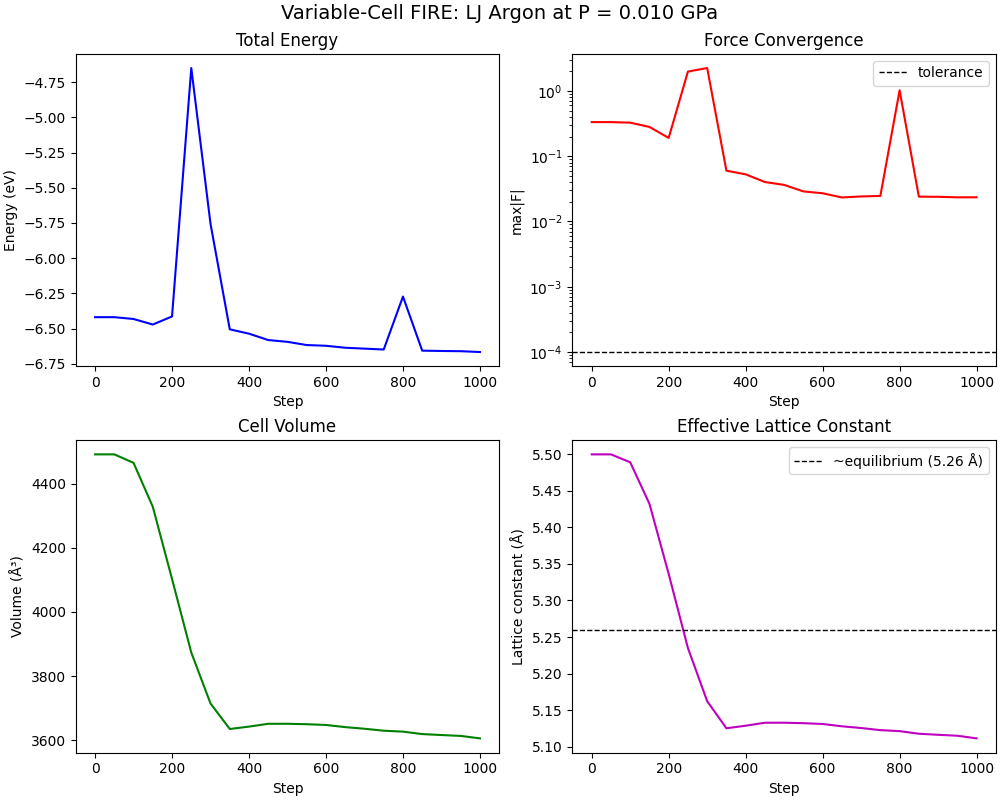
Plot Convergence#
fig, axes = plt.subplots(2, 2, figsize=(10, 8), constrained_layout=True)

steps = np.arange(len(energy_hist)) * check_interval

# Energy
axes[0, 0].plot(steps, energy_hist, "b-", lw=1.5)
axes[0, 0].set_xlabel("Step")
axes[0, 0].set_ylabel("Energy (eV)")
axes[0, 0].set_title("Total Energy")

# Force convergence
axes[0, 1].semilogy(steps, max_force_hist, "r-", lw=1.5)
axes[0, 1].axhline(force_tol, color="k", ls="--", lw=1, label="tolerance")
axes[0, 1].set_xlabel("Step")
axes[0, 1].set_ylabel("max|F|")
axes[0, 1].set_title("Force Convergence")
axes[0, 1].legend()

# Volume
axes[1, 0].plot(steps, volume_hist, "g-", lw=1.5)
axes[1, 0].set_xlabel("Step")
axes[1, 0].set_ylabel("Volume (ų)")
axes[1, 0].set_title("Cell Volume")

# Lattice constant
axes[1, 1].plot(steps, lattice_const_hist, "m-", lw=1.5)
axes[1, 1].axhline(5.26, color="k", ls="--", lw=1, label="~equilibrium (5.26 Å)")
axes[1, 1].set_xlabel("Step")
axes[1, 1].set_ylabel("Lattice constant (Å)")
axes[1, 1].set_title("Effective Lattice Constant")
axes[1, 1].legend()

fig.suptitle(
    f"Variable-Cell FIRE: LJ Argon at P = {target_pressure_gpa:.3f} GPa", fontsize=14
)
plt.show()
Total running time of the script: (0 minutes 0.835 seconds)