
Note
Go to the end to download the full example code.
FIRE Geometry Optimization (LJ Cluster)#
This example demonstrates geometry optimization with the FIRE optimizer using:
- The package LJ implementation (neighbor-list accelerated)
- The package FIRE kernels (nvalchemiops.dynamics.optimizers)
- The shared example utilities in examples.dynamics._dynamics_utils
We optimize a small Lennard-Jones cluster (an isolated cluster inside a large box) and plot convergence (energy and max force).
from __future__ import annotations

import matplotlib.pyplot as plt
import numpy as np
import warp as wp
from _dynamics_utils import MDSystem, create_random_cluster

from nvalchemiops.dynamics.optimizers import fire_step

wp.init()

device = "cuda:0" if wp.is_cuda_available() else "cpu"
print(f"Using device: {device}")
Using device: cuda:0
Create a Lennard-Jones Cluster#
We use an “isolated cluster in a large box” approach (PBC far away), which works well with the existing neighbor-list machinery.
num_atoms = 32
epsilon = 0.0104  # eV (argon-like)
sigma = 3.40  # Å
cutoff = 2.5 * sigma
skin = 0.5
box_L = 80.0  # Å (large to avoid self-interaction across PBC)

cell = np.eye(3, dtype=np.float64) * box_L
initial_positions = create_random_cluster(
    num_atoms=num_atoms,
    radius=12.0,
    min_dist=0.9 * sigma,
    center=np.array([0.5 * box_L, 0.5 * box_L, 0.5 * box_L]),
    seed=42,
)

system = MDSystem(
    positions=initial_positions,
    cell=cell,
    masses=np.full(num_atoms, 39.948, dtype=np.float64),  # amu (argon)
    epsilon=epsilon,
    sigma=sigma,
    cutoff=cutoff,
    skin=skin,
    switch_width=0.0,
    device=device,
    dtype=np.float64,
)
Initialized MD system with 32 atoms
  Cell: 80.00 x 80.00 x 80.00 Å
  Cutoff: 8.50 Å (+ 0.50 Å skin)
  LJ: ε = 0.0104 eV, σ = 3.40 Å
  Device: cuda:0, dtype: <class 'numpy.float64'>
  Units: x [Å], t [fs], E [eV], m [eV·fs²/Ų] (from amu), v [Å/fs]
FIRE Optimization Loop#
We use the unified fire_step API that handles:
- Velocity mixing (FIRE algorithm)
- Adaptive timestep (dt)
- Adaptive mixing parameter (alpha)
- MD-like position update with maxstep capping
max_steps = 3000
force_tolerance = 1e-3  # eV/Å (max force)

# FIRE parameters
dt0 = 1.0
dt_max = 10.0
dt_min = 1e-3
alpha0 = 0.1
f_inc = 1.1
f_dec = 0.5
f_alpha = 0.99
n_min = 5
maxstep = 0.2 * sigma  # Å (max displacement per iteration)

# Device-side FIRE state arrays (shape = (1,) for single system)
wp_dtype = system.wp_dtype
dt_wp = wp.array([dt0], dtype=wp_dtype, device=device)
alpha_wp = wp.array([alpha0], dtype=wp_dtype, device=device)
alpha_start_wp = wp.array([alpha0], dtype=wp_dtype, device=device)
f_alpha_wp = wp.array([f_alpha], dtype=wp_dtype, device=device)
dt_min_wp = wp.array([dt_min], dtype=wp_dtype, device=device)
dt_max_wp = wp.array([dt_max], dtype=wp_dtype, device=device)
maxstep_wp = wp.array([maxstep], dtype=wp_dtype, device=device)
n_steps_positive_wp = wp.zeros(1, dtype=wp.int32, device=device)
n_min_wp = wp.array([n_min], dtype=wp.int32, device=device)
f_dec_wp = wp.array([f_dec], dtype=wp_dtype, device=device)
f_inc_wp = wp.array([f_inc], dtype=wp_dtype, device=device)
uphill_flag_wp = wp.zeros(1, dtype=wp.int32, device=device)

# Accumulators for diagnostic scalars (vf, vv, ff) - must be zeroed before each step
vf_wp = wp.zeros(1, dtype=wp_dtype, device=device)
vv_wp = wp.zeros(1, dtype=wp_dtype, device=device)
ff_wp = wp.zeros(1, dtype=wp_dtype, device=device)

# History for plotting
energy_hist: list[float] = []
maxf_hist: list[float] = []
dt_hist: list[float] = []
alpha_hist: list[float] = []

print("\n" + "=" * 95)
print("FIRE GEOMETRY OPTIMIZATION (LJ cluster)")
print("=" * 95)
print(f"  atoms: {num_atoms}, cutoff={cutoff:.2f} Å, box={box_L:.1f} Å")
print(f"  max_steps={max_steps}, force_tol={force_tolerance:.2e} eV/Å")
print(f"  dt0={dt0}, dt_max={dt_max}, alpha0={alpha0}, n_min={n_min}")
print(f"  dt_min={dt_min}, maxstep={maxstep:.3f} Å")

log_interval = 100
check_interval = 50

for step in range(max_steps):
    # Compute forces at current positions
    energies = system.compute_forces()

    # Zero the accumulators before each FIRE step
    vf_wp.zero_()
    vv_wp.zero_()
    ff_wp.zero_()

    # Single FIRE step using the unified API
    # This performs: diagnostic computation, velocity mixing, parameter update, MD step
    fire_step(
        positions=system.wp_positions,
        velocities=system.wp_velocities,
        forces=system.wp_forces,
        masses=system.wp_masses,
        alpha=alpha_wp,
        dt=dt_wp,
        alpha_start=alpha_start_wp,
        f_alpha=f_alpha_wp,
        dt_min=dt_min_wp,
        dt_max=dt_max_wp,
        maxstep=maxstep_wp,
        n_steps_positive=n_steps_positive_wp,
        n_min=n_min_wp,
        f_dec=f_dec_wp,
        f_inc=f_inc_wp,
        uphill_flag=uphill_flag_wp,
        vf=vf_wp,
        vv=vv_wp,
        ff=ff_wp,
    )

    # Logging / stopping criteria (host read only at intervals)
    if step % check_interval == 0 or step == max_steps - 1:
        pe = float(energies.numpy().sum())
        fmax = float(np.linalg.norm(system.wp_forces.numpy(), axis=1).max())

        energy_hist.append(pe)
        maxf_hist.append(fmax)
        dt_hist.append(float(dt_wp.numpy()[0]))
        alpha_hist.append(float(alpha_wp.numpy()[0]))

        if step % log_interval == 0 or step == max_steps - 1:
            print(
                f"step={step:5d}  PE={pe:12.6f} eV  max|F|={fmax:10.3e} eV/Å  "
                f"dt={dt_hist[-1]:6.3f}  alpha={alpha_hist[-1]:7.4f}  "
                f"n+={int(n_steps_positive_wp.numpy()[0]):3d}"
            )

        if fmax < force_tolerance:
            print(f"\nConverged at step {step} (max|F|={fmax:.3e} eV/Å).")
            break
===============================================================================================
FIRE GEOMETRY OPTIMIZATION (LJ cluster)
===============================================================================================
  atoms: 32, cutoff=8.50 Å, box=80.0 Å
  max_steps=3000, force_tol=1.00e-03 eV/Å
  dt0=1.0, dt_max=10.0, alpha0=0.1, n_min=5
  dt_min=0.001, maxstep=0.680 Å
step=    0  PE=   -0.022508 eV  max|F|= 3.541e-01 eV/Å  dt= 0.500  alpha= 0.1000  n+=  0
step=  100  PE=   -0.321531 eV  max|F|= 1.081e-02 eV/Å  dt=10.000  alpha= 0.0381  n+=100
step=  200  PE=   -0.394863 eV  max|F|= 2.618e-02 eV/Å  dt=10.000  alpha= 0.0139  n+=200
step=  300  PE=   -0.457969 eV  max|F|= 2.563e-02 eV/Å  dt=10.000  alpha= 0.0051  n+=300
step=  400  PE=   -0.511123 eV  max|F|= 1.267e-02 eV/Å  dt=10.000  alpha= 0.0430  n+= 88
step=  500  PE=   -0.567782 eV  max|F|= 1.829e-02 eV/Å  dt=10.000  alpha= 0.0157  n+=188
step=  600  PE=   -0.621281 eV  max|F|= 3.008e-02 eV/Å  dt=10.000  alpha= 0.0058  n+=288
step=  700  PE=   -0.668527 eV  max|F|= 6.530e-03 eV/Å  dt=10.000  alpha= 0.0662  n+= 45
step=  800  PE=   -0.744103 eV  max|F|= 1.079e-02 eV/Å  dt=10.000  alpha= 0.0242  n+=145
step=  900  PE=   -0.810186 eV  max|F|= 1.669e-02 eV/Å  dt=10.000  alpha= 0.0089  n+=245
step= 1000  PE=   -0.872658 eV  max|F|= 1.165e-02 eV/Å  dt=10.000  alpha= 0.0611  n+= 53
step= 1100  PE=   -0.934003 eV  max|F|= 1.227e-02 eV/Å  dt=10.000  alpha= 0.0224  n+=153
step= 1200  PE=   -0.954023 eV  max|F|= 3.749e-03 eV/Å  dt=10.000  alpha= 0.0457  n+= 82
step= 1300  PE=   -0.996963 eV  max|F|= 8.952e-03 eV/Å  dt=10.000  alpha= 0.0167  n+=182
step= 1400  PE=   -1.016477 eV  max|F|= 6.099e-03 eV/Å  dt=10.000  alpha= 0.0747  n+= 33
step= 1500  PE=   -1.034997 eV  max|F|= 4.540e-03 eV/Å  dt=10.000  alpha= 0.0273  n+=133
step= 1600  PE=   -1.078106 eV  max|F|= 1.045e-02 eV/Å  dt=10.000  alpha= 0.0100  n+=233
step= 1700  PE=   -1.097269 eV  max|F|= 1.413e-02 eV/Å  dt= 8.858  alpha= 0.0941  n+= 10
step= 1800  PE=   -1.109143 eV  max|F|= 2.956e-03 eV/Å  dt=10.000  alpha= 0.0345  n+=110
step= 1900  PE=   -1.117740 eV  max|F|= 1.849e-03 eV/Å  dt=10.000  alpha= 0.0778  n+= 29
step= 2000  PE=   -1.119411 eV  max|F|= 2.907e-03 eV/Å  dt=10.000  alpha= 0.0285  n+=129
step= 2100  PE=   -1.127265 eV  max|F|= 1.813e-03 eV/Å  dt=10.000  alpha= 0.0818  n+= 24

Converged at step 2150 (max|F|=5.054e-04 eV/Å).
Plot convergence
steps = np.arange(len(energy_hist))

fig, ax = plt.subplots(2, 1, figsize=(7.0, 5.5), sharex=True, constrained_layout=True)
ax[0].plot(steps, energy_hist, lw=1.5)
ax[0].set_ylabel("Potential Energy (eV)")
ax[0].set_title("FIRE Optimization Convergence")

ax[1].semilogy(steps, maxf_hist, lw=1.5)
ax[1].axhline(force_tolerance, color="k", ls="--", lw=1.0, label="tolerance")
ax[1].set_xlabel("Log point index")
ax[1].set_ylabel(r"max$|F|$ (eV/$\AA$)")
ax[1].legend(frameon=False, loc="best")
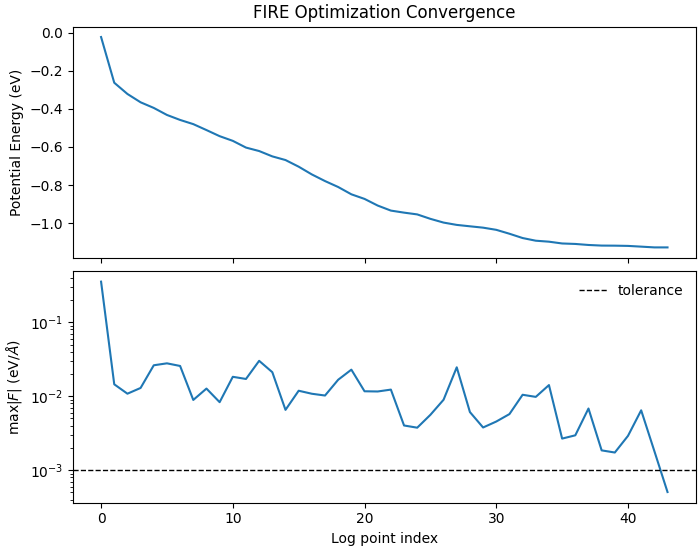
<matplotlib.legend.Legend object at 0x1551b7e17c50>
Visualize initial vs final geometry (XY projection)
pos0 = initial_positions
pos1 = system.wp_positions.numpy()

fig2, ax2 = plt.subplots(
    1, 2, figsize=(8.0, 3.5), sharex=True, sharey=True, constrained_layout=True
)
ax2[0].scatter(pos0[:, 0], pos0[:, 1], s=20)
ax2[0].set_title("Initial (XY)")
ax2[0].set_xlabel("x (Å)")
ax2[0].set_ylabel("y (Å)")
ax2[1].scatter(pos1[:, 0], pos1[:, 1], s=20)
ax2[1].set_title("Optimized (XY)")
ax2[1].set_xlabel("x (Å)")

plt.show()
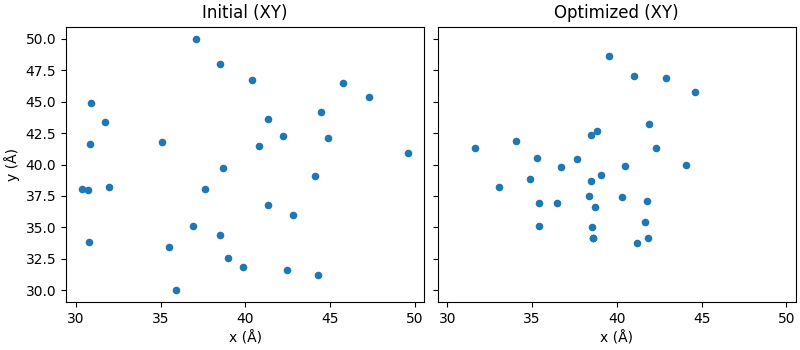
Total running time of the script: (0 minutes 1.091 seconds)