
Note
Go to the end to download the full example code.
Batched FIRE2 Optimization with LJ Clusters#
This example demonstrates batched geometry optimization using the FIRE2
optimizer (Guenole et al., 2020) with batch_idx batching.
Compared to FIRE (08_fire_batched.py), FIRE2:
Assumes unit mass (no
massesparameter)Has a simpler state: only
alpha,dt,nsteps_incper systemHyperparameters are Python scalars (
delaystep,dtgrow, etc.)Only supports
batch_idxmode (noatom_ptrvariant)
We optimize multiple independent LJ clusters in parallel, with per-system FIRE2 parameters that adapt independently.
from __future__ import annotations

import matplotlib.pyplot as plt
import numpy as np
import warp as wp
from _dynamics_utils import (
    DEFAULT_CUTOFF,
    DEFAULT_SKIN,
    EPSILON_AR,
    SIGMA_AR,
    BatchedMDSystem,
    create_random_box_cluster,
)

from nvalchemiops.batch_utils import create_atom_ptr, create_batch_idx
from nvalchemiops.dynamics.optimizers import fire2_step
from nvalchemiops.segment_ops import (
    segmented_max_norm,
    segmented_sum,
)

# ==============================================================================
# Main Example
# ==============================================================================

wp.init()
device = "cuda:0" if wp.is_cuda_available() else "cpu"
print(f"Using device: {device}")
Using device: cuda:0
Create Batch of LJ Clusters#
num_systems = 4
atom_counts = [16, 24, 20, 32]  # Different sizes per system
total_atoms = sum(atom_counts)

# Box size large enough to avoid self-interaction
box_L = 30.0  # Å
min_dist = 0.9 * SIGMA_AR

print("\nBatch setup:")
print(f"  Number of systems: {num_systems}")
print(f"  Atoms per system: {atom_counts}")
print(f"  Total atoms: {total_atoms}")
print(f"  LJ parameters: ε = {EPSILON_AR:.4f} eV, σ = {SIGMA_AR:.2f} Å")

# Generate initial positions for all systems
all_positions = []
all_cells = []
for sys_id, count in enumerate(atom_counts):
    pos = create_random_box_cluster(count, box_L, min_dist, seed=42 + sys_id)
    all_positions.append(pos)
    all_cells.append(np.eye(3, dtype=np.float64) * box_L)

# Concatenate into batched arrays
positions_np = np.concatenate(all_positions, axis=0)
cells_np = np.stack(all_cells, axis=0)
batch_idx_np = np.concatenate(
    [np.full(count, sys_id, dtype=np.int32) for sys_id, count in enumerate(atom_counts)]
)

# Create Warp arrays
positions = wp.array(positions_np.copy(), dtype=wp.vec3d, device=device)
velocities = wp.zeros(total_atoms, dtype=wp.vec3d, device=device)

# Create batching arrays
atom_counts_wp = wp.array(np.array(atom_counts, dtype=np.int32), device=device)
atom_ptr = wp.zeros(num_systems + 1, dtype=wp.int32, device=device)
create_atom_ptr(atom_counts_wp, atom_ptr)
batch_idx = wp.zeros(total_atoms, dtype=wp.int32, device=device)
create_batch_idx(atom_ptr, batch_idx)

print(f"  batch_idx shape: {batch_idx.shape}")
print(f"  atom_ptr shape: {atom_ptr.shape}")
print(f"  atom_ptr values: {atom_ptr.numpy()}")

# Create batched MD system (using BatchedMDSystem, ignoring velocities/masses for FIRE2)
lj_system = BatchedMDSystem(
    positions=positions_np,
    cells=cells_np,
    batch_idx=batch_idx_np,
    num_systems=num_systems,
    epsilon=EPSILON_AR,
    sigma=SIGMA_AR,
    cutoff=DEFAULT_CUTOFF,
    skin=DEFAULT_SKIN,
    switch_width=1.0,  # Smooth cutoff for optimization
    device=device,
)
Batch setup:
  Number of systems: 4
  Atoms per system: [16, 24, 20, 32]
  Total atoms: 92
  LJ parameters: ε = 0.0104 eV, σ = 3.40 Å
  batch_idx shape: (92,)
  atom_ptr shape: (5,)
  atom_ptr values: [ 0 16 40 60 92]
FIRE2 Parameters (per-system)#
FIRE2 state: only alpha, dt, nsteps_inc per system. Hyperparameters are Python scalars with sensible defaults.
# Per-system state arrays (shape (B,))
alpha = wp.array([0.09] * num_systems, dtype=wp.float64, device=device)
dt = wp.array([0.005] * num_systems, dtype=wp.float64, device=device)
nsteps_inc = wp.zeros(num_systems, dtype=wp.int32, device=device)

# Scratch buffers (shape (B,))
vf = wp.zeros(num_systems, dtype=wp.float64, device=device)
v_sumsq = wp.zeros(num_systems, dtype=wp.float64, device=device)
f_sumsq = wp.zeros(num_systems, dtype=wp.float64, device=device)
max_norm = wp.zeros(num_systems, dtype=wp.float64, device=device)
FIRE2 Optimization#
max_steps = 2000
force_tol = 1e-3  # eV/Å
log_interval = 200
check_interval = 50

# History
energy_hist = []
maxf_hist = []

print("\n" + "=" * 80)
print("FIRE2 BATCHED OPTIMIZATION (batch_idx)")
print("=" * 80)
print(f"\nRunning FIRE2 optimization ({max_steps} max steps)...")
print(f"Force tolerance: {force_tol:.1e} eV/Å")
print("FIRE2 defaults: delaystep=60, dtgrow=1.05, alpha0=0.09, maxstep=0.1")
print("-" * 70)
print(f"{'Step':>6} {'Total E':>14} {'max|F|':>12} {'Converged':>12}")
print("-" * 70)

for step in range(max_steps):
    # Update positions in LJ system and compute forces
    wp.copy(lj_system.wp_positions, positions)
    energies = lj_system.compute_forces()

    # FIRE2 step
    fire2_step(
        positions=positions,
        velocities=velocities,
        forces=lj_system.wp_forces,
        batch_idx=batch_idx,
        alpha=alpha,
        dt=dt,
        nsteps_inc=nsteps_inc,
        vf=vf,
        v_sumsq=v_sumsq,
        f_sumsq=f_sumsq,
        max_norm=max_norm,
    )

    # Check convergence at intervals
    if step % check_interval == 0 or step == max_steps - 1:
        system_energies = wp.zeros(num_systems, dtype=wp.float64, device=device)
        segmented_sum(energies, batch_idx, system_energies)
        max_forces = wp.zeros(num_systems, dtype=wp.float64, device=device)
        segmented_max_norm(lj_system.wp_forces, batch_idx, max_forces)

        wp.synchronize()
        system_energies_np = system_energies.numpy()
        max_forces_np = max_forces.numpy()

        total_energy = system_energies_np.sum()
        global_max_f = max_forces_np.max()
        num_converged = (max_forces_np < force_tol).sum()

        energy_hist.append(total_energy)
        maxf_hist.append(global_max_f)

        if step % log_interval == 0 or step == max_steps - 1:
            print(
                f"{step:>6d} {total_energy:>14.6f} {global_max_f:>12.2e} {num_converged:>8d}/{num_systems}"
            )

        if num_converged == num_systems:
            print(f"\nAll systems converged at step {step}!")
            break

print(f"\nFinal per-system energies: {system_energies_np}")
print(f"Final max forces per system: {max_forces_np}")
================================================================================
FIRE2 BATCHED OPTIMIZATION (batch_idx)
================================================================================

Running FIRE2 optimization (2000 max steps)...
Force tolerance: 1.0e-03 eV/Å
FIRE2 defaults: delaystep=60, dtgrow=1.05, alpha0=0.09, maxstep=0.1
----------------------------------------------------------------------
  Step        Total E       max|F|    Converged
----------------------------------------------------------------------
     0      -0.178234     2.85e-01        0/4
   200      -0.302223     1.45e-02        0/4
   400      -0.456152     5.03e-02        0/4
   600      -0.600681     1.30e-02        0/4
   800      -0.734234     3.88e-02        0/4
  1000      -0.861586     1.64e-02        0/4
  1200      -0.957798     3.51e-02        0/4
  1400      -1.017783     1.08e-02        0/4
  1600      -1.065102     1.43e-02        0/4
  1800      -1.116602     7.41e-03        0/4
  1999      -1.154061     5.18e-03        0/4

Final per-system energies: [-0.15214219 -0.27857798 -0.15079847 -0.5725424 ]
Final max forces per system: [0.00517704 0.00192463 0.00161538 0.00500106]
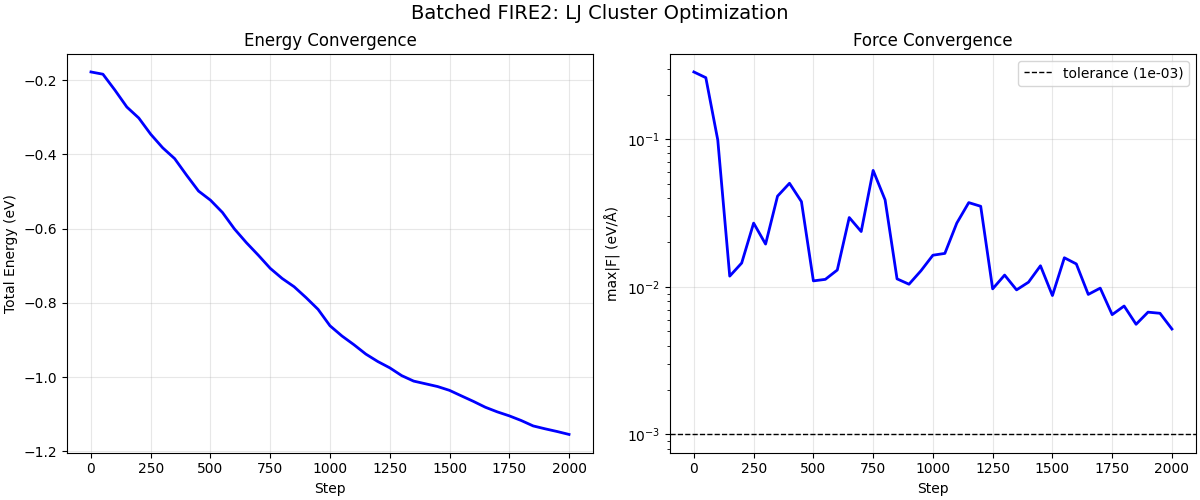
Plot Convergence#
fig, axes = plt.subplots(1, 2, figsize=(12, 5), constrained_layout=True)

steps_arr = np.arange(len(energy_hist)) * check_interval

axes[0].plot(steps_arr, energy_hist, "b-", lw=2)
axes[0].set_xlabel("Step")
axes[0].set_ylabel("Total Energy (eV)")
axes[0].set_title("Energy Convergence")
axes[0].grid(True, alpha=0.3)

axes[1].semilogy(steps_arr, maxf_hist, "b-", lw=2)
axes[1].axhline(
    force_tol, color="k", ls="--", lw=1, label=f"tolerance ({force_tol:.0e})"
)
axes[1].set_xlabel("Step")
axes[1].set_ylabel("max|F| (eV/Å)")
axes[1].set_title("Force Convergence")
axes[1].legend()
axes[1].grid(True, alpha=0.3)

fig.suptitle("Batched FIRE2: LJ Cluster Optimization", fontsize=14)
plt.show()
Total running time of the script: (0 minutes 1.039 seconds)