

display_color_response (FET006 Display Color)#
Property |
Value |
|---|---|
Test name |
display_color_response |
Feature(s) |
FET_010_STANDARD |
Requirement |
DISP.001, DISP.003 |
Engine |
Kit / Isaac Sim (>=2024.2.0) |
Test version |
0.4.0 |
Summary#
Binds the material DISP.001’s Guidance nominates over the whole asset and renders it with the primvar reader swapped in and out. A measurable part of the silhouette must render differently from the same surface driven by the reader’s own fallback color as a constant, which is primvars:displayColor reaching the shader and driving pixels. A further frame asks the same of displayOpacity. Nothing on the asset is edited.
What Pass Guarantees#
A pass means display color is live in the engine. It does not mean the asset is conformant.
That division of labour is worth stating before anything else on this page. A passing result confirms that display colors this asset ships reach a renderer through the material the specification nominates for them: a consumer that does not evaluate materials gets the asset’s own colors rather than a uniform default, not because the file says so but because the render moved when the primvar was taken out from behind it.
It says nothing about how much of the asset carries one. An asset with a display color on one prim in fifty passes this benchmark and fails DISP.001.
Question |
Answered by |
How |
|---|---|---|
Is |
DISP.001, DISP.002 — validator |
Reads the file, per Gprim |
Does every renderable Gprim resolve one? |
DISP.001 — validator |
Reads the file, per Gprim, and names the ones that do not |
Do the values reach a renderer at all? |
This benchmark |
Renders the asset with the reader swapped in and out |
Are the values the right colors? |
Nothing |
DISP.002 sets no plausibility band and says none is planned |
The third row is the only one a render can add, and it is not redundant: refer to Inherited Display Color Inside an Instance for a conformant asset that the validator passes and a consumer sees no color on.
A pass also confirms that the opacity half of the nominated material works: primvars:displayOpacity reaches geometry_opacity, and geometry that omits the primvar stays opaque because the reader’s inputs:default of 1.0 is holding it there. Presence again, not extent.
A pass does not judge whether the shipped colors are the right ones, and it asserts nothing about which of them is brighter than which. DISP.002 sets no plausibility band and says none is planned, on the grounds that Rec.709 weights blue at 0.0722 and a saturated navy computes a lower luminance than charcoal. Nothing here computes a luminance.
Why Coverage Is Not Measured Here#
The ratio this test produces is denominated in pixels. DISP.001 is denominated in Gprims. The two come apart badly, and the fixtures show it directly:
Fixture |
Gprims resolving no display color |
Response ratio |
|---|---|---|
Toaster, a color on the body alone |
4 of 5 |
97.5% |
Toaster, a color on the four small parts alone |
1 of 5 |
2.7% |
The same requirement is broken in both. The larger defect reads thirty-five times higher, because the body is most of the toaster’s silhouette and the lever, tray, dial and cancel button are not. No floor on this ratio orders those two correctly, and any floor chosen to fail one of them either fails conformant assets or passes the other.
DISP.001 orders both correctly, per Gprim, and names the offending prims. So coverage stays with the validator, which runs ahead of the benchmarks, and this test asks the one question the validator cannot: whether any of it reaches a renderer.
That is why both floors here sit where nothing separates from something, an order of magnitude above the render’s own noise, rather than anywhere near full coverage.
What It Checks#
Three frames, all the same OpenPBR surface bound over the whole asset, plus a duplicate of the first that serves as the noise control. They differ only in what drives base_color and geometry_opacity:
Frame |
|
|
|---|---|---|
|
|
1.0 |
|
byte-for-byte what |
1.0 |
|
flat magenta constant, no reader |
1.0 |
|
|
0.0 |
Display color reaches the shader, and it is what drove the pixels. read against removed is one comparison answering both. The two materials paint the same magenta — one as the reader’s inputs:default, one as a constant with no reader behind it — so geometry that resolved a display color of its own renders that color in read and magenta in removed, and geometry that resolved none renders magenta in both. Any difference above the render’s own swap noise is display color reaching the shader; the size of the difference is not asserted, for the reasons above.
Display opacity reaches the surface. read against opacity drops the opacity reader’s fallback from 1.0 to 0.0. Where no Gprim resolves a displayOpacity of its own, geometry should disappear, because every one of them was holding its opacity from that fallback. Where all of them do resolve one, nothing should change, because the fallback is never reached. Both are asserted as presence, not extent; a mixed asset is measured and reported without a floor, because the geometry that would disappear may be occluded by the geometry that would not.
How much of the silhouette goes with it is deliberately not asserted. The workbench tool renders at a mean of (0.059, 0.053, 0.050) against this test’s black room, so an invisible copy of it differs from a visible one over less than half the silhouette. It measured 41.2 percent with the opacity reader working correctly, and the 90 percent floor this test used to carry failed a conformant shipping sample on nothing but how dark it is.
The render is settled. A control frame renders read again through a second material that duplicates it. Both frames sit on the far side of a material swap and should be indistinguishable; when they are not, the run is unsettled and no comparison from it is a measurement. The control’s own ceiling is also what the DISP.003 no-change case is measured against, since that is the same shape of question.
The test skips when the asset has no renderable geometry.
What Changed in 0.4.0#
Coverage used to be a fourth frame, altered, which was read with the reader’s fallback moved from magenta to green, and it was gated the other way up: geometry resolving nothing changed color between the two frames, so a high difference was the failure.
read against removed measures the same geometry from the opposite side, and it establishes causality at the same time, which read against altered does not. The green reader and its gate are gone. The adaptive coverage limit — max(max_coverage_ratio, control × coverage_noise_multiple) — went with them.
The deeper change is what replaced it. altered was an attempt to measure coverage in pixels, which is the wrong instrument for a per-Gprim requirement however it is gated, so the claim went back to the validator rather than being re-tuned here. Refer to Why Coverage Is Not Measured Here. Two thresholds moved with it: min_response_ratio from 0.99 to 0.005 and min_opacity_response_ratio from 0.90 to 0.005, both now presence floors an order of magnitude above the render’s own noise.
One case the collapse can no longer tell apart. Geometry whose authored display color is the probe’s magenta renders identically in read and removed and is counted as unresponsive. Under read against altered it rendered magenta in both frames and was correctly counted as covered. Refer to When the Asset’s Own Color Is the Probe’s.
How It Works#
One material is bound on the asset’s root prim, with bindMaterialAs = "strongerThanDescendants". That beats every binding the asset authors below it, so swapping that one binding swaps the shading of the whole asset. Reproduced on a stage carrying, at once, a binding inside a prototype, a strongerThanDescendants binding inside that prototype, a GeomSubset binding, a collection binding on an intermediate Scope, a strongerThanDescendants binding on an intermediate Xform, and an instance nested inside another prototype: the one root binding took all ten resolved prims.
Nothing is authored on the asset. That matters most for instanced content: an instance proxy cannot be authored on at all, and the asset’s own root prim never is one, because instance proxies are by definition descendants of an instance. Assets with nested instancing need no special handling.
The material is the one DISP.001’s Guidance nominates: ND_geompropvalue_color3 on displayColor into base_color and ND_geompropvalue_float on displayOpacity into geometry_opacity, both feeding ND_open_pbr_surface_surfaceshader. Using it means the benchmark measures what the specification asks authors to produce rather than the internals of whichever fallback a renderer ships. It is also what reaches DISP.003: Kit’s own fallback for unbound geometry, kit/mdl/rtx/Default.mdl, declares a surface and no opacity term.
The fallback color is magenta rather than the plausible grey the Guidance suggests. A plausible grey is the right thing for an asset shipping the material and the wrong thing for a probe, because it is indistinguishable from a display color that resolved.
Every ratio is denominated in the asset’s own silhouette, cut out of the removed frame, where the asset is flat magenta by construction, by magenta dominance. A whole-frame difference would also count the shadow the asset casts and the light it bounces onto the room, neither of which is the asset.
The scene is a black room lit by a dome alone, and mtlx has to be in Kit’s render-context list or the probe resolves to no surface at all. The list is read and reported, and its absence fails the run rather than being measured.
Where the Floors Sit#
Measured on Isaac Sim 6.0, inside the asset’s own silhouette. The response ratio is read against removed; the control is read against its duplicate; the opacity ratio is read against opacity. Both floors are 0.5 percent.
Fixture |
Gprims with a display color |
Control |
Response |
Opacity |
Result |
|---|---|---|---|---|---|
Reference toaster, a color on each Gprim |
5 of 5 |
0.002% |
100.000% |
98.510% |
PASS |
Reference toaster, one constant on an ancestor |
5 of 5 |
0.025% |
99.994% |
99.990% |
PASS |
Workbench tool |
11 of 11 |
0.000% |
100.000% |
41.210% |
PASS |
Joystick |
3 of 3 |
0.008% |
100.000% |
99.501% |
PASS |
Lamp |
4 of 4 |
0.000% |
99.999% |
99.924% |
PASS |
Light bulb |
1 of 1 |
0.009% |
100.000% |
100.000% |
PASS |
Toaster, a color on the body alone |
1 of 5 |
0.012% |
97.499% |
99.946% |
PASS |
Toaster, a color on the four small parts alone |
4 of 5 |
0.043% |
2.741% |
99.962% |
PASS |
Toaster, no display color anywhere |
0 of 5 |
0.055% |
0.076% |
99.996% |
FAIL |
Toaster, every color authored as the probe’s magenta |
5 of 5 |
0.055% |
0.077% |
99.996% |
FAIL |
The two partial fixtures pass, and that is the intended behaviour. Display color is doing something in the engine on both, which is all this benchmark is in a position to say. DISP.001 fails both in the validator, per Gprim, and names the prims: four of five on one, one of five on the other. Refer to Why Coverage Is Not Measured Here.
The floor is where the two populations part. Everything with a display color reaching the shader read 2.7 percent or more; the two assets where nothing reaches it read 0.076 and 0.077 percent, and the worst control across every run was 0.055 percent. 0.5 percent is the geometric middle of 0.077 and 2.7 — six times the loudest inert run, five times under the quietest live one, and nine times the worst control.
The gap is narrower than the conformant column suggests. The quietest live run is 2.7 percent, not 97, because the geometry carrying a display color there is small. A floor picked from the conformant assets alone — anything at or above 5 percent — fails it.
Note that the two partial fixtures sit 35 times apart with the larger defect reading higher. That is the measurement being denominated in pixels rather than Gprims, and it is the whole argument for leaving coverage to the validator.
When the Asset’s Own Color Is the Probe’s#
Geometry whose authored display color is the probe’s magenta renders identically in read and in removed, and this test reads it as geometry that resolved nothing.
Measured: a toaster with primvars:displayColor = (1, 0, 1) on an enclosing Xform reads 0.077 percent, against 0.076 percent for the same toaster with no display color at all. The two are indistinguishable in the number.
This is documented rather than mitigated, on four grounds:
It is a false failure, not a false pass. It costs an author an investigation; it does not ship a defect.
The failure is diagnosable from what the test already reports. The file-side count says every Gprim resolves a color, the message names the probe’s constant, and the
readframe shows a magenta object.The probe’s constant is pure saturated magenta, which is the color a pipeline uses to mean missing. A display color is meant to stand in for a material’s albedo, and few assets ship that value deliberately.
Mitigating it costs more than it looks. A second
removedframe at a different constant would detect it, but the silhouette is cut from theremovedframe because it is flat magenta, so a second constant means either another swap and capture or decoupling the mask from the frame it is currently free with.
If it turns out to matter, the fix is the fifth frame: removed again at a different constant, with the asset required to respond to at least one of the two.
A Dark Asset and the DISP.003 Floor#
The workbench tool renders at a mean of (0.059, 0.053, 0.050) against the test’s black room. Dropping the opacity reader’s fallback to zero makes it invisible, and an invisible object and a very dark one differ by less than the 0.08 pixel threshold over most of the silhouette, so it measures 41.2 percent with the opacity reader working correctly.
Against the 90 percent floor this test carried through 0.3.1, that failed a conformant shipping sample on nothing but how dark it is. It was the clearest evidence that the DISP.003 floor was measuring the wrong thing: how much of the silhouette disappears is a property of the asset’s colors and of the room it is rendered in, not of whether displayOpacity reaches geometry_opacity.
The floor is now 0.5 percent and the workbench tool passes with eighty times the margin. What still fails is an opacity reader that does nothing at all, which is the only thing this frame is in a position to establish.
Failure Cases#
Symptom |
Likely cause |
|---|---|
Replacing the reader with a constant changes nothing, and the file says every Gprim resolves no |
The asset carries none. This is DISP.001, and the validator names every prim |
The same, and the file says every Gprim resolves one |
The values are authored and are not reaching the shader — on instanced geometry, an inherited value on an intermediate prim inside the prototype is the usual cause — or they are reaching it and they are the probe’s magenta |
The test passes and the validator fails DISP.001 |
Expected. Some display color reaches the renderer and some Gprims carry none; the validator is the coverage check |
The asset covers too few magenta pixels |
The camera did not frame the object; |
Dropping the opacity fallback to zero changed nothing on an asset that omits |
The opacity half of the nominated material is not reaching |
Dropping it changed something on an asset that authors |
The authored value is not resolving, so geometry is taking the fallback |
Some Gprim does not resolve the probe material |
Something above the asset root is binding a material over it |
|
An earlier run narrowed the persisted list; Kit writes that key to |
The two renders of the same material differ |
The render is not settled; raise |
Test skipped |
The asset has no renderable Gprims |
How to Fix#
A failure here means no display color at all reached the renderer, so start from the whole asset rather than from one prim. Author primvars:displayColor on the geometry, or once on an ancestor with constant interpolation. Only constant primvars are inheritable, so an ancestor value at any other interpolation will not reach the Gprim.
For which prims are missing one, read the validator’s DISP.001 result rather than this test’s number. This test will pass as soon as any of them resolves.
If the file says every Gprim resolves one and the render disagrees, the value is authored and is not reaching the shader — or it is the probe’s magenta. On instanced geometry, check where the value sits before anything else: see Inherited Display Color Inside an Instance below. Otherwise look at the primvar’s type, its element count against its declared interpolation, and, for an indexed primvar, its indices.
If the asset covers too few magenta pixels, check primvars:displayOpacity before anything else. Geometry resolving an opacity of zero renders invisible under the nominated material whatever its display color says, and DISP.003 calls that out as a common artifact of an unconfigured export.
If the two renders of the same material differ, the run is unsettled rather than the asset broken. Raise settle_frames and run again.
Expected Result#
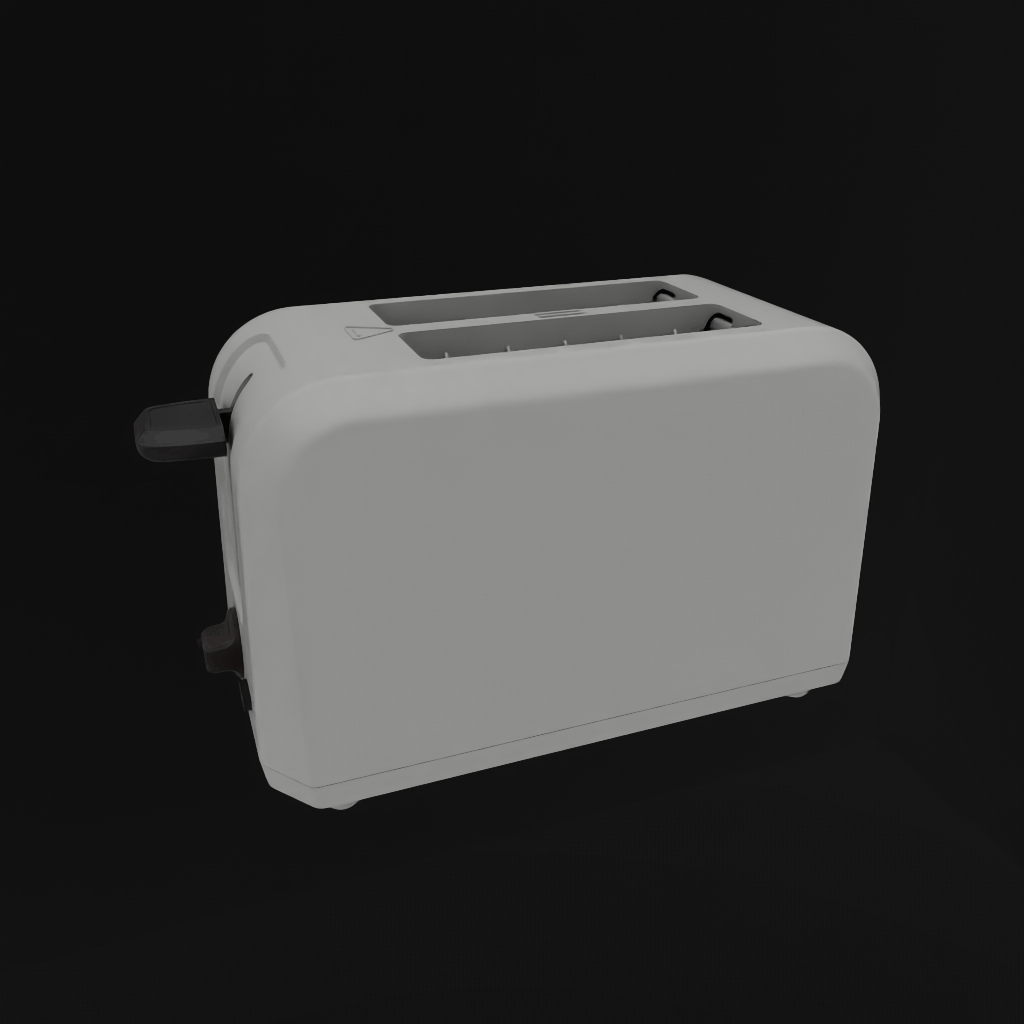
The reference toaster shaded by the material DISP.001 nominates, driven by the primvars:displayColor it ships. The dark lever and dial against the pale body are the primvar’s doing; the OmniPBR materials the asset binds are all overridden by the probe.
On this sample all 5 renderable Gprims resolved the probe material through the single root binding, and the asset covered 294,812 silhouette pixels.
Measurement |
Result |
Limit |
|---|---|---|
Two renders of the same material |
0.002% of the silhouette |
below 2% |
Replacing the reader with a constant |
100.0% |
above 0.5% |
Dropping the opacity fallback to zero |
98.5% |
above 0.5% |
The two results sit three orders of magnitude above their floors, and that is the normal shape of a pass here rather than a close call. The floors are set to separate something from nothing; on an asset where the feature works at all they are not close.
No Gprim on this asset resolves a primvars:displayOpacity, so every one of them holds its opacity from the reader’s inputs:default of 1.0, and dropping that default to 0.0 took 98.5 percent of the silhouette with it. That is DISP.003 covered by render: the primvar reaches geometry_opacity, and the default is what keeps geometry omitting it opaque.
Run the same test against the same asset before its display colors were authored and replacing the reader with a constant moves 0.076 percent instead of 100 percent, below the floor, and the test fails. The read frame is then a magenta toaster.
Inherited Display Color Inside an Instance#
An inherited display color does not reach the geometry in Kit when it sits on an intermediate prim inside an instance prototype. DISP.001 allows authoring one value on an enclosing Xform or Scope, USD resolves it on the instance proxies, and the render comes back on the reader’s fallback anyway.
Measured across four fixtures on Isaac Sim 6.0:
Where |
Instanced |
Reaches the geometry |
|---|---|---|
On each Gprim |
no |
yes |
On an ancestor |
no |
yes |
On each Gprim inside the prototype |
yes |
yes |
On the prototype’s own root prim |
yes |
yes |
On an intermediate prim inside the prototype |
yes |
no |
The last row is a conformant asset. Nothing in the file is wrong, the validator passes it, and a consumer that reads display color sees none. It is what this test exists to catch, and it is not visible to any file-level check. The workaround for an author is to put the value on the geometry itself, or on the prototype’s root prim.
The same shape appears when the asset’s own root prim is instanceable, because everything under it is then a prototype.
Notes and Caveats#
Nothing here compares one Gprim’s rendered brightness with another’s, and nothing compares a pixel with an authored value. DISP.002 rules out the first two kinds of claim and RTX tone-mapping rules out the third. An earlier version of this test asserted a per-Gprim rendered-luminance ordering; that assertion is gone and nothing has replaced it.
The test does not require the asset to carry more than one display color. DISP.001 explicitly allows one constant value on an enclosing Xform or Scope, and an asset shaped that way passes here with no variation to measure.
Coverage is not measured here at all. The validator is the check for DISP.001 and it runs ahead of the benchmarks; what this test adds is that the values reach a renderer, which is what What Pass Guarantees states at the top of the page.
The pixel threshold is 0.08 rather than the 0.04 the material tests use. Every signal here is a swap between saturated colors: magenta against the asset’s own color, opaque against invisible. A material swap, meanwhile, costs the path tracer its accumulated history and lands it on a different noise realisation. Measured on the two-box fixtures, that noise was 4.0 percent of the silhouette at 0.04 and 0.05 percent at 0.08, with every real signal still at 100 percent.
The test edits the stage it loaded, in one place: a material binding on the asset’s root prim, taken off again at the end. It authors nothing on the asset’s own geometry, de-instances nothing, and writes nothing to disk.
Display color is a primvar rather than a material, so none of the render-context machinery in the FET006 Materials family applies to it. The one thing the two share is that the nominated probe carries an mtlx surface, so mtlx has to be resolvable.