The xFit measurements on this page report uncertainties from a fitted covariance or a fixed-PSF flux estimate. xRep resamples your variance planes, xPois propagates them into the difference image, and xFit uses them as weights. Use this page to assess correlated noise, read the transient chain’s error budget, and check error bars on your own data. Failed or unsupported uncertainty estimates can be NaN.
You need:
cuPhoton with the CPU profile (Chapter 1), and Matplotlib for the figure.
A target and a reference image with variance planes. This page makes a sample pair.
NoteSample data
This page runs on a small synthetic pair. The printed values only demonstrate the API.
10.1 Make a sample pair
The block below writes the pair of Chapter 2. The target is rotated by 3 degrees against the reference and has slightly larger pixels.
Create the sample pair (NumPy and Astropy only)
# Writes sample/reference.fits and sample/target.fits: two synthetic star fields# of the same sky on different pixel grids, with different blur and sky level.# The target also holds one new source and one star three times brighter.# Noise is independent Gaussian noise with variance expected_image / gain;# this teaching sample has no read noise, saturation, or detector artifacts.from pathlib import Pathimport numpy as npfrom astropy.io import fitsfrom astropy.wcs import WCSrng = np.random.default_rng(7)def make_wcs(shape, scale_arcsec, rotation_deg, crpix_shift): w = WCS(naxis=2) w.wcs.ctype = ["RA---TAN", "DEC--TAN"] w.wcs.crval = [150.0, 2.0] w.wcs.crpix = [shape[1] /2+ crpix_shift[0], shape[0] /2+ crpix_shift[1]] c, s = np.cos(np.radians(rotation_deg)), np.sin(np.radians(rotation_deg)) w.wcs.cd = scale_arcsec /3600* np.array([[-c, s], [s, c]])return wdef render(shape, wcs, ra, dec, flux, sigma, sky, gain): x, y = wcs.world_to_pixel_values(ra, dec) yy, xx = np.mgrid[: shape[0], : shape[1]] image = np.full(shape, sky, dtype=float)for xi, yi, fi inzip(x, y, flux): image += fi / (2* np.pi * sigma**2) * np.exp(-((xx - xi) **2+ (yy - yi) **2) / (2* sigma**2))return rng.normal(image, np.sqrt(image / gain)).astype(np.float32)ra =150.0+ rng.uniform(-0.016, 0.016, 150)dec =2.0+ rng.uniform(-0.016, 0.016, 150)flux =10** rng.uniform(2.5, 4.5, 150)target_flux = np.r_[3* flux[0], flux[1:], 4000.0] # star 0 brightens; one new sourcetarget_ra, target_dec = np.r_[ra, 150.004], np.r_[dec, 2.003]Path("sample").mkdir(exist_ok=True)for name, shape, wcs, sky_coords, fl, sigma, sky, gain in [ ("reference", (300, 300), make_wcs((300, 300), 0.26, 0.0, (0, 0)), (ra, dec), flux, 1.2, 100.0, 8.0), ("target", (256, 256), make_wcs((256, 256), 0.27, 3.0, (4.3, -2.7)), (target_ra, target_dec), target_flux, 1.8, 120.0, 2.0),]: header = wcs.to_header() header["GAIN"] = (gain, "electrons per data number (DN)") header["PSFSIG"] = (sigma, "Gaussian PSF sigma [px]") fits.writeto(f"sample/{name}.fits", render(shape, wcs, *sky_coords, fl, sigma, sky, gain), header, overwrite=True)
10.2 Follow the noise through the pipeline
These calls propagate and use the per-pixel variance planes:
Step
Call
Noise it returns
Guide
Your input
a variance plane per image
the expected squared error of each pixel, in squared image units
marginal_residual_variance, the target variance plus the reference variance convolved with the squared kernel, and standardized_residual, the difference over its square root
These variance planes store one variance per pixel, without covariances between pixels. The subtraction diagnostic below treats the fitted kernel as fixed, and the xFit errors initially assume independent pixels. The blocks align and subtract as in Chapter 7, and print the median variance after each step.
import numpy as npfrom astropy.wcs import WCSfrom cuphoton.core.fits_io import read_fits_imagesfrom cuphoton.xrep import BBox, ReprojectionSpec, make_wcs_pair_transform, prepare_reprojection, reproject_masked_arraytarget_read, reference_read = (read_fits_images(f"sample/{name}.fits", [0]) for name in ("target", "reference"))target, reference = (r.arrays[0].astype(np.float64) for r in (target_read, reference_read))target_header, reference_header = target_read.infos[0].header, reference_read.infos[0].headertarget_variance = np.clip(target, 0, None) / target_header["GAIN"] # your own variance planes go herereference_variance = np.clip(reference, 0, None) / reference_header["GAIN"]spec = ReprojectionSpec(mapping=make_wcs_pair_transform(WCS(target_header), WCS(reference_header)), output_bbox=BBox(0, 0, target.shape[1], target.shape[0])) # (x, y) origin, then the sizeprepared = prepare_reprojection(spec, source_shape=reference.shape)no_bad_pixels = np.zeros(reference.shape, dtype=bool)aligned = reproject_masked_array(reference, reference_variance, no_bad_pixels, spec, backend="cpu", prepared=prepared)
reference                      median variance  12.52
reference, aligned             median variance  11.54
reference, through the kernel  median variance   0.49
target                         median variance  60.29
difference                     median variance  60.78
In this example, alignment and the kernel reduce the reference’s median variance by combining input pixels. Resampling and convolution also correlate neighboring output pixels, which a per-pixel variance does not describe. The variance need not decrease for other interpolation weights, pixel-area scalings or kernels.
10.3 Measure the candidates
Find the two candidates and fit them with xFit. The window, \(2\lceil 5\sigma\rceil + 1\) pixels for a PSF (point spread function) width \(\sigma\), is the one the transient chain uses.
from cuphoton.xfit import fit_single_sourcesfrom cuphoton.xpois import window_stampsregions = identify_residual_hotspots(noise.standardized_residual, robust_sigma=1.0, max_regions=None)candidates = np.array([region["peak_yx"][::-1] for region in regions], dtype=float) # (x, y)psf_sigma = target_header["PSFSIG"]size =2*int(np.ceil(5* psf_sigma)) +1cutout_variance = window_stamps(difference_variance, candidates, size)sources = fit_single_sources(window_stamps(difference, candidates, size), cutout_variance, np.zeros((len(candidates), 2)), psf_sigma, mask=np.isfinite(cutout_variance), sign=1) # both candidates brightenedprint("window", size, "px, uncertainty_valid", sources.uncertainty_valid)print("flux error ", sources.flux_error.round(1))print("x position error", sources.position_error_x.round(4))
window 19 px, uncertainty_valid [ True  True]
flux error       [113.5  70.6]
x position error [0.0194 0.0393]
The errors come from the fit covariance and are NaN where uncertainty_valid is false.
10.4 Correct for correlated noise
A fixed-PSF flux is a weighted sum of difference pixels; a fitted position can be approximated by one after linearizing the fit. The correlation factor \(f\) is the variance of that sum including covariance, divided by the variance predicted from independent pixels. Multiply its error bar by \(\sqrt{f}\) to account for that covariance. The factor depends on the estimator’s weights and can be below one, especially for signed derivative weights.
10.4.1 Measure the factor at empty positions
empty_positions picks pixels more than one window from every candidate and every loud pixel. empirical_correlation_factor divides the weighted sum of the difference at each by its predicted error, and returns the squared robust spread (1.4826 times the median absolute deviation) of the ratios. psf_weights builds a Gaussian PSF and its derivatives. These approximate flux and position weights for a symmetric PSF in uniform noise; inverse-variance weighting, masks and joint parameter fitting change the actual weights.
from cuphoton.xpois import empirical_correlation_factor, empty_positions, psf_weights# loud: pixels more than 5 robust sigmas from the median of the differenceempty, _ = empty_positions(inside, exclude_xy=candidates, window=size, count=500, loud=(difference, 5.0))weights = np.stack([psf_weights(psf_sigma, size), psf_weights(psf_sigma, size, derivative="x"), psf_weights(psf_sigma, size, derivative="y")]) # a flux, an x and a y positionmeasured = empirical_correlation_factor(difference, difference_variance, weights, empty)n = measured.positions_usedstandard_error = measured.factor * np.sqrt(2/ (0.3675* (n -1))) # as the transient chain computes itprint(f"{n} positions. Factors for the flux, x and y: {measured.factor.round(3)}; nominal SE {standard_error.round(3)}")
415 positions. Factors for the flux, x and y: [1.138 1.065 1.026]; nominal SE [0.131 0.122 0.118]
The printed standard error is the chain’s approximation for independent Gaussian samples. Empty windows can overlap and share noise, so increasing their count does not necessarily add independent information. Use separated positions or repeated independent images to assess the sampling uncertainty.
10.4.2 Apply the factor
The following scaling illustrates an approximate adjustment to the fitted errors. A factor measured with background PSF weights need not describe a bright source or a joint nonlinear fit exactly. For a particular estimator, use its weights and variance, as the forced-photometry example below does. Flooring the factor at one is the chain’s conservative policy, not a mathematical bound on \(f\).
flux error       [113.5  70.6] -> [121.1  75.3]
x position error [0.0194 0.0393] -> [0.02   0.0405]
10.4.3 Compute the factor in closed form
correlation_factor estimates \(f\) at each position from the kernel, both variance planes and the interpolation weights that xRep applied there, which resampling_weights_at returns. It assumes independent target and reference input noise, a fixed kernel, and locally stationary resampling. It infers a local reference-noise level from the resampled variance; this is not exact propagation of an arbitrary spatially varying input covariance. Pass resampling_weights_at the prepared mapping of the alignment.
The closed form is supported only where the mapping between the grids is locally a shift. is_translation is false where the local Jacobian, the change of reference pixel per target pixel, differs from the identity by more than 1e-3. Here it shows the rotation and the change of pixel scale. On such a pair, a measured factor can still diagnose the noise. When the chain’s correlation term is active, an undefined closed-form factor leaves the affected computed error bars NaN; the measured factor does not replace it (Section 9.11.1).
Write a target that only a shift separates from the reference, and subtract it. make_wcs and render come from the sample-pair block.
closed form, median [1.129 1.081 1.081]
measured            [1.069 1.237 1.222] nominal SE [0.123 0.143 0.141]
The closed form models the resampling and the kernel, but omits correlations already present in a coadd (a stack of resampled exposures). The chain accepts a measured factor when it exceeds one and the median closed form by more than two nominal standard errors. It then raises a candidate’s factor only if the candidate’s closed form is finite and smaller than that measured value.
10.5 Read the transient chain’s error budget
The transient chain (Chapter 9) runs these calls and adds three more terms. For each computed quantity q, one of center_x, center_y, positive_x, positive_y and psf_flux, it writes the error bar <q>_err and each term in its own column. The flux budget is available only when forced photometry ran:
Table 10.1: The terms of the chain’s error budget, from docs/uncertainty-quantification.md and transient_chain/uq.py.
Term
Column
What it adds
Applies to
Needs
fit
<q>_err_fit
xFit’s error, weighted by the target variance plane
all five
the fit. Without a target variance plane, xFit scales the covariance by the reduced chi-square
corr
<q>_err_corr
the reference’s noise and its correlation, <q>_err_fit * sqrt(max(f, 1) - 1), with f relative to the target variance
all five
target and reference variance planes, and a PSF width
kfit
<q>_err_kfit
the uncertainty of the fitted kernel and background, largest on a bright reference source
all five
a target variance plane, a PSF width and uq.kernel_fit: true
kmatch
<q>_err_kmatch
reference flux the kernel did not match, eta times the matched reference flux at the source
psf_flux, 0 for positions
a target variance plane, a PSF width and at least 5 stars matched by the refine stage
mis
<q>_err_mis
the alignment error left after the refine stage
positions, 0 for psf_flux
a misalignment model: align.refine: true, an affine refinement, a star finder other than daofind, and a reference that the chain reprojects or mosaics onto the target grid
sky
sky_err_arcsec
the absolute sky astrometry of the exposure
reported apart, never added to <q>_err
uq.sky_astrometry_arcsec and uq.sky_astrometry_source
A term without its inputs is left out; that does not establish that its physical contribution is zero. Check the recorded exclusions when interpreting the result. The uq block of the configuration sets the budget:
Key
Default
Effect
uq.enabled
true
false sets every <q>_err to <q>_err_fit and every other term to 0
uq.kernel_fit
true
computes the kfit term
uq.measure_correlation
true
measures the correlation factor at empty positions of each exposure
uq.correlation_positions
1000
the number of empty positions for that measurement, at least 20
uq.max_lobe_reach_px
32
the largest center-to-lobe distance that keeps a center error bar
uq.single_source_refit
true
refits a candidate with one unsupported lobe with the one-lobe model
set together. They are copied to sky_err_arcsec and sky_err_source
With the budget enabled, quote <q>_err. It is NaN when its fit error is nonfinite, its required window is unusable or its active correlation factor is undefined. A window needs at least half its pixels usable, and center estimates require both lobes within the configured reach. uq_valid covers the quantities that the budget computed; it does not certify every catalog output or the availability of all terms. With uq.enabled: false, the flag is set true without those checks. The block below, which needs a finished run (Section 9.11.1), rebuilds an error bar without one term.
import jsonimport pandas as pdtable = pd.read_parquet("out/catalog.parquet")rows = table[table["uq_valid"]]terms = ["fit", "corr", "kfit", "kmatch", "mis"]print(rows[["psf_flux", "psf_flux_err"] + [f"psf_flux_err_{term}"for term in terms]])without_kfit = np.sqrt(sum(rows[f"psf_flux_err_{term}"] **2for term in terms if term !="kfit"))summary = json.load(open("out/items/S1-v1/summary.json"))print(summary["uq_terms"])uq = summary["uq"]if uq isnotNone: # no budget summary when no candidates were foundprint(uq["excluded"]) correlation = uq.get("correlation")if correlation isnotNone: # absent when disabled or unavailableprint(correlation["source"])
These fields record how the error bars were built:
Field
Holds
uq_terms in summary.json
the terms that went into <q>_err
uq.excluded
each term left out, with the reason. uq is null for an item with no candidates
uq.correlation
closed_form, measured, measured_se, plain_ratio and source for the flux and the two position weightings
rows whose window lost masked pixels, and rows that used the measured factor
10.6 Check your error bars with injected sources
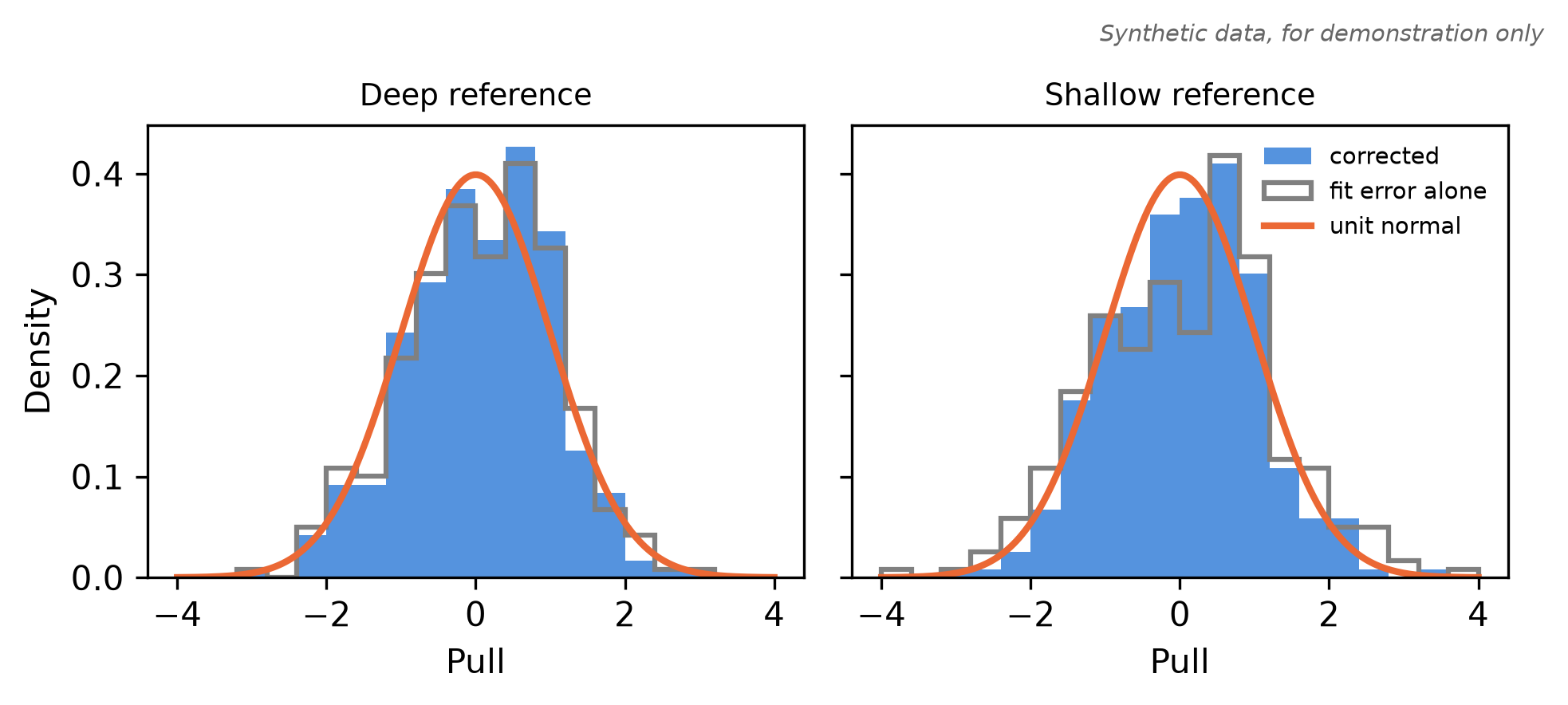
Inject sources of known flux into your difference image and measure them as you measure your candidates. A source’s pull is its measured minus true flux, over its error bar. Unbiased estimates with calibrated errors should have pulls centered near zero with width near one in the tested regime.
This example tests fixed-position forced photometry conditional on an already fitted subtraction. It does not test detection and selection, errors in fitted positions, or the effect of injected sources on alignment and kernel fitting. For those, inject into the input exposures and rerun the relevant stages.
The correction matters when the reference’s noise is a large part of the difference image’s noise, and xRep resampled the reference onto the target grid. The sample reference is much deeper than the target, and its correction is small. Make a second reference as noisy as the target, on the same grid, and subtract it from the shifted target:
gain = target_header["GAIN"]# the sample reference's stars, grid and PSF, with the target's sky level and gainshallow = render(reference.shape, WCS(reference_header), ra, dec, flux, reference_header["PSFSIG"], 120.0, gain).astype(np.float64)shallow_variance = np.clip(shallow, 0, None) / gainshallow_aligned = reproject_masked_array(shallow, shallow_variance, no_bad_pixels, shift_spec, backend="cpu", prepared=shift_prepared)shallow_fit = solve_constant_kernel(shallow_aligned.image, shifted, basis, kernel_shape=(19, 19), variance=shifted_variance, background_degree=1, backend="cpu")shallow_noise = standardize_constant_kernel_residual(shallow_fit.residual, kernel=shallow_fit.kernel, target_variance=shifted_variance, reference_variance=shallow_aligned.variance)print(f"median variance: deep reference {np.median(reference_variance):.1f}, "f"shallow reference {np.median(shallow_variance):.1f}, target {np.median(shifted_variance):.1f}")
median variance: deep reference 12.5, shallow reference 60.1, target 60.3
Place one source per cell of an 11 pixel grid where the window is empty, adding a Gaussian approximation to photon noise. Both pairs get the same sources and noise. Their measurement windows overlap, so the pulls are not independent samples.
injection_test injects the sources into one difference and measures them with forced_flux_at at their true positions, without estimating a local sky. It adjusts each flux error with the closed-form factor for that forced estimator’s inverse-variance weights. It also measures the background factor at the empty positions.
from cuphoton.xpois import forced_flux_atsource_taps = resampling_weights_at(shift_spec, true_xy[:, 0], true_xy[:, 1], prepared=shift_prepared, source_shape=reference.shape)def injection_test(aligned_reference, subtraction, subtraction_noise): injected = subtraction.residual + model + source_noise injected_variance = subtraction_noise.marginal_residual_variance + model / gain photometry = forced_flux_at(injected, true_xy, psf_sigma, window=size, variance=injected_variance, local_sky=False) pull = (photometry.flux - true_flux) / photometry.flux_error flux_weights = (psf_weights(psf_sigma, size, offset=true_xy - np.rint(true_xy))/ window_stamps(injected_variance, true_xy, size)) # the weights of the forced flux closed = correlation_factor(flux_weights, kernel=subtraction.kernel, target_variance=shifted_variance + model / gain, reference_variance=aligned_reference.variance, resampling_weights=source_taps.weights, positions=true_xy, residual_variance=injected_variance, is_translation=source_taps.is_translation).factor measured = empirical_correlation_factor(subtraction.residual, subtraction_noise.marginal_residual_variance, weights[0], shift_empty)return pull, pull / np.sqrt(np.maximum(closed, 1.0)), closed, measured
Run it on both pairs and compare:
results = {"deep reference": injection_test(shift_aligned, shift_fit, shift_noise),"shallow reference": injection_test(shallow_aligned, shallow_fit, shallow_noise)}print(f"{'':18s}{'measured factor':>16s}{'closed form':>12s}{'fit-only width':>15s}{'corrected width':>16s}")for name, (pull, corrected, closed, measured) in results.items(): width = [f"{p.std(ddof=1):.2f}"for p in (pull, corrected)]print(f"{name:18s}{measured.factor:16.2f}{np.median(closed):12.2f}{width[0]:>15s} "f"{width[1]:>16s}")
                    measured factor  closed form  fit-only width  corrected width
deep reference                 1.07         1.10            1.01             0.96
shallow reference              1.54         1.45            1.20             0.99
Here the closed form, a median over the sources, is smaller than the background measurement: the sources add independent photon noise, and their inverse-variance weights differ from the background weights. With the shallow reference, the fit-only pulls are wider than one and the corrected pulls sit nearer one. With the deep reference, the correction is small. Figure 10.1 shows both cases; these overlapping samples do not establish an independent-sample significance for the width difference.
Figure 10.1: Pulls of the injected sources, measured minus true flux over the flux error, for the deep sample reference (left) and a reference as noisy as the target (right). Gray outline: with the fit error alone. Blue bars: with the closed-form correlation factor applied. Orange line: a unit normal for comparison with unbiased Gaussian errors. With the noisy reference, the fit-only pulls spread wider than the unit normal. Synthetic data, for demonstration only.
Read the result like this:
Result
What it means
What to change
width near one, mean near zero
the errors are consistent with the scatter in this test
test other fluxes, positions and observing conditions
width above one
possible missing variance, model error or outliers
check covariance, gain, read noise, the PSF and the background; compare the chain’s full budget
width below one
possible excess variance or effects of selection and shared noise
check for noise counted twice and measure the factor before applying it. A factor near one means little net correction for those weights, not proof that a variance plane contains covariance
mean away from zero
the fluxes are biased, for example by a wrong PSF width or a background left in the difference
measure the PSF width from your stars, and check the background fit
For repeated exposures of one field, repeat_catalogs.py runs the same test on the chain’s catalogs, without injections. Run it from the root of your cuPhoton checkout:
It scores <q>_err with and without each term. Reusing a reference correlates measurements across exposures: a common noise contribution can cancel in their differences, although changing PSFs or weights changes how it projects into each measurement. A score below one can therefore coexist with appropriate errors for individual measurements. A bias that every exposure shares passes the test unseen. The repeat test explains its report.
10.7 Limits
The error bars do not cover these cases:
A PSF model that does not match the data. A wrong width biases a forced flux, and the flux error does not include the bias.
The absolute sky astrometry (how well pixels map to sky positions), which the chain reports in sky_err_arcsec.
Errors that are not small next to the PSF width and the lobe separation. The error bars are first order.
Wrong variance planes. The fit term and the closed form assume that the planes describe the pixel noise.
Unmatched reference light in a position. The kmatch term covers the flux only.
10.8 Options
The options of the calls that compute and measure the factor:
Option
Default
Effect
correlation_factor(residual_variance=...)
the target variance plus the reference variance times the kernel’s sum of squares
the per-pixel variance that the factor compares against. Pass the variance your measurement used
correlation_factor(is_translation=...)
none, no position is checked
positions flagged false get NaN and count in n_rotated
correlation_factor(valid=...)
none
the window pixels to use. Masked pixels get zero weight, and n_masked counts them
weights of correlation_factor
required
(N, s, s), (N, q, s, s) for q weightings, or with positions one (s, s) stamp for every position
empty_positions(count=...)
required
the number of positions wanted, spread evenly over the empty pixels
empty_positions(loud=...)
none
(image, n_sigma) also keeps windows away from pixels beyond n_sigma robust sigmas
resampling_weights_at(translation_tolerance=...)
1e-3
the largest deviation of the local Jacobian from the identity that still counts as a shift
psf_weights(offset=..., derivative=...)
none
sub-pixel offsets of the source, and "x" or "y" for position weights
10.9 On a GPU
empty_positions, empirical_correlation_factor, correlation_factor and forced_flux_at follow the array module of their inputs. With the gpu profile, pass CuPy arrays. They run on the GPU and return CuPy arrays:
correlation_factor returns NaN, and n_rotated is above 0
The grid mapping is not locally a shift. A measured factor can diagnose the noise in a separate analysis; the chain retains NaN for undefined closed-form factors
correlation_factor returns NaN, and n_rotated is 0
A window pixel is not finite, as in the edge band, or the reference does not cover the position and its resampling weights are all zero. Pass valid, or drop the position
empirical_correlation_factor returns NaN
Fewer than two positions had a finite window. Check positions_used, and ask empty_positions for more positions
10.11 Next steps
Predict the noise of a difference image: Chapter 6.
Fit candidates and read their covariance: Chapter 7.
Run the transient chain and read its error bars: Section 9.11.1.
Uncertainty quantification builds a PSF-flux error bar with every library call, the kernel-fit term included.
The xPois and xRep references cover the factor and the resampling weights. The chain’s README defines every term.