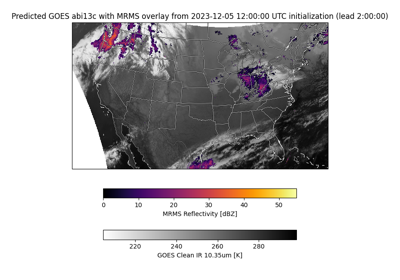

StormScopeGOES#
- class earth2studio.models.px.StormScopeGOES(
- model_spec,
- means,
- stds,
- latitudes,
- longitudes,
- variables=array(['abi01c', 'abi02c', 'abi03c', 'abi07c', 'abi08c', 'abi09c', 'abi10c', 'abi13c'], dtype='<U6'),
- conditioning_variables=array(['z500'], dtype='<U4'),
- conditioning_means=None,
- conditioning_stds=None,
- conditioning_data_source=None,
- glm_mask=None,
- conditioning_glm_mask=None,
- topo=None,
- nexrad_proximity=None,
- sampler_args={'S_churn': 10, 'num_steps': 100},
- input_times=array([0], dtype='timedelta64[h]'),
- output_times=array([1], dtype='timedelta64[h]'),
- y_coords=None,
- x_coords=None,
- input_interp_max_dist_km=12.0,
- conditioning_interp_max_dist_km=26.0,
- amp=True,
- compile=False,
- NANWC202680 GB
StormScope model forecasting GOES data on the HRRR grid.
This model supports multiple variants at different spatiotemporal resolutions, selected by passing
model_nametoload_model(default:"3km_10min"). The primary focus is CONUS nowcasting at 3km resolution; coarser 6km nearcasting variants are retained as legacy checkpoints. Variant names are semantic (<resolution>_<cadence>):3km_10min: 3km resolution, 10 minute timestep (CONUS nowcasting)6km_1hr: 6km resolution, 60 minute timestep (legacy nearcasting)
Use
list_available_models()to inspect the variants in a given package (including any added after this release). Legacy training-style names are still accepted as aliases.Variants whose input cadence is finer than their output cadence use a sliding window of input timesteps and predict one output timestep; others use a single input timestep and predict one output timestep.
- Parameters:
model_spec (list[dict[str, Any]]) – Sequence of stage specifications; see StormScopeBase.
means (torch.Tensor) – Per-variable mean for normalization, shape [1, C, 1, 1].
stds (torch.Tensor) – Per-variable std for normalization, shape [1, C, 1, 1].
latitudes (torch.Tensor) – Latitudes of the grid, expected shape [H, W].
longitudes (torch.Tensor) – Longitudes of the grid, expected shape [H, W].
variables (np.ndarray, optional) – GOES input variables. Default is [“abi01c”, “abi02c”, “abi03c”, “abi07c”, “abi08c”, “abi09c”, “abi10c”, “abi13c”].
conditioning_variables (np.ndarray, optional) – Auxiliary conditioning variables. Default is [“z500”].
conditioning_means (torch.Tensor | None, optional) – Means to normalize any external conditioning data. Default is None.
conditioning_stds (torch.Tensor | None, optional) – Stds to normalize any external conditioning data. Default is None.
conditioning_data_source (Any | None, optional) – Data source for external conditioning. Default is None.
sampler_args (dict[str, Any] | None, optional) – Default sampler arguments passed to the diffusion sampler. Default is {“num_steps”: 100, “S_churn”: 10}.
input_times (np.ndarray, optional) – Input timesteps, of type timedelta64. Default is [0 m] (i.e., the current time).
output_times (np.ndarray, optional) – Output timesteps, of type timedelta64. Default is [60 m] (i.e., 1 hour from the current time).
y_coords (np.ndarray | None, optional) – Y coordinates of the grid, expected shape [H, W]. Default is None, in which case the model uses the enumerated indices inferred from the latitude and longitude grid shapes.
x_coords (np.ndarray | None, optional) – X coordinates of the grid, expected shape [H, W]. Default is None, in which case the model uses the enumerated indices inferred from the latitude and longitude grid shapes.
input_interp_max_dist_km (float, optional) – Maximum distance in kilometers for nearest neighbor interpolation of input data. Points beyond this distance are masked as invalid. Default is 12.0.
conditioning_interp_max_dist_km (float, optional) – Maximum distance in kilometers for nearest neighbor interpolation of conditioning data. Points beyond this distance are masked as invalid. Default is 26.0.
glm_mask (Tensor | None)
conditioning_glm_mask (Tensor | None)
topo (Tensor | None)
nexrad_proximity (Tensor | None)
amp (bool)
compile (bool)
Note
To have a unified coordinate system over CONUS for convenience, the model uses the HRRR grid. As a result, there are portions of the domain which go beyond the extent of the GOES-East data, so these portions are masked as invalid (set to NaN).
- __call__(x, coords)[source]#
Runs the prognostic model one step. Assumes the last two dimensions of the input tensor are the spatial dimensions.
- Parameters:
x (torch.Tensor) – Input tensor.
coords (CoordSystem) – Input coordinate system.
- Returns:
Output tensor and coordinate system.
- Return type:
tuple[torch.Tensor, CoordSystem]
- create_iterator(x, coords)[source]#
Creates an iterator to perform time-integration of the prognostic model.
- Parameters:
x (torch.Tensor) – Input tensor.
coords (CoordSystem) – Input coordinate system.
- Yields:
Iterator[tuple[torch.Tensor, CoordSystem]] – Iterator that generates time-steps of the prognostic model containing the output data tensor and coordinate system dictionary.
- Return type:
Iterator[tuple[Tensor, OrderedDict[str, ndarray]]]
- classmethod load_default_package()[source]#
Load the default StormScope package from Hugging Face.
- Return type:
- classmethod load_model(
- package,
- model_name='3km_10min',
- conditioning_data_source=None,
- amp=True,
- compile=False,
Load model from package.
- Parameters:
package (Package) – Package to load model from
model_name (Literal["3km_10min", "6km_1hr"], optional) –
Variant to load, by default
"3km_10min"(the recommended CONUS nowcasting variant). Available variants (seelist_available_models()):"3km_10min": 3km resolution, 10 minute timestep (CONUS nowcasting)"6km_1hr": 6km resolution, 60 minute timestep (legacy nearcasting)
Legacy training-style names are accepted as aliases.
conditioning_data_source (DataSource | ForecastSource | None, optional) – Data source to use for conditioning, by default None.
amp (bool, optional) – Enable automatic mixed precision (autocast) for the sampler’s network forward passes. Default is True.
compile (bool, optional) – Compile each staged expert with
torch.compile(“reduce-overhead”). Default is False.
- Returns:
Instantiated StormScopeGOES model
- Return type:
PrognosticModel